
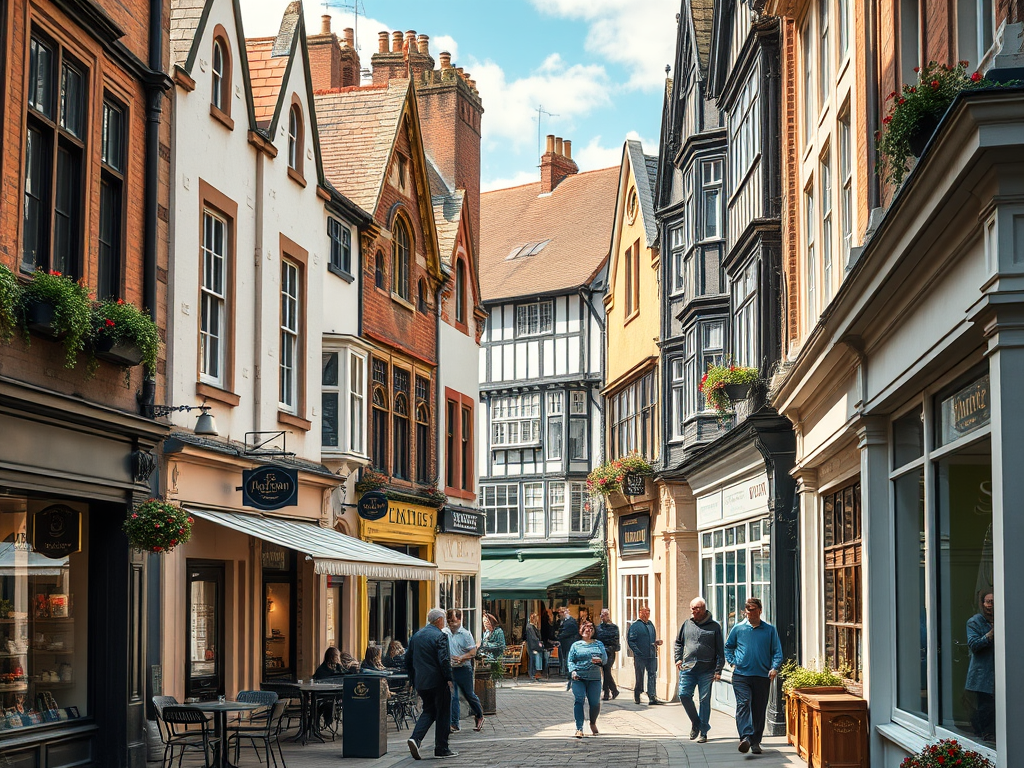
Traveling is great. There’s always something new to try. OK, I’ll add a caveat to that observation. There’s usually something new to try. What I’m focusing on here is our English urban environment. Whether that be the centre of a major city or a main street of a small town. Variety is the spice. Often communing from layers and layers of changes over decades.
What I can’t pretend is that all is well. There are well-known places that have cut out a specialist niche to thrive whatever the tidal wave of changes. However, even they are impacted by the trend for bland uniformity that the commercial world loves so much.
Yes, I might have a delightful afternoon in Oxford or Bath and think all is well. Then a stop in a less well-regarded city or town and the problems becomes clear. The shifting sands of our High Streets is leaving areas blighted by neglect or sanitised by unthinking development.
The function of the High Street is no longer that captured in Victorian photographs. The butcher, the baker and the candlestick maker. This Dickensian Street scene maybe nice to look at as a novelty. It hardly makes sense unless the intention is to preserve a museum like atmosphere.
Our town planning can still be caught up a sort of Victoriana. Intent on preserving the line of shops that has existed since the traction engine replaced the horse. It’s nice to see, centrally placed, a traditional coaching inn, but even they survive as restaurants serving specialised cuisine or dusty antique shops.
So, what to do? I have a couple of themes. One is community identity. Another is facing the reality of the on-line world, and another is to bring everyday life back into centres.
Avoiding the bland mediocrity of modern design[1] should be up there high on the list. Future generations will castigate us we leave them such dull ordinariness as to make them look away. Every place has a story. It’s not a question of packaging that story up as a museum exhibit. It’s more a question of making a 21st century interpretation of a history.
Embrace the on-line world. It’s not going away. I don’t say hordes of flashing lights and screens the size of houses. No, let’s be a less crass. Free high-speed connections ought to be in the heart of our communities. Innovative thinking like portals[2] between centres offers opportunities. Even if these must be carefully managed. Connecting places creates new experiences.
There’s often a tussle between the wish to bring living spaces back to High Steets and the demands of the night-time economy. People make spaces work. That could be window boxes full of flowers or tables out on cobbled streets on a moon light night. What’s clear is that public transport, infrastructure, and affordable housing are a must.
More effort is needed to square this circle. Make sure a good life can be lived in a centre but at the same time it be welcoming to visitors. That’s tough for designers and planners but that’s where they should aim.
[1] https://www.prospectmagazine.co.uk/essays/42227/the-duel-has-modern-architecture-ruined-britain
[2] https://time.com/6977881/dublin-new-york-city-portal-temporarily-shut-down/

 John Vincent