
The News can be overwhelming. It’s a constant barrage of terrible calamities, inadequacies, and past failures. I guess, that’s the manner of the daily News cycle. Put out a positive press release and watch it get ignored. Report of catastrophes and every media outlet copies the stories.
It’s as well to remember that within a week a new round of headlines displaces what was there before. It’s as well to step back. Perspective is an interesting phenomenon. It condenses the past, so that we see the major events more clearly. The nitty gritty of the everyday often fades and only the significant happenings remain.
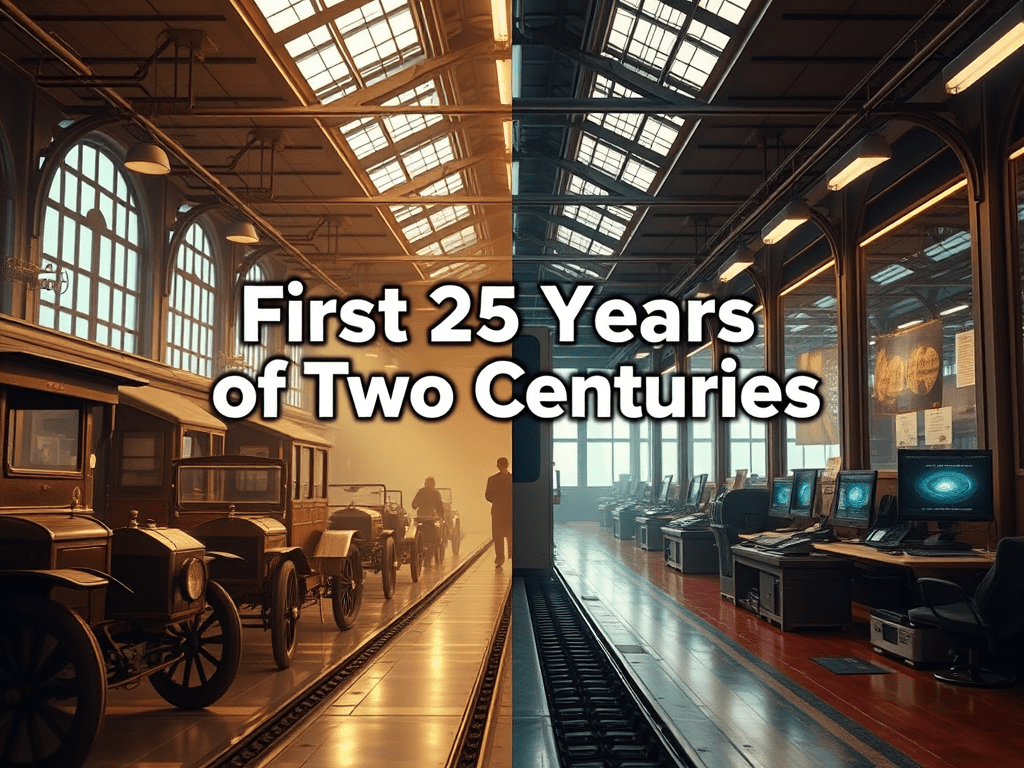
Let’s dabble in the macro and not the micro. What’s the big picture? It’s time to do a simple comparison. Take the first 25-years of the 20th Century and compare with the first 25-years of the 21st Century. Certainly, at the end of this year a complete summing-up could be done.
For now, I’ll do a random sweep across those two generations separated by a century.
Let’s think. There were no powered aeroplanes in 1900[1]. Few had an inkling that a world war was on the way. We were just figuring out what an Atom might be. Even the motor car was mostly for wealthy folk. The railways were king.
In 2000, I remember the optimistic fireworks and the controversy over the millennium dome. The forgotten panic of Y2K now seems strange. The World Wide Web[2] was getting traction amongst geeks. Mobile phones were gaining ground. Few saw the attack of 9/11 coming.
Being a child of the last century it’s easier to appreciate the changes. Let’s face it, today’s 25-year-olds had history lessons about subject that many people lived through. Although, there are a growing number of centenarians, most of them were in inkling in the parents’ eyes or babies pre-1925. Thus, we need to relay on the writers of history.
Here’s a proposition that warrants testing. Compared with the first 25-years of the 20th Century nothing much has happened in the first 25-years of the 21st Century. I know any division in time is an arbitrary matter. The Earth spinning on its axis cares little for human affairs. 24 hours in a day come and go whatever we do. That said, my proposition above does run contrary to the way people may feel about time passing. If indeed it does pass.
In both periods we might measure significance by the impact events have on people. There’s a propensity to say that world wars top the list in any account. That may well be fair. However, if we look at the growth in global population and the general improvements in human health despite that fact, then this is the greatest point to note.
When I say, nothing much has happened between 2000 and 2025, by comparison, it’s more to do with the pivotal moments that led to the creation of the technologies that we all now take for granted. Mastering the elements of science has made the biggest difference.
I’d say, in the public and social field, of politics, philosophy and economics[3] and we are as perhaps foolish as we have ever been. Convince me otherwise.
[1] https://www1.grc.nasa.gov/beginners-guide-to-aeronautics/powered-aircraft/
[2] https://www.w3.org/People/Berners-Lee/Weaving/Overview.html
[3] https://www.theguardian.com/education/2017/feb/23/ppe-oxford-university-degree-that-rules-britain

 John Vincent