
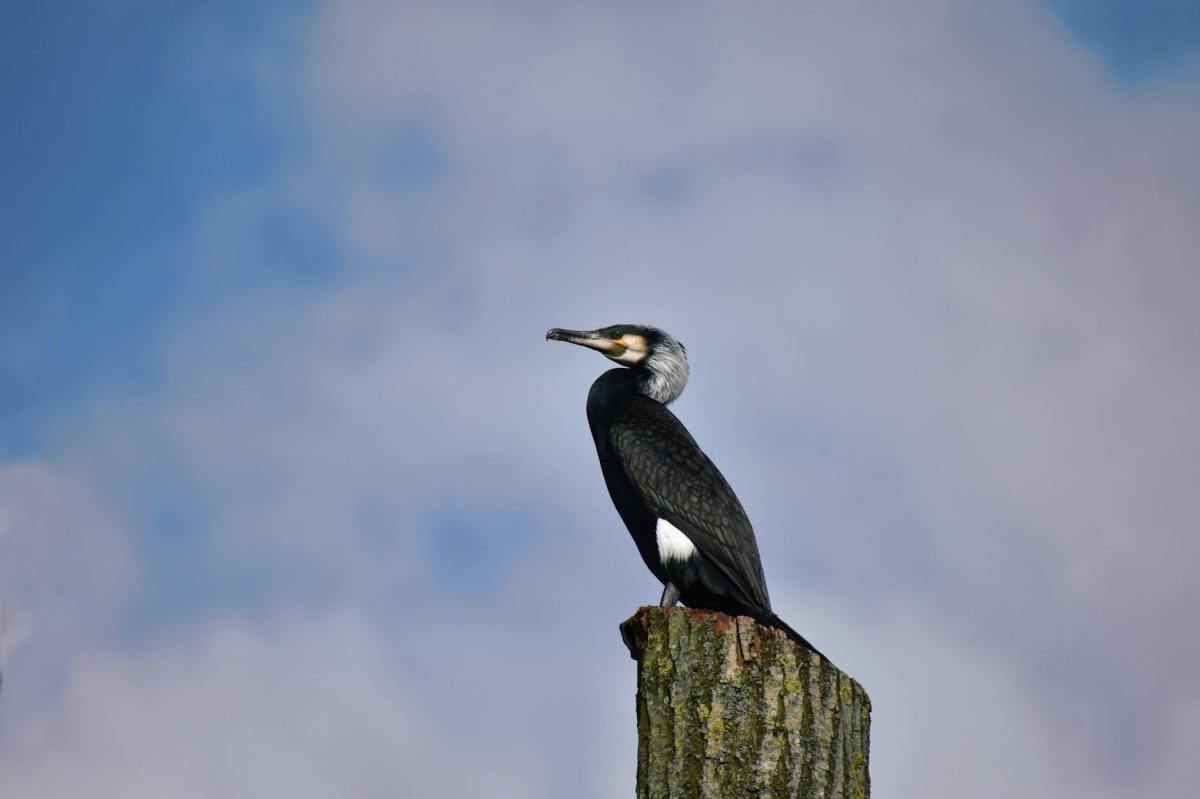
As the winter sun rose this morning, I focused my binoculars on a distant silhouette of a bird. We inherited these bird watching binoculars from my father-in-law. With a times 30 magnification this majestic black waterbird was easy to see.
A tall trunk of a dead tree rises above the riverbank. It’s a perch where the Cormorant[1] sits in the early morning sunshine. I’d guess it’s a regular post fishing ritual. We sometime see him or her perfectly balanced with their wings outstretched. Two Jackdaws were sitting below this larger bird. It was clear the Cormorant was none to happy to have their company.
In our kitchen, as the radio burbled away, what struck me was the importance of distant vison. Looking out to see what’s on the horizon. As the sun illuminated the treeline. Leafless trees outlined against a blue sky. I hasten to add that this clear morning is more the exception than the rule over the last couple of weeks.
Because the Cormorant is an excellent fisher this is a good sign for the health of the river. The River Lambourn is a chalk stream that passes west to east at the boundary of the field adjoining our house. Fortunately, the river is far enough away for winter flooding not to be a problem. We have the benefit of seeing Berkshire’s riverbank wildlife as it makes its way quite oblivious to us watching it.
What a contrast. My eyes are now focused on a computer screen that is no more than a couple of feet away from me. If I was using my mobile phone or tablet, I’d be even closer to an electronic screen. I can see a nice picture of a typical Cormorant on my screen. It’s informative but no substitute for the real thing. A real individual.
Let’s make an assertion. Since 2006, the ratio of a person’s time spent looking at a close by screen as opposed to a distant image has dramatically changed. I’ve used that datum as it’s a convenient one related to the abundant mobile phone of any make and kind. I wonder what this has done for our visual perception capabilities. Will there come a time when looking for objects at a distance is a less than familiar experience.
It’s fascinating to see that the Boy Scouts still have an aircraft recognition list. The expectation that a young person looks up and spots a distant silhouette in the sky and can recognise it. Takes me back to the simplest childhood game of all. “I spy with my little eye, something beginning with A”. Looking heavenward at a fast-moving outline and shouting “Aircraft”.
Will these abilities diminish? Afterall it would be so much easier to let a phones’ camera and a suitable App do the work. Point and tap. Would that lead to people recognising more aircraft or birds or less? The jury is out on what our tech is doing to us. There are a lot of questions worth asking. Particularly when it comes to visual perception. Matching pictures and names are one thing. Looking at a distance in real-time and doing the same with confidence, that’s another.
[1] https://www.rspb.org.uk/birds-and-wildlife/cormorant

 John Vincent