
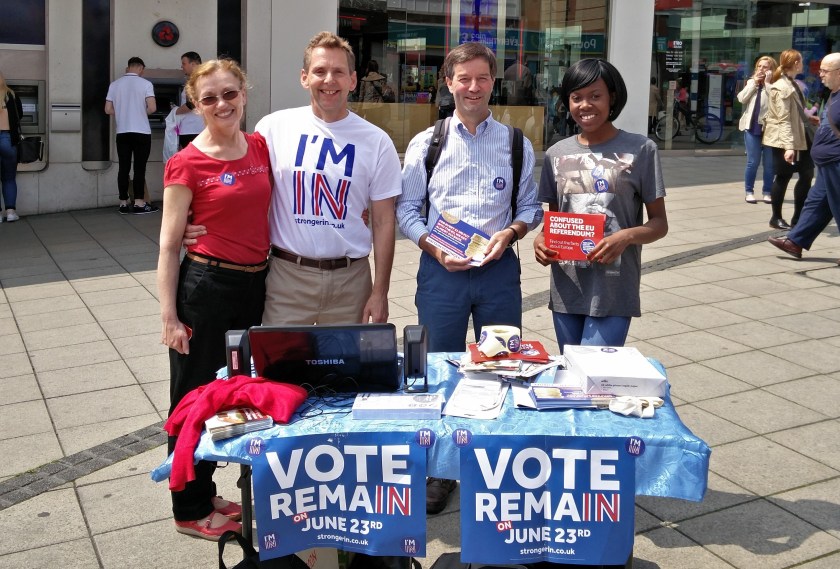
 The Westminster constituency of Uxbridge and South Ruislip is currently represented in the House of Commons by the infamous Boris Johnson. It’s currently considered to be a safe Conservative seat. In the past that meant that you could put a donkey with a blue rosette on the ballot and it would get elected. Much like Reigate in Surrey. In fact, in the election battle of 1997 Eurosceptic Sir George Gardiner paraded a donkey along the High Street in Reigate. That donkey was named “Crispin”. A name shared with the current Reigate MP who ironically is backing Vote Leave. How times change.
Yesterday, Saturday I joined the Stronger in Europe Campaign stall in the centre of Uxbridge. The weather was great and there was a lot of people in the town just before lunchtime. So how did it go – I know you are asking. The answer is surprisingly well and I’m not just saying that for effect. People were freely coming up to the stall to ask questions and take leaflets.
Amongst the “outers” that I spoke to none were of the shouty variety that populate social media. One woman cited immigration as her concern but her reasoning was not typical. She was hoping there would be fewer immigrants so that would get lazy Brits off of their backsides and working.
The smiles and nods you get from supporters really boosted our spirts. That glance and “I’m IN too” as they passed by was a good indication that there is much more support for remaining in the EU than is indicated in the polls or in the media.
One young guy, self-employed, said his business was doing well but he hadn’t made his mind up. He put it like this: my head tells me to REMAIN in the EU but my heart doesn’t always agree. After we had a short chat I’d be happy to bet that he goes into the polling station and votes to REMAIN.
One middle-aged couple were mildly animated, saying that there was no need for this referendum vote at all – why was it happening? One Western Canadian woman I spoke to was bemused by the whole event. Again, she couldn’t understand why we were having this referendum.
I exchanged stories about living in Germany with one older woman. Although we agreed on many issues, unfortunately I didn’t persuader her to come across to REMAIN.
Much as we are seeing in the national media the two biggest issues that came up in conversation were the economy and immigration. In my mind you can’t separate these two issues. Free movement has been a huge boost to the British economy. Also it’s a complete myth that quitting the EU will change immigration to Britain.
After this referendum has passed I do intend to walk the Colne Valley all the way from Staines to Uxbridge. On the edge of the City it’s surprisingly rural except for one or two places like the end of the Heathrow runways. That should be a nice wind down.
Tag: EU
Marbles
 I don’t like to be disrespectful so what I say does not refer to all Vote Leave campaigners. In fact, I’ve had a perfectly rational, sane and sensible debate with a few. However, I’ve met enough of them to say that it’s true that a number of them have the characteristics of those people who write letters to Councillors in green ink. That is EVERYTHING (in Bold) is accentuated! Nothing is left to the chance that you might not fully hear, echoing through the pages every point they are making. Even in a noisy room with a jet flying overhead and constant interruptions. What does a conversation with the other side sound like? Standing in a High Street meeting passers-by and offering a positive REMAIN message this can go several ways.
One way is the normal gentile route. For example: They smile and say: “I don’t agree with this leaflet but I take my hat off to you for standing in such a cold alleyway. I know what it’s like”.
Another way is the combative route: They comment: “You know you lot are going to lose – don’t you? I don’t know how you can believe this stuff?”
Finally, and all too often the aggressive route: They shout: “No democracy. Nazi super state. Can’t control our borders. Traitor – I want my Country back”.
In the first case I can shake their hand. In the second case I have a bit of banter. In the final case they get offensive, nasty and unpleasant. Any engagement is just time wasting. Whatever the rights or wrongs of it, some people have lost their marbles over this referendum. All the wows of the world are sharply focused on an instinctive urge to kick something. Logic goes right out of the window. Fallacies become the fashion. The Leave campaign can be summed up as; make as much noise as possible don’t bother about the detail.
I choose to believe that the latter case is a minority. The vast majority of people are calmly considering which way to vote. The positive REMAIN message is hitting home. To quote G. K. Chesterton: “But we are the people of England; and we have not spoken yet”.
A to B
 People want to be in a successful place. Britain’s economic success is attracting workers from across the EU Member States as new migration figures show. The majority of EU citizens come to work or to find work. These workers are making a large contribution to the wealth of the nation. Leaving the EU could cause a shortage of workers and the closure of businesses.
Most EU workers coming to Britain are young, fit and hardworking. Britain’s health and social care sector is highly dependent on EU staff. With an ageing population its vital that posts are filled.
There are indicators that when these migrants return to their countries of origin they take with them an entrepreneurial spirit and the English language which makes then excellent future business partners. The single market works as it should only when people can move from A to B.
Britain already has the tightest borders in Europe. However, Brexit campaigners say rise in net migration means border controls should be tightened even further. Quitting the Union isn’t going to make that easier. Controlling borders requires a great deal of cooperation with neighbouring Countries. This is particularly true of the ferry routes across the channel.
I was a frequent user of the DFDS ferries from Dover to Dunkirk. This is a busy route for both trucks and car drivers. The Port of Dover is the busiest international 24/7 roll-on roll-off ferry port in Europe. Huge improvements are being made to the port. These improvements are being part funded by the EU as part of its Trans-European Transport Network (TEN-T) project. Projects across the EU will help the economy to grow, with a budget of over €24 billion up to 2020.
To continue this success, we need to REMAIN part of the EU. If we leave the EU, it’s anyone’s guess what will happen. Certainly we will lose the advantages we already have that are delivering British economic success.
Turkey
You have until 7th June to register to vote in the EU referendum. Now the countdown is really underway. Yes, its 26 May. Where did the first 5 months of the year go?
Let’s not forget this referendum isn’t about sending a message about the bad behaviour of our Westminster politicians. Rather, it’s a once in a lifetime national vote to determine the direction that the whole Country takes. No one can escape the vibrant, lively and sometimes heated debate about Britain’s place in the EU.
I think we should look less at the media personalities. After all they will come and go much as previous generations of British politicians have come and gone. It’s far more important to look at the real issues, like: health, education, the economy and immigration. That said it’s the last 2 issues in that list that are most impacted by Europe.
Over recent days those campaigning to leave the EU once again returned to scaremongering. Using Turkey as an example, they say that Britain is powerless to stop new countries joining the EU. This is NOT true.
• What they failed to mention is that; Turkey has been trying to join the EU for 30 years.
• What they failed to mention is that; any EU decision must be based on a unanimous approval – that means that every EU Member State can veto Turkey’s accession.
• What they failed to mention is that; at this time only 1 of 35 chapters in the approval process has been concluded by Turkey and the EU.
Turkey has been a member of NATO since the 1952. Along with Britain, it is a member of many other intergovernmental bodies. There will always be a need for the EU and its Member States to be in discussions and negotiations with Turkey. Also the tensions caused by the 1974 Turkish invasion of Cyprus have not gone away. Seeking a solution to that situation is a problem that the EU continues to focus on.
Vote Leave’s shameless scaremongering sadly reveals a couple of things. First, this episode shows worrying lack of depth of knowledge of how the EU works and what it is doing. Secondly, as many in the Vote Leave campaign are experienced politicians and will understand the issues, the alternative conclusion is that the anti-Europeans are happily and knowingly misleading the public.
Those of us campaigning to remain in the EU are concentrating on reality and not pedalling myths. The case for REMAIN is a strong one. If we really want to maintain control over our economy and immigration, we need to REMAIN a Member of the largest trading block in the world – the EU.
Lone State
Are you a reliable partner? Most of us would like to think that we act with integrity. It’s quintessentially British to hold someone to play by the rules. Naturally that’s as long as the rules are properly applied, safe and fair to everyone.
I’ve seen some arguments that say we don’t need the EU because Britain can make ad-hoc deals with whom it likes, where and when it serves our its interests to do so. Britain can form a coalition with Tom, Dick and Harry and if that doesn’t work out then take-off with Sid, Hancock and Kenneth. Sorry, I’ve only used male names.
Whether its bananas, aviation or international banking trade deals can be made up anytime, anywhere for any reason. This way forward sounds superficially attractive but in reality the relationships between the 195 independent sovereign states in the world doesn’t quite work that way. For a basic start there’s a hell of a lot of history that gets in the way of totally free, open and unrestricted exchange.
A lone State may have to jump in and out of bed with others to keep its trade afloat. It may not look too closely at its partner’s human rights record. It may accept terms and conditions that others would shun. To counter this, forming a regional coalition or alliance is often an effective means of increasing their bargaining power. However, these regional coalitions or alliances often struggle to counter the competition between neighbouring States. That’s certainly true in the Middle East or Asia. In the Americas the issue is the dominance of one of the partners.
Europe has the EU. It was born out of the most devastating conflicts. The EU is a model that others look at with envy. It has a key advantage and that is the rule of law. So if say; Tom, Dick and Harry don’t play by the rules there is a means of redress. There’s more than peer pressure that ensures that Tom, Dick and Harry remain reliable partners.
I believe, Britain would be foolish to throw that away this advantage. A vote to REMAIN in the EU is a confident assertion in a volatile world. A vote to REMAIN in the EU is to be a trustworthy and reliable partner across the globe. A vote to REMAIN in the EU enhances Britain’s sovereignty.
40 years ago
Britain signed the Treaty of Rome and joined the European Economic Community (EEC) in 1973. Then Britain backed continued membership of the EEC, by a large majority in a referendum held on 6 June 1975. In the run-up to that referendum the Labour Prime Minister Harold Wilson declared that the Government would recommend a “Yes” vote. In addition, the then Conservatives Party leader Margaret Thatcher campaigned to stay in the Common Market.
Now, just like Wilson, British Prime Minister Cameron has a small majority. So, with the referendum to be held on 23 June there are some parallels with the events of over 40 years ago. In 1975, Government Ministers were given freedom to campaign on the side of their choosing – as now.
One argument that was put in 1975 was that if people vote “No” the EEC will not go away. A “No” vote would mean that Britain had no voice at the table of its biggest trading partner. That argument remains true. In 1975, it was said that; Commonwealth Governments want Britain to stay in the EEC. Again, that remains true. Interestingly it was Pierre Trudeau who spoke for Canada at that time.
Another argument that was used was: “Remember: All the other countries in the Market enjoy, like us, democratically elected governments answerable to their own parliaments and their own voters. They do not want to weaken their Parliaments any more than we would.” I believe that statement remains true too. Since, I don’t see the French becoming any less French or the Germans becoming any less German or any other Member State giving up on their own parliaments.
Liberal leader Jo Grimond said: “If we were to come out of Europe this summer I can see no other result except even fiercer inflation and even higher unemployment”. We have to remember that inflation in the 1970s was in double figures and reached over 25% at one stage. The British economy was in a dire situation. We certainly don’t have damaging inflation in 2016 but the basic economic arguments still apply.
Our last chance to vote on our membership of the EU was decisive. This summer, my hope is that there will be a decisive vote to REMAIN in the EU.
On the Record
Prior to 1925 records were acoustically recorded. That is the artists voice cut the master disk directly. After that date the technology of electric recording became popular. I discovered this information as I was sorting out a pile of about fifty 78 rpm records. Heavy and brittle they were once the only way to own music. Great British names like; Brunswick, Colombia, Decca, HMV and Parlophone dominated the business.
Its stunning to me that in one person’s lifetime we have gone from shouting down a big horn to my now dated iPod loaded with 13,975 songs. Predicting the future is mind bogglingly difficult. Occasionally, almost by chance science fiction predicts a development that does end up as an everyday object. To a degree that’s true of the humble mobile phone. The idea of having a personal communication device, like in the early Star Trek communicator has been around for a while.
So, the notion that any confident politician can tell you that this or that is bound to happen in the next decade is a bit far-fetched. However, this is what the Vote Leave people have been doing. The certainly with which they speak of impending disaster because of an event that may or may not happen is dumbfounding. The future of Europe is unwritten. It is for us to write that future.
That’s not to say that no one can make predictions. Forecasts are made particularly when it comes to subjects that lend themselves to numerical methods. We are accustomed to watching the weather forecast and taking actions based on the information provided. Huge and complex computer models are used to guess what the economy will do next. For example, the Bank of England and other central banks will take actions based upon the output of forecasts. They are not perfect but on the balance of probabilities they are miles better than the word of a dogmatic politician.
I think those advocating that we stay in the European Union have got it about right. Use the available facts carefully to support the argument to REMAIN in the EU. Correct those arguments when new information becomes available. Don’t mislead giving the impression that your crystal ball is way better than any that has been discovered throughout the whole of history.
If I now jump to 2025, which is only 9 years away and a prediction from me. Whatever international standard we will be using to distribute music, I am certain Europe would have had a major impact on its design and development. Harmonised European standards are the way forward.
Ancient & Modern
Believe it or not the town of Staines-upon-Thames is ancient. Ad Pontes (“The Bridges”) is the Roman name for the town. It was a settlement on the road between the provincial capital Londinium (London) and Calleva Atrebatum (Silchester) where the Thames river was crossed. Maybe a day’s march each way. The name Staines means “stones” and it was highly likely this referred to a prehistoric circle of nine stones which has long since been lost.
Why this history lesson? Today, standing on windy Staines High Street you need an exceptional imagination to visualise what it may have been like around AD 50. That said, because it was on an important Roman road going west it’s likely that there was trade and commerce as there is to this day. People from all over Europe probably passed through the town everyday nearly 2000 years ago.
Lunchtime this Saturday there was a regular market in the High Street. Lots of hustle and bustle where you can buy a pasty, a plant or print for the wall. Three groups were out campaigning for the forthcoming referendum: The Lib Dems, The Greens and Vote Leave. So, the two opposite camps of REMAIN and LEAVE were roughly equally represented.
What did I discover? Top line for me was a real mix of responses making it impossible to call if there was a poll of people on that day. There was a civility on both sides of the fence that nicely restores one’s faith in humanity. Naturally, not everyone was interested and a surprising large number of people were still mulling over the information still to make their minds up which way to vote.
If you walked all the way down the High Street you could get leafleted by McDonalds, a chip shop and an evangelical church group. Next to us a market stall was offering samples of their feta cheese. Watching if a passer-by tried the feta cheese was a good indicator that they might take a leaflet.
Approaching couples provided interesting moments especially when one person was for IN and the other was for OUT. Or that one had assumed that they both shared the same point of view and they didn’t.
Unsolicited stories popped up too. One woman told me her retired Dad had done important work for De Havilland. Being an aviation professional he had convinced her to vote to REMAIN. One man stopped me after he had spoken to the Vote Leave camp and said: you know they are still telling lies that we spend £350 million a week on the EU. No prompting from me at all. Without stereotyping too much there was a tendency for younger people to be much more willing to take a leaflet and read it than a number of the older passers-by.
It was a Saturday lunchtime well spent. The overall response to our REMAIN message was positive. Let’s hope that’s the same up and down the Country.
Over the top
This week, mindless production line phrases have been the speciality of the Brexiters. The EU is a dictatorship. Like hell it is otherwise they would have banned this vote. The EU has passed its sell by date. What on earth do they mean? We (Brits) can’t make our own laws. Sheer nonsense on the week of the opening of Parliament. This strange disposition is like knowing grass is green but swearing that its black or blue. Or reverting to pre-Copernicus ideas that the Earth is at the centre of the universe. He was from Poland by the way. Or taking-up David Icke with his conspiracy theories about shape shifting lizards in Buckingham Palace.
What’s even more bizarre is that if you ask difficult questions or raise awkward facts then suddenly you are cast as anti-British! Just waving the flag of St. George is supposed to wash away any inconvenient information. If published claims don’t measure up, then it’s because you’re not listening properly or you’re biased.
It’s not only the in/out debate that stirs-up peculiar reactions. This week’s opinion polls have shown an increase in the lead of the REMAIN side. Several reactions have been along the lines of; these are not real polls but simply made up by a propaganda campaign. However fair, professional and objective the analysis is the ostriches bury their heads in the sand. There are times when I feel the need to say: you need help or clam down and take it easy but I know its wiser not to.
I’m sure there are genuine, serious and thoughtful Brexiters who can construct coherent and rational arguments but where are they, where have they gone? Have the EU’s secret police locked them all up and thrown away the key? That’s a joke – just in case the next e-mail tells me it’s all true and it’s not fair.
The UK’s referendum to be held on Thursday, 23 June will decide whether Britain leaves or remains in the EU. It’s the biggest vote in my lifetime. My plea is; don’t throw the baby out with the bath water. I truly believe that we can shape the EU to work better for everyone. Separate out the false from the true. If it sounds over the top, then it probably is over the top. A vote to REMAIN.
I stay
Tuneful it’s not. Discord, insults and random noise fills the air from the referendum campaigns. Leavers in a perpetual stage of outrage are oblivious to the outrage they are causing. The same question gets asked a hundred times and the same exaggeration or downright fib gets rolled out each time by those wanting to leave the EU. But I’ll put this annoyance to one side and focus on something more interesting. Now is the time to mention a few musical connections.
It’s good to hear that BBC Radio has taken up using: “Should I Stay or Should I Go?” from The Clash. Although I’d change their lyrics to say: “If I stay there will be trouble. An’ if I go it will be double”. Definitely music from my era. 7 February 1980 at Tiffany’s in Coventry was probably the most memorable concert I ever went to as a student. It was a menacing battle of leather, light and fierce electric energy that mixed in a way that hasn’t been matched.
On a lighter note, bunches of bananas have been in the news. That takes me back to being a 9-year-old when colour television was still a novelty. Now when I see Boris Johnson, the “Banana Splits” Tra La Song comes into my head: One Banana, Two Banana. Can’t help it.
Since I’ve touched the 60s and the 80s my next songs come from the 70s and ought to sum up where we are with a month to go. After all it’s the 1970s when the last referendum took place. There’s that well-worn disk that always got played at the end of discos: “If you leave me now” by Chicago. On the same theme there’s: “Don’t leave me this way” by Harold Melvin and the Blue Notes. Then on the really slushy side there’s: “Without You” by Harry Nilsson.
In the end I’m drawn to: “False from True” by singer and songwriter Pete Seeger. In the hope that people can cut through the discord, insults and random noise to separate the false from true.
 John Vincent