
Halloween Timeless Spooky

He’s a legend but I don’t agree with DJ Tony Blackburn on this one. The headline reads: “BBC radio legend Tony Blackburn says, ‘modern music won’t last’ 60 years[1]”. Maybe it’s newspaper click bait but there’s a sentiment in those words that will resonate widely.

To me, every new generation does something different. To even think that you or I can predict what’s going to be listened to in 2084 is way off the scale. One hundred years from the infamous 1984.

Stepping back 60-years there’s a nicely curated version of 1964 to entertain us. I’ll bet there are those long gone, whose tapes and vinyl records have been trashed, who thought they would echo down the generations and haven’t. To match that there’s those who’ve had a few unexpected days of fame but that we still listen to their music with great affection.

Tony, in his Radio One role inspired me. I remember trying to put on a school disco and even proposing a school radio station. I found that our “modern” 60s built secondary school had been wired for an audio system but that it was never used. Probably for the best, the headmaster at the time was not so enthusiastic. As a 14–15-year-old who’s hobby included dismantling electrical bits and pieces, wiring up an audio system wasn’t a big deal.

It’s almost Halloween. That’s a time for the spooky singles of the past start to surface from the crypt. The first one to rise from the dead is the one that I played in my teenage school days. The Monster Mash[2] got a re-release. It came out in 1962. I’m sure it was charting around 75 too. Boris Pickett and The Crypt Kickers have stood the test of time, as all good monsters should.

Next on my horror list is the Werewolves of London by Warren Zevon[3]. Ah-hoo. Better not let him in. Comic and scary at the same time.

Having started a list, I suppose I’d better keep going. Don’t Fear the Reaper by Blue Oyster Cult has to be up there, on the top[4]. Although strangely this song has an upbeat feeling about it.

The video is as B movie lookalike as possible. Made by a man who did transform throughout his life. Michael Jackson left us with a seminal music video, half of which no one needs to watch[5]. “Thriller” has to be part of a Halloween list. Zombies have never been so popular. They ought to have their own prime time Stickly Come Dancing show.

For number five, for all its devilish despair I call up: “Paranoid[6]“. Black Sabbath, just the name of the band is enough to qualify. So, the line goes: Happiness, I can’t feel. The sound is enough to explode any gramophone. The louder the better. It will wake the dead.

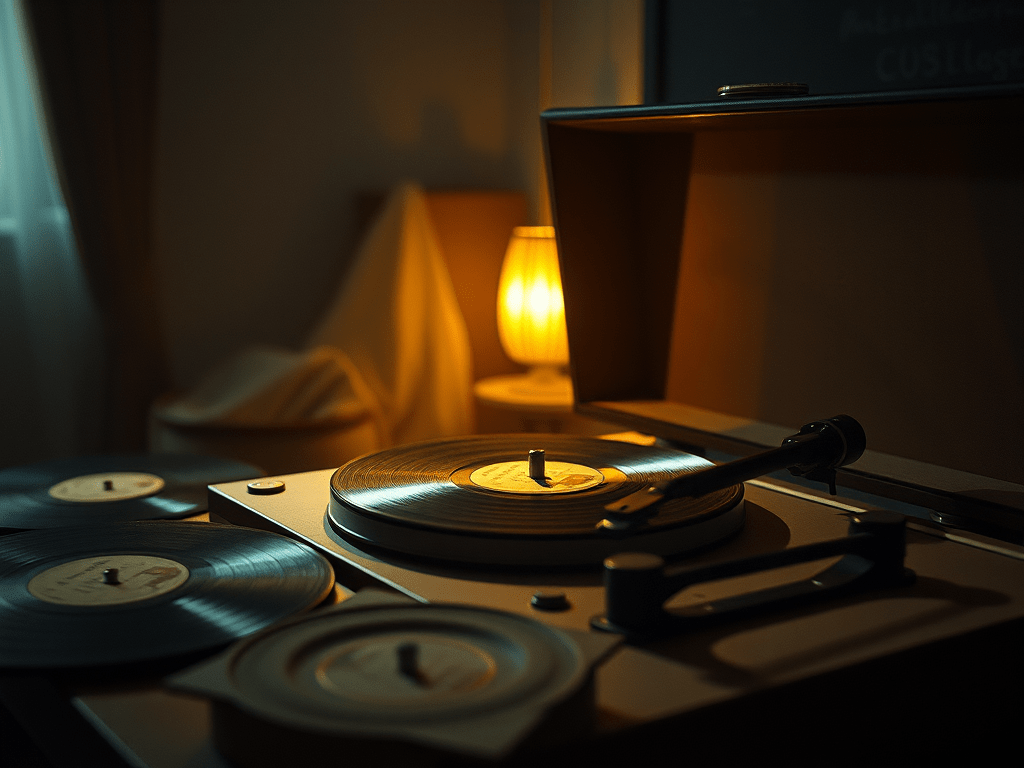
POST: Here the AI generated image is bizarrely spooky. In the gloom, the tone arm of the record player hovers over the disk playing. Is that because the AI was being clever or is it because the AI hasn’t got a clue how a recorder player works? I think maybe the later.


[1] https://metro.co.uk/2024/10/26/bbc-radio-legend-tony-blackburn-says-modern-music-wont-last-60-years-21843219/

[2] https://youtu.be/-tHyRQOdqf0

[3] https://youtu.be/c6M89iDabwM

[4] https://www.youtube.com/watch?v=m-4G18t5se8

[5] https://youtu.be/sOnqjkJTMaA

[6] https://youtu.be/0qanF-91aJo

On my radio

Out on the edge of the city of Coventry is the campus of Warwick University. At the heart of the campus is the Warwick Arts Centre. I recall “Rockpile[1]” when they played a UK university tour in 1978 or 9. One of their concerts was at the Warwick Arts Centre and I was there.

It was a fantastic night. No idea how I got there or got home to my rundown student accommodation in Coventry. My student days were at what was then called the Lanchester Polytechnic. A clumsy group of post-war modernist buildings strung up in the centre of a struggling city.

Music-wise I was living at the centre of the known universe. Between 1978 and 82 Coventry was alive. Venues were full. It was a youthful eruption of music. There was an air of decay in the crumbling manufacturing heart of the West Midlands. The brutalist and raw concrete architecture of the city was gathering moss, springing leaks, and not living up to the idealism that built it. Maybe the cost of living was not so hight, but something kicked-off an explosion of creativity. The energy of 40-years ago made its mark on popular culture.

Anyway, what I’m recalling here is a BBC Radio 1 DJ. She was that at the time. This week Annie Nightingale[2] has passed away. It seems fit to remember her with her finger on the pulse of what was happening. She was at the Rockpile Warwick Arts Centre concert, seeing and being seen. Much senior to the students in that hall. That didn’t matter one bit. Whispers went around in respect – that’s Annie Nightingale. We knew we were at a special event.

There’s another recollection I want to get off my chest. It involves cassette tape and an amber-red Sunbeam Imp[3]. Making compilations was all the rage with cassette tape. In this case it was Annie Nightingale’s compilation. Probably in the early 1980s.

Who knows which Halloween it was, but I had one recoding of one radio show she did that was my favourite car tape. Her instincts were prefect. It was one of those tapes that could be played repeatedly wherever I was going. My school days echo with the “Monster Mash.” A smile comes over my face when I hear Barnes & Barnes and Fish Heads[4]. Or “Werewolves of London” by Warren Zevon[5]. Don’t Fear the Reaper by Blue Öyster Cult. A great selection of fun packed horror-themed tunes.

Annie’s Halloween radio show was a masterpiece. She defined cult classics. Her earnest side aside she was mischievous. In a box. I know not where that tape may still exist. I’ve a mind to look for it. Thanks Annie.


[1] https://en.wikipedia.org/wiki/Rockpile

[2] https://www.theguardian.com/tv-and-radio/2024/jan/12/annie-nightingale-radio-1-dj-dies-aged-83

[3] https://classicmotorsports.com/articles/not-mini-sunbeam-imp/

[4] https://youtu.be/cn73Wtem0No

[5] https://youtu.be/c6M89iDabwM

Pod

Will podcasts overtake broadcast radio? It’s a question that it had not occurred to me to ask until yesterday. I’ve not been a first adopter as far as listening to podcasts. There’s a routine of turning the radio on at a particular time of day to listen to news and current affairs. That daily routine or habit is born of a long tradition. The morning starts with the Today programme on BBC Radio 4.

Yes, I’m way behind the curve. Go into any large electrical shop, one wall of the warehouse will be filled with earpieces and headphones of every size and shape. The variety of choices is staggering. Sit on bus, train, or aeroplane and more than half the people around will be turned into a source of audio entertainment. Music and talk fight for our attention.

This is great for the streamers and downloaders but lossy for conversation. Sitting next to an interesting person on a long flight is a wonderful way of occupying a couple of hours. That opportunity is diminishing as people become absorbed in digital media. Even the smallest of phones has become a multipurpose entertainment system.

I have long been converted to digital media. FM radio is great for its universality but with less DAB[1] blind spots its life expectancy must be diminishing. Broadcast digital radio based on DAB is a global standard even though coverage is not universal. The digital avalanche is pushing aside any remaining analogue system that populate our lives. Ironically, as far as physical media ownership is concerned, vinyl and even cassettes are resurgent. On the airwaves it’s less likely there will be a romance for analogue radio.

Why have I reassessed the virtues of podcasts? Yesterday, I listened to The Rest Is Politics[2]. This podcast has a conversational style. It’s Alastair Campbell and Rory Stewart talking about current affairs in the UK. Two people who have had their moment in the political sun but remain articulate and inquisitive. They have something to say and it’s engaging.

This is a bridge to podcasts from broadcast radio in that the material is up to date. The topics discussed are wrapped around the news. It’s refreshing too. The ability of the two to argue in a calm and collected manner is unusual in our time. So much of the presentation of news is calamitous and confrontational that this is shocking to say.

Maybe that’s the role of podcasts. Reflection and analysis can be better done in slow time. Broadcast radio news is crammed full of snippets of what’s happening. It would loose its edge if it drifted off into too much extended investigations or drawn-out interviews. So, what may seem like competition between two forms of readily accessible media should be viewed as complementary. Both can fulfil an appealing role in the digital media landscape.


[1] https://www.worlddab.org/

[2] https://podcasts.apple.com/gb/podcast/the-rest-is-politics/id1611374685