
There are moments when it’s dark and grey outside. Moments to ponder a what-if. That’s a what-if something hadn’t happened or physical laws aren’t what they have been found to be.
In my youth I do remember making a “crystal” radio receiver[1]. A relatively fragile germanium diode and a couple of other components scraped from junk radios, record players and TV sets. It worked quite well. It was a good introduction to the theory of amplitude modulation (AM). The diode detector demodulates the radio signal and provides a faint signal to listen to. The whole arrangement is crude but cheap and simple. It depends on that useful device – a semiconductor diode.
My what-if is right there in plain sight. Let’s put aside the physical laws that give certain materials their properties. What-if the whole world of semiconductors didn’t exist?
The most immediate repercussion is that this keyboard, screen and computer would look entirely different, if it existed at all. What I’m doing now is dependent upon millions of semiconductors all doing exactly what they’ve been designed to do. Easy to take for granted – isn’t it. Our modern world is enabled by semiconductors.
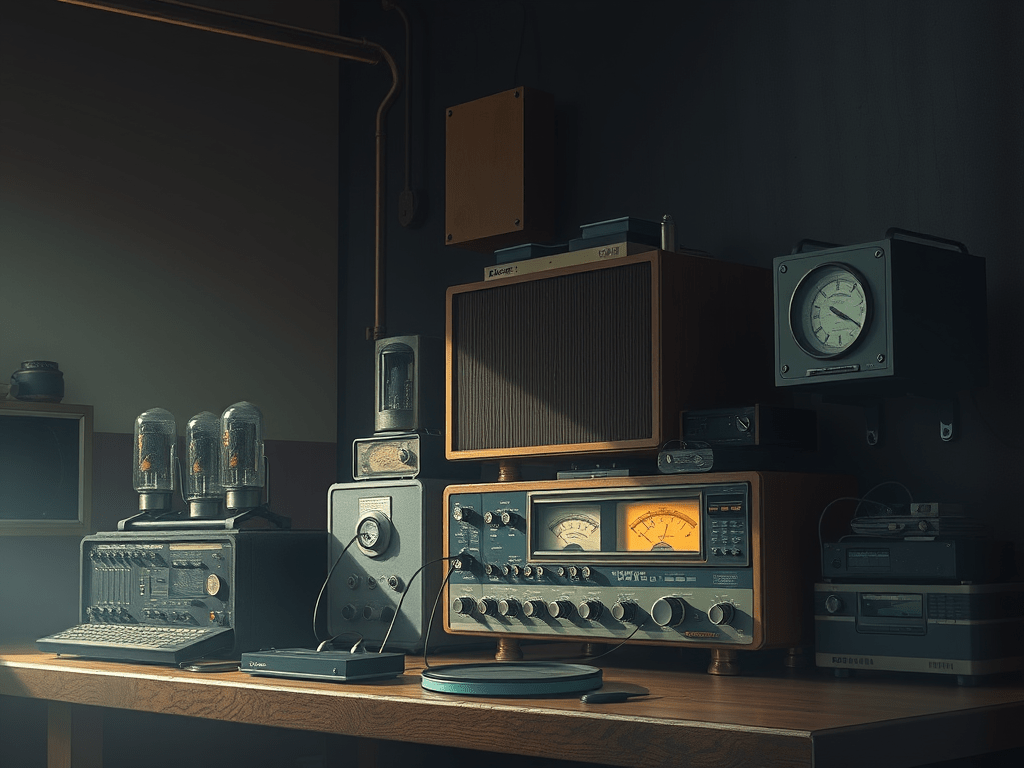
Electronics would still exist. Before semiconductors were understood thermionic valves provided the ways and means to control electrical signals. Don’t think that valves[2] have disappeared in the 21st century. There’re enthusiasts who prefer them for amplification. The sound is better (different) – so they say.
Unlike semiconductors, thermionic valves don’t lend themselves to miniaturisation. A world without semiconductors would be populated by machines that are considerably larger and heavier than those of today. But it wouldn’t be a world without sophistication. Just look at the English Electric Canberra[3]. An incredibly capable aircraft for its day. It lived a long life. Without a semiconductor in sight.
It’s difficult to imagine e-mail without semiconductors. It’s difficult to imagine the INTERNET or the mobile phone. Not that such key markets wouldn’t be satisfied by some other means. The transition to a global dependency on digital systems would probably have been considerably slowed. Maybe the pace of life wouldn’t have accelerated so much.
I don’t think we would have been trapped in a 1950s like society. Only that patterns of work would have taken a different developmental path. Would it have been the one painted in the grim tale of 1984? No. Even that takes a position of a freezing of the state of human progress.
A non-semiconductor existence would have meant less proliferation of electronic devices. It might have led to a less wasteful society where repairing equipment was given more weight.
I suspect that large global corporations would inevitably have a hold over whatever technology was most popular. That side of human behaviour is technology agnostic.
[1] https://www.nutsvolts.com/magazine/article/remembering-the-crystal-radio
[2] https://brimaruk.com/valves/
[3] https://www.baesystems.com/en-uk/english-electric-canberra
 John Vincent