
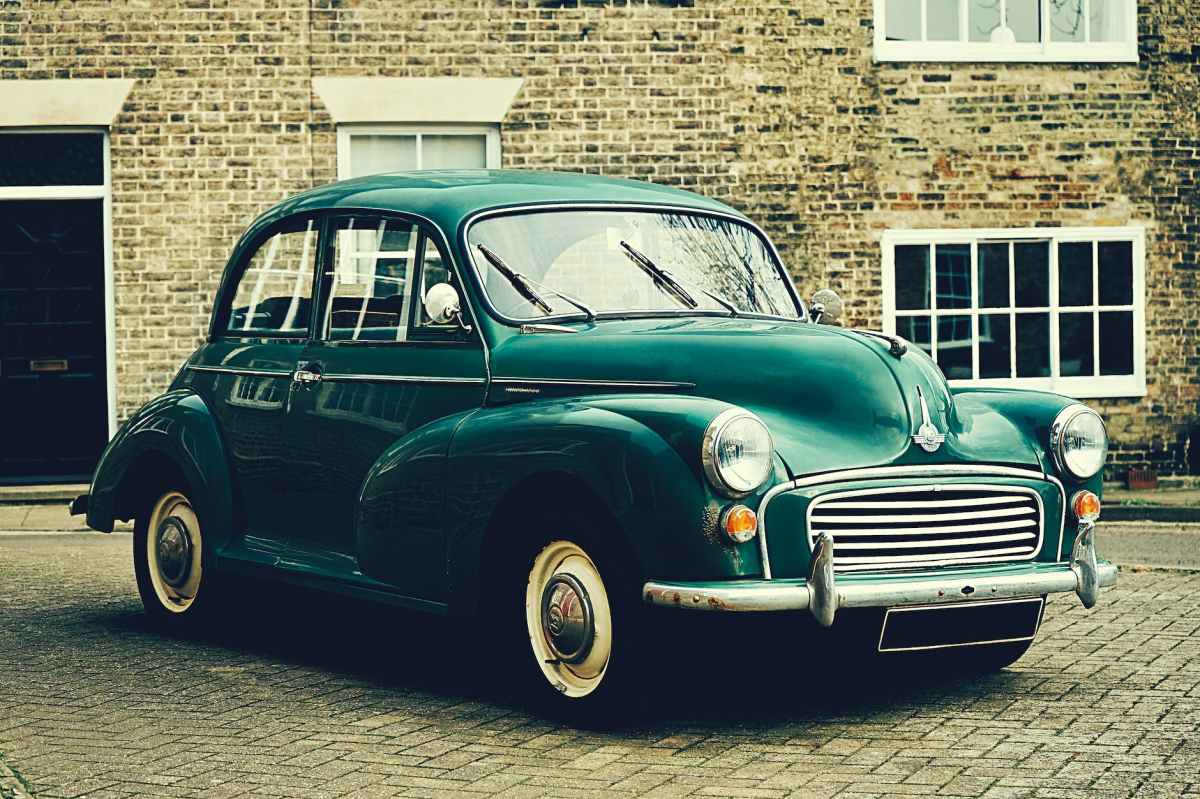
How many people do you know who have taken a sharp axe to a Morris 1000[1] van? It’s a surprisingly effective tool. It was a hot day. The task took a fair degree of persistence. Nothing for an energetic 16-year-old.
What I was doing was to cut out the front sub-frame complete with the suspension complete. The van differed from the construction of the car by having a separate chassis. The Morris Minor had a straightforward torsion bar front suspension. Corrosion can be a real problem with these cars, but this old grey van was structurally sound.
The reason? For popular cars of its era, it had a ruggedness and simplicity that made it easy to work with and, I suppose, we got hold of an MOT failure with ease and probably little money. Besides a working BMC “A” series engine always had a value.
After the careful attention of my axe the remaining parts were to become the rear part of a car that we were building at school. That Morris 1000 front end would be welded to a Triumph Herald[2] front end. We didn’t do that. Our friend, mentor and teacher did the welding of the two chassis components. It was another year before I picked up that useful skill.
Why a Triumph Herald? That small car had a tight turning circle. I think it was about 28 feet. Funny, what gets remembered. That, and its availability in 1976 were the reasons it was valuable to my school friends and me. Putting all that together formed the basic frame of a car. Four wheels, brakes, steering and suspension. It was an ungainly looking crude construction, but it did the job. It was a good start.
What came next was an engine. This really was a version of that story from Johnny Cash’s[3] “One Piece At A Time.” No, the engine didn’t come from a Morris or a Triumph. It came from a Reliant[4].
That question of why comes up again? Well, the Reliant engine we had got out hands on was made of aluminium. It was considerably lighter than the engines of a Morris or a Triumph. The baby Reliant engine we had was bathed in oil. It took a good kicking to get it to spark into life. I recall trying to fix brackets for engine mountings. It was an exercise done by eye. Getting the engine to run smoothly and without too much vibration was fun.
What was entity novel for a small car was our transmission system. I don’t know how this came about but we wrote to Volvo asking for them to sponsor our school’s project. They did. They provided our school with a hydrostatic drive system. That’s the pumps/motors and the assorted hydraulic plumbing. The removal of a mechanical transmission with fixed gears was the benefit we were promoting. Hydrostatic transmissions were used in boats and construction machinery but not in a small car.
All of this was stored in a tin shed at our school. Without the stubbornness of our teacher this project may have fallen into the wilderness, but we kept the faith. As I left school the project was handed on to the next generation. It was mobile. It worked, after a fashion.
The basic car became an entry in the BP Build-a-Car competition in October 1976[5]. This was a national competition where schools around the country designed and built a “practical” 2-seater car. The prize was a new school minibus. So, the competition attracted some capable, smart, and well-resourced schools.
I’d started an apprenticeship by then so didn’t get to go on the trip to the Royal Electrical and Mechanical Engineers (REME). This was the site for the contest to show off what the cars could do.
It was reported back to me that some of my designs for an electronic dashboard using LEDs attracted the interest of the judges. At the time Lagonda were ready to take on the world with a bold new design and a car with electronic instrumentation[6].
Later in my career, aircraft cockpit instrumentation design and integration were a big feature.
NOTE: I suddenly have more respect for Rick Astley. Just watch She Makes Me (Official Music Video)
[2] https://www.autoexpress.co.uk/classic-cars/104977/triumph-herald-buying-guide-and-review-1959-1971
[3] https://youtu.be/Pv8yTqjYCGM
[4] https://www.reliant.website/history.shtml
[5] https://youtu.be/evDWFB58Vo0
[6] https://www.auto-data.net/en/aston-martin-lagonda-ii-5.3-310hp-3052#image3

 John Vincent