Britain deserves better

Post-Brexit Britain will be more bureaucratic. The recently published Government papers are full of new regulatory regimes, doubling up of registration and extra processes for British business and consumers.  When Ministers say, like Dominic Raab: “the UK will be better off outside the EU in any scenario…” we all know these are meaningless words.  It’s his job to say that sort of nonsense even if this is turning reality on its head.

For the Conservatives it’s too late to change direction.  They know that their negotiating strategy has fallen apart.  Focusing on the negative, like threats of a “no deal” have done, has alienated potential partners.  During negotiations, blaming people for intransigence has been a diplomatic blunder of the first order.  It’s reinforced the solidarity of the potential partners.

The first batch in a series of Technical Notices on “no deal” assume a great deal of good will on the part of the EU.  Some of them ignore the constraints that apply because of existing legislation in Europe.  In an emergency, circumventing Regulations can be done but its going to be hard if the only reasons are ideological and pressures are like a game of Russian roulette.

The UK voted to leave the European Union on 23 June 2016.  The world of early 2019 will not be the same as the world of early 2016.  Populism remains but its not gathering any head of steam.  It’s a minority of ideological radicals who keep pushing their cherished project.  We don’t have to accept their view of the world.

We need a #PeoplesVote.  But we need a positive campaign about the benefits of European solidarity.  A campaign must present the facts and expose the lies of the last referendum.  Britain deserves better.

Brexit and Aviation 28

The EU has already produced a series of notices on “Brexit preparedness”.  It’s now the turn of the UK to publish notices.  Taking the current course, the UK plans to leave the EU on 29 March 2019.   What happens at that point remains a subject of much debate and discussion.  Many hours of media time are dominated by speculation and those desperate to influence public opinion.

Brinkmanship is the apparent escalation of threats to achieve one’s aims.  For brinkmanship to work, both sides escalate their threats.  We never seem to be on the brink of anything good.  Most “brinks” are on the edge of catastrophise, cataclysm, disasters, ruin, suffering or harm.

Pro-Brexit people often dismiss any such talk as, so called: “Project Fear”.   That’s disingenuous because it’s an unscrupulous attempt to hide what brinkmanship is by definition.  A threat, or outcome that no one sensible wants is ineffective unless it’s credible.   It’s no good blaming anyone for this dreadful state of affairs.  If the doctrine of – nothing is agreed until everything is agreed – continues, then this is what will happen.

Also, its foolish to think that this situation will only exist in the UK – EU relationship.  It’s most likely to be encountered whenever the UK is negotiating with a larger Country or region.  So, if Brexit happens we had better get used to it.

Naturally there’s the potential for errors or misjudgements.  History is littered with brinkmanship gone wrong.  It always better to have a life jacket than not have one but whether it will be any use or not is quite another matter.

Today, civil aviation is not on the list of how to prepare if the UK leaves the EU with no deal[1].

There are some inferences that can be taken from the notice on “Regulating medicines”.  Basically, that’s the UK will continue to apply and accept the application of EU regulations even if there’s no deal.  Ideally, the UK would like to remain part of the European Medicines Agency (EMA).

An attempt at humour, and the Bacon Lettuce and Tomato sandwich scenario after Brexit, fell flat.  That said, most of the scenarios for no deal Brexit are Bl**dy Ludicrous Threats (BLTs).  Better to stop this folly altogether and adopt a more practical, pragmatic and proportionate approach to EU Membership.

[1] https://www.gov.uk/government/collections/how-to-prepare-if-the-uk-leaves-the-eu-with-no-deal


Brexit and Aviation 27

In civil aviation, deal or no deal, the Convention on International Civil Aviation, signed in Chicago on 7 December 1944, which provides for implementation of the measures necessary to ensure the safe operation of aircraft will continue to apply in all European States.

Deal or no deal, The UK will remain a member of European Civil Aviation Conference (ECAC) and EUROCONTROL.  But even before REGULATION (EEC) No 3922/91 of 16 December 1991 on the harmonization of technical requirements and administrative procedures in the field of civil aviation a great deal of work was being done to harmonise of technical requirements in Europe.

Deal or no deal, the 508 million of the current EU28 want high levels of civil aviation safety and common technical requirements in Europe.  Simply put the public demand will continue to be to strives to improve safety and protect the environment.  European skies see over 10 million flights a year and that’s growing.

Frankly, to do any different would be a grave dereliction of duty.  Each European country is unique.  However, it doesn’t matter who you are or where you are from, if you are a passenger on an international flight you expect the same level of safety as everyone else.  Competition can drive improvements in industry but no one sensible or sane competes on safety grounds.

So, talk of “no deal” isn’t of any usefulness because there will always be a deal of some kind.

Tomorrow Ministers are set to publish the “no deal” Brexit plans that have been worked-up.  Whether this is healthy or unhealthy isn’t so much about what they contain as the state of mind that produced them in the first place.   The irrational beliefs at the heart of Brexit have little to do with practical reality.  The honest practical reality is that there will be deals.

No half-way houses

What do you do in a deeply divided country like ours?  They say perception is all.  Spend just 5 minutes reading Hard Remain Tweets and then 5 minutes reading Hard Leave Tweets.  These two communities will NOT reconcile in anyone’s lifetime.   We have Internationalist English and the Nationalist English.  They live in different worlds and their beliefs are poles apart.  They delight in insulting each other in ever more creative ways.  Both believe the other one is sabotaging their dreams.  Strong deals, good deals, bad deals, weak deals or no deal, whatever the final deal a large proportion of the English population will object to it even if they haven’t a clue what it means.  We all know the status-quo is not tenable but where do we go from here?  The traditional “bell curve” of politics is taking a holiday.  That’s where once many politicians looked to position themseleves with the central moderate majority.

Let’s be clear that at a time of such troubles we need to get back to fundamentals.

“The first duty of the Government is to afford protection to its citizens.”  My interpretation of the word “protection” takes in: safety, security, justice, economic wellbeing, social solidarity and environmental protection.

This is where the two camps are NOT equal.  Wherever you are, you do need to pick a side.  Appeasement has a poor history in all nations.

A quick look at the Brexiters priorities leave no doubt, in my mind that they are authoritarian and unscrupulous.  Here’s a range of thing they want to do:  One Party rule.  In Parliament, shut down the House of Lords, as they say; no second house needed.  More popular referendums to keep politicians on a leash.  Returning capital punishment.  Pulling up the draw-bridge to all but the wealthy.  Privatisation of the BBC, NHS and other public bodies.  Wholesale deregulation.  Drastic cuts in welfare to let people sink or swim.  Making dissent and protest crimes of treason.  This list is a sample from Brexiters current on-line discussions.

Public safety, security, justice, economic wellbeing, social solidarity and environmental protection, will all be in jeopardy if they succeed.   An outcome that “will be regretted for generations” is on the cards right now.

Let’s be clear the opinion to remain as an EU Member State is no longer the status-quo.  The world has moved in the last two-years.  A new dynamic exists in Europe as we face the challenges of Trump, Russia, China and the huge tech giants who dominate our lives. Nationalist voices will continue to make noise but that should on a level playing field with moderate voices.

If democratic States are to thrive and ordinary people not lose out, Government and its institutions must listen to their people.  There is a growing demand and support for a #PeoplesVote.  Let’s have that vote and show that the real deal is the one people want.

Brexit and Aviation 26

On my desk is coaster that says: “30 Years MOR Scheme 1976-2006”.  It has the Civil Aviation Authority logo above the words.  Now that was worth celebrating.  Three decades of Mandatory Occurrence Reporting in civil aviation in the UK[1].

It would be difficult to put a number on the number of potential accidents and incidents prevented by the learning that has flowed from thousands of MORs.  Nevertheless, there are certainly people who have been spared the fate of being involved in life threatening events.

1976 was my first year of paid employment.  It was a glorious hot summer.  In the autumn, I started an apprenticeship with no idea that the path of my career would lead to me working with MORs.

At that time, I was working out how to do engineering drawing and make precision items using machine tools.  If remember right, being on a flat roof at Yeovil College experimenting with a solar water heater.  Working out how to stop it leaking and pump at the right times.

Not my biggest interest but aviation was around me given the presence of Westland Helicopters in the town.  That company had its own apprentice training school.  Many of the college apprentices like me worked for small engineering companies that depended on Westland’s.

I recollect this because, at that time, my memories of a fatal aircraft accident were of the one that led to the establishment of the MOR system in the UK.  In 1972, British European Airways flight 548 crashed in Staines killing 118 people on board[2].  This was a British aircraft, operated by a British company on British soil.  A sad and tragic event.  I plan to go to see the Trident memorial window in St Mary’s Church in Staines.  The 118 stars in its border represent those who died.

The UK has contributed considerably to shaping the rules that now apply in Europe.

When I arrived in Cologne in 2004, the Directive 2003/42/EC was in place.  This wasn’t the strongest piece of legislation and although it required EU Member States to have an MOR system it was weak on getting people to share information.  That’s one of the big benefits of such approaches.  It’s to learn from others so that you don’t have to experience the same problems.

Now, to give it the full title we have: Regulation (EU) No 376/2014 of the European Parliament and of the Council of 3 April 2014 on the reporting, analysis and follow-up of occurrences in civil aviation, amending Regulation (EU) No 996/2010 of the European Parliament and of the Council and repealing Directive 2003/42/EC of the European Parliament and of the Council and Commission Regulations (EC) No 1321/2007 and (EC) No 1330/2007 Text with EEA relevance.

Yes, that’s a mouthful but the text of the Regulation is invaluable to make a system of collecting and sharing MORs throughout the whole European aviation system.  Will the UK continue to participate in this European system post-Brexit?  Everyone assumes it will but the answer to the question how is – no one knows.

[1] https://www.caa.co.uk/Our-work/Make-a-report-or-complaint/MOR/Mandatory-occurrence-reporting/


[2] https://aviation-safety.net/database/record.php?id=19720618-0


Brexit & Aviation 25

Changing perspectives on Brexit, I’ll consider it more from the point of view of being an air passenger.  I’ve written about aviation’s regulatory framework and the impacts on industry, but I fly too.  So, what’s likely to change with the passing of March 2019?

Today’s UK News is about the UK-based airline Virgin Atlantic and their story on ques at London Heathrow airport[1].  On 6th July, non-EU visitors had to wait for up to 2 hours and 36 minutes at Heathrow.  That’s a lot to add to the end of a long-haul flight.  Brits may be accustomed to queuing, but it annoys and frustrates most people.

I’m lucky.  I have a shiny new British passport with the words “European Union” on the front cover.  As a British passenger, I can use the electronic passport gates which currently are open to EU passengers.

Currently Europe’s busiest airport, that’s the EU’s busiest airport isn’t offering good services to non-EU visitors.  Will this change after March next year?  Or will EU passengers get more hassle than they do now?  There’s media speculation about a Brits only immigration line at airports but what could that possibly mean in reality?  No one knows.

Regulation (EC) No 261/2004[2] isn’t liked much by the aviation industry but passengers have been happy to see this legislation enacted.  Now, will an Air Transport deal between the EU and UK include consumer rights such as flight delay compensation?  Even if the intent of this Regulation is copied into UK law it wouldn’t be much good applied to non-UK airlines.  I understand that Switzerland participates in 261/2004.  So, it should be possible for a post-Brexit UK to participate in the legislation.  This needs to happen otherwise British passengers delayed by EU airlines will not be appropriately compensated.  A notice to this effect has been published.

When traveling we like to keep in touch with family, friends and colleagues.  Today we get mobile phone roaming in the EU at domestic prices.  This requires continued regulation of prices by UK and EU networks. Will this end?  No one knows.

The UK Government continues to say: “Our focus is making a success of Brexit and attempting to get the best deal possible. A deal that is in the interests of both the United Kingdom and the European Union. And one that takes in both economic and security cooperation.”

Flying to and from the UK may change after March 2019.  Unless the above issues are fully addressed the experience maybe a lot worse than it is today.  So, be prepared.

[1] https://uk.reuters.com/article/uk-britain-airports-virgin-atlantic/heathrow-airport-passport-queues-reached-two-and-a-half-hours-in-july-data-idUKKBN1KY0PC


[2] Regulation (EC) No 261/2004 of the European Parliament and of the Council of 11 February 2004 establishing common rules on compensation and assistance to passengers in the event of denied boarding and of cancellation or long delay of flights……………………….

Brexit & Aviation 24

Like it or not, the holiday season will end.  Facts are incontrovertible.  The UK and EU have just a few months to finish a Withdrawal Agreement.  This is to allow for scrutiny and ratification in both the UK and the EU’s 27 Member States.  A Withdrawal Agreement must be signed in October and that’s just days away.

Let’s look at one more civil aviation issue.  The continuing airworthiness of a civil aircraft is dependent on the exchange of information between authorities and organisations across the globe.  This is flow of information is practically improved if working arrangements or bilateral agreements exist between Countries.  These are built on mutual interest, trust and a long-established familiarity with each other’s regulatory systems.

Yes, the duties of Countries under their obligations as signatories of the Convention on International Civil Aviation, dated 7th December 1944 (known as the “Chicago Convention”) exist but these are the basics and even then, those basics are often given scant regard.

In the 1970s, some European civil aviation authorities started to co-operate to produce common “Joint Airworthiness Requirements.”  Even before the 1990 Cyprus arrangement[1] in Europe, both the US and European authorities had been working to harmonise rules and reduce duplication of regulatory activities.

Today, a mature EU-US bilateral is in place.  So, if a British manufacture wishes to export an aviation product to the US it can do so with relative ease.  As per Subpart G 21.A.163 of Commission Regulation 748/2012, the holder of a production organisation approval may issue authorised release certificates (EASA Form 1) without further showing.   That EASA Form 1 is then recognised in the US.

The Treaty’s Article 50 clock stops at the end of March 2019.  It’s reasonable to ask the question; what Authorised Release Certificate will be used in the UK after that date and will it be recognised?

Anyone know?

All the loud yah-boo politics, so loved of Westminster, doesn’t offer an answer.


NOTE 1: The EASA Authorised Release Certificate is known as the EASA Form 1.

NOTE 2: The FAA Authorised Release Certificate is known as the FAA Form 8130 -3, Airworthiness Approval Tag[2].


[1] ARRANGEMENTS CONCERNING THE DEVELOPMENT, THE ACCEPTANCE AND THE IMPLEMENTATION OF JOINT AVIATION REQUIREMENTS

[2] Reference:  FAA Order 8130.21H—Published August 1, 2013, Effective February 1, 2014.

Brexit & Aviation 23

Hearing hard core Brexiters herald statements from IAG S.A.[1] about working though Brexit is strange to say the least.   By the way, if you’ve never heard of them the International Airlines Group was created in 2011, is one of the world’s largest airline groups and includes British Airways.  It’s a Spanish registered company with shares traded on the London and Spanish Stock Exchanges. IAG operational headquarters is in London.

At the point of the 2016 UK referendum IAG shares took a hit.  Ever since then there has been a consistent recovery in their position.  Brexit, or no Brexit they are well placed on both sides of the fence.  Today, their airlines have Air Operator Certificates (AOCs)[2] in the EU.  After the end of March next year its likely those AOCs will remain unchanged.   The basis for their UK operators validity will shift from European Regulation to National Legislation.

Despite the high level of integration of the European aviation market place there is no single European registry of aircraft.  Each ICAO Contracting State has its own aircraft registry.

However, to fly into the EU all non-EU aeroplane operators must have a Third Country Operators (TCO) authorisation[3].  This is a way of ensuring that non-EU aeroplane operators are compliant with all applicable technical standards of the Annexes to the Chicago Convention.

In the EU the authorities undertake ramp inspections of aeroplanes in operation.

Naturally, after the end of March next year aeroplane operators who transition from being EU operators to non-EU aeroplane operators will need a TCO authorisation.  In theory, this should be an administrative matter since the transitioning operators already meet the applicable standards.

The TCO authorisation process can require that an audit be performed at the operational premises of the aeroplane operator.  This is one of the tasks undertaken by the European Agency EASA.

It’s worth noting that the TCO only considers the safety-related part of foreign operator assessment, whereas operating permits (commercial traffic rights) are issued by individual EU Member States.   In many Brexit articles these often a confusion between safety related rules and commercial related rules.  It’s generally the case that operating permits are not granted unless the TCO is in place first.

So, far from the Brexiters cries of: “take back control” the result of all this is that our interdependence across Europe changes but remains.  And for very good reasons too.

[1] https://www.londonstockexchange.com/exchange/prices-and-markets/stocks/summary/company-summary/ES0177542018GBGBXSET1.html


[2] https://www.skybrary.aero/index.php/Air_Operator_Certificate_(AOC)


[3] Commission Regulation (EU) No 452/2014 (the ‘TCO Regulation’)

No Treaty means no Treaty

This week the Bank of England’s interest-rate increase has become another bump on the road to Brexit.  BoE Governor Mark Carney commented that the risk of the UK dropping out of the EU with “no deal” was “uncomfortably high.”  Ripples of vitriolic Brexit Tweets and alike popped up to denounce this as, so called Project Fear Mark 2.

The cautious and conservative, with a small “c”, Carney dared to give an expert assessment of the current situation based on his reasoning and experience.  Such is the tribalism in British politics that anything that gives the merest impression that Brexit might not be wonderful immediately sparks fanatical cries.  Rational thinking in this battleground gets two fingers in the air.

Reading, listening and watching discussions about a “no deal” outcome, I’m struck that so many people talk about it but often they mean something completely different.

Let’s be clear.  The so called “no deal” is in Article 50 paragraph 3[1].  It is that the Treaties we are currently signed up to will cease to apply from one day to the next.   Without a withdrawal agreement in place or an extension to the two-year period we enter the unknown.

Brexiters might be happy with this outcome but that’s a foolish position to take.  Treaties, by their nature, have benefits and obligations for both parties involved.  Take away those in one day and put nothing in their place is most likely to cause mayhem.

Contacts may become void.  Certificates that are mutually recognised are no longer recognised.  Qualifications are questioned.  Massive numbers of technical and administrative processes become uncertain.  Brits working in the EU are put in limbo, as are EU citizens working in the UK.

No Treaty means no Treaty.

Its like pulling up a drawbridge or pulling down the shutters and saying the shop is closed to the 27 Member States of the EU while we refurbish the premises.  Now, I agree such a situation would not last forever as people of goodwill will desperately struggled to find workarounds.  People who don’t have goodwill will try to take advantage of the uncertainty.  It’s likely that the larger organisations will have protective contingency measures in place.  However, SMEs and individuals will be vulnerable and subject to unpredictable costs.

There needs to be a withdrawal agreement in place even if it’s just one page saying; carry on.

[1] 3. The Treaties shall cease to apply to the State in question from the date of entry into force of the withdrawal agreement or, failing that, two years after the notification referred to in paragraph 2, unless the European Council, in agreement with the Member State concerned, unanimously decides to extend this period.

A couple of hours in Redhill Town

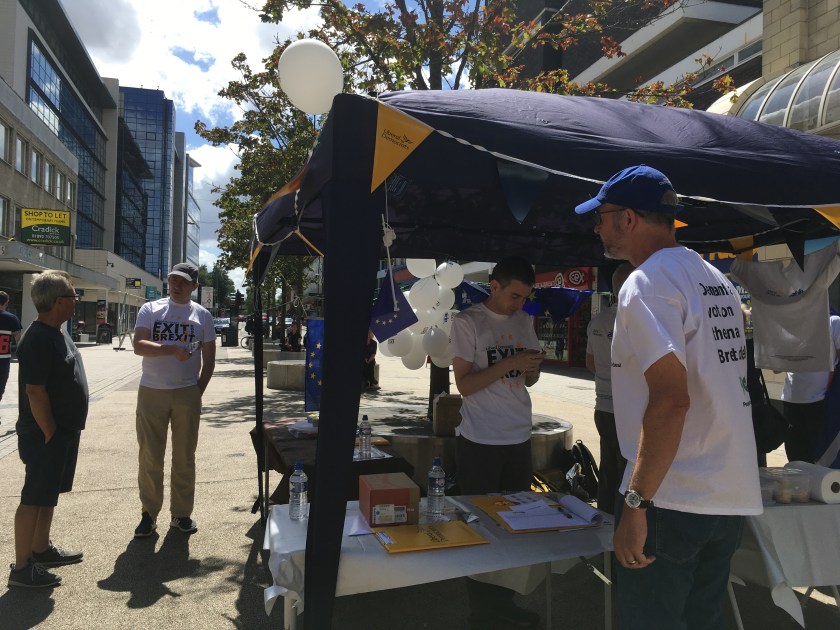
IMG_3954A Saturday morning spent campaigning in Redhill is a real eye opener.  A group of us set-up a street stall with free cakes, leaflets galore and a couple of European flags.  We set-up outside the local shopping centre to be seen by as many people as possible.  The heat of the week has gone.  At one point, the wind almost took the whole stall away as the British weather has changed to become stormy.

We collected a lot of signatures for our #PeoplesVote petition.  Whatever you do, please don’t get the wrong impression from what I write here.  The morning was a campaigning success story as so many people came over to our stall.  So, many great people to chat to about the positive things we can do to bring about change.  That said, it’s the difficult conversations that are interesting.  Here’s a few tales from the streets of Redhill.

An old Liberal friend who I hadn’t seen for many years, dead set against the European Union, was a joy to meet.  Yes, we had our differences but there wasn’t that unpleasant animosity that springs forth so easily from some people who supported the Leave vote.

One Labour voter let me know that the EU was a big capitalist conspiracy.  He was a retired railwayman.  To him the EU was responsible for all the tiresome rules and regulations that the railways had to implement.  It was as if taking the EU away would suddenly transform British railways.  Yet, as we know most of the disastrous decisions made by the current Minister responsible for the railways are purely national mistakes.

A conversation with, I would guess an East Surrey UKIP member, was kept on an even keel by our mutual interest in aviation.  He delighted in telling me stories that he though I was too young to know.  I figured out he once worked in the defence industry.  Possibly at Filton in Bristol.  It’s amazing how the bitterness of a decision made in 1965 has lingered so long in the mind.  The cancellation of the British Aircraft Corporation TSR-2 was part of his lament.  It seemed crazy that this was part of his package of reasons for being anti-EU when that decision, and many similar ones, had nothing what so ever to do with Europe.

Three or four times the argument came at me, as if it was an unstoppable force, that: “we’ve had a vote”.  That vote was enough, and we shouldn’t have any more.  A couple of, mostly older men said: “what you are doing is undemocratic”.  I felt myself getting agitated but kept my cool.  I just wonder if the people who say such things have even the slightest idea how their democracy works.  Not even one of them can claim to have stood for election in a real democratic process as many times as I have done.  Yet, they will come at you aggressively with this simple line.

In fact, they get stranger.  One guy used a football analogy that fell flat on its face.  He said: if you played a football game and lost you would have to accept the result – wouldn’t you?  To which I answered: “well, I’m just trying to win the next match as you would expect any good player to do”.  As expected that made him even grumpier.

A middle-aged woman pronounced that the Country was full.  She didn’t want to say what she meant outright but it was clear enough.

A couple of young lads passed me by.  I said: “want one of my leaflets?” and the response was – no we’ve had enough of that – people keep changing their minds.  That’s not encouraging.  The idea that changing your mind is somehow too much to cope with is disconcerting.

One older man repeated the line that he didn’t want to be ruled by the Germans.  I asked what he knew about how the EU worked and if he had been to Germany recently.  I even admitted that I had lived there for 11 years.  That was a bad move on my part.  The immortal line got thrown back at me – if you like it so much why don’t you ******* off back there.  To which the only answer is to smile and walk away.

Remarkably there were things that I found to agree upon with those in Redhill who didn’t share my enthusiasms for a #PeoplesVote.

One: Bring back Spitting Image.  What they could do with today’s dull politicians and Royals.

Two: May’s Government is doing a terrible job – mass unhappiness – nobody gets what they want.

Three: Jeremy Corbyn is the worst official opposition leader in a generation or more.

There’s a generation, most of whom had a referendum vote in 1975, who have lumped all their troubles and fears into one big bag and called it “Europe”.  Its clear, that’s not their real concern but that hardly matters.  Europe has become a proxy for a bucket load of negative emotions and troublesome fears.  Historians will not make sense of this in years to come as we can’t make sense of it now.

Calling for a referendum on the deal that the Government comes up with in the end, has its risks.  Although the pendulum is swinging against the Leave vote, there is still a hard core of disgruntled people who will shoot their own foot rather than think again.  Now, we are a terribly confused Nation.  I’m convinced that after March next year none of the people’s real concerns will have been addressed.  Stay tuned, this saga has a long way to run.
