
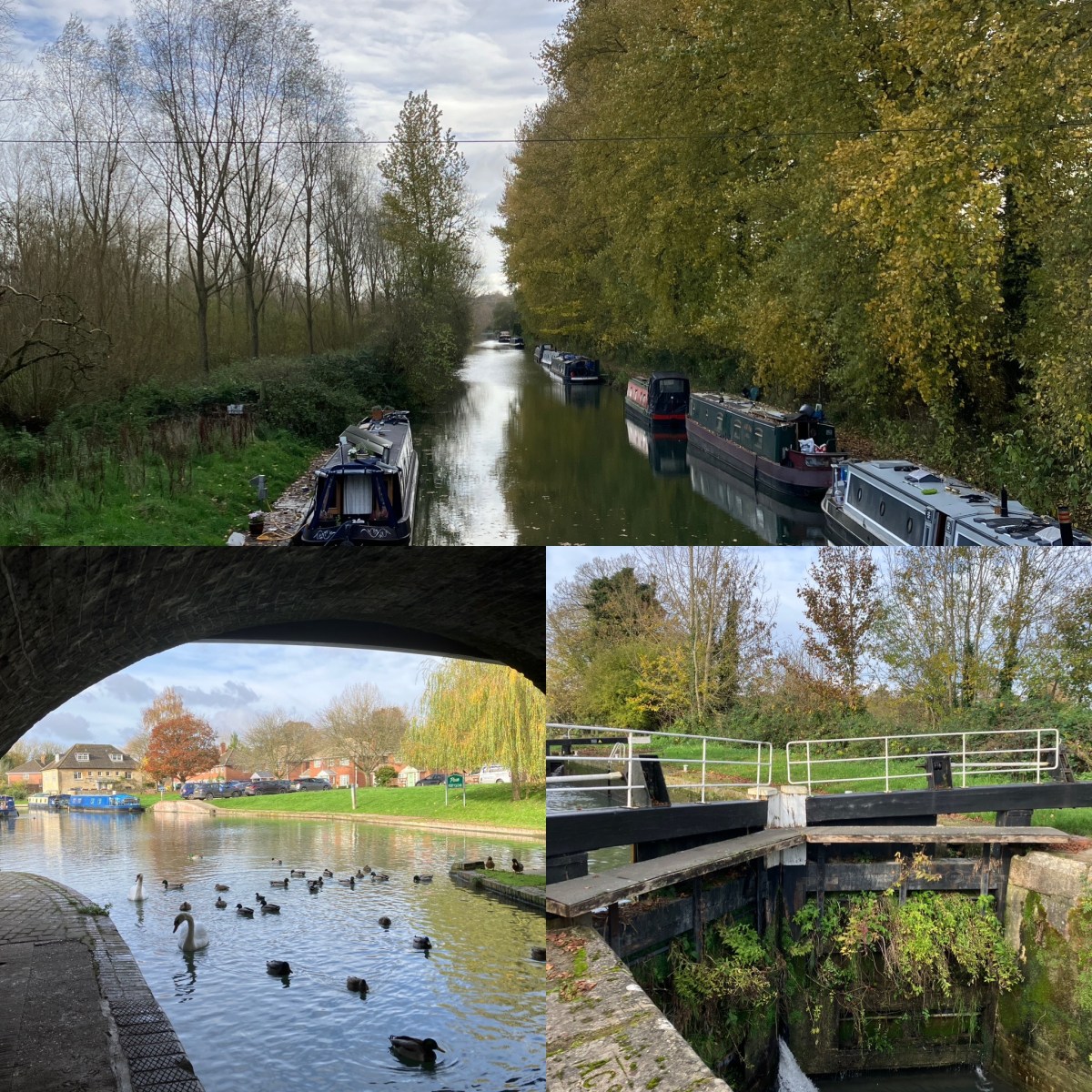
Exploring the Kennet & Avon Canal

It’s the road to the west. The A4 out of London heads towards the west. It’s younger but bigger brother the M4 motorway goes the same way. Going the same way too is the Great Western railway and before that a major waterway, a canal. I guess the ancient roads predate the lot of them given that east-west traffic is an important part of English history. Certainly, the Romans went that way.

I now live at what is roughly the halfway point between London and the west. It’s where what is largely a level route from London starts to rise at a slow pace. That climb made linking rivers, most particularly the London Thames and the river Avon in the west, a challenge. The incentives were evident. So, much potential for trade. Moving heavy commodities around. Canals are truly visionary engineering infrastructure and now an inheritance that’s much treasured.

For people who like to walk, like me, canal towpaths[1] provide flat route between towns. A direct waterside route that wanders through lush countryside. Yesterday, I did the 15km between Newbury and Hungerford. Along that stretch, the Kennet & Avon Canal raises about 150 feet but it’s almost unnoticeable. The main signs are the difference between the fast-flowing waters of the river Kennet and the sober slow canal. A littering of canal locks and small brick-built bridges are a feature too.

The Kennet & Avon Canal was constructed between 1795 and 1810. It was eventually killed-off as a commercial enterprise by the construction of the Great Western railway. Being cheaper and faster along the iron road, transport of goods by water couldn’t compete. It’s in this modern time that the canal was restored. It’s been working again for the last 30 years. Now, it’s a centre of leisure pursuits, small businesses and alternative lifestyles.

The canal’s path follows the River Kennet and its narrowing flood plain. I found looking at how the waterflow is controlled by sluice gates and weirs a fascinating part of the walk. Ambling along the canal’s towpath is a great way to venture into the Berkshire countryside. There are a couple of points where the path changes sides and it’s a bit soggy in one or two places but overall, it’s relatively easy walking.

I did see an Otter on the opposite bank. It was a fleeting glimpse. He, or she, slinked away almost before I realised what I was looking at. Quite different from noisy ducks this Otter made virtually no sound or ripples on the water. 

Dotted along the canal near bridges, decaying concrete World War II-era pillboxes are a reminder that this would have been a defensive line if Britain had ever been invaded.

The walk took me under 4 hours. I was exceedingly fortunate with the weather on the day. A cool breeze and intermittent sunshine. Not bad for November.


[1] https://canalrivertrust.org.uk/things-to-do/walking

View

As I looked out of the kitchen window, this morning a face started back at me. It wasn’t a human face. Thank God. Silhouetted against the ultra-green spring grass of the field at the back of our house was the face of our new neighbours. Their shiny black coats and notably short standing is distinctive. One stately bull, two cows and two claves. A contented family group.

Just as the flood water has receded, and the ground hardened so the grass has shot-up in an instant. It’s a rough pasture but there’s plenty of grass for five cattle to munch away at. My calculation is that the small field out back is about seven acres is size. So, they have plenty of space to roam around all day long. A riverbank on one side. Large shady trees on the main road side. To the southside of the field about five houses, including ours. Some refer to this arrangement as conservation grazing. These cattle are complementary to the wildlife that inhabits this next-door greenspace.

It was funny to watch the Canada Geese get to realise that they have to share the field. There’s as many as 18 of them nibbling away at the grass. At first, they were spooked by the cattle, and their natural curiosity. Soon the two parties decided to ignore each other and get on with life.

Dexters are the smallest native breed of cattle in the British Isles[1]. They are often seen at agricultural shows[2]. They are a breed of cattle that are easier to keep on a small holding than some of the larger and more demanding breeds of cattle. That said, I am told that they can be temperamental and stubborn. However charming the black Dexter bull may look, I don’t think I would argue with him for one minute. He looks quite capable of repelling anyone he doesn’t know or thinks to be friendly.

Interestingly, these cattle are a native breed at risk. At least they are listed in the existing government guidance[3]. This situation does attract a supplement of a certain amount per area grazed. So, there is a useful incentive within the countryside stewardship scheme. This is subject to a whole set of conditions but that’s quite common for such grant schemes.

Frankly, I don’t think there’s any chance that Dexters will become extinct in the next hundred years. For one there’s the attractiveness of the breed. For another, Dexter beef is a quality product. True they are not “commercial” in the sense of being suitable for supermarket shelves.

In the last week, it’s nice to see our new neighbours settle in. They seem to be more than happy with their summer pastures. Seeing the two young claves run around with their tails in the air is a pure delight. They are having fun without a care in the world. The geese, ducks, moor hens, jackdaws, roe deer and red kites are all happy to share the small field and riverbank. Not forgetting the occasional swan. It’s a proper country scene.


[1] https://www.dextercattle.co.uk/

[2] https://www.stackyard.com/orgs/agricultural_shows/dates.html

[3] https://www.gov.uk/government/publications/uk-native-animal-breeds-at-risk-list