Exploring a Riverside

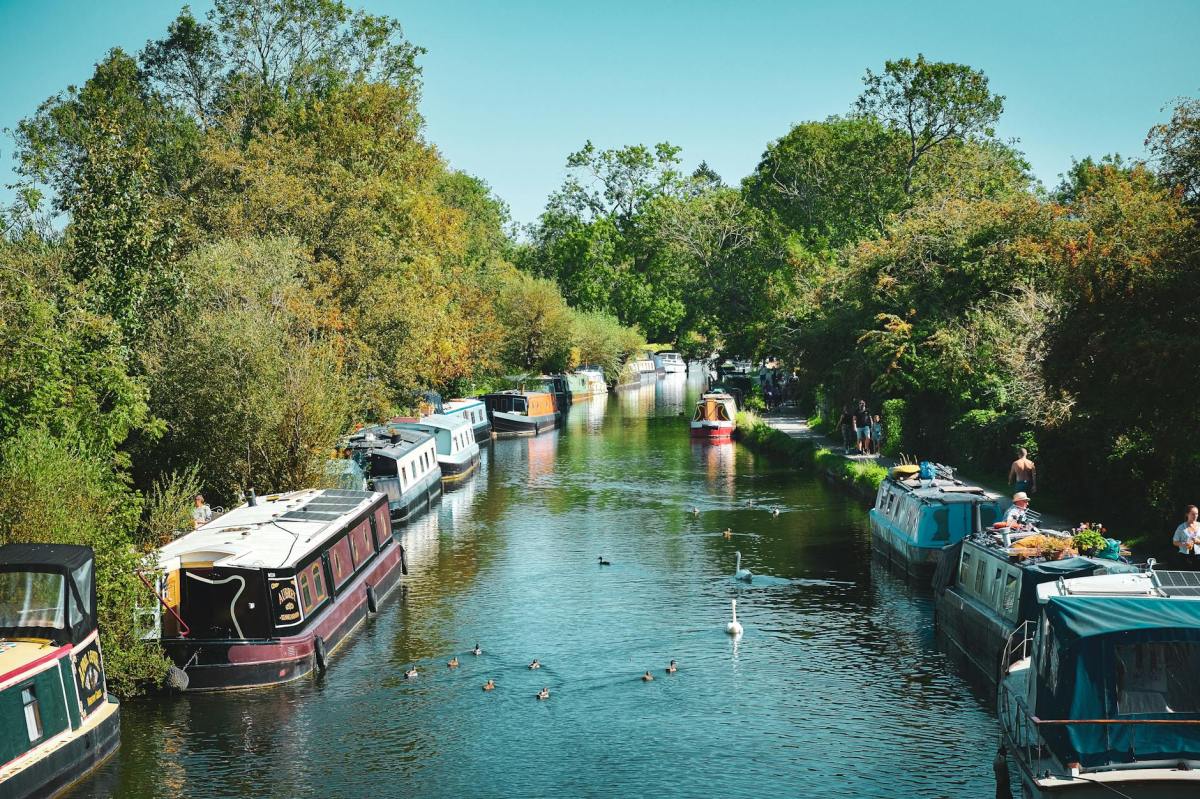
Riverside walks can be pleasant ways of spending a sunny spring evening. That’s what I did on Friday. Sun shining with a cool breeze sweeping through the trees. Underfoot even the unmade-up paths were dry, which is testament to the rainless weather of recent weeks. Even so, the riverbank showed signs of the flooding of the winter.

Reading is a town[1]. It’s England’s largest town. Now, I didn’t know that until I looked it up. The largest English town that I’ve been familiar with over the years is Crawley in Sussex. I think of that as a large town but it’s less than half the size of Reading. It’s the railway that makes Reading. Reading railway station was the last stop on the Great Western Railway (GWR)[2] when it was first opened in 1840. After that the railway forged west to be what we know now as the main thoroughfare across southern England.

Reading town has a long history. That’s no surprise given its position on the river Thames. It’s where the river Kennet, the canal and the river Thames meet. An obvious place for trading since Roman times. It’s a commercial town. Glass sided office blocks and Victorian brick work. For all that it doesn’t stand out as an architectural masterpiece.

Another surprise for me was leaning that town twinning is alive and well. That Reading in twined with Düsseldorf in Germany. A city more than twice the size of Reading. In fact, until this last year, I’ve been more familiar with Düsseldorf.

Our walk ended at The Fishermans Cottage[3]. I’m happy to recommend this small riverside pub.

From there, on the walk back to the railway station I did see the one of the more notable sites in Reading. That’s the Banksy’s Great Escape artwork[4] on Reading prison wall. Oscar Wilde spent time in that jail. The artwork has got a Perspex cover to keep the pigeons off. And anyone else who might think of spraying it.

That reminds me. It’s not unusual to have a phobia about dogs. Although dog owners mostly have a difficulty in getting their heads around the fact. On my riverside walk dogs were not the problem. Amongst our small group of walkers had a different phobia.

As we got to the confluence of the Thames and the Kennet, we discovered the phobia of one of our walkers. Alfred Hitchcock would approve. The Kennet’s tow path attracts Swans. These Swans are attracted by people with food. With no inclination to get out of the gently flowing river these lazy Swans wait for passers-by to pay attention to their needs. That’s no problem.

It’s called Ornithophobia. A fear of birds. Birds flock when free food is on offer. The worst of these can be thought of as flying rats. I talk of pigeons. That how I think of pigeons. Tom Lehrer[5] had the right idea about these annoying birdies. Frightening them away, at least for a moment, cleared our pathway. Like a flash they returned as we strolled into the pub.


[1] https://www.reading.gov.uk/

[2] https://www.gwr.com/stations-and-destinations/travel-inspiration/blogs/history-of-the-railways

[3] https://www.tripadvisor.co.uk/Restaurant_Review-g186363-d7363678-Reviews-The_Fishermans_Cottage-Reading_Berkshire_England.html

[4] https://banksyexplained.com/create-escape-march-2021/

[5] https://youtu.be/yhuMLpdnOjY

Exploring Sunday

To the rationalist everyday is the same. Earth turns on its axis. We all experience day and night. Day and night change as the season change. It’s all mechanical and predicable. Even the builders of Stonehenge knew that there was a rhythm to the year.

Last night, to mark that transition between the cold winter months and spring, the clocks went forward one hour. So, I’m already out of sync with my normal routine. Happy with it. Those extra hours of light in the evening are a great joy. Time to get the garden in shape.

This seventh and last day of the week, has a marker too. Christian communities see this day as a day to take stock, to rest. We don’t entirely observe that tradition anymore, but it is a different day. A day when life takes a slower pace.

If I go back to my youth, Sundays were distinct. The day was always a time set aside for visiting relatives. Now and then, a church or chapel service in the evening. West Country village life was one of compromises. We went backwards and forwards between the Church of England and a small Methodist chapel in an adjoining village.

Sunny spring and summer Sunday evenings could be unlike every other day. Until my parents gave up the dairy, and reliance on a cheque from the Milk Marketing Board[1], everything we did had to fit around milking time. Cows have internal clocks. They know when the time has come for milking.

Lighter spring evenings opened the opportunity to go visiting or, as we often did, going for a drive. All six of us would get packed into the family’s Wolseley 16/60. Dad would head off over the hills and vales of Somerset and Dorset to get some relief from the constant demands of the farm. Later on, the 16/60 was replaced by a newer bright white Wolseley 18/85[2]. A quite dreadful car to ride in. It was a time when the British car industry was desperately trying to modernise. The Japanese had started to produce cars that were starting to offer better value and reliability.

Cruising around the country lanes was not only an opportunity to get out and about, but this was also a way of looking over the hedges and surveying the landscape. Finding out what the neighbours were up to. Checking out some new farming venture that was being talked about at market. Criticising poor husbandry or the dereliction of what was once a “good” farm.

This childhood experience has left me with a curiosity. Could be inherited. That need to know what’s around the next corner or just over the brow of a hill. It’s imbedded. Naturally, that curiosity was stimulated by the unending variety of the topography. On my trips to America, it has always struck me that driving for miles and miles can be easy, but it takes a long way for the sights and sounds to change. Somerset and Dorset, and I mustn’t forget Wiltshire, have a world around every corner. Sundays were explorer days. Adventure days too.


[1] https://discovery.nationalarchives.gov.uk/details/r/C179

[2] https://www.wolseleyregister.co.uk/wolseley-history/blmc/1885-six/

The Impact of the English Civil War

Yesterday afternoon, I met King Charles. No, not the one who lives in Buckingham Place. No, not the one who hide up a tree. No, it was Charles I. Or at least a man dressed as Charles I.

Reasonably you might say, didn’t that King have his head cut off a long time ago? A lot depends on any recollection of English history you may have. It’s not a part of history that is taught in the national curriculum. Which is odd when considering how important it is.

Shaw House[1] is a beautiful Elizabethan building that has seen a great deal of history. In the 17th Century an English Civil War battle was fought there, and in the surrounding area.

In Newbury, 1644 was a turbulent time. As I understand it, the civil war that was raging all around could have been brought to a swift halt. King Charles and his forces, the Royalists, facing defeat, fled in the dark of night and made their way to Oxford. Thus, the Parliamentarian forces were left with a pyrrhic victory.

Eventually, the Parliamentarian forces succeeded. Charles I was tried, convicted, and executed for high treason in January 1649. The bloody execution of the war left a scar on English society. Brother fought brother. Families were torn apart. Nowhere was left untouched by the conflict.

The events in Newbury led to the formation of the New Model Army in 1645. Parliamentarian success may be traced to that decisive reorganisation.

The Earl Rivers Regiment Muster (Members of The Sealed Knot[2]) is a group of reenactors who bring the 17th Century back to life in the 21st Century. So, my day out at Shaw House was an immersion in times long past. People dressed up, showing off swords, muskets and pikes is entertaining and, without doubt, an important reminder of why today’s society is the way it is.

This was the time in English history when Parliament gained its supremacy. No more would the divine rights of Kings rule the English people. It’s true that the English republic didn’t last long but the supremacy of Parliament stuck.

Along with the re-enactments of battles there’s an exploration of how life once was. Exhibits of tradesmen and women the civilians who accompanied the armies. Reliving history by staging events beings alive the country’s past struggles. It’s a good reminder that conflict is ever with us.

By the way, if I had to choose a side, I surely would have been a Roundhead. The Royalist may have been said to be romantic, but they were on the wrong side of inevitable change.

POST: For more of the story BBC Four – Charles I: Downfall of a King


[1] https://www.westberkshireheritage.org/shaw-house

[2] https://www.thesealedknot.org.uk/

Sainsbury’s Sanctuary

As I left Reigate the temperature was up at 30C. It was oppressively hot. Sticky and brewing an immense storm. Not that I minded so much, since I seem to thrive in the heat. Dark shades on. Lightest tee-shirt I could find. Primative old iPhone 4S blasting out an upbeat medially.

Sitting in my black car, on black leather seats, with an air conditioning system that cessed to work about a year ago, was a special kind of heat treatment. Windows open. It was like being blown by a powerful hairdryer from two sides. Fortunately for me London’s M25 was moving. Going west. Maybe wiser people than me had made a choice to delay their journey, or not go anywhere at all. In between the eight wheeled trucks, the shafts of sunlight rained down like a Martian death ray.

Grassy embankments that had been lush green earlier in the year were now charred brown. Motorway roadworks that had been bogged down in slimy mud now dust bowls. Colourful heavy earth moving machinery working on its limits. Roadworkers looking as if they would rather be anywhere but where they were. Lucky ones sheltering in the shade.

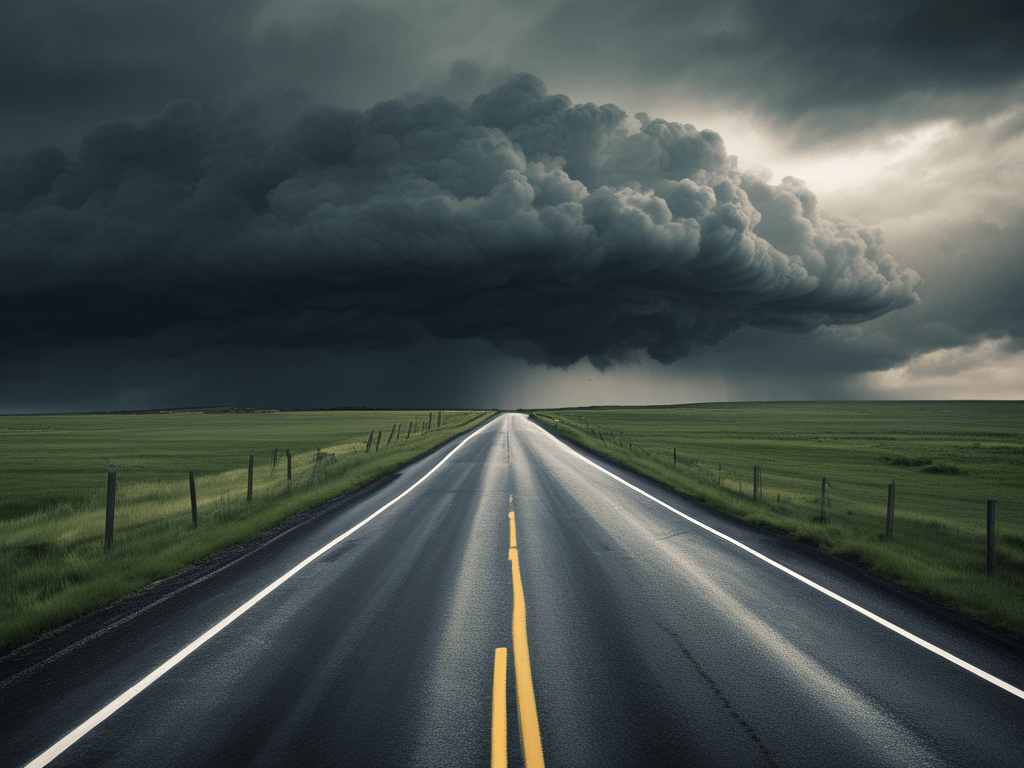
My journey had not been without basic planning. I knew that the heaviest of storms was slowing making its way west to east across southern England. I got almost a quarter through my trip before the immense thunder clouds loomed off in the distance. The sunlight was slowly changing. Going from perfect clear blue skies, with a little haze, to a brooding caldron of shafts of bright light and rolling off-white clouds, towering up to the stratosphere.

Onto the M3 motorway going west. Through the roadworks. The perpetual roadworks, Where the nation’s highway planners are trying to correct mistakes that they made erecting “smart” motorways. Closing the running hard shoulder to erect new emergency stopping bays.

Still the temperature was shifting up and down around 30C. Would I get to my motorway exist before the downpour that now seemed inevitable? I slowed to let a heavy truck into the nearside lane. We were both keen to get off the gradually slowing motorway.

Almost as if I’d timed the weather and pressed a button for rain, it started on the slip road. Trickles at first. Dark grey skies and indications of what was to come. My car’s dashboard thermometer started to plummet. By the time the traffic lights turned green, and we passed over the M3, visibility was disappearing. In a mishmash of road traffic on that junction there was potential for every kind of accident.

Time to slow down. It doesn’t matter that the duel carriageway signs going north said 40 mph. It would have been foolish to speed beyond that limit. At that moment the monster storm was just getting going. The timing between lightning strikes and thunder was shortening. Still, I had a good 5-miles to go to a sanctuary.

Again, almost as if I’d timed the weather, I exited right to turn into a Sainsbury’s superstore as the dark monster above our heads did its worst. Great pools of water where splattered on the ground with rain falling like millions of tennis balls. It was time to sit out the storm and take a coffee. Already the temperature had dropped ten degrees.

My cosy coffee shop sanctuary was the number one best place to watch shoppers getting soaked as they trudged across the windswept car park. I certainly wasn’t going to be in that kind of hurry. I sat it out. Glad I did.

On my radio

Out on the edge of the city of Coventry is the campus of Warwick University. At the heart of the campus is the Warwick Arts Centre. I recall “Rockpile[1]” when they played a UK university tour in 1978 or 9. One of their concerts was at the Warwick Arts Centre and I was there.

It was a fantastic night. No idea how I got there or got home to my rundown student accommodation in Coventry. My student days were at what was then called the Lanchester Polytechnic. A clumsy group of post-war modernist buildings strung up in the centre of a struggling city.

Music-wise I was living at the centre of the known universe. Between 1978 and 82 Coventry was alive. Venues were full. It was a youthful eruption of music. There was an air of decay in the crumbling manufacturing heart of the West Midlands. The brutalist and raw concrete architecture of the city was gathering moss, springing leaks, and not living up to the idealism that built it. Maybe the cost of living was not so hight, but something kicked-off an explosion of creativity. The energy of 40-years ago made its mark on popular culture.

Anyway, what I’m recalling here is a BBC Radio 1 DJ. She was that at the time. This week Annie Nightingale[2] has passed away. It seems fit to remember her with her finger on the pulse of what was happening. She was at the Rockpile Warwick Arts Centre concert, seeing and being seen. Much senior to the students in that hall. That didn’t matter one bit. Whispers went around in respect – that’s Annie Nightingale. We knew we were at a special event.

There’s another recollection I want to get off my chest. It involves cassette tape and an amber-red Sunbeam Imp[3]. Making compilations was all the rage with cassette tape. In this case it was Annie Nightingale’s compilation. Probably in the early 1980s.

Who knows which Halloween it was, but I had one recoding of one radio show she did that was my favourite car tape. Her instincts were prefect. It was one of those tapes that could be played repeatedly wherever I was going. My school days echo with the “Monster Mash.” A smile comes over my face when I hear Barnes & Barnes and Fish Heads[4]. Or “Werewolves of London” by Warren Zevon[5]. Don’t Fear the Reaper by Blue Öyster Cult. A great selection of fun packed horror-themed tunes.

Annie’s Halloween radio show was a masterpiece. She defined cult classics. Her earnest side aside she was mischievous. In a box. I know not where that tape may still exist. I’ve a mind to look for it. Thanks Annie.


[1] https://en.wikipedia.org/wiki/Rockpile

[2] https://www.theguardian.com/tv-and-radio/2024/jan/12/annie-nightingale-radio-1-dj-dies-aged-83

[3] https://classicmotorsports.com/articles/not-mini-sunbeam-imp/

[4] https://youtu.be/cn73Wtem0No

[5] https://youtu.be/c6M89iDabwM