
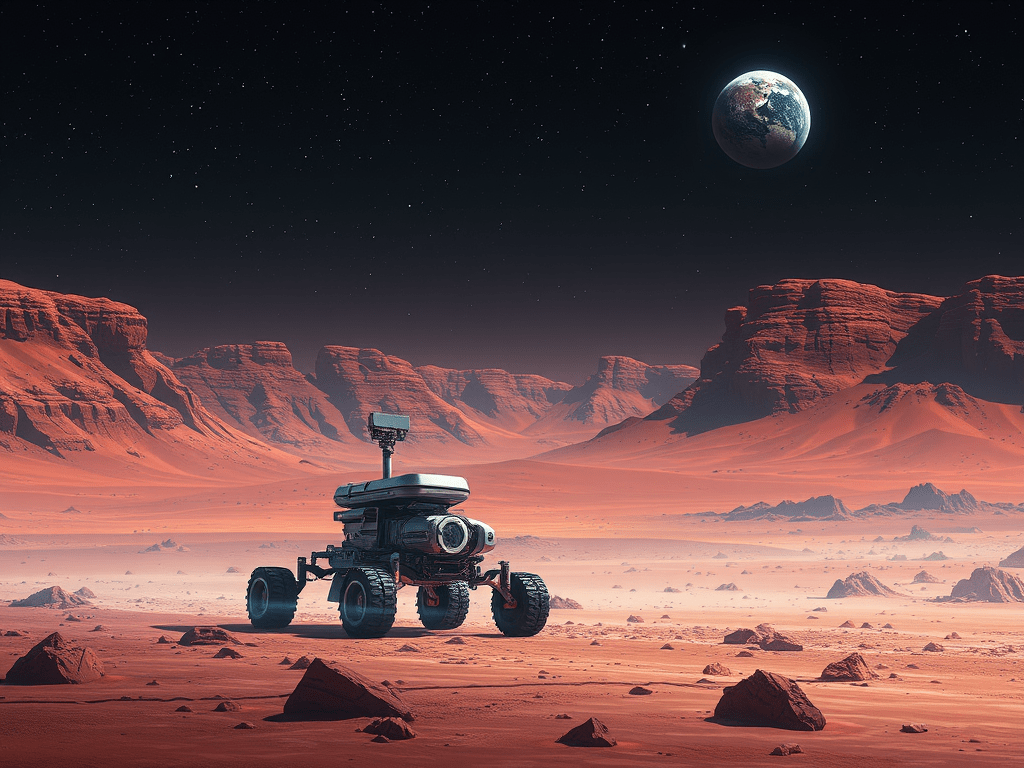
Exploration is part of our DNA. There are parts of the planet that we don’t know well. That said, there are not so many spots where a human foot has not trod. The mysteries of the deep ocean remain to be better known. Only we more often look heavenward than we study deep waters.
Looking up at the night sky the fascination with a twinkling red dot runs through history. It’s surprisingly recent that the notion that Mars might be inhabited prevailed. A 100 years ago a scientist might be frowned upon but wouldn’t get locked up for such a conjecture.
The possibility of Martian life still gets discussed. If existing, it would be extremely rare and unlike the life we take for granted on Earth. Discoveries are more likely to tell us about the history of Mars than the present.
A search for other civilisations goes on. Today, Mars is a planet for robots. Rovers and other contrivances are best equipped to deal with the harshness of the natural environment. If the radiation doesn’t get you the wide-ranging temperature fluctuations will. Humans are not well suited to live in extremely harsh environments.
On a trip to Phoenix in the United States about 30-years ago, I drove out into the desert. This was to have a look at the Biosphere[1]. A curious experiment in human behaviour. The experiment attempted to reproduce what it would be like to live as extraterrestrials. We’d be the alien civilisation on Mars. Living in a huge greenhouse on Earth. As much as to say this brave but shaky experiment proved that extraterrestrial living is very hard. In fact, impossible in the way it was conceived. The lesson from such empirical experiments is to value our unique circumstances even more. Polluting and trashing Earth is about the stupidest act “intelligent” but fragile beings could do.
There are plenty of extremely harsh environments on Earth. Wisely we (humans) choose not to live in them on a permanent basis although we like to make documentaries about them. For example, there must be an exceptional motivator to get people to live in a box in Antarctica.
It’s reported that Musk says that Space X will go to Mars next year. Adding more robots to the Martian population. In the field of exploration this makes sense to me. What doesn’t make any sense at all is the determination to put humans on the surface of Mars.
The only civilisation that is likely to inhabit Mars successfully, in the next century, is an android one. Every sign is that the capability of robotic life will advance ever more rapidly. They can be designed to thrive where we would fall by the wayside. What better use can we put our future robotic friends to than advancing exploration?
Putting a date on the first human footsteps on Mars is about as ridiculous as last century’s imaginative speculation about a Martian invasion. Although, such popular stories make great science fiction.
POST: This remote station has had reported problems. A case in point. Antarctic scientists plead for help after colleague ‘threatens to kill’ team members | The Independent
[1] https://www.euronews.com/green/2022/01/29/living-in-a-bubble-did-this-failed-90s-experiment-predict-the-future

 John Vincent