
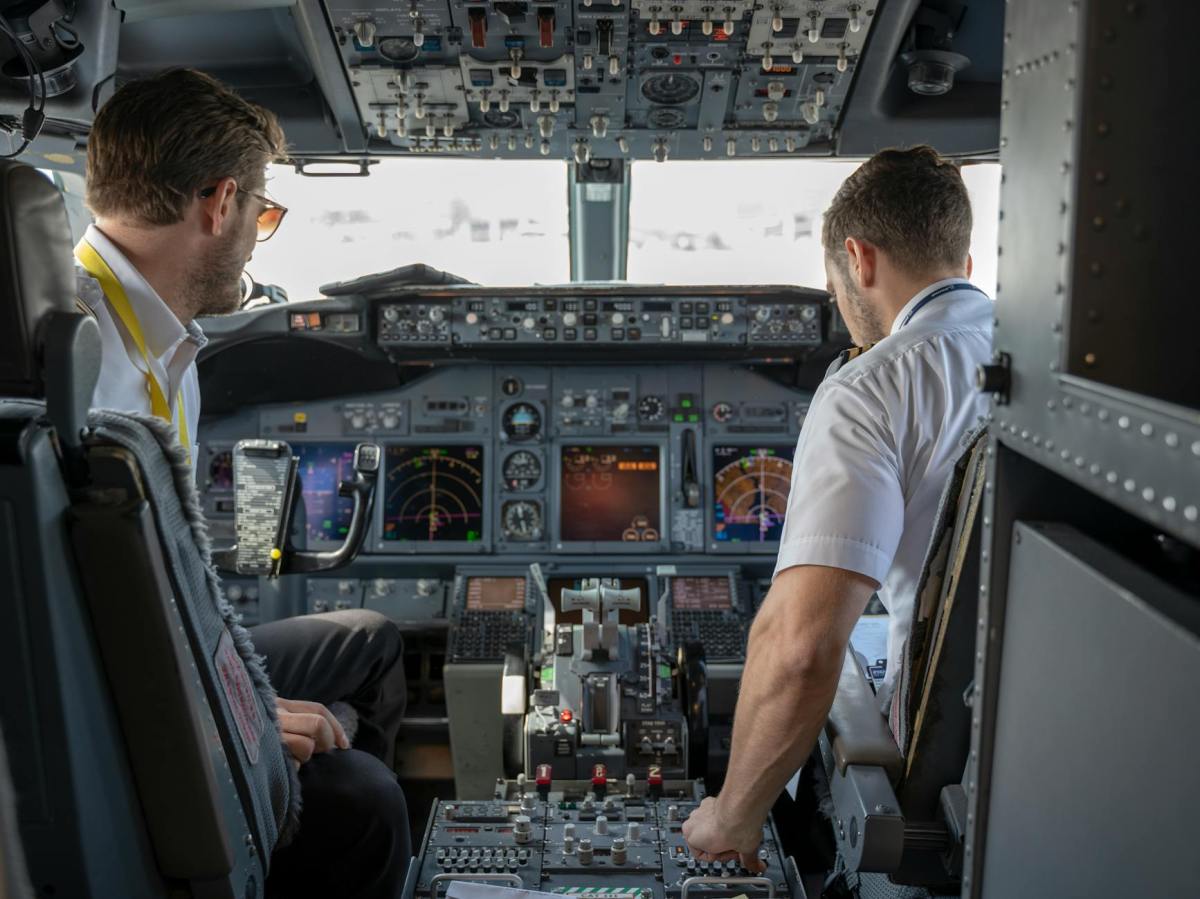
Flying embraces automation. Now, there’s a statement that didn’t ought to be controversial, but it can be. Even before we became engulfed by the modern digital age, analogue autopilots could assist in the task of flying. Some early ones were mechanical.
The need for full-time hands-on piloting of the physical controls that linked a human and an aircraft’s control surfaces is not fundamental. Large transport aircraft have stepped further, somewhat mimicking what their military counterparts did, and fly-by-wire systems have become commonplace.
As far as technological evolution is concerned, we remain in a transitionary phase. Commercial aircraft that fly overhead are a mixed community. Some, like the Boeing 737 series continue to have cables and pulleys that link aircraft systems and controls. Others, like the Airbus A320 series are the fly-by-wire digital aircraft types in regular service.
Between the pilots in the cockpit and the motion of an aircraft there is a computer. In fact, several computers arranged in a manner so that they continue to work even when subject to failures. A great deal of thought and effort has gone into designing aircraft systems that will be reliable in-service.
Looking at the safety numbers, starting in the 1980s when fly-by-wire was introduced, the overall service experience is extremely good. The practice of system safety assessment has delivered dependable and robust aircraft. Rigorous certification processes are applied.
Through the technical developments that marched on from the 1980s one requirement has remained. That is that two pilots are needed in the aircraft cockpit. Granted there are exceptions to this rule for smaller transport aircraft. Single pilot operations are not new. For example, in many countries, the Cessna Caravan[1] is approved for a single pilot.
It’s 2025. It’s difficult not to notice the debate around Single Pilot Operations (SPO). That is to open large transport aircraft operations to a new rule. Lower operating costs may be achievable by making a change. It’s even said that this move is a way of continuing aviation’s growth as it becomes more and more difficult worldwide to increase the number of qualified pilots.
It’s good to see this subject being taken up in a forthcoming conference.
RAeS Flight Operations Conference 2025: Single Pilot Operations – Logical Progression or a Step Too Far?[2] 19 March 2025 – 20 March 2025. Royal Aeronautical Society Headquarters in London.
SPO may be enabled by use of complex systems to help make mission-critical decisions. The next step maybe with real-time “artificial” copilots and intelligent monitoring. Will this move the aviation industry toward safer and more efficient aircraft operations? That is the question.
[1] https://cessna.txtav.com/en/turboprop/caravan
[2] https://www.aerosociety.com/events-calendar/raes-flight-operations-conference-2025-single-pilot-operations-logical-progression-or-a-step-too-far

 John Vincent