
Changing perspectives on Brexit, I’ll consider it more from the point of view of being an air passenger. I’ve written about aviation’s regulatory framework and the impacts on industry, but I fly too. So, what’s likely to change with the passing of March 2019?
Today’s UK News is about the UK-based airline Virgin Atlantic and their story on ques at London Heathrow airport[1]. On 6th July, non-EU visitors had to wait for up to 2 hours and 36 minutes at Heathrow. That’s a lot to add to the end of a long-haul flight. Brits may be accustomed to queuing, but it annoys and frustrates most people.
I’m lucky. I have a shiny new British passport with the words “European Union” on the front cover. As a British passenger, I can use the electronic passport gates which currently are open to EU passengers.
Currently Europe’s busiest airport, that’s the EU’s busiest airport isn’t offering good services to non-EU visitors. Will this change after March next year? Or will EU passengers get more hassle than they do now? There’s media speculation about a Brits only immigration line at airports but what could that possibly mean in reality? No one knows.
Regulation (EC) No 261/2004[2] isn’t liked much by the aviation industry but passengers have been happy to see this legislation enacted. Now, will an Air Transport deal between the EU and UK include consumer rights such as flight delay compensation? Even if the intent of this Regulation is copied into UK law it wouldn’t be much good applied to non-UK airlines. I understand that Switzerland participates in 261/2004. So, it should be possible for a post-Brexit UK to participate in the legislation. This needs to happen otherwise British passengers delayed by EU airlines will not be appropriately compensated. A notice to this effect has been published.
When traveling we like to keep in touch with family, friends and colleagues. Today we get mobile phone roaming in the EU at domestic prices. This requires continued regulation of prices by UK and EU networks. Will this end? No one knows.
The UK Government continues to say: “Our focus is making a success of Brexit and attempting to get the best deal possible. A deal that is in the interests of both the United Kingdom and the European Union. And one that takes in both economic and security cooperation.”
Flying to and from the UK may change after March 2019. Unless the above issues are fully addressed the experience maybe a lot worse than it is today. So, be prepared.
[1] https://uk.reuters.com/article/uk-britain-airports-virgin-atlantic/heathrow-airport-passport-queues-reached-two-and-a-half-hours-in-july-data-idUKKBN1KY0PC
[2] Regulation (EC) No 261/2004 of the European Parliament and of the Council of 11 February 2004 establishing common rules on compensation and assistance to passengers in the event of denied boarding and of cancellation or long delay of flights……………………….
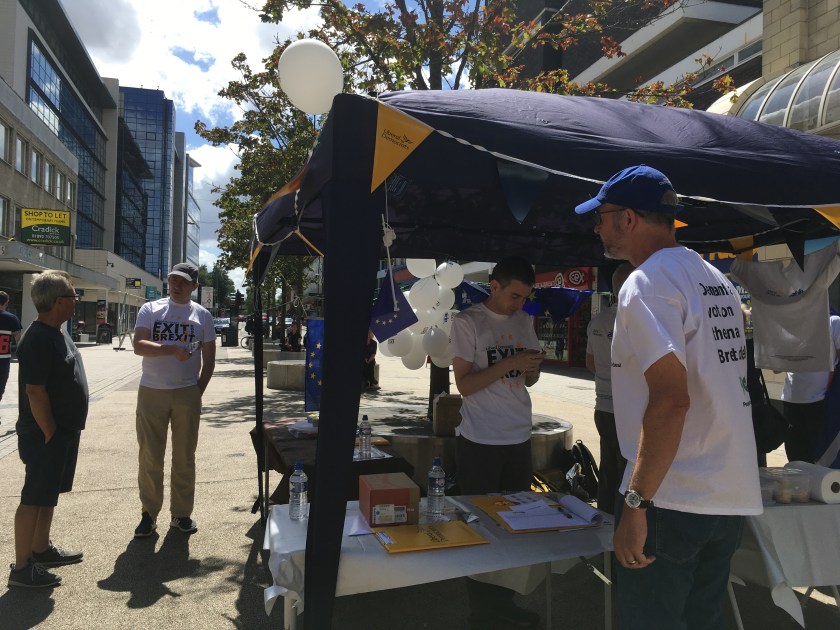 A Saturday morning spent campaigning in Redhill is a real eye opener. A group of us set-up a street stall with free cakes, leaflets galore and a couple of European flags. We set-up outside the local shopping centre to be seen by as many people as possible. The heat of the week has gone. At one point, the wind almost took the whole stall away as the British weather has changed to become stormy.
 Let’s unbox this rule-taker verses rule-maker dichotomy. For one it’s NOT a binary choice. In so far as international aviation safety rule making is concerned I have seen small, well informed organisations have a major impact of new rules and large powerful Countries asleep at the wheel.
