
Threatening Democracy

Yesterday’s newspapers have a couple of short pieces from hardened Brexiters.  The general theme is; if Brexit is thwarted, in even the slightest then; public’s rage will boil over.  Or we must go all the way otherwise no one will ever vote again.  Yes, it does get that ridiculously hysterical.

Week after week the Brexit supporters’ loose arguments but they trundled on and on.  I can’t remember the last time that they fairly and honestly won a debate without coercion.

Listening to the populist arguments from prominent Brexit supporting MPs, it’s clear they want no relationship with the EU whatsoever in the future.  The mantra “Brexit means Brexit” is still being churned out.  The foolishness of these deceiving arguments is plain to see.  Any Treaty that a Country signs with any other includes obligations and responsibilities.  The idea that we can have a beneficial and positive relationship without any of these is unreal.

It’s true that some people, who rarely if ever vote, suddenly decided to go to the polls in June 2016.  As is often the case, quite a lot were in the mood to give the Government of the day a bloody nose.  Lots went to the ballot assuming their vote would just be a momentary angry protest.  After all everyone had had quite enough of austerity and the blandness of Mr Cameron.

Now, many have recanted and would like to take back their referendum vote.  Our democracy is being threatened by the die-hard Brexit obsessives who fear the fact that a majority of people may have reconsidered.  I believe, this Country is mature enough to have a choice over the deal that is being cobbled together.  It is consistent with our pragmatic traditions.

On a Vote

It has been said that: “The UK electorate is split down the middle, but another vote would make things worse”.  Frankly, that’s not a good argument given the traditionally adversarial nature of UK politics.  You might even say that our whole British political system aims at dividing everyone into one of two camps.

What do I remember about Parliament and the House of Commons? The distance between Government Party and Opposition Party benches is two swords length.  So, don’t give me any of that nonsense about division.  Sure, I’d prefer a more consensual approach to National decision-making but that is not what we have in the UK.

The UK referendum of 1975 was so much easier in that it created a clear winner and a clear looser.  Unfortunately, after so much confusion, muddle and downright lying the 2016 referendum must go done in history as the worst exercise in democracy any Country has engaged in modern times.

Are we just to leave it there and let the British frog[1] be boiled slowly?  Or are we to say – no, enough is enough and act?  I believe, another national referendum is needed to either confirm the decision to leave or to remain a European Union Member State.  Its true there are other ways to move forward and it is a matter of our sovereign Parliament.  Will they or won’t they go for a referendum on the deal?

Let’s consider the three conditions: no referendum, referendum supporting Leave and referendum supporting Remain.

The first case just leaves the sharp divide in place and the frog gets boiled, to use that metaphor again.   However, there’s plenty of potential for a further crisis and the need for a snap General Election.  Nobody gets what they want.

In the second case, where say; in an Autumn referendum the outcome confirms the leave vote, the direction of travel continues but with a lot more resolve.

In the third case, where say; in an Autumn referendum the outcome calls for a correction of direction it can be done without too much pain.

Those who fear a referendum on the deal should think about what’s in the best interests of the whole Country.  Ironically, it’s the period we are passing through that has given most voters a much better understanding of the nature of European Union membership. More than they ever had before 2016.  Knowing what’s at stake and voting accordingly, the result would stick for a good long time.

[1] https://en.wikipedia.org/wiki/Boiling_frog


Bad Petition

It seems the ardent Brexit promoters now want to abolish the House of Lords[1].  I guess this is not an unexpected reaction to their vote in favour of remaining in the Customs Union[2].  Foolishness is rife within a vigorous but small section of the population.  We need to remember that it wasn’t that long ago that these people wanted to get rid of High Court judges and called them the “enemies of the people”.  Some are actively calling for a dictatorship to take over by exclaiming: politicians cannot be relied upon to implement the people’s will.

I have some sympathy with the call to: “Give the electorate a referendum on the abolition of the House of Lords” but only if there was an immediate democratic replacement.  Personally, I think the idea of an elected Senate where senators represent the regions of the Country, is a good idea.  That would be progressive.  What I fear with the latest call form the Brexit fanatics is an abolition of the House of Lords with no replacement and thus an elimination of the balance of powers that is essential to a modern democracy.  Dismantling our British institutions at the same time as pandering to xenophobia is a dreadful mistake.  History tells us that moving in such a direction can have catastrophic outcomes.

If we add up what Brexit promoters have achieved since the 2016 referendum one word comes to mind: shambles.  Fiasco, mess, muddle and disaster are words that could do the job too.

In normal times, the loud shouts and cries from the fringes of politics would command only a passing glimpse.  Something has changed with the national media.   Banner headline are composed more to shock and entertain than to inform.  And they all jump on the same bandwagon with just a few variations of coverage.

When a noisy few run around insulting everyone who disagrees with them, the problem is self-evident.  The House of Lords does need reform but where were the Brexit advocates when this was last seriously debated.  In fact, many of them where on the side of defending privilege, traditions and ancient institutions.

The House of Lords should not be punished for applying common sense.  I only hope the House of Commons will apply similar common sense.

[1] https://petition.parliament.uk/petitions/209433


[2] http://www.bbc.co.uk/news/uk-politics-43812360


Sunny Saturday Morning

IMG_2217It’s one thing to discuss the technicalities of Brexit but there’s nothing like standing in a High Street and talking to people.  Before the day slips from my mind I thought I’d write a few short reflections.
Our weather hasn’t shown much sign of Spring but on Saturday it was almost as if the heavens were smiling on us.  Sunshine brought lots of people out for a stroll, shopping and much else.  It’s so rewarding working with a likeminded team.  A cross-Party group of us met-up in the centre of the Surrey town of Dorking.  Determined to show that there’s a movement for change.

I approach leafleting with a smile and a greeting – would you like a leaflet?  It works.  Yes, one or two people don’t want to be bothered or smile back but that’s normal.  Who knows what’s going on in the lives of those you meet by chance on a Saturday morning.  Being respectful is essential.  First impressions matter so much.  With a badge, some stickers and colleagues around we made it clear that we were campaigning on Europe.  What we find is that the politeness and civility of most people reminds me that there’s a lot worth fighting for in Britain.

On Saturday, I’d guess no more than 1 in 20 of those I leafleted presented a negative view of what we were doing.  From them, not one original new saying came up.  Responses were mostly stock phrases, like: “We’ve voted once” or “I want out” or “the sooner we get out the better”.   Not the basis for conversation.  Generally street campaigning isn’t about arguing with people.  At its best, its more about connecting with supporters and offering information to those with an open mind.

I did engage with one guy who thought one vote was enough.  My counter argument was the fact that we vote every year in local elections and democracy is open to people changing their minds.  Much as I expected, he wasn’t moved by this way of thinking.   With a small minority there’s a kind of belligerence.  Its true of other life situations too.  Pride or stubbornness or absolute blind conviction means that little real discussion is possible.  The strange thing is often we spend a disproportionate amount of time talking about people who behave this way.

Without a shadow of doubt there’s a strong demand for a vote of the deal.  A clear majority of people we meet in Dorking want to have a choice over the Brexit deal.

The call for a #PeoplesVote is gaining momentum.  Lots support the @peoplesvote_uk campaign for the people to have the final say over the #Brexit deal, not politicians.

Wake up the sentinels

When I half remember good advice, it drives me to do a bit of research.  This week, watching all the questions being asked of Facebook, I couldn’t help but recall something I’d read more than 30 years ago.  Yes, going back that far does have relevance because fundamental questions are exactly that; fundamental.

It seems every time technology advances the law follows but several steps behind.  That’s law makers and those who sit in judgement trying to interpret tomes of law need to speed up.  It was starkly apparent to me that Facebook was getting an easy ride, as questioning politicians struggled to keep up.  Few question hit the mark or even attempted to look ahead.

For me, as for many, even research can’t be conducted without a heavy reliance on technology.  So, I searched with the fragments of what I’d remembered.  Typing into Google’s almighty search engine the two words “sleeping sentinels” because that’s what I thought was the name of a book.

Initially, I didn’t find what I wanted but what I did find was intriguing.  I wasn’t previously aware of the story of the “sleeping sentinel”.  A Union Army soldier during the American Civil War.  He fell asleep whilst on duty, was court-martialled and sentenced to be executed.  Harsh treatment indeed.  But after his death sentence was read, a pardon was read thus saving his life.  Lincoln had interceded on Scott’s behalf.

In this tale there’s an indication of the awakening of the idea of a “just culture”.  Today, people with safety related work are expected to report such a case as; falling asleep on the job due to fatigue.  In a “just culture” they should not be punished if others can learn from their experience.

I digress, since my aim was to rediscover an almost forgotten book on law.  Eventually, I came to a reference to a book called: “The Slumbering Sentinels: Law and Human Rights in the Wake of Technology”[1].  This was the paperback I remembered.

One of the tenants of the book is that the law is sleeping while technology is racing ahead.  Clear insight from the 1970s and 80s trying to consider the implications of personal commuters and alike.

Equally important to the case of understanding Social Media is the changing landscape of political campaigning.  Its only now that everyone is discovering the details of what happened in June 2016 in the UK.

Its Friday 13th and the news media is full of conflict and tension, but I hope this material gets well discussed.  It does amount to finding out, after the event, hugely significant facts about the referendum of 2016.

https://www.parliament.uk/business/committees/committees-a-z/commons-select/digital-culture-media-and-sport-committee/news/fake-news-matrix-evidence-17-19/

To quote: “192. If the Commission indeed refrains from even exercising a discretion as to whether to refer a matter to the police or prosecuting authorities until it is satisfied beyond reasonable doubt that an offence has been committed, this in our view would constitute an unlawful fetter on its regulatory discretion.”

What a dilemma.  If the Electoral Commission, police or prosecuting authorities do not respond then they are indeed Slumbering Sentinels.

If they do respond, the case could be made for invalidating the 2016 referendum.  To reassure them, as I have been saying in this article, they will not be the first to wake-up while technology is racing ahead.  It’s difficult to foresee how technology will be misused in the future especially when money is no object.  That said, we can’t ignore the facts.

[1] The Slumbering Sentinels: Law and Human Rights in the Wake of Technology (Pelican) Paperback – November 24, 1983 by C. G. Weeramantry


Our right to a referendum

I have just read “Why a second Brexit referendum is required by law” and find the arguments made in this article compelling[1].

It’s basically saying, any proposed future EU treaty that transfers areas of power, or competences, should be subject to a referendum on that treaty.  The ‘referendum locks’ introduced in sections 2, 3 and 6 of The European Union Act 2011 (EUA) form part of a broader system of control over the making of various decisions related to the EU[2].

The exit agreement that’s being negotiated by Government Ministers will, if successful result in a future UK-EU treaty.  Thus, it follows that that treaty should be subject to a referendum.  That’s not a referendum about staying in the EU or leaving it, but a referendum on the final treaty that deals with the powers and competences of the EU in relation to the UK post the leaving date.  Since there will be a transition period we know that there will be legal obligations to be met by both UK and EU.

I hope, I have understood this situation correctly as it seems eminently logical.  The EUA remains in place to date.  The reasons for the EUA being made law in the first place remain valid.  As this is the case a referendum on the “deal” is thus required by UK law. To change this the Government of the day would have to repeal this EUA and as a result take away any direct say the British people may have over a final deal and transition period.

It’s not a simple passive matter of something lapsing.  Being of 2011, it’s not an out-of-date law.  A repeal of the EUA would be an active and wilful disenfranchisement of the British people.  Quite the extreme opposite of “take back control”.  More a question of we (Conservative Government) have control and there’s no way we will let the people have a say.   Even to the extent of changing the law to stop a referendum taking place.

[1] https://www.prospectmagazine.co.uk/politics/why-a-second-brexit-referendum-is-required-by-law


[2] https://ukconstitutionallaw.org/2012/01/12/mike-gordon-the-european-union-act-2011/


Better Steps

WP_20170804_006What is needed more than anything else now is a good strategy for backing out of Brexit.  It would be ironic if those who criticised the lack of planning for Brexit didn’t have a plan to get out of it.  A road map to turn the ship of State around would help to give confidence to the world.

In the mix are legal niceties, political realities and social upsets but none are insurmountable.

The first of these, legal means, maybe the easiest.  Since there’s so little written to explain what Article 50 intended in terms of detailed process and procedures then invention is possible.  Add to that the fact that those who came up with the original words have expressed the view that the mechanism is reversible.  So, when the moment is right it’s a simple matter for the negotiators to close the books and walk away from the table.

A second factor, the politics, is difficult but day-by-day the whole Brexit road trip is becoming more and more unpopular in the UK.  For a politician worth their salt there must be the sense that, to be on the winning side, the time is right to move away from the hard liners.  To be part of the future it’s time to start making those speeches that spell out what comes next.  Not to be reactive and wait for an almighty crisis but to get out ahead and describe a better future.

On the third point, the social element, the shift could get complicated.  There is no doubt there would be a degree of revolt orchestrated by the diehard supporters of Brexit.   Even if a significant majority clearly show a wish to drop Brexit a powerful, monied and noisy group would kick out.   Unfortunately, that means some conflict may be unavoidable but it would be short lived and sporadic in its nature.

Weighing up the costs and benefits of the above, I believe there’s a clear case to drop Brexit before more damage is done.  The ways and means are not so complicated and are achievable over a couple of years.  How to make all this move forward?  The excepted wisdom of the moment is that a second referendum is needed to test the public mood.   Equally, a General Election could be the trigger for the change.   Alternatively, a realignment of the political parties may be another way to take this step.

Let’s see a confident Britain in Europe and in the rest of the world and do it now.

Our place

IMG_0886The outcome of the EU Referendum has left many of us shocked.  There’s still a sense of disbelief that a small majority is driving such a massive change in this Country.  The emotional bonds that bind Europeans are deep rooted.  That’s a reason why having this terrible divorce forced upon the nation is overwhelmingly depressing.  One foolish gambling British Prime Minister threw the dice and lost his shirt and ours too. 
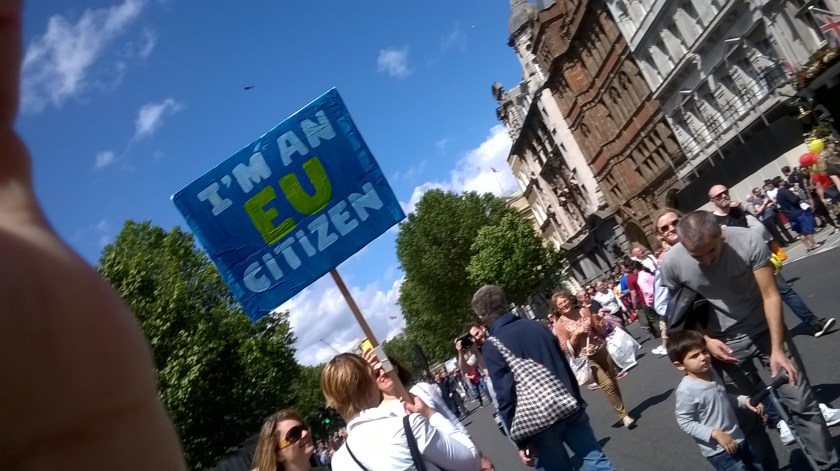
Every citizen in the European Union is European.  Granted the EU is one part of Europe.  Our European family comes together in different ways and it can be counted as over 50 Countries.  Although Britain sits at the North West corner of the continent its every bit as European as the continental mainland.  There isn’t a moment in our history when our affairs haven’t been intertwined.  Even the builders of Stonehenge traded with tribes beyond these islands. 

It was fascinating to listen to the author Clive James on Channel 4 News, last evening.  Although he edged towards the leave camp his overwhelming reflection was how embedded we are in European culture.  Any view from afar places Britain firmly and squarely in Europe.  Socially, culturally and geographically our place can’t be denied. 

Now, in these uncertain times there are more questions than answers.  Uncertainty isn’t just about numbers it’s about how people feel about the future.  Ironically, prolonged uncertainty may be one of the only certainties in the next couple of years. 

My truth

WP_20160702_14_19_01_Pro

There’s a difference between lies and exaggeration.  Oh yes there is.  I faced the argument that – both sides lied in the EU referendum didn’t they?  It not uncommon for people to become cynical about politics and politician’s and that’s a reason they give; none of them can be trusted.  Post referendum this notion is embedded more than ever it was in the minds of the British people. 

We might ask – what is truth.  Equally – what is exaggeration?  There’s a real distinction.  It’s reasonable for a passionate argument to spill over into exaggeration but it’s NOT when it moves to downright lies.  Say for example, we have a whole pile of adjectives in the English language that emphasise the largeness or smallness of a number but they don’t change that number.  If I said; an “extremely large” number of people instead of a number of people, you’d take it as read. 

Newspaper headlines that scream: “£350 million a week for NHS” quoted from those with no intention of delivering that funding are deliberately false promises (lies).  Soundbites that say: “Brussels tell us what to do” are crude distortions – that’s a kind of selective lying.  Like saying; “I hold a banana in my hand” when in fact it’s a beetroot. 

The EU referendum was won by only a tiny margin.  That tiny margin of British voters were swung by misinformation, distortion and deliberately false promises – yes; lies.  It isn’t clear where to go from here but it’s a dreadful place to start any journey.  Humpty Dumpy really has fallen off the wall. 

My biggest concern is that capable, honest and passionate people will become silent because they have been drowned out by unchallenged cheaters.  Good people will steer away from public life because it’s so horribly tainted.  Talented young people will seek their fortunes elsewhere as a new British “brain drain” kicks off. 

It will take more time for the “dust to settle” but this should not stop us challenging the result. 

Tricked

IMG_0690

Yes, I did go to Sunday school.  At the small parish church in Horsington.  St John the Baptist’s has all the features you would expect of an English village church.  Back in the 1960s a small area was set aside for Sunday school.  I hear there’s still a children’s corner in the Church.  Also, as a family we attended the Methodist Chapel in South Cheriton.  Contrasting with the CoE, this was a place where animated lay-preachers offered a more down to earth view of heaven and hell. 

I’m telling you this just to give a little background on what shaped my view of right and wrong.  A lot more than this youthful experience seeped into my subconscious as I became agnostic about religion.  Being sceptical probably came more from non-conformism, my secondary school teachers and my argumentative nature than any sermons or doctrine. 

Out of a vibrant mix in the 60s and 70s, I developed a rational way of looking at the world and a strong sense that people should tell the truth.  That there are such things as provable facts.  That progress is the natural order.  And that you help yourself by helping others.  Now, this all sounds strangely retro as I reflect on what has happened over the last few weeks. 

Taking the UK out of the European Union will be hugely complex.  A lot of people said it would be hugely complex.  Many sound arguments were set out as to why it would be hugely complex.  Regardless of all that this is the path that has been chosen by a majority of voters in the UK all but by a small margin.  That said, I can’t help but think that a deception has been practiced on the British people.  So many half-truths and nefarious speculations were put-up on banner headlines.  Dubious statistics and manipulated facts presented bright and colourful did sway the direction the vote took. 

Now, a flurry of back tracking is underway.  Quick comparisons with before and after interviews make it clear: a week really is a long time in British politics.  Outcomes are manifold but one is to reward those who made the biggest exaggerations and told the dodgiest selective stories.  So, how can this be right?  I guess, it isn’t.