Another week gone

Last week, I wrote: “I think, the UK House of Commons is likly to reject Prime Minister May’s Deal next Tuesday.  Then on Wednesday it’s likly to reject a No-Deal outcome to Brexit.”  Both have come true.  Now, with the vote planned for today, an extension to the Art. 50 process is possible.  The drama that is being played out is very much a Westminster drama.  Once upon a time we depended upon the BBC’s Eastenders for high drama and suspense but not any more.

Parliament is deadlocked.  It’s abundantly clear, that there is no majority for the PM’s deal.  Bringing that deal back to the Commons a 3rd or 4th time won’t change the situation.  There needs to be a way to break the deadlock.

It was said to me that what we need is an alien invassion to get people to lift up their eyes and consider the big picture.  Whereas the Westminster Parliament was once seen as a example to the world, it no longer holds that position.  The UK’s Brexit drama needs to come to a final conclusion.

My view is that the best way is to revoke Art. 50 and set aside Brexit.  There’s nothing to stop the debate returning again in a couple of decades but this current phase of increasing instability needs to be brought to an end.

There is likly to be dramatic changes to British politics but these have been long overdue.  This domestic change is not a matter for the EU.  We need to get our house in order.  That means a big realignment.

NOTE:

Tonight, MPs have voted to extend Brexit beyond 29 March by backing a Government motion forced on PM Theresa May by the Commons.  Thus we can expect new legislation to come forward to change the Brexit date in UK law.  Also, a request will have to be made to the European Union (EU) to make this happen.

Stuck in a deep dark sinkhole

Here’s a cut and paste of an e-mail that just turned up in my mail box.  It’s worth copying just to show how deep the current problems are in the UK.  In reading it must be remembered that a referendum is not binding in the UK.  What’s here is the policy of one Government or even one part of one Government.

Dear ,

The Government has responded to the petition you signed – “Revoke Art.50 if there is no Brexit plan by the 25 of February”.

Government responded:  The Government’s policy is not to revoke Article 50. Instead, we continue to work with Parliament to deliver a deal that ensures we leave the European Union, as planned, on March 29th.  Revoking Article 50 would not respect the vote of the British people in the 2016 referendum.

Almost three quarters of the electorate took part in the referendum and 17.4 million people voted to leave the European Union. This is the highest number of votes cast for anything in UK electoral history and the biggest democratic mandate for a course of action ever directed at any UK Government. This result was then overwhelmingly confirmed by Parliament, who voted with clear and convincing majorities in both of its Houses for the European Union (Notification of Withdrawal) Act. Then, in the 2017 General Election, over 80% of people then also voted for parties committing to respect the result of the referendum and it was the stated policy of both major parties that the decision of the people would be respected.

This Government has therefore been given a clear mandate to implement the will expressed by the electorate in the referendum, and to revoke Article 50 would undermine that mandate.  As it is the responsibility of this Government to deliver the exit that people voted for, and as Parliament is clear that it does not wish to deliver a ‘no deal’, we must secure a deal. However, the Government recognises the views expressed by the House that it cannot support the deal as it currently is, and we are now confident that a deal with changes to the backstop, combined with measures to address concerns over Parliament’s role in the negotiation of the future relationship and commitments on workers’ rights will secure the majority needed in the House to leave the EU with a deal.

The Prime Minister has therefore continued to work with Members across the House to deliver on the decision that the British people took in June 2016 and she will go back to Brussels to secure a deal this House can support.

Department for Exiting the European Union

To comment:

In reference to the words; “biggest democratic mandate” and “given a clear mandate” this is not the case.  A mandate comes from the majority and, as we all know the majority by which the Leave vote won the referendum was a relatively small one.

The term; “respect the result of the referendum” has become meaningless since it has been used to mean more than 101 different things to millions of people across Britain. It’s not known what the result of the referendum indicated in any detail since there was no plan for the outcome.

The reason that Art. 50 may not be revoked is said to be that this week the UK’s PM will go back to the EU in Brussels and secure a deal the UK Parliament can support.  The chance of this outcome being secured in the last 5 weeks that have to run on the clock is tiny.  The political balances within the UK Parliament favour those who wish to see the UK crash out of the EU without a deal.

Finally, the Goverement department making this public statement of policy was created for one purpose.  It would be strange if it answered differently from that above given such a bias.


People’s Vote in Epsom

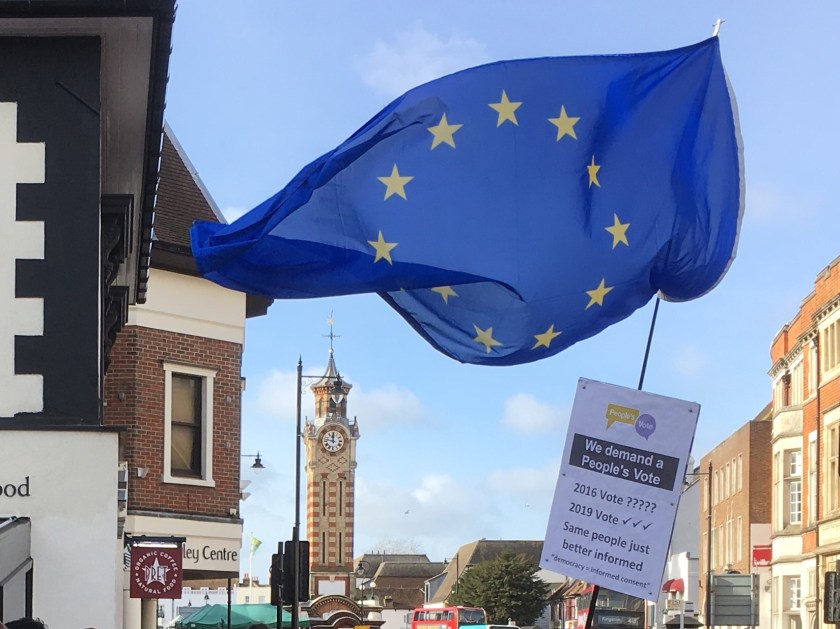
IMG_6372 (2)A good way of judging what’s perception and what’s reality to stand on a street corner campaigning for what you believe in.  This Saturday morning, with a cold wind blowing but sunshine in the sky a group of us stood in the centre of the Surrey town of Epsom.  It’s a well to do town with levels of prosperity that parts of England would love to share.   Being connected to London there are major service industries that ensure Epsom flourishes.  Its not just Derby Day.

The Brexit deal on the table provides no clarity or certainty about the future.  The signs are that Brexit will become a never-ending nightmare if we go through with it.  However, it’s both evidence and emotion that shape our view of the world and no more so than with Brexit.

Regardless of political views, in a public place there are people who engage and there are those that don’t.  On a British High Street in winter, most are busying themselves about their business and are not keen to dwell.  It’s more often that those with stronger views are the ones who take the time to engage in conversation.  My approach is to try not to impede anyone but to make it clear that I’d like to talk.  It’s easier with a leaflet in hand and a simple introduction.  So, I start: “we’re campaign for a People’s Vote – Would you like a leaflet”?  Then it’s a question of quickly gauging any response.  As a flavour of the comebacks that I got here are a few sentences on what happened.

Those who welcomed our campaigning efforts were more than happy to express a view.  A positive warmth and support came to the fore without prompting.  Frequently, there was an astonishment that the Country had got itself into such a ridiculous situation.   Everyone has a story to tell about how Brexit is affecting their lives.  Younger people were concerned that opportunities previous generations had will be cut off.

I got a warm answer from a French woman, but as she whispered – I don’t have a vote.

One middle-aged man seemed sullenly pragmatic about the affair.  His expectations were so low that he anticipated nothing better than an unholy mess.  He was grateful to see us campaigning, but he held out little hope that it would make any difference.  It’s a pessimism and sad resignation that more than a few must feel.

One guy suggested that I go back to Germany if I liked the Europe so much.  When faced with this, politeness is the only way to be.  There’s little I can say in that moment to transform his outlook.  Little Englanders are not new.

I got a couple that told me they were bored with the whole subject.  They had gone past caring what happens next.  It’s like it’s not my problem and another version of the sad resignation I mentioned earlier.

Believe me, I am not being biased when I say this, but the angrier people are Leave supporters.  It’s like they have an inner rage.  One or two will swear without any provocation whatsoever other than just seeing a European symbol.   All you hear is negative slogans right out of the Daily Mail.

Overall, the hours we spent were productive and I’m sure we offered a hope for those with a positive assessment of our role in Europe.  The indication was masses of dots on our chart calling for a People’s Vote.   Concluding, it’s clear that the last couple of years have not healed the wounds of the referendum.  Opinion on the streets is just as divided as it was when I was campaigning in early 2016.  No wonder Parliament is divided when the Country is divided.  It’s only by going back to the people that there will be any resolution to this impasse.

Brexit & Aviation 57

It’s reported that the Director General of the British Chambers of Commerce said: “There are no more words to describe the frustration, impatience, and growing anger amongst business after two and a half years on a high-stakes political rollercoaster ride that shows no sign of stopping.[1]

I’m sure that those words would be echoed by a great number of people in the aviation sector.

A defeat of 230 votes is massive.  MPs have rejected the Prime Minister’s proposals by the biggest UK Government defeat in modern history.  That ought to be a signal to change direction but we have yet to see if a new approach will be forthcoming.

Beyond the political hoo-ha there’s the need to act.  A great deal of implementing legislation needs to be passed through the UK Parliament, whatever the destination.  Naturally, this is needed if the Article 50 letter is not withdrawn and the whole Brexit process stopped.

The European Union (EU) continues to flourish despite having faced innumerable hard problems thrown at it over many decades.  This is not Greenland[2], this is a large and prosperous Country giving up its membership of the EU.  Thus, the avoidance of the loose-loose scenario, of a No Deal Brexit should be at the top of everyone’s priority list.  Meanwhile large sums of money, that could have been used growing European businesses are being pumped into contingencies.

If this Withdraw Agreement (WA) is not acceptable as it stands then it may return as WA2 but don’t expect that to be substantially different from what’s already on the table.  Alternatively, there could be public vote to consider the options.

The e-mail subscriptions to “SkyWise[3]” is useful to stay up-to-date with news, safety alerts, consultations, rule changes and airspace amendments from the UK CAA.  The site has a section for EU exit alerts.

There is useful material out there, but it indicates a poor state of readiness given all the caveats and unknowns that exist.  Just as business leaders are warning, the UK is like a super-tanker heading for the rocks.   72 days isn’t long to put that right.

[1] https://news.sky.com/story/growing-anger-frustration-and-impatience-from-businesses-over-brexit-11608581

[2] https://www.politico.eu/article/greenland-exit-warning-to-britain-brexit-eu-referendum-europe-vote-news-denmark/

[3] http://skywise.caa.co.uk/category/eu-exit/


Brexit & Aviation 56

On the 23 June 2016, the United Kingdom (UK) voted in an advisory referendum to leave the European Union (EU).  74 days to go before the date scheduled for Brexit and the Country is still vacillating.

As time ticks away its not a bad idea to have an eye on priorities.  If there’s some issues that rank above others in importance.  This is recognised throughout aviation.   It’s the way we construct an Aircraft Flight Manual (AFM).  Top of the list in an AFM are the Emergency Procedures.  It seems to me that we need a set of Brexit Emergency Procedures.  The future relationship between the UK and EU remains unclear and may do so for a long time.  That said, I’m not alone in considering what might happen in the different scenarios that can come into play[1][2].

Having made this proposition what would be in such a set of procedures?  Here’s a non-exclusive list of major topics that can not be left to chance.

  • Air Services Agreements
  • Safety Regulation
  • Security Management
  • Air Traffic Management
  • Environment

Today, civil aviation is regulated at European level.  All 5 of these subjects have been addressed in recent advisory publications at both national and European level.  However, it is still up to individual aviation stakeholders how and when they react.  There are no new directives that mandate a course of action for air transport services, even the essential ones.

If chaos does ensue on the effective withdrawal as of midnight (00h00) on 30 March 2019, then it will not be easy to understand where blame should rest.  The resolution of problems will need a forum to coordinate fixes too.  That is the unfortunate nature of the current situation.

Aviation is a dynamic part of the UK, contributing £52 billion to UK gross domestic product (GDP) and supporting close to one million jobs[3].   To be where we are now, with only 74 days to go is highly disadvantageous, to say the least.

[1] https://www.internationalairportreview.com/article/75237/brexit-and-aviation/


[2] https://www.iata.org/policy/consumer-pax-rights/Pages/brexit-study.aspx


[3] https://www.instituteforgovernment.org.uk/explainers/european-common-aviation-area-brexit?gclid=Cj0KCQiAg_HhBRDNARIsAGHLV53iNpXElpsIy2vuN9a9jRIYGMWjwTEZ7Slm5UDYXZQqeRMgkMpaUcgaAhxqEALw_wcB


Change is Good

Let’s imagine two and a half years ago you had taken an interest in moving to a new house.  Soundly and sensibly you got a survey done.  The survey showed up that the house was not worth the asking price.  Further inquiry showed that the original details were wrong and that the vendor had been less than honest.  Even with all your doubts, the vendor and his agents applied pressure to get you to sign-up.  The deal on the table was not a good one and the price is going up daily.  Would you carry on regardless or would you stop and say: no thank you, I’m better off where I am?

That’s where we are with Brexit.  Two and a half years of agonising debate and investigation but finally a decision must be made.  The world looks quite different from that of two and a half years ago.  People have come and gone.  The world is that much more unstable, but the big problems, like climate change and poverty remain.

So, why is changing minds so difficult?  I guess, it’s a human characteristic that none of us like to lose face.  Stepping back and admitting that; maybe we were wrong two and a half years ago is never going to be easy.   Our media is not helping.  Write-ups that say there’s a 50-50 chance that Brexit may be stopped are phrased in negative terms.  The reality is that for a huge part of the population that outcome would be entirely positive.

Prime Minister May’s deal does deliver an orderly termination of European Union membership but a noisy cabal of those who supported the “Leave” vote in 2016 do not accept this fact.   It’s certain that they never will.  On the one hand there’s the fact of leaving and on the other there’s a set of political slogans, images and rituals that some have attached to the whole process.

We now have a much worse division of opinion than we did the day after the referendum.   Two political blocks who continue to promote “Leave” (and “Brexit”) disagree venously.   Yet, bigger than either of these two blocks are those who continue to support a different option.  I believe it’s impossible to resolve this political grid lock in less than 90 days.

A Country that can change its mind is a brave and courageous place.  It has wisdom.  The ability to consider, reflect and change is an admirable characteristic.  It’s the action of a mature and strong liberal democracy.   We have one of the worlds largest economic bloc on our doorstep.  Our history is a European history.  The cultural ties are deep.

At the time of the year when we look back but also look forward, we can say; I’d like to change for the better and rebuild.  I’d like to make the most of our European Union membership.  I’d like to be at the heart of Europe.   Let’s vote.

Responding to the Brexit Blog of Reigate’s MP (Part 3)

In the UK’s representative democracy, an MP is a representative, so they are not excepted to have any specific skills or education or knowledge.  They are selected by a political Party and then stand before the electorate in a defined constituency.  Thus, I should not be shocked or surprised when reviewing material published by Reigate’s current MP.  One thing is clear, The MP does not understand how industry and regulation work.

The term “regulation” is not used in the general description of the World Trade Organization (WTO).  Yes, it does have Member States, but it does not have a framework of directly applicable law.  WTO administers the trade agreements that are the foundation of rules.  It’s an international intergovernmental bureaucracy with a slow-moving Dispute Settlement Body (DSB).

Today, the 28 Member States of the EU are WTO members.  They work together since the EU has a single customs union with a single trade policy and tariffs.  That will not change if the UK leaves the EU on 29 March 2019.   The EU’s single trade policy and tariffs, as declared to the WTO, will apply to the UK as a “third country” in relation to the EU.

Unlike, ICAO[1] in the world of aviation the WTO is not a UN agency.  In fact, US President Trump says he will abandon the global trade body “if they don’t shape up”[2].

There are some Westminster MPs, who might be called “neo-imperialists” in the UK, who fail to recognise that the EU is the UK’s largest trading partner[3].  Post Brexit, the EU’s economy is about 7 times bigger than the UK’s.  If Brexit happens it’s imperative that detailed trade negotiations start early in 2019.

The threat of a “No Deal” outcome to the Brexit negotiations sets a dreadful precedent for future negotiations.  If the UK rejects the WA and PD that has been tabled, then there’s not much basis for improving the UKs position as a “third country” in existing EU legislation.  And a great deal of “good will” will have been expended.  Naturally, the option to remain as a powerful EU Member States is currently possible too.

Some Ministers are touting the notion of a “Managed No Deal”.  This is an entirely false prospectus since no ad-hoc last-minute fixes are offered by our partners.

The other, disruptive notion is to withhold funds during an agreed transition period.  This is extreme bad faith since the UK accepted the EU’s multiannual financial framework during its membership.  Why would anyone sign a generous Free Trade Agreement (FTA) with a former partner acting in such bad faith?  Other world States, looking on, may then take a similar view.  This strategy is foolhardy.

[1] International Civil Aviation Organisation


[2] https://www.bbc.co.uk/news/world-us-canada-45364150


[3] https://researchbriefings.parliament.uk/ResearchBriefing/Summary/CBP-7851


Responding to the Brexit Blog of Reigate’s MP (Part 2)

One of the most disagreeable aspect of the arguments made by hard-core Brexiters is that when they are cornered they just revert to slogans and slurs.  There have been too many to count but include such nebulous stuff as; Take Back Control, Brexit means Brexit and references to the “establishment”.

One issue on which I do agree with Reigate’s current MP is that the Prime Minister’s deal is a bad one.  As an EU Member State, we (UK) had a vote and the means to influence and change European legislation.  The Withdrawal Agreement (WA) means applying EU law in the UK for at least two years after 29 March next year.  To an extent this is a given, as current EU law is being translated into UK law at this moment.  I believe the problem arises in automatically adopting changes that we (UK) had no means amend or reject.  This is hardly a return of the sovereignty we pooled as a Member State.

Accompanying the WA is a Political Declaration (PD).  This is problematic too.  Much as it is advantageous to have an indication of future intentions of the part of both EU and UK, the whole document is remarkably nebulous.  It might be said that the PD is better than nothing, but it doesn’t much help decision-makers or investors who must act in the transition period.

Put the WA and PD together and they become the starting point for another couple of years of difficult negotiations between the EU and UK.  Clearly, it would be in both sides strong interests to arrive at a new deal at the end of the transition period.  That new EU-UK deal could be a model for many others across the globe.

Reigate’s current MP anticipates failure in this endeavour even before it starts.  I’m often shocked how little confidence is shown in professional British civil servants.  You could say; if they can’t get a good win-win deal with our partners of 40 years what hope is there for the rest of the world?  None.

In the end, no deal can be as good as the deal we already have as an EU Member State.

Today, there are 28 EU Member States.  The membership of the World Trade Organisation (WTO) has 164 members.  Just do the maths.  Negotiating with a smaller number is undoubtably easier than with a larger number.  In the media there’re endless naive statements made about reverting to WTO rules.  Almost no one trades only on WTO rules and those rules don’t cover many vital sectors.

We (UK) would pay a heavy cost for a “No Deal” outcome between the EU and UK.  It is not a sane option.


Responding to the Brexit Blog of Reigate’s MP (Part 1)

The start of the arguments of the Reigate MP are built on sand[1].   One of the fundamentals of the European Union (EU) is that it’s a product of the will of its Member States.  To assume that “integration” is a foregone conclusion is to claim that you have a unique knowledge of the future.  The general trend is for those advocating greater integration to be declining in political influence.   The coming European elections will change the political landscape considerably.  In fact, we have a greater problem in the UK with our highly centralised institutions.

The EU has a powerful role on the international stage.  That role will grow.  As part of the EU this has given the UK increasing influence in the regions and global institutions.   Often other regions of the world look to the EU as a role model and a source of solutions to complex intergovernmental issues.

After years and years of turmoil in the UK a Conservative Party Prime Minister made the choice to hold an advisory referendum hoping that this move would resolve a divisive political issue.   It was a poor gamble.  Of the topics of most concern to the British people the EU was low down on the list until the referendum was announced.

A whole series of dreadful mistruths formed a campaign that traded on fantasy projections.   The legalities of the campaign are being questioned in the law courts.  Over all this a slim margin gave the “Leave” campaigners a win.  In most Countries constitutional changes require more than a simple majority but this did not happen in the UK.  Effectively the referendum result caused the biggest single division the UK has ever recorded.

The situation became so bad that a snap General Election was called in 2017.  Unfortunately, this ill-judged move created even more national problems.  To sum up recent events.  We have had, two General Elections, one referendum and two votes on the leadership of the Conservative Party.  However, despite these events we have a solid log jam in the UK Parliament.

Now, the arguments for a final Referendum on the deal, that is now in front of the UK Parliament, are strong.  Going back to the British people is essential when there’s no clear way forward coming from either the Government or the UK Parliament.  Democracy does not end in one day.  Many prominent Leave campaigners made exactly this point before June 2016.   The ballot is owned by the people not self-serving politicians.   Don’t let them tell you: you can’t have a People’s Vote.  The choice is clear: the deal on the table or to Remain in the EU.

The Prime Minister and her officials have succeeded in proposing an EU accepted Withdrawal Agreement (WA).  The remaining 27 EU Member States have agreed that WA.  Everyone can read this document and come to a point of view.  Unlike in June 2016, this detailed document is real.

As it stands, one of the greatest difficulties with the WA is that, at least for 2 years, it makes the UK a rule-taker rather than a rule-maker.  Across the board people are not willing to accept this deal.  Meantime the UK’s Prime Minister is stubborn and deaf to creative and constructive solutions to the impasse.   Parliament needs to assert control and advance a Peoples Vote.

[1] my statement …….. intends to give my constituents a clear overview of my position on this fraught and difficult issue for our country.

The British Crisis

Life is full of “if” this or “if” that but it’s the only way we can plan.  I’m convinced planning is not optional.  Even the simplest diary has one or two dates for things to do in the future.  At work, the saying: failure to plan is a plan to fail often rattled around in my head.

We are getting closer to 29 March 2019.  If no action is taken, no agreement, no revoking of Article 50, no new referendum then the UK leaves without a deal and all EU treaties will end on 29 March 2019.  There are some extremely foolish people who are looking forward to the hardship and suffering that this will cause but thankfully they are in the minority.   The real danger is interminable muddle, incompetence and inaction.  A great Country, such as ours, should not be entertaining any thought of “crashing out” of a relationship of 40 years.  The only triumph would be of failure.

It would be nice to switch off from the political twists and turns at Westminster, but this is a time for action.  Englishman Thomas Paine wrote these siring words in late 1776: These are the times that try men’s souls[1].  He was addressing the American crisis of that time.  Here, 242 years later we have the British crisis.  Now, similar stirring words are needed to overthrow the tyranny of the Brexiters and the hell they promise.

The British Crisis.

When it seems that we are overcome, and every door is closing, we must change.  Take a moment to ask the basic question.  Who do we want to be?

June 2016 was like an axe falling.  Division was the only result.  In times of crisis, as now, the ballot is the most powerful right all British citizens have too hand.  And the strength of British genius is creative imagination.  It’s not for us to be dull drones who blindly walk to the cliff edge.  We must take control from a cohort of failed politicians.

Unity is not easily forged.   But it’s a vote that can forge that unity.  A Peoples Vote can free us from this turmoil.  A Peoples Vote to conquer division.  A Peoples Vote so we can lead again in Europe.

[1] THESE are the times that try men’s souls. The summer soldier and the sunshine patriot will, in this crisis, shrink from the service of their country; but he that stands by it now, deserves the love and thanks of man and woman. Tyranny, like hell, is not easily conquered; yet we have this consolation with us, that the harder the conflict, the more glorious the triumph.