Our Bubbles

I’ll coin a way of thinking about the world that’s more empirical than the result of any in-depth study. Maybe it’s not even original. The idea came to my mind because of something someone said this week. It was part of seeing a wider world rather than their everyday experience.

As an aside, and not surprising given that I was 6 years old in 1966, my football team was West Ham United. Not because I lived anywhere near West Ham, or had any concept of what London was like, but that team had the best players. Bobby Moore and Geoff Hurst.

Be patient, there’s a link. “I’m Forever Blowing Bubbles[1]” is so tightly associated with West Ham it’s as important as those years after the 1966 England World Cup win. The club anthem of West Ham is a strange song for a long-standing English sports team. Especially when the club’s origins are more to do with the river Thames, its industry and docks.

Now, I know. It’s impressive and it’s akin to the so-called butterfly effect. A small event happens but it sets off a chain of events that become much larger, and unrelated to the original event. The song has endured, I suspect, because it sums up sporting success and failure. Hard to grasp, continually bursting but enduring because there’s always another opportunity to win.

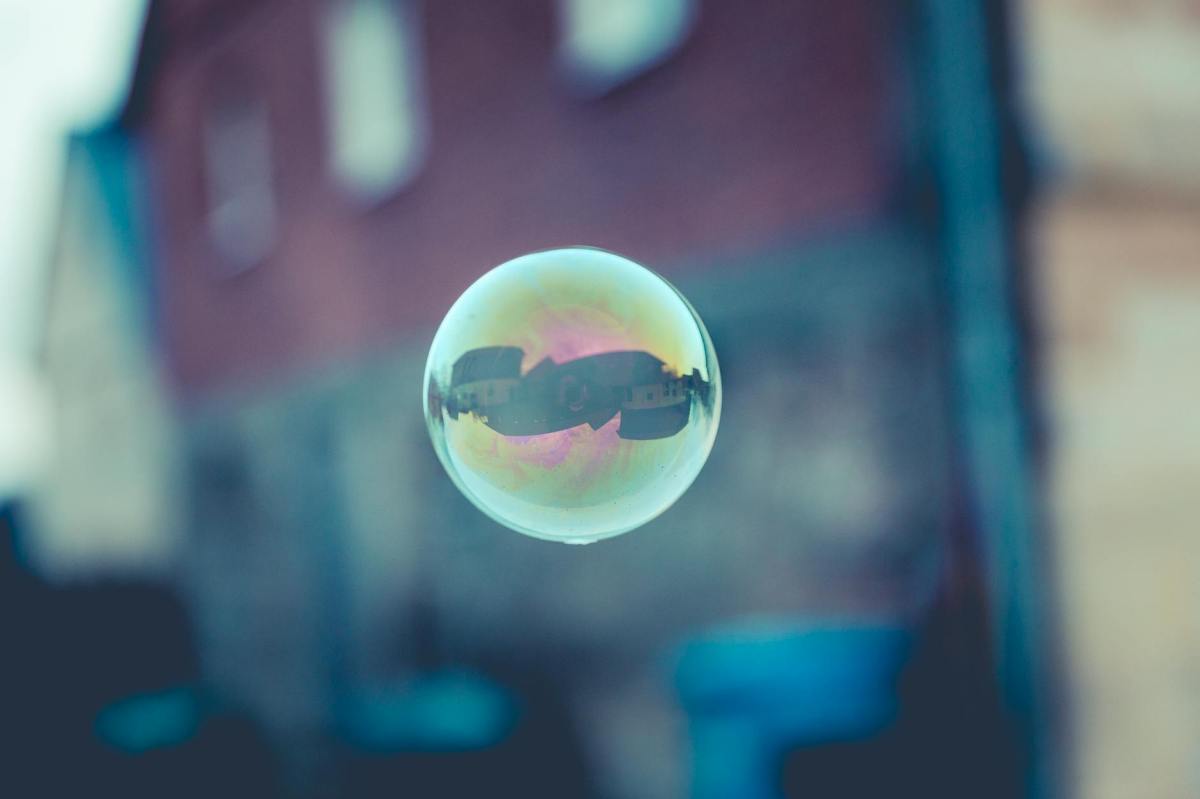
If I’m going to discuss bubbles then that’s the first thought that comes to my head. Those ephemeral objects that float through the air. Perfectly self-contained only hanging together by tiny molecular bonds. Pretty bubble floating through the air.

Here’s what was said: “We live in a bubble”. Meaning those commonplace, often tedious, daily concerns and troubles that enclose our place and time. Bubbles can only be seen if an observer steps outside their boundaries and looks at the innumerable other bubbles.

I wander around with ahead full of thoughts and notions. They are often repetitious and going around in circles. That annoying job I’ve put off. Those awkward words that I now regret. That wondering how I’m going to tell someone that I’m not going to do what they want done. The list goes on and on. There’re good thoughts too. How much I appreciate my partners tolerance. How fortunate I am when compared with those mentioned in the morning News. Remembering a past success and a nice cup of coffee.

“We live in a bubble”. It’s so easy to take a point of view based on nothing more or less than the contents of our minds in own bubble world. Mental bubbles overlap. Several people may have bubbles that are more or less the same. In politics, I could say there’s a liberal bubble, a conservative bubble, socialist bubble, a fascist bubble. There’re all out there somewhere in bubble world.

Being an early riser, my first conscious act is to hit the “on” button on my radio. This week, I caught a prayer for the day by Steve Taylor[2]. He was making the point that it’s often our sense of separateness that is the cause of a lot of suffering. I interpret this as people being stuck in a bubble without comprehension of all the other bubbles in existence.

When we transcend our separate mental bubbles there’s a chance of better understanding. I’m not brave enough to say that this act would sort the conflicts in the world, but it would be a good start.


[1] https://youtu.be/H62SuMpMhc0

[2] https://www.bbc.co.uk/sounds/play/m002g4mn

What If We Brought Back a Dinosaur?

Daily writing prompt
If you could bring back one dinosaur, which one would it be?

Let’s just say that the dino that I’d bring back, time machine permitting, would be the biggest vegetarian that ever existed. It would be downright irresponsible to bring back a meat-eater. Haven’t we seen enough excitable movies on the theme of what can go wrong? The last genetic recreation humanity needs is one that would like to eat us.

If reptilian brains had advanced as fast as homo sapiens maybe the world would be dramatically different. Still, they had several hundred million years, and they wasted the lot. Thus, there’s not much to fear when faced with a large slow-moving vegetarian.

As the planet warms, so there will be more habitable regions where big plodding 40-ton dinos can do some good. A spectacle for sure. And a way to reshape landscapes. Driving evolution in the wilderness.

Here’s a crazy thought. The permafrost in Siberia is melting. Carbon is being released into the atmosphere. That’s not good. Let loose a lot of ultra-heavy dinos across such a wilderness. Feeding on the forests. Fertilising the forests. Equally compressing and churning up the soil. That might keep some of the carbon locked up.

Lusotitan monsters[1] wouldn’t threaten humanity. They might be an asset as well as being fascinating. Large herbivores exist today. We might value them more in the sight of a large dino lumbering across the terrain.


[1] https://www.bbc.co.uk/programmes/p0ll5jcv

Absolutely!

Daily writing prompt
List 10 things you know to be absolutely certain.

For some obscure reason my mind goes immediately to René Magritte. A painter who knew how to play with reality and illusion. “This is not a pipe.” A painting is not a pipe, but rather an image of a pipe. So, why not say so.

I could say that there is nothing that we can be totally certain about. Afterall, some deep thinkers imagine that we live in a simulation where nothing is real. Personally, I don’t go with that theory. It’s absurd in the sense that the next question becomes – who made the simulation? And for them, could they not be part of a greater simulation? That would create a Russian doll set that would go on to infinity. And we all have a problem with infinity.

Let me go for 10 things that I think to be certain within the bounds of my limited knowledge.

  1. My name. It gets used by those I met. Documents have it well recorded. My parents were consistent in using it. So, I’ll say that it certainly is John.
  2. Earth. The existence of the planet where I live. The ground beneath my feet. The physical mass that generates enough gravity to keep me here.
  3. Water. Now, I’m listing the four classical elements (Earth, water, air and fire). I depend on them every day. To walk, to drink, to breath, to keep warm in winter.
  4. Air.
  5. Fire.
  6. Space. A generic name for the huge expanse beyond the Earth. Even with no personal experience of Space, I’m certain that it exists. Its precise nature is another matter.
  7. Food. The existence of which sustains me. Without it I’d perish.
  8. My senses. My five senses – sight, hearing, smell, taste, and touch.
  9. My size and shape. Measurements taken and recorded. Hight, weight and a proliferation of other dimensions. Not that they are static.
  10. My emotions. Facts aside, so many likes and dislikes, engage, distract, motivate and repel with such consistency that their existence cannot be denied.

Having produced this fine list, I will now press the big red button marked do not press. Is there any reason why I shouldn’t engage the infinite improbability drive?

Insights from AAIB Report on Boeing 787 Accident

Now, we know more about the most tragic aviation accident of recent years. The report by India’s Aircraft Accident Investigation Bureau (AAIB) about the June 12 fatal accident of a Boeing 787 raises new questions.

The careful wording of the preliminary report[1] is eminently sensible. The facts are what they are, but it remains difficult to construct a scenario around these facts. I suspect that all the parties involved in this fatal accident investigation had a hand in ensuring that the words used where as clear as can be at this early stage. As I said, the facts are what they are.

It’s good that the report shuts down some of the fervent and erroneous speculation that was filling the international media. For this accident, fuel supply being the substantive issue, decisions around flying controls and other aircraft performance issues can be put to one side.

The crew encountered, or were responsible for a situation that once established led to one inevitable sad outcome. The time available to react, at such low altitude, was less than that which was needed to continue a safe flight.

A focus at this point is on the Boeing 787 aircraft’s fuel control switches. These switches are installed in the flight deck and used by a pilot to cutoff fuel to the engines. When correctly installed, these fuel control switches have a locking feature to prevent inadvertent operation.

Clearly unintended switch movement between the fuel supply and fuel cutoff positions can be hazardous. Inadvertent operation of one or both switches could result in an unintended consequence, e.g. engine(s) shutdown. What we know is that sufficient fuel was supplied to the aircraft engines to conduct a take-off. Then for some unknown reason that fuel supply did not continue as it should.

So far, the respectable technical speculation I’ve read (pilot and aircraft engineer led), raises a limited number of possibilities.

One being that the crew acted in an inappropriate or inadvertent manner. Another being that the aircraft’s fuel control switches failed or were caused to fail. Another being that aircraft’s fuel control system (including wiring) failed or were caused to fail. The movement of the flight deck switches may or may not have been involved. What we know is that the record on the accident flight recorder shows a condition occurred that should not occur.

There is no doubt that this would have been a highly stressful situation in the cockpit whatever the root cause. Normally, immediately after the aircraft is leaving the runway the pilot-in-command would have no good reason to look at the aircraft’s fuel control switches. They would be looking forward at the aircraft instruments.

We can take it that every aviation authority/agency/administration with a Boeing aircraft on its aircraft register will be closely watching the progress of this accident investigation. Since, to date, no Airworthiness Directive (AD) has been issued, related this fatal accident, it is reasonable to assume that aircraft systems and equipment failure or maintenance error has not been found. That said, it is worth noting FAA Special Airworthiness Information Bulletin (SAIB) No. NM-18-33 dated December 17, 2018.

We cannot rule out the possibility that this fatal accident was intentional. However, in the whole history of civil aviation this is one of the most extreme explanations. Looking at evidence, a situation when a competent and sane pilot is found to choose to act in an irrational manner is hard to diagnose.

POST: Just over 3-years ago, I wrote “The case for video”. That case to update the rules is now stronger than ever. The case for video.


[1] https://aaib.gov.in/

Music Genres

Daily writing prompt
What is your favorite genre of music?

One way I could throw out a “smart” answer is to say – the one that hasn’t been coined yet. Let’s face it, going back a decade and more the list of categories was far smaller than it is today.

Why? It could be fusion. Where two types of music are fused to create a new one. It could be pure invention. It could be sounds in nature that we suddenly “discover”.

The audible spectrum for most people may not reach the highest frequencies that a good pair of speakers can handle but the range is there for an almost infinite combination of frequencies. Then there’s timing. Let’s just say that the potential of new sounds is still there despite the proliferation of different types of music.

Maybe my answer should centre around what’s on my phone. I’m predictable. It’s rock.

Long view

What are you most worried about for the future?

Our inclination to think of time without perspective. Short term mentality is an enemy. The thought that big problems are fixed by a wave of the hand is a human weakness. Attractive propositions are easily accepted even if their result is merely to delay or avoid the action that’s needed. Nature runs on longer timescales than our news cycles. If we are to have a future we need to take the tough road now and then.

Key Ingredients

Daily writing prompt
What are the most important things needed to live a good life?

Let’s say that the rudimentary basics are already at hand. Air, water and food are right at the top of the pyramid of needs. If that’s all that was available to me huddling in my damp cave, a good life it certainly wouldn’t be.

I was going to go to Roman times and quote Cicero: “If you have a garden and a library, you have everything you need”. With that one I think it would be reasonable to expand “garden” to mean the whole of the natural world. A garden’s gifts, a variety of plentiful decent sustenance. Not just beans and potatoes.

Next to satisfy the intellect. A library, in the conventional sense, sitting here in the digital 21st Century, isn’t enough. But do I really want to say – INTERNET access? This is too worthy.

Cut to the chase. There is no good life without fun. That meaningless, pointless, misdirection of effort for no other reason than it’s fun. Difficult to define universal fun. So, what’s needed is the freedom to do whatever it is that amuses and entertains (within civilised boundaries).

illusion

Daily writing prompt
What does “having it all” mean to you? Is it attainable?

Not a phrase I find the least bit appealing. Could be applied to the movie The Truman Show. Those three words, “having it all” are an illusion and not a comic one. Even the concept of “all” is dodgy. Our universe is so complex and astonishing that it’s impossible to know what’s around the next corner. At least that’s true for any current day human.

The only way to satisfy these criteria is to give-up on ambition, learning and wonder and settle for the here and now, whatever. Even if I say the criteria is now satisfied, the troublesome problem of doubt will inevitably creep in.

If you don’t believe me, just flip a decade. In 10-years, in our time, change occurs so quickly that what I once thought important is now way down the list. We are not meant to be static creatures. Our whole essence is change and the ability to adapt to it.

Revisiting Brexit: Lessons

In life partnership is key. Most of us have no desire to live as a hermit. The dull confines of a hermitage are best left to a small few. That extends to communities as well. It’s rare for societies to live in isolation and avoiding relationships with others. People come together when they share values. So, it has been in Europe in the post-war era.

Relative to the astronomical losses that the whole UK accumulated because of Brexit, the gains of the latest European Union (EU) – UK deal are modest. The positive take, from Monday, is the direction of travel. Cool heads have prevailed, and a new deal of mutual benefit to both parties has been agreed. There’s more detail to follow as might be expected.

Unsurprisingly, those who failed miserably over the last decade are now carping bitterly[1]. Remember Johnson, who as UK Prime Minister (PM) had a large parliamentary majority that he threw away. His incompetent administration sealed an extremely bad deal.

The years following the 2016 referendum have been wasted years. Tedious nonsense about Brexit benefits have echoed through those years without anything good arising. Brexit “freedoms” are a metaphor for acting foolishly and without any relation to prevailing facts.

Last July, the British electorate said “no” to the parade of Conservative Party catastrophes[2]. The UK decided to go in a different direction. It was the Labour Party that toped the poll. Lib Dems and Greens doing well too. Since the General Election, and since the beginning of the year, the ebb and flow of global events has been truly turbulent. In historic terms, when UK PM Harold Macmillan was asked what the biggest challenge for a statesperson was, he replied: “Events, dear boy, events”[3]. Seems he was right.

Starmer is a fascinating character. Not the characteristic statement of a lifelong liberal, like me. The tool makers son, who schooled in Reigate, to become a top lawyer, climbed the slippery pole of pollical life, to become PM. Along the way he’s done what’s most typical of successful British politicians. That is, he’s changed his mind and allegiances along the way. Going from Labour Party leader to PM in 4-years is quite an achievement.

I don’t have to agree with the PM. In fact, as far as his priorities in government, I don’t agree with the PM a lot. Although, I’ve personalised these words, I wish to take due care. I speak only of him as PM. I’ve never met him. So, let’s focus on his role.

An EU-UK Brexit “reset” was inevitable. If it didn’t happen now, it would have happened eventually. Why would both global trading partners persist with a lose-lose situation? Dealing with serious national issues is a PM’s job. It’s not to avoid or obfuscate. Here Starmer is praiseworthy. Instead of struggling on as if nothing could be done, he’s acted.

What I dislike is the mindless bile that emerges in the conservative Press and in dark corners of social media. Swilling around with ever more hostile adjectives, it’s as if all sense has been lost by part of society. By all means express unhappiness if the cherished beliefs of Brexit are being contested. Everyone has a right to criticise. Please do it in a civilised manner.

What’s foolish is the leader of the Conservative Party who has jumped on the pessimist’s bandwagon. Why do they persist in talking Britain down? Gloomy and unattractive it’s no wonder their poll ratings are plunging. Instead of speaking on Europe, with eloquent and knowledgeable thoughtfulness, we get a diatribe of prejudice and backward thinking. Sad indeed.


[1] Read the Daily Telegraph, The Mail or Express. Newspapers in name only.

[2] https://researchbriefings.files.parliament.uk/documents/CBP-10009/CBP-10009.pdf

[3] Harold Macmillan’s time as PM (1957-1963) was marked by major events, including the Suez Crisis.

Work-Life Balance

Now retired, I sure didn’t always do this daily balancing act well. It was a difficult one to master at the best of times. Especially when work involves travel and was dictated by unpredictable events and demands. In aviation, I mean experiences like accidents and incidents, and the more unusual, like the closure of airspace by the volcanic eruptions in Iceland in 2010.

The maxim: “If you love what you do, you’ll never work a day in your life” can be a deceptive little ditty. That’s because time travels incredibly fast when busy and working at interesting problems.

What advice would I give to my younger self? Learn to say “no” in a smart way. Don’t let pride or guilt, those testy emotions, influence too much. And don’t let others use them against you.

Additionally, jobs with responsibility do have unpleasant and mundane aspects. Say, someone’s performance appraisal didn’t go well, or the budgetary forecast were way off or the advice you gave was based on flawed assumptions. These situations happen to everyone. The message is don’t take this baggage home if you can avoid it.