Not maybe the best but the most memorable by far. My student days. Mayhem, music, and menace. 1980, The Clash. Coventry UK Coventry Music Articles by Pete Clemons: THE CLASH – TIFFANYS 1980
Tag: dailyprompt
Make a mark
I vote, stand, campaign, but never officiate in public ones. It needs to be said time and time again. Particularly to younger people. If you don’t vote, then don’t complain afterwards. Not that, that would make much difference afterwards given that complaining is part of our culture. A cross in a box, as it is in the UK, mostly, is key part of a citizen’s responsibility. Make a mark, even if it seems small beer. That said, it’s as well to take a moment to consider the candidates in front of you on their individual merit.
Refuse to Go
A place with no redeeming features. A place void of life. A place where the sun doesn’t shine or shines unendingly. Well, not really. I’d be fine with the above landscapes. Not for long, naturally.
The place I don’t want to be is where a large predator sees me as its next lunch. Add to that having no way of avoiding an unpleasant fate. That’s no place to be.
A Rational Perspective
I do not have superstitions. I have never had superstitions. I deplore superstitions.
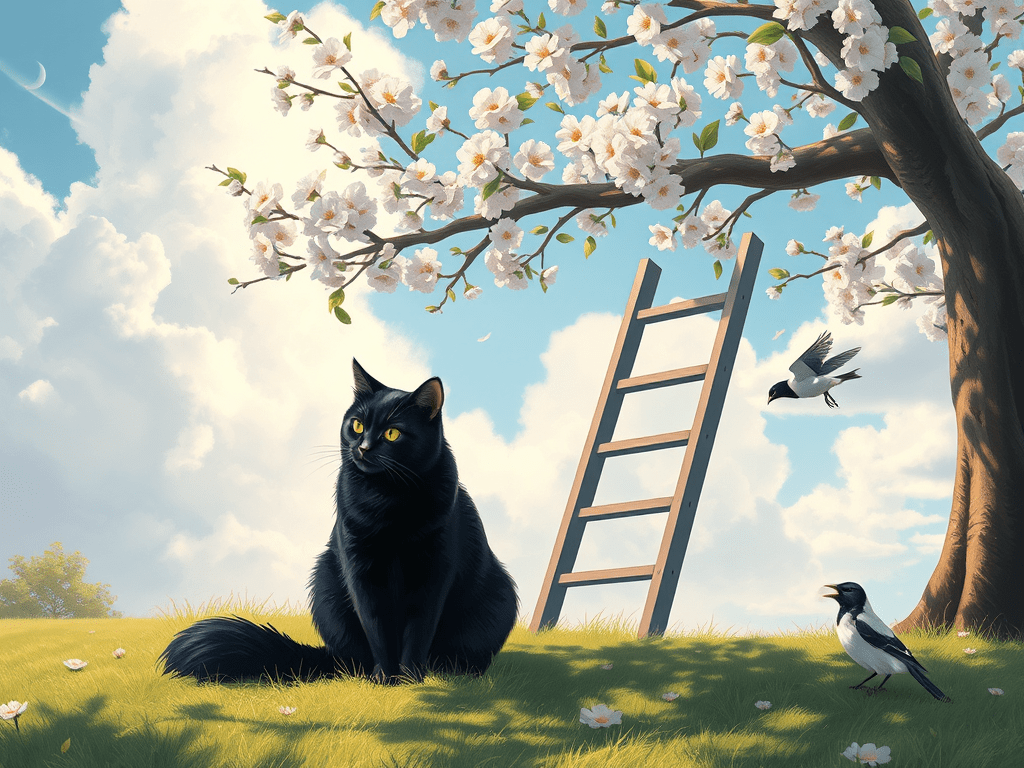
My avoiding walking under ladders of unknown quality is merely a matter of judiciously applied risk assessment. Thus, I have never been hit on the head by a stray tin of paint.
Considering the number 13 as unusual and embowed with certain qualities is merely an association with past encounters with the number 13. Especially on my birthday (13th).
Years of observations prove to me that black cats are particularly perceptive and animals of great wisdom. Thus, such a cat crossing my path is a pleasurable happenstance.
If I see two magpies, it’s only natural to consider this as a celebration of the joys of nature. Empathy with a lonely magpie can be a rational response to my hope that they will find a mate.
Clouds with silver linings are merely a positive meteorological phenomenon that suggests, at any time of year, bright warm sunshine is only moments away.
It would be entirely ridiculous to assert that superstitions have any validity. Ah!
Part 3
The complete opposite to the list Ian Dury came up with in 1979. Reasons To Be Cheerful, Part 3. Why the song is part 3, I have no idea.
I say this although it’s difficult to come up with the opposite to “Cheddar cheese and pickle, the Vincent motorsickle”.
How about: Cheesy strings and things, the brothers of Kings (just to be mildly controversial).
Think
To un-invent would be to un-think. Although, there are numerous mechanism and ways of doing business that it would be fantastic to get rid of it’s not so easy to tell us to stop thinking. If it can be conceived of, for good or ill, it will be conceived of. Since we didn’t write the laws of nature then what come out of their application was intended by a greater power, if there is such a power in the universe. Putting this aside, if I had the undiluted power to un-invent something it would processes, means and mechanisms that enable and encourage stupidity.
Memorable Encounters
This simple question is open to interpretation. When I say I’ve met someone, it’s that of being in the same place as that person and not necessarily having a long in-depth conversation with them over lunch. I’ll not mention any politicians, notable or otherwise.
I did sit next to Tom Selleck, the actor, on an internal flight in the US. I think it might have been a connection with Delta airlines. It was back in the mid-1990s. I do think I remember that we both said “yes” to the bag of nuts the cabin crew were offering. It was basic rations.
In 2010, I did meet Captain Eric Moody. Following the eruption of Eyjafjallajökull volcano in Iceland. Now, I wonder if you know his story. “All Four Engines Have Failed” is probably one of the most compelling descriptions of surviving imminent peril that modern civil aviation has to offer. The title eludes to the most serious of incidents. Flying through volcanic ash that’s exactly what happened to the engines of a Boeing 747 in 1982. Through calm and diligent actions Captain Moody and his crew got everyone home safely. It’s quite a story.
To the Moon
About £10. If it was good enough for the Apollo astronauts, it’s good enough for me.
“Fly me to the moon. Let me play among the stars”. Just imagine what that song, ringing out in the empty space between Earth and its satellite, would feel like.
Recorded in 1964 it was timed so well. The “We Choose to Go to the Moon” speech happened in 1962. The song is older than that, but I wonder if that was a reason for Frank Sinatra[1] taking it up? If this song doesn’t put a smile on your face – what will on Earth.
Shifting Perspectives
If you write the perfect rule, you will get the desired outcome. Authoring a specification that is robust and watertight will assure success. Having the best possible plan will deliver the best possible results. All sounds reasonable – doesn’t it? It’s not surprising that someone like me, having been schooled in project management, and working in engineering, would have a rational and systematic approach to problem solving. A proven highly successful way of implementing complex technical projects and delivering successful outcomes.
As an analogy I’ll start with mathematics. Nature is a curious beast. What we lean about complex systems is that what happens is highly dependent upon a start point. The initial conditions. Graduate level mathematics about control systems with feedback show that their behaviour changes a lot with a change of initial conditions. So, it’s reasonable to extend that to a systematic approach to just about anything. It’s often true.
Fail to plan – plan to fail. That idiom is a simple few words to sum up this cause and effect. Used by famous names and often quoted. Management training books are littered with this notion.
20-years ago, my team introduced the first European Aviation Safety Plan[1]. This initiative was built around the idea that to achieve a common objective a plan is the best and quickest way to get there. A roadmap, a pathway, a strategy, call it what you will.
Start by identifying problems and then propose a fix for each one. Not all problems but the ones that fit that awkward Americanism – the low hanging fruit. Namely, the biggest problems (fruit) that can be solved with the least effort (easily picked).
Here’s where I’ve changed your mind. Maybe not changed in a dramatic sense but shifted perspective. It’s essential to have a plan, even if it’s just in my head, but it can be overstated as the most important part of a process of change.
The Plan, Do, Check, and Act (PDCA) cycle, starts with a plan. It must start that way. However, each of the four steps is equally important. Seems obvious to say. Even so, it’s often the case that a press release, or alike, will state – we have a plan, roadmap, pathway, strategy, as if that’s the job done.
Management teams will smile with a sense of achievement and show off their plans. A decade down the line that celebration might seem less momentous as the “do” part of the process turns out to be harder than anticipated.
This basic model for systematic change is a good one. Where I’ve changed my emphasis is in the distribution of effort. Don’t put all available energies into constructing the perfect plan. Yes, the initial conditions are important but they are not everything. The key part of the process is the cycle. Going around it with regularity is a way of delivering continuous improvement. Afterall, when it comes to a subject like aviation safety, that’s what’s needed.
[1] 2005 – DECISION OF THE MANAGEMENT BOARD ADOPTING THE 2006 WORK PROGRAMME OF THE EUROPEAN AVIATION SAFETY AGENCY
Nostalgic Reflection
Try telling the kids of today. They’ll never believe you. This is the punchline of the “Four Yorkshiremen” sketch. It’s a comic sketch of four retirees, enjoying a cocktail, or two, on a sunshine holiday. They tell stories and try to outdo each other with reminiscence of hardship and their humble beginnings. Naturally, it gets silly.
Here’s my go. My childhood was tough. My brothers and I had to entertain ourselves with board games, toy cars, Lego and Meccano. Kicking a ball around, building camps out of hay bales and fighting wars with cider apples as ammunition. Building a tank out of egg crates and a milk churn trolly. Trying to make kites out of scraps of polythene sheeting. Spending hours on a riverbank waiting for a lone dace, minnow or roach to take the line.
We used to dream of having a computer (not true). Massive arrays of flashing lights, panels of buttons and dials and deafening teletype machines. None of us would have known what to do with one if we had one. Any appeal would have been for roleplaying futuristic stories. The small screen gave us so many visons of the future to feed our imaginations. My image of computers was shaped by Voyage to the Bottom of the Sea, Space 1999. Blake’s 7, Captain Scarlet And The Mysterons and Thunderbirds, to name a few.
It’s nice to be nostalgic, occasionally. There was life without computers. It wasn’t so bad.
Back to the question. What would my life look like in 2025 without computers? Let’s just say – I wouldn’t be writing this answer.