
Avition & Brexit 8

Now we have seen the consequences of a UK Government Minister misleading Parliament it’s time to take a Minister’s words seriously.  Chris Grayling the Secretary of State for Transport recently answered an MP’s written question with these words:

“During the time-limited implementation period, the UK will no longer be an EU Member State. However, as set out in the terms of the agreement, common rules will remain in place. The EASA basic regulation will therefore continue to apply, so all UK-issued certificates, approvals and licences will be automatically recognised as valid in the EASA system (and vice versa).  As the Prime Minister made clear in her speech last month, beyond the implementation period we will want to explore with the EU the terms on which we could remain part of the relevant agencies, such as EASA. This will form part of the negotiations with the EU and Member States on how best to continue cooperation in the field of aviation safety and standards post-exit.[1]

The concussion I draw from this is that there’s no need to cancel next year’s foreign holiday because it looks like business as usual, even if we (UK) have left the European Union.

To verify this conclusion, I had a look at the: “Draft Agreement on the withdrawal of the United Kingdom of Great Britain and Northern Ireland from the European Union and the European Atomic Energy Community” published a month ago.  It’s not much help as there’s no specific mention of aviation or the EASA Basic Regulation (EC) No 216/2008.   However, agreed, and thus coloured in green, is the statement in Article 122 that: “Union law shall be applicable to and in the United Kingdom during the transition period.”

So, until 31 December 2020, it’s like we (UK) have many of the obligations of a Member State but no so many rights.  The UK will not participate in a European Parliament election in 2019.

What is unclear is the plan for the first day of 2021 and beyond.  Yes, there’s an aspiration to continue to play a part in the European Aviation Safety Agency’s (EASA) but nothing much else.  The need for common and proportionate safety standards will not go away.  The European Union has brought benefits for both UK consumers and the aviation industry.  Better to stay than go.

[1] https://www.theyworkforyou.com/wrans/?id=2018-04-17.136090.h


Aviation & Brexit 7

Generalities are all well and good.  In so far as they are constructive and positive they set a direction of travel.  This is pertinent to the words of the UK Government in respect of the future of aviation safety regulation.  If assurances are correct and negotiations are successful, then UK organisations should experience a gradual transition and not a sudden disruption after March 2019.

Unfortunately, there are some square pegs being presented to round holes.  Most of these are associated with the “red lines” that we are told are the policy for the UK Government.  Three are: regulatory autonomy, an end of European Court of Justice (ECJ) jurisdiction and an end to the free of movement of people.

Currently, there seems to be conflicting indications as to any flexibility on these positions.  If they are hard and fixed, then this means an end of participation in European Aviation Safety Agency (EASA).  However, that contradicts the statements from Transport Ministers that the UK wishes to remain an EASA Member State.  So, for civil aviation, will there be a rounding of the square peg?

My focus tends to be on the part of the aviation industry that does; development, design, manufacture, maintenance, repair, and overhaul.  In fact, airworthiness was the original remit for EASA back in 2003.  Since then, that remit has been progressively extended in a way that involves both EASA and the National Aviation Authorities (NAAs).

Today, EASA works on just about all aspects of aviation safety regulation, including; aircraft operations, the licencing of pilots, engineers and air traffic controllers, airports and even environmental noise and emissions.

A full hard Brexit would mean the all internationally required regulatory work would return to the UK.  To meet this the levels of activity, capabilities and resources of the UK CAA would need grow substantially.  This would be true even if the whole exercise was just to rubber stamp foreign certificates and host their auditors.

You might say what a waste of taxpayers’ money.  Maybe not so.  Both EASA and UK CAA work on a cost recovery basis for a large part of their annual funding.  Now, that’s the real rub.  To fund the newly acquired workload UK industry fees and charges would likely increase.  Because industry would continue to be active across Europe then it would then end up paying twice.  Not what the Brexit advocates promised; duplication of activities and costs but with no tangible benefits.

Given this scenario and considering corporate due diligence, international organisations will be looking at the costs, benefits, and risks.  So, what kind of contingencies are being considered?  For some organisations it will be to move their Principal Place of Business and approvals to an EASA Member State.  Defining the term: “Principal place of Business[1]” was one of the tasks taken up in the early days of EASA.  This is to ensure the correct Authority is identified before an application for organisational approval can be accepted and a valid approval issued.

Let’s hope that a firm agreement on continuity will mean this contingency is not needed.

[1] http://publicapps.caa.co.uk/modalapplication.aspx?appid=11&catid=1&id=7872&mode=detail&pagetype=65


Aviation & Brexit 6

Where are we now with Brexit?  This month, a couple of statements have been put in the public domain.  One of them is the European Commission’s publication: “Withdrawal of the United Kingdom and EU aviation safety rules” from 13 April 2018.  This European Union (EU) paper describes the situation with respect to the UK as a non-EU country without a new agreement in place.  However, it’s clear that public statements from industry, the Government and the UK Civil Aviation Authority (UK CAA) all indicate a desire of the UK to remain as a member of the European Aviation Safety Agency (EASA).  That wish will need to be implemented in some manner or form.

In the longer term, there’s some expectation that a Bilateral Aviation Safety Agreement (BASA) could be signed between the EU and the UK as a non-EU country.  This would be used to detail the cooperation between the EU and UK, including any mutual acceptance of certificates.

In the shorter term, it’s possible to imagine a Working Arrangement (WA) between EASA and the UK CAA that would address continuing technical matters.

Either way any new agreement is a matter for the EU and the UK Government.  It may or may not be in place during the much talked of implementation period after March 2019.

The UK is unlike other Countries in that it has been a founding member of both the Joint Aviation Authorities (JAA) and EASA but will be the first to plan to leave the EU.  Nevertheless, in the European aviation field the UK remains a member of intergovernmental bodies like; ECAC[1] and EUROCONTROL.

It is worth noting that the JAA Cyprus Arrangements ceased in 30 June 2009.  Other non-EU States that were part of the JAA had to find new working arrangements with EASA after that date.

Today, four non-EU European States are EASA Member States and have a seat on the EASA Management Board.  The Management Board is responsible for the definition of the Agency’s priorities, the establishment of the budget and for monitoring the Agency’s operation.

It is possible to imagine the UK becoming the fifth.

If this is not achieved, and no unique or emergency measure are in place then significant difficulties will arise.  On its website, the UK CAA[2] has made it clear that even for such an unlikely situation contingency plans are being made.

[1] https://www.ecac-ceac.org/


[2] https://www.caa.co.uk/Our-work/Newsroom/Hot-topics/


Sunny Saturday Morning

IMG_2217It’s one thing to discuss the technicalities of Brexit but there’s nothing like standing in a High Street and talking to people.  Before the day slips from my mind I thought I’d write a few short reflections.

Our weather hasn’t shown much sign of Spring but on Saturday it was almost as if the heavens were smiling on us.  Sunshine brought lots of people out for a stroll, shopping and much else.  It’s so rewarding working with a likeminded team.  A cross-Party group of us met-up in the centre of the Surrey town of Dorking.  Determined to show that there’s a movement for change.

I approach leafleting with a smile and a greeting – would you like a leaflet?  It works.  Yes, one or two people don’t want to be bothered or smile back but that’s normal.  Who knows what’s going on in the lives of those you meet by chance on a Saturday morning.  Being respectful is essential.  First impressions matter so much.  With a badge, some stickers and colleagues around we made it clear that we were campaigning on Europe.  What we find is that the politeness and civility of most people reminds me that there’s a lot worth fighting for in Britain.

On Saturday, I’d guess no more than 1 in 20 of those I leafleted presented a negative view of what we were doing.  From them, not one original new saying came up.  Responses were mostly stock phrases, like: “We’ve voted once” or “I want out” or “the sooner we get out the better”.   Not the basis for conversation.  Generally street campaigning isn’t about arguing with people.  At its best, its more about connecting with supporters and offering information to those with an open mind.

I did engage with one guy who thought one vote was enough.  My counter argument was the fact that we vote every year in local elections and democracy is open to people changing their minds.  Much as I expected, he wasn’t moved by this way of thinking.   With a small minority there’s a kind of belligerence.  Its true of other life situations too.  Pride or stubbornness or absolute blind conviction means that little real discussion is possible.  The strange thing is often we spend a disproportionate amount of time talking about people who behave this way.

Without a shadow of doubt there’s a strong demand for a vote of the deal.  A clear majority of people we meet in Dorking want to have a choice over the Brexit deal.

The call for a #PeoplesVote is gaining momentum.  Lots support the @peoplesvote_uk campaign for the people to have the final say over the #Brexit deal, not politicians.

Representative Democracy

It remains remarkable to me that the Government’s stated position on Brexit is: “The British people voted to leave, and the Government will implement their decision. The vote on the final deal will give Parliament the choice to accept the agreement or leave the EU with no agreement.”

A debate will take place in Parliament on Monday, 30 April 2018[1].  This is the result of a petition with over 100,000 votes, that reads: “Parliament’s vote on the Brexit deal must include an option to remain in the EU.”

I wonder how long this Conservative luddite[2] approach to political decision-making will continue.  It’s almost without parallel that a weak British executive such seek to bully a sovereign Parliament into a cul-de-sac.  So, utterly desperate are the current Conservative Party to save the Conservative Party that they resort to attempting to ride rough shod over the British constitution.

Edmund Burke would be turning in his grave.  He’s often considered as an authoritative source for modern Conservative views.  I’ll quote him from a speech to the electors of the City of Bristol on 3 November 1774[3].

“Parliament is not a congress of ambassadors from different and hostile interests; which interests each must maintain, as an agent and advocate, against other agents and advocates; but parliament is a deliberative assembly of one nation, with one interest, that of the whole; where, not local purposes, not local prejudices, ought to guide, but the general good, resulting from the general reason of the whole.”

It’s clear that, given evidence that Brexit is not in the general good it should be rejected.  I believe, a general reasoned free debate in Parliament will surely show that Brexit, deal or no-deal, is not for the general good of the nation.  Thus, MPs must have the opportunity to vote for an option to remain in the EU.  This is not a time to smash up our representative Parliamentary democracy.  It’s a time to reinforce it.

[1] https://petition.parliament.uk/petitions/205169


[2] http://www.bbc.co.uk/news/magazine-17770171


[3] http://press-pubs.uchicago.edu/founders/documents/v1ch13s7.html


Not long at all

Remarkable again – yes, it’s less than three and a half years to the year 2020.  It doesn’t seem five minutes ago that the millennium was all the talk.  That strange construction; The Dome was the darling of the newspaper columnists.  At the turn of the Century, I had imagined we would have flying cars by 2020.  Just like that crazy flying taxi driven by Bruce Willis in the 1997 movie The Fifth Element.  Incidentally, his screen character was called Korben – sound familiar?

What I’m getting at is that there aren’t many really big projects that get launched and delivered in only three and a half years.  Hang about, it’s just over three and a half years to the next UK General Election.

One might reasonably suppose that the mechanics of Brexit are going to prove to be massively more complex that even a latter day managerial pessimist might think.  Three and a half years to rewrite a vast catalogue of legislation.  Three and a half years to deploy world class negotiators left, right and centre.  Three and a half years and no other monumental events get in the way?

This could be 42 months of; let’s see how it goes.  There’s a grand number from the book of science fiction humour – 42: The answer to Life, the Universe and Everything.  I wonder what Douglas Adams would have thought about the referendum and all its characters?

We are in a period when the ship of State is sailing through a storm that rises and falls in an entirely unpredictable manner.  As the Brexit project gets underway it will be shaped by the frequent storms ahead.  By the time we get to the run-up to the next General Election what we call Brexit is likely to be a very different thing from what it’s imagined to be today.  The public mood will be different too.

I’m hopeful that the reality of this situation is that a new accommodation can be found that doesn’t disconnect the UK from the rest of Europe.  Our shared problems will remain our shared problems.  Our shared solutions may continue to be our shared solutions.  All but the precise shape and form of our international relationships will be different.  Let’s be positive and optimistic.

High Summer

IMG_0485Isn’t it remarkable?  One month has passed, a lot has changed and yet not much has changed.  It feels as if the thick dust that was kicked-up by the European Union referendum might be permanently in the atmosphere.  Gravity just doesn’t want to do its job.  There’s enough hot air rising to counteract anything gravity can do, at least for now.  You could say the debate continues.  The burning issues have not been resolved, it’s more a case of shaken and stirred and then repeated. 

I’ve been driving between Staines and Reigate and there are still plenty of signs of the referendum around us.  Today, I passed a roadside bin with a blue “Stronger IN” board sticking out of the top.  Traveling down the M25 motorway, or up depending how you look at it, there’s a couple of large Union Jacks in the hedge rows.  One or two cars display campaign stickers and the subject is never off the radio as I sit in the endless stream of traffic in the hot weather. 

I can hear someone saying – why don’t you take the train?  There’s one answer to that suggestion and it’s called: Southern Railways.  Everywhere the high summer heat is taking its toll on travellers.  In the South East, there’s a reason for annoyances and short tempers.  Add a whole truck load of uncertainty.  Then see the Pound devalue just before holidaymakers’ rush for the beaches and the mix is bound to produce a sour mood. 

Delay is needed.  The case for saying that little of any sense is going to be said for another month isn’t too far short of the mark.  Some cooling air is needed.  Gravity must do its job and settle the dust too.  Then reasoned arguments for and against courses of action can be heard and properly debated.  Whichever box people put their cross in a month ago they have a right to expect a level of sanity to prevail in cutting the best deal for the Country.  In my mind that means everything is still on the table before any declarations are made with respect to the triggering of the famous Article 50 and beginning the real process of the UK leaving the EU.

Our place

IMG_0886The outcome of the EU Referendum has left many of us shocked.  There’s still a sense of disbelief that a small majority is driving such a massive change in this Country.  The emotional bonds that bind Europeans are deep rooted.  That’s a reason why having this terrible divorce forced upon the nation is overwhelmingly depressing.  One foolish gambling British Prime Minister threw the dice and lost his shirt and ours too. 
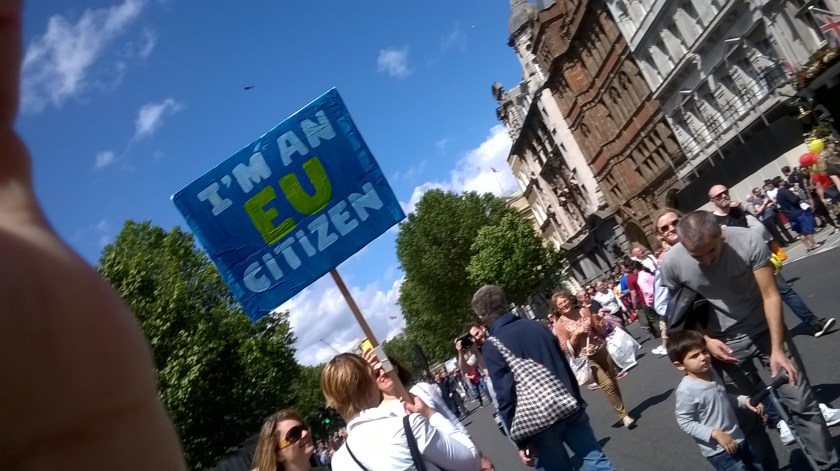
Every citizen in the European Union is European.  Granted the EU is one part of Europe.  Our European family comes together in different ways and it can be counted as over 50 Countries.  Although Britain sits at the North West corner of the continent its every bit as European as the continental mainland.  There isn’t a moment in our history when our affairs haven’t been intertwined.  Even the builders of Stonehenge traded with tribes beyond these islands. 

It was fascinating to listen to the author Clive James on Channel 4 News, last evening.  Although he edged towards the leave camp his overwhelming reflection was how embedded we are in European culture.  Any view from afar places Britain firmly and squarely in Europe.  Socially, culturally and geographically our place can’t be denied. 

Now, in these uncertain times there are more questions than answers.  Uncertainty isn’t just about numbers it’s about how people feel about the future.  Ironically, prolonged uncertainty may be one of the only certainties in the next couple of years. 

My truth

WP_20160702_14_19_01_Pro

There’s a difference between lies and exaggeration.  Oh yes there is.  I faced the argument that – both sides lied in the EU referendum didn’t they?  It not uncommon for people to become cynical about politics and politician’s and that’s a reason they give; none of them can be trusted.  Post referendum this notion is embedded more than ever it was in the minds of the British people. 

We might ask – what is truth.  Equally – what is exaggeration?  There’s a real distinction.  It’s reasonable for a passionate argument to spill over into exaggeration but it’s NOT when it moves to downright lies.  Say for example, we have a whole pile of adjectives in the English language that emphasise the largeness or smallness of a number but they don’t change that number.  If I said; an “extremely large” number of people instead of a number of people, you’d take it as read. 

Newspaper headlines that scream: “£350 million a week for NHS” quoted from those with no intention of delivering that funding are deliberately false promises (lies).  Soundbites that say: “Brussels tell us what to do” are crude distortions – that’s a kind of selective lying.  Like saying; “I hold a banana in my hand” when in fact it’s a beetroot. 

The EU referendum was won by only a tiny margin.  That tiny margin of British voters were swung by misinformation, distortion and deliberately false promises – yes; lies.  It isn’t clear where to go from here but it’s a dreadful place to start any journey.  Humpty Dumpy really has fallen off the wall. 

My biggest concern is that capable, honest and passionate people will become silent because they have been drowned out by unchallenged cheaters.  Good people will steer away from public life because it’s so horribly tainted.  Talented young people will seek their fortunes elsewhere as a new British “brain drain” kicks off. 

It will take more time for the “dust to settle” but this should not stop us challenging the result. 

Tricked

IMG_0690

Yes, I did go to Sunday school.  At the small parish church in Horsington.  St John the Baptist’s has all the features you would expect of an English village church.  Back in the 1960s a small area was set aside for Sunday school.  I hear there’s still a children’s corner in the Church.  Also, as a family we attended the Methodist Chapel in South Cheriton.  Contrasting with the CoE, this was a place where animated lay-preachers offered a more down to earth view of heaven and hell. 

I’m telling you this just to give a little background on what shaped my view of right and wrong.  A lot more than this youthful experience seeped into my subconscious as I became agnostic about religion.  Being sceptical probably came more from non-conformism, my secondary school teachers and my argumentative nature than any sermons or doctrine. 

Out of a vibrant mix in the 60s and 70s, I developed a rational way of looking at the world and a strong sense that people should tell the truth.  That there are such things as provable facts.  That progress is the natural order.  And that you help yourself by helping others.  Now, this all sounds strangely retro as I reflect on what has happened over the last few weeks. 

Taking the UK out of the European Union will be hugely complex.  A lot of people said it would be hugely complex.  Many sound arguments were set out as to why it would be hugely complex.  Regardless of all that this is the path that has been chosen by a majority of voters in the UK all but by a small margin.  That said, I can’t help but think that a deception has been practiced on the British people.  So many half-truths and nefarious speculations were put-up on banner headlines.  Dubious statistics and manipulated facts presented bright and colourful did sway the direction the vote took. 

Now, a flurry of back tracking is underway.  Quick comparisons with before and after interviews make it clear: a week really is a long time in British politics.  Outcomes are manifold but one is to reward those who made the biggest exaggerations and told the dodgiest selective stories.  So, how can this be right?  I guess, it isn’t.