Link Box

It’s the petite agricultural tractor commonly known as the Little Grey Fergie

The Mendip Hills in Somerset are known for quarrying. A variety of rock types end up in construction and road building. For farmers, not far under the soil that rock is both good and bad. When it comes to grazing land and the annual ritual of haymaking, hard rock is a menace to machinery.

I’m going back in time. I did this, this week. One or two memories flashed through my head as I walked around the vintage tractors at the South of England Show[1] in Ardingly, West Sussex. I’m glad I went on Friday. A large agricultural showground in the heat of this summer weekend must have been quite testing. It was dry, hot, and breezy on Friday. Every other stall was selling hats. It was a day for suncream and plenty of drinking water.

There was a good selection of livestock at the show but no poultry, for obvious reasons this year. Bird flu. The animal numbers were not large, as they might have been in former times, but the quality was clear to see. Sitting under the shade of a large oak tree watching the pigs being judged was more entertaining than it sounds. Pigs have a mind of their own, and go the way they want.

In the 1960s, farm machinery was miniature in comparison with the massive high-tech machines on display to serious buyers. It was basic. Much like the cars and vans of the time. An average village mechanic could fix just about anything. Everything was manual. Everything was raw metal. Everything wasn’t made for comfort, or safety for that matter.

Seeing the simple cast iron seat of a Fordson Major[2], the contrast with an environmentally controlled tractor cabs of today couldn’t be starker. That said, there’s something to love about these heritage farm machines. Often lovingly restored, cherished by their owners and worth more than you would imagine. It’s the petite agricultural tractor commonly known as the Little Grey Fergie that I’m remembering. My granddad had one. A Ferguson TE20 to be precise[3]. And it was grey, or was it red?

On the A371, south of Shepton Mallet, Somerset is a small hamlet called Prestleigh. It was a regular haunt of my early childhood. Yew Tree Farm consisted of an ancient farmhouse on the west side of the main road and buildings and a yard on the eastern side of the road. The farm gate was in a treacherous place. On a corner, on a steep hill. In my time, my grandparents sold the farmhouse and built a bungalow to the south of the farmyard.

As far as I recollect, it was a small business that ticked over keeping my granddad busy. He was an avid gardener too. Nothing is flat in that part of the Mendip countryside. The rolling slope of the land formed a shallow valley. You couldn’t avoid the local landmark. The Somerset & Dorset railway traversed the valley by an impressive viaduct. Granddad’s fields went up to the railway and to the other side of the viaduct.

Yes, some of my early childhood conjures up images of The Railway Children. The steam trains trundled along that line until 1965. After that it was a place for us to explore and have mini adventures. It’s more the stories of steam trains than the trains themselves. It’s difficult to believe that the trains acted as a time piece for the countryside. Daily trains signalled milking time or teatime.

Back to stones. Sharp limestones. They littered the field above the Prestleigh railway viaduct. When it came to mowing that field, the abundant stones would blunt the blades of a cutter bar mower[4]. They could do a lot of damage.

There was a job for the Little Grey Fergie, my granddad, my brother, and me. He had two energetic young boys in his service. He’d drive the tractor at a snail’s pace across the field. We’d jump in and out of the link box on the back. Strong summer sun turned the grass brown.

Arm outstretched granddad pointed out the bigger stones and, like a couple of retrievers we’d run off, pick them up and then stash them in the tractor link box. It was the task of Sisyphus[5]. There was no beginning and no end to the task. The sun backed ground brought stones to the surface every season. At the end of the day we measured our work by the weight of the link box.

That’s what the vintage tractors at the South of England show reminded me of, amongst other childhood farming memories of an era gone forever.


[1] https://www.seas.org.uk/south-of-england-show/

[2] https://heritagemachines.com/tractors/the-fordson-major-story/

[3] https://www.coventrytelegraph.net/news/coventry-news/massey-ferguson-coventry-manufacturing-giant-15739539

[4] https://www.pinterest.at/pin/121034308718777099/

[5] Sisyphus is punished in the underworld by the god Zeus, who forces him to roll a boulder up a hill for eternity.
Cider pigs

Out the back of the farmhouse was a scruffy orchard. It was through the east facing garden, then over an awkward cobbled together fence. The orchard was an L-shape with a soggy wet depression in the middle. The trees at the top end of the orchard had long since gone by the time of my childhood. The lower part of the orchard was populated with the most venerable but neglected cider apple trees. Never pruned with that crusty, mossy look of years of struggle against the elements.

There was no money in growing cider apples in the 1960s and besides the ones that still stood were probably originally grown for homemade home consumed cider. The orchard was a piggery.  Several well-made timber pig huts stood in the field. Except for one. In a corner there was strange construction made of used railway sleepers, arranged vertically, and covered with a round tin roof. It was the only hut that was not moveable. A rough concrete floor kept the railway sleepers in place.

Now, that was a good set-up. There’s a thing that most pigs like and it’s ripe cider apples. Trouble is that they don’t know when to stop. So, when they fell, we had to find something to do with them by the bucket load. For us boys, that wasn’t a problem. Cider apple[1] wars were a feature of the autumn.

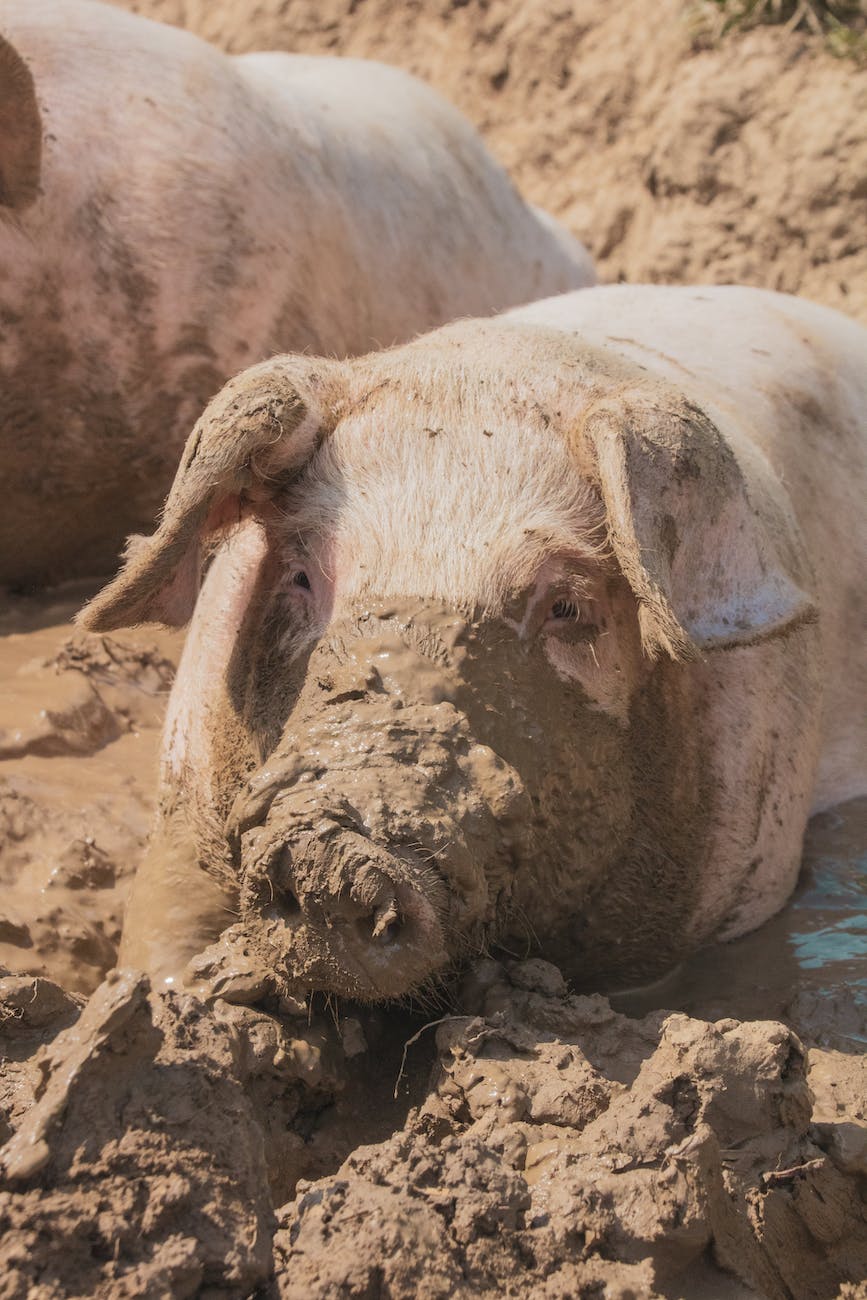
If I’d taken a shine to farming in those early years, it would have been keeping pigs. That orchard was always as carved up as a fresh battle ground. Nothing more satisfying to a happy pig than rooting through the dirt. In good weather making our way across the ground was easy. In bad weather getting stuck in the sticky clay mud was guaranteed. The thick mud was ideal in the summer. Wallows would form so the pigs could do what they do best when it gets hot.

All that said, I can’t imagine domesticated pigs in any other setting than outdoors. As I drive around, it makes me pleased to see so many examples of outdoor reared animals. Pigs are inquisitive and intelligent animals that deserve the freedom to roam around in an open space.

At one time or another, I kept a British Saddleback[2], a Landrace[3], and a Large White[4] pig.  The Large White pigs could be a handful if the pig took a disliking to you. Saddlebacks were the best when it came to temperament. Agreeable, content, and excellent mothers.

My brothers and I were being tutored in animal husbandry from a young age. The principle aim was not to pamper a pet but to look after the pigs with the aim of having as big a litter of piglets as possible. That’s where profit lay. We kept records of the cost of the pig food, bedding needs and everything that went into our mini farming enterprises.

Encouraged by my parents, my brother and I were often in competition.  I remember once sitting up late into the evening with a sow and being so proud of having helped 14 piglets into the world alive. This could be a hazardous business in a confined space of a small pig hut. The job was making sure the piglets found their way to their mother’s teat and didn’t get squashed on the way. If they let out a loud squeal the sow could move and could unwittingly squash one of the litter.

In my mind, Somerset cider is tied with pigs. The two go hand in hand.


[1] https://ciderappletrees.co.uk/

[2] https://www.britishpigs.org.uk/british-saddleback

[3] https://www.britishpigs.org.uk/british-landrace

[4] https://www.britishpigs.org.uk/large-white

Big Red Barn

Farmers lung is not a myth. Or at least the causes are real. Being under a haybarn roof on a super-hot summer day with dust and chaff saturating the air is not to be recommended. The red painted galvanised tin roof of the barn created an oven to work in.

Haymaking was a big event in my family’s year. My pocket money was earnt at haymaking time. My brothers and I did a lot for 25p an hour.

It was never entirely the same from year to year. That is, even if the work of cutting grass, drying it, baling it, stacking it, and hauling it back to the barn was the same. Weather made the biggest difference. Damp heavy bales or light dry bales are a world apart.

Each field presented a different test of our strength and endurance. They all had names. “Big Ground” was flat, wide, and open but wet at one end. “Pump Ground” sloped towards the small brook and had its own ruts and wet patches. “Goulds Farm Moor” was a far-off place, or it seemed to me, that was bounded by the River Cale. “Little Ground” was the easiest and its name says why.

Back to the big red barn. We refined stacking hay bales as if it was an artform. There were good practical reasons for taking care where hay bales were placed. They were building bricks. Like Lego. Stacking them alternately gave some stability. We learnt by making mistakes. If we didn’t stack them differently from layer to layer the whole construction would move alarmingly or present crevasses which were less than safe.

In the big red barn, at least the steel uprights gave some square corners and support. In a field, a hayrick had to be built with a sound foundation and skill otherwise it would not survive the winter.

Most of the summertime, it was too hot and sweaty to wear gloves. That wasn’t so bad when baler twine was made of sisal[1]. As polythene baler twine came along it could be brutal on the hands.

As a 15-year-old, my ability to throw hay bales across a barn is not something I could match now. That is picking them off a much abused Lister bale elevator and then throwing them to whoever was staking, Dad or one of my brothers. We’d swap jobs from time to time. Staking was often the hardest job. Keeping up with the pace was tough.

As an aside the bale elevator[2] itself was a story. Every year, Dad would grease and oil it to make sure the moving parts worked. Inevitably the winter took its toll on the mechanics and a fix had to be improvised. I use the word “improvised” but what I really mean is botched. Baler twine, coach bolts and nails have many uses.

Powering the whole contraption was a much-abused Briggs and Stratton petrol engine[3]. It had a cord pull start. It was one where we often pulled endlessly in hope rather than and chance of getting it to start. When it did start, if the drive chain didn’t come off, it would warble away contently.

It’s droning sound moved up and down the scales as more or less bales were place on the elevator. If, usually my Mum, would put more than 4 bales on the conveyer it would all but stop. Slowly puffing away and straining to get the load to move. Most disturbing was the habit the engine had of leaking petrol. How we never came to burn down a hay barn or stack I will never know.

Looking back in time, the whole show was a health and safety nightmare. In 1975, that was not the overriding thought that went through anyone’s head. We live to tell the tale.


[1] https://www.chelfordfarmsupplies.co.uk/farmer-s-golden-sisal-baler-twine-9000

[2] https://www.agrimanuals.com/lister-multi-level-elevator-brochure-4522-p.asp

[3] https://www.briggsandstratton.com/na/en_us/support/faqs/browse/antique-engine-specifications.html#Collectors

Turnip

Root crops come in different shapes and forms. In Britain, most of our sugar comes from sugar beets[1]. It’s weaned the country off colonial sourced sugar cane of decades ago[2]. It’s a large home-grown industry that goes on under the radar. Given recent utterances, Government Ministers may not know that it exists.

There are deep cultural themes that are associated with root crops in Britan. Some of this imagery comes from a long history of growing root crops. Some of this comes from the British war time experience of ploughing up every available space for food production. In a time of food rationing the humble turnip played a key role. The turnip, Brassica rapa L., is one of the world’s oldest cultivated vegetables. Afterall they don’t require a lot of attention and can endure hostile weather quite well.

It’s a common myth that we (the British) all eat seasonally. It was mostly the poorer people in a community who had little choice.

My own recollection is of my father unsuccessfully growing a small field of turnips. They will grow in heavy Somerset clay soil but the mess of cultivating them on land that floods is beyond a joke. Machinery gets bogged down and the harvest is more dirt than turnips. I remember that the crop made good animal feed and little else. The field was quickly retuned to a new lay of grass.

This week, Conservative Secretary of State for the Environment, Food and Rural Affairs Therese Coffey told the UK Parliament: “lot of people would be eating turnips[3]…”. This was a government statement addressing empty British supermarket shelves.

Now, I’m not about to have a downer on the poor turnip. They are a bit of an acquire taste but have meritorious qualities and are inexpensive. It’s more the silliness of the Minister’s utterance in the House of Commons that is surprising. It’s a naive exposition that casts the vital subject of food security as a comic game. The Minister doesn’t seem to have a command of her brief.

We all know that crop production can be sensitive to weather conditions throughout the growing season and at harvest. Farmers know that and live that fact. Supermarkets know that and live that fact. Both food production and distribution adapt, accordingly.

The British problem is that the cost of production has rocketed. Brexit and high energy costs have hammered farmers. Former specialisms in agriculture, like tomato production under glass, are not sufficiently supported to remain viable in current condition. In fact, tomato production is not alone in this respect.

What’s clear is that the UK’s Minister needs to get a grip. She needs to understand the nature of British agriculture and stop making foolish excuses.


[1] https://en.wikipedia.org/wiki/Sugar_beet

[2] https://www.countrysideonline.co.uk/articles/british-sugar-all-you-need-to-know

[3] https://news.sky.com/story/eat-turnips-instead-of-tomatoes-suggests-minister-as-she-admits-food-shortages-could-last-a-month-12817794

Food and Farming

Those two words, food and farming are intimately linked.

Now, the UK Government is preventing Westminster MPs from voting on a House of Lords amendment to the Agriculture Bill.  Thus, the planned UK Trade and Agriculture Commission will not be empowered to protect food and animal welfare standard in the UK. 

An unending stream of underhand tactics, lies, rule breaking, shortcuts, manipulation and deceit power this Conservative Government. They are ushering in low standards, cheap imports and industrial farming practices that will be bad for animals, bad for humans and bad for the environment. 

The Agriculture Bill provides the legislative framework for the replacement of agricultural support schemes in place during EU membership. For some people, the Brexit project was about cutting red-tape in the belief that bureaucracy was the problem. So far, the post-Brexit world is presenting ever more complex bureaucracy producing poorer and poorer results at a greater cost than before. 

National Farming Union’s president Minette Batters said: “We have the chance to become a global leader in climate-friendly farming, and neither farmers nor the public want to see that ambition fall by the wayside because our trade policy does not hold food imports to the same standards as are expected of our own farmers.”

The coming week will test if this UK Government is united with the majority of the public and farmers in not wanting to accept lower quality food imports or doesn’t give a dam. 

Bath & West

WP_20160602_16_04_07_Pro

Thursday, I spent at the Royal Bath & West Show in Somerset. Remarkably, I’ve been going to agricultural shows for 50 years.  I was 5 years old when this show found a permanent home near Shepton Mallet.

My grandfather owned Yew Tree Farm which was next to the site. Yew Tree Farm House is on the left hand side of the road going up Prestleigh Hill on the A371.  Apparently they used to herd cows up Prestleigh Hill.  Now that’s steep.  However, in the 1950s-60s road traffic wasn’t anything like it is now.  Except maybe for one or two heavy quarry trucks.

Timekeeping for the farm was the sound of the steam trains echoing across the valley. That railway line was axed as so many were in 1965.

I have a childhood memories of the showground in the summer sun and in the pouring rain. As a boy I’d hop over the gate into the field used as a car park and into the show ground.  Then there were few permanent features.  The show was a sea of white tents.

What has changed? The long and the short of it is that it’s now not just an agricultural show.  In fact, farming is at the heart of what goes on but everything else is much bigger.  It’s a place where town and country meet.