Responding to the Brexit Blog of Reigate’s MP (Part 3)

In the UK’s representative democracy, an MP is a representative, so they are not excepted to have any specific skills or education or knowledge.  They are selected by a political Party and then stand before the electorate in a defined constituency.  Thus, I should not be shocked or surprised when reviewing material published by Reigate’s current MP.  One thing is clear, The MP does not understand how industry and regulation work.

The term “regulation” is not used in the general description of the World Trade Organization (WTO).  Yes, it does have Member States, but it does not have a framework of directly applicable law.  WTO administers the trade agreements that are the foundation of rules.  It’s an international intergovernmental bureaucracy with a slow-moving Dispute Settlement Body (DSB).

Today, the 28 Member States of the EU are WTO members.  They work together since the EU has a single customs union with a single trade policy and tariffs.  That will not change if the UK leaves the EU on 29 March 2019.   The EU’s single trade policy and tariffs, as declared to the WTO, will apply to the UK as a “third country” in relation to the EU.

Unlike, ICAO[1] in the world of aviation the WTO is not a UN agency.  In fact, US President Trump says he will abandon the global trade body “if they don’t shape up”[2].

There are some Westminster MPs, who might be called “neo-imperialists” in the UK, who fail to recognise that the EU is the UK’s largest trading partner[3].  Post Brexit, the EU’s economy is about 7 times bigger than the UK’s.  If Brexit happens it’s imperative that detailed trade negotiations start early in 2019.

The threat of a “No Deal” outcome to the Brexit negotiations sets a dreadful precedent for future negotiations.  If the UK rejects the WA and PD that has been tabled, then there’s not much basis for improving the UKs position as a “third country” in existing EU legislation.  And a great deal of “good will” will have been expended.  Naturally, the option to remain as a powerful EU Member States is currently possible too.

Some Ministers are touting the notion of a “Managed No Deal”.  This is an entirely false prospectus since no ad-hoc last-minute fixes are offered by our partners.

The other, disruptive notion is to withhold funds during an agreed transition period.  This is extreme bad faith since the UK accepted the EU’s multiannual financial framework during its membership.  Why would anyone sign a generous Free Trade Agreement (FTA) with a former partner acting in such bad faith?  Other world States, looking on, may then take a similar view.  This strategy is foolhardy.

[1] International Civil Aviation Organisation


[2] https://www.bbc.co.uk/news/world-us-canada-45364150


[3] https://researchbriefings.parliament.uk/ResearchBriefing/Summary/CBP-7851


Responding to the Brexit Blog of Reigate’s MP (Part 2)

One of the most disagreeable aspect of the arguments made by hard-core Brexiters is that when they are cornered they just revert to slogans and slurs.  There have been too many to count but include such nebulous stuff as; Take Back Control, Brexit means Brexit and references to the “establishment”.

One issue on which I do agree with Reigate’s current MP is that the Prime Minister’s deal is a bad one.  As an EU Member State, we (UK) had a vote and the means to influence and change European legislation.  The Withdrawal Agreement (WA) means applying EU law in the UK for at least two years after 29 March next year.  To an extent this is a given, as current EU law is being translated into UK law at this moment.  I believe the problem arises in automatically adopting changes that we (UK) had no means amend or reject.  This is hardly a return of the sovereignty we pooled as a Member State.

Accompanying the WA is a Political Declaration (PD).  This is problematic too.  Much as it is advantageous to have an indication of future intentions of the part of both EU and UK, the whole document is remarkably nebulous.  It might be said that the PD is better than nothing, but it doesn’t much help decision-makers or investors who must act in the transition period.

Put the WA and PD together and they become the starting point for another couple of years of difficult negotiations between the EU and UK.  Clearly, it would be in both sides strong interests to arrive at a new deal at the end of the transition period.  That new EU-UK deal could be a model for many others across the globe.

Reigate’s current MP anticipates failure in this endeavour even before it starts.  I’m often shocked how little confidence is shown in professional British civil servants.  You could say; if they can’t get a good win-win deal with our partners of 40 years what hope is there for the rest of the world?  None.

In the end, no deal can be as good as the deal we already have as an EU Member State.

Today, there are 28 EU Member States.  The membership of the World Trade Organisation (WTO) has 164 members.  Just do the maths.  Negotiating with a smaller number is undoubtably easier than with a larger number.  In the media there’re endless naive statements made about reverting to WTO rules.  Almost no one trades only on WTO rules and those rules don’t cover many vital sectors.

We (UK) would pay a heavy cost for a “No Deal” outcome between the EU and UK.  It is not a sane option.


Responding to the Brexit Blog of Reigate’s MP (Part 1)

The start of the arguments of the Reigate MP are built on sand[1].   One of the fundamentals of the European Union (EU) is that it’s a product of the will of its Member States.  To assume that “integration” is a foregone conclusion is to claim that you have a unique knowledge of the future.  The general trend is for those advocating greater integration to be declining in political influence.   The coming European elections will change the political landscape considerably.  In fact, we have a greater problem in the UK with our highly centralised institutions.

The EU has a powerful role on the international stage.  That role will grow.  As part of the EU this has given the UK increasing influence in the regions and global institutions.   Often other regions of the world look to the EU as a role model and a source of solutions to complex intergovernmental issues.

After years and years of turmoil in the UK a Conservative Party Prime Minister made the choice to hold an advisory referendum hoping that this move would resolve a divisive political issue.   It was a poor gamble.  Of the topics of most concern to the British people the EU was low down on the list until the referendum was announced.

A whole series of dreadful mistruths formed a campaign that traded on fantasy projections.   The legalities of the campaign are being questioned in the law courts.  Over all this a slim margin gave the “Leave” campaigners a win.  In most Countries constitutional changes require more than a simple majority but this did not happen in the UK.  Effectively the referendum result caused the biggest single division the UK has ever recorded.

The situation became so bad that a snap General Election was called in 2017.  Unfortunately, this ill-judged move created even more national problems.  To sum up recent events.  We have had, two General Elections, one referendum and two votes on the leadership of the Conservative Party.  However, despite these events we have a solid log jam in the UK Parliament.

Now, the arguments for a final Referendum on the deal, that is now in front of the UK Parliament, are strong.  Going back to the British people is essential when there’s no clear way forward coming from either the Government or the UK Parliament.  Democracy does not end in one day.  Many prominent Leave campaigners made exactly this point before June 2016.   The ballot is owned by the people not self-serving politicians.   Don’t let them tell you: you can’t have a People’s Vote.  The choice is clear: the deal on the table or to Remain in the EU.

The Prime Minister and her officials have succeeded in proposing an EU accepted Withdrawal Agreement (WA).  The remaining 27 EU Member States have agreed that WA.  Everyone can read this document and come to a point of view.  Unlike in June 2016, this detailed document is real.

As it stands, one of the greatest difficulties with the WA is that, at least for 2 years, it makes the UK a rule-taker rather than a rule-maker.  Across the board people are not willing to accept this deal.  Meantime the UK’s Prime Minister is stubborn and deaf to creative and constructive solutions to the impasse.   Parliament needs to assert control and advance a Peoples Vote.

[1] my statement …….. intends to give my constituents a clear overview of my position on this fraught and difficult issue for our country.

The British Crisis

Life is full of “if” this or “if” that but it’s the only way we can plan.  I’m convinced planning is not optional.  Even the simplest diary has one or two dates for things to do in the future.  At work, the saying: failure to plan is a plan to fail often rattled around in my head.

We are getting closer to 29 March 2019.  If no action is taken, no agreement, no revoking of Article 50, no new referendum then the UK leaves without a deal and all EU treaties will end on 29 March 2019.  There are some extremely foolish people who are looking forward to the hardship and suffering that this will cause but thankfully they are in the minority.   The real danger is interminable muddle, incompetence and inaction.  A great Country, such as ours, should not be entertaining any thought of “crashing out” of a relationship of 40 years.  The only triumph would be of failure.

It would be nice to switch off from the political twists and turns at Westminster, but this is a time for action.  Englishman Thomas Paine wrote these siring words in late 1776: These are the times that try men’s souls[1].  He was addressing the American crisis of that time.  Here, 242 years later we have the British crisis.  Now, similar stirring words are needed to overthrow the tyranny of the Brexiters and the hell they promise.

The British Crisis.

When it seems that we are overcome, and every door is closing, we must change.  Take a moment to ask the basic question.  Who do we want to be?

June 2016 was like an axe falling.  Division was the only result.  In times of crisis, as now, the ballot is the most powerful right all British citizens have too hand.  And the strength of British genius is creative imagination.  It’s not for us to be dull drones who blindly walk to the cliff edge.  We must take control from a cohort of failed politicians.

Unity is not easily forged.   But it’s a vote that can forge that unity.  A Peoples Vote can free us from this turmoil.  A Peoples Vote to conquer division.  A Peoples Vote so we can lead again in Europe.

[1] THESE are the times that try men’s souls. The summer soldier and the sunshine patriot will, in this crisis, shrink from the service of their country; but he that stands by it now, deserves the love and thanks of man and woman. Tyranny, like hell, is not easily conquered; yet we have this consolation with us, that the harder the conflict, the more glorious the triumph.

Brexit and Aviation 51

On Friday last, we sat on the ground in Duesseldorf.  Having boarded BA945 ahead of time, we sat waiting for the instruction to go.  We sat on the ground for an hour given the high winds that battered London Heathrow.  That was our intended destination.  As a passenger, this was frustrating, but I know it’s a safe way of managing the large volumes of European air traffic.

Without a doubt, Brexit or no Brexit we have a far from perfect air transport systems in Europe.  Capacity is limited by the dated infrastructure we have in place.   Safety is assured by managing the system as a cooperative effort.  London Heathrow is a challenge given that such large numbers of international aircraft movements take place at a two-runway hub airport.

Since 2011, the European Union has had a Network Manager[1].  This is what was previously called the Central Flow Management Unit (CFMU) based at EUROCONTROL[2] in Brussels.  The Network Manager Operations Centre is a vital part of Europe’s Air Traffic Management (ATM) system.  If you want to peek at what’s happening there’s a public portal showing the current state of the system[3].

In some respects, Summer 2018 pushed the European aviation system to its limits and Summer 2019 promises to present even more challenges.  I cannot conceive of any situation where European ATM will not be of interest to the UK.  Indeed, there’s no indication of the withdrawal of the UK from EUROCONTROL.  Nice as this might sound, Brexit is going to have the impact of pulling the UK out of the major decision-making that that takes place within Europe.

Today, EU regulations determine operations, safety regulation and performance monitoring.  If Brexit goes ahead, the UK will no longer have a leading influence over these EU regulations.  People are starting to plan for how to manage the Summer of 2019.  You might want to think seriously about your holiday choices next year.  We all know what its like to be stranded at airports living out long delays.

News has come in on a matter of great interest about the almost mythical Article 50.  The European Court (ECJ) has sided with petitioners both *against* the European Council/Commission and *against* the UK government.  The UK is free to unilaterally revoke the notification of its intention to withdraw from the EU – Case C-621/18 Wightman #Brexit[4].

This does open an option to the UK.  With such deadlock amongst the politicians and a big campaign to bring about a #PeoplesVote that would seem the wise course of action to take.

[1] COMMISSION REGULATION (EU) No 677/2011 of 7 July 2011 laying down detailed rules for the implementation of air traffic management (ATM) network functions and amending Regulation (EU) No 691/2010.

[2] The European Organisation for the Safety of Air Navigation (EUROCONTROL)

[3] https://www.public.nm.eurocontrol.int/PUBPORTAL/gateway/spec/index.html


[4] https://twitter.com/EUCourtPress/status/1072039706123210752?s=20


Mettle and Mulligrubs

My last post had a glimmer of optimism about it.  As the week progresses the basis for that optimism is subsiding.  Slowly but surely.  One cause is the endless, wholly erroneous diatribe of macho language that bleeds from the Brexit supporters.  So, much effort and energy are being expended provoking conflict, heightening tensions and blaming others.

Constant uncertainty of the Brexit clock ticking is doing damage, even as we speak.  The health of manufacturing confidence has reached a low.  Contingency measures are kicking-in as companies move out of the UK.  Hard working, tax paying, long-standing EU nationals are drifting away.

As real impacts are being felt by real people, so our politics seems more unreal.  The UK is divided between people who are head-down studying, training or working and frantic groups that are fighting ancient battles.  Politically Left or Right there’s a myopic obsession infecting public life.

Former governor of the Bank of England, Lord King has branded Brexit preparations as: “incompetent”.  He’s coming from a position of supporting Brexit.  My answer to him is the earthy historic phrase: you can’t make a silk purse out of a pig’s ear.  The poor of preparation started the day an “advisory” referendum was proposed and driven through by a gambling PM.

Now, we have the ridiculous situation of the Brexit secretary Raab saying those in Parliament worried about warnings of damage to the UK car industry: “show more mettle”.  Again a 17th century phrase.  Maybe it’s time to revive some other historic words and phrases from that era.

Government is telling a: “Banbury tale” which is a form of: “cock and bull” story.  That’s a ridiculous story, or a tale that rambles on without going anywhere.  How apt for Brexit.  Particularly considering that David Cameron’s constituency was in Oxfordshire.

I’m always astonished how many Brexiters are “mulligrubs”.  That’s people in an exaggerated bad mood all the time.  How they keep it up being so sullen when they “won” the referendum in 2016 is beyond belief.  That word rolls off the tongue so maybe it’s worth reviving.

The political media is full of “pickthanks”.  That’s gossiping tell-tales who spreads malicious rumours to carry favour.  I can see why that one died.  There are better words for such people but many of them are not to be used in polite company.

Brexit isn’t an answer to our current predicament.  It’s a symptom of a much deeper problem.  The longer we avoid that reality the worse the situation will get.  Regrets are not enough.  We need serious action to rethink.  Sign-up[1].

[1] https://www.peoples-vote.uk/


No half-way houses

What do you do in a deeply divided country like ours?  They say perception is all.  Spend just 5 minutes reading Hard Remain Tweets and then 5 minutes reading Hard Leave Tweets.  These two communities will NOT reconcile in anyone’s lifetime.   We have Internationalist English and the Nationalist English.  They live in different worlds and their beliefs are poles apart.  They delight in insulting each other in ever more creative ways.  Both believe the other one is sabotaging their dreams.  Strong deals, good deals, bad deals, weak deals or no deal, whatever the final deal a large proportion of the English population will object to it even if they haven’t a clue what it means.  We all know the status-quo is not tenable but where do we go from here?  The traditional “bell curve” of politics is taking a holiday.  That’s where once many politicians looked to position themseleves with the central moderate majority.

Let’s be clear that at a time of such troubles we need to get back to fundamentals.

“The first duty of the Government is to afford protection to its citizens.”  My interpretation of the word “protection” takes in: safety, security, justice, economic wellbeing, social solidarity and environmental protection.

This is where the two camps are NOT equal.  Wherever you are, you do need to pick a side.  Appeasement has a poor history in all nations.

A quick look at the Brexiters priorities leave no doubt, in my mind that they are authoritarian and unscrupulous.  Here’s a range of thing they want to do:  One Party rule.  In Parliament, shut down the House of Lords, as they say; no second house needed.  More popular referendums to keep politicians on a leash.  Returning capital punishment.  Pulling up the draw-bridge to all but the wealthy.  Privatisation of the BBC, NHS and other public bodies.  Wholesale deregulation.  Drastic cuts in welfare to let people sink or swim.  Making dissent and protest crimes of treason.  This list is a sample from Brexiters current on-line discussions.

Public safety, security, justice, economic wellbeing, social solidarity and environmental protection, will all be in jeopardy if they succeed.   An outcome that “will be regretted for generations” is on the cards right now.

Let’s be clear the opinion to remain as an EU Member State is no longer the status-quo.  The world has moved in the last two-years.  A new dynamic exists in Europe as we face the challenges of Trump, Russia, China and the huge tech giants who dominate our lives. Nationalist voices will continue to make noise but that should on a level playing field with moderate voices.

If democratic States are to thrive and ordinary people not lose out, Government and its institutions must listen to their people.  There is a growing demand and support for a #PeoplesVote.  Let’s have that vote and show that the real deal is the one people want.

A couple of hours in Redhill Town

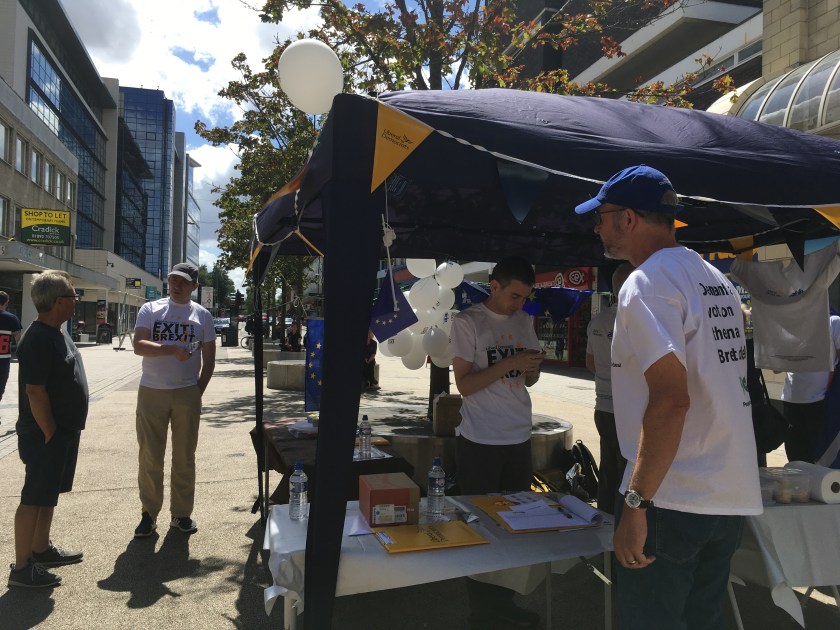
IMG_3954A Saturday morning spent campaigning in Redhill is a real eye opener.  A group of us set-up a street stall with free cakes, leaflets galore and a couple of European flags.  We set-up outside the local shopping centre to be seen by as many people as possible.  The heat of the week has gone.  At one point, the wind almost took the whole stall away as the British weather has changed to become stormy.

We collected a lot of signatures for our #PeoplesVote petition.  Whatever you do, please don’t get the wrong impression from what I write here.  The morning was a campaigning success story as so many people came over to our stall.  So, many great people to chat to about the positive things we can do to bring about change.  That said, it’s the difficult conversations that are interesting.  Here’s a few tales from the streets of Redhill.

An old Liberal friend who I hadn’t seen for many years, dead set against the European Union, was a joy to meet.  Yes, we had our differences but there wasn’t that unpleasant animosity that springs forth so easily from some people who supported the Leave vote.

One Labour voter let me know that the EU was a big capitalist conspiracy.  He was a retired railwayman.  To him the EU was responsible for all the tiresome rules and regulations that the railways had to implement.  It was as if taking the EU away would suddenly transform British railways.  Yet, as we know most of the disastrous decisions made by the current Minister responsible for the railways are purely national mistakes.

A conversation with, I would guess an East Surrey UKIP member, was kept on an even keel by our mutual interest in aviation.  He delighted in telling me stories that he though I was too young to know.  I figured out he once worked in the defence industry.  Possibly at Filton in Bristol.  It’s amazing how the bitterness of a decision made in 1965 has lingered so long in the mind.  The cancellation of the British Aircraft Corporation TSR-2 was part of his lament.  It seemed crazy that this was part of his package of reasons for being anti-EU when that decision, and many similar ones, had nothing what so ever to do with Europe.

Three or four times the argument came at me, as if it was an unstoppable force, that: “we’ve had a vote”.  That vote was enough, and we shouldn’t have any more.  A couple of, mostly older men said: “what you are doing is undemocratic”.  I felt myself getting agitated but kept my cool.  I just wonder if the people who say such things have even the slightest idea how their democracy works.  Not even one of them can claim to have stood for election in a real democratic process as many times as I have done.  Yet, they will come at you aggressively with this simple line.

In fact, they get stranger.  One guy used a football analogy that fell flat on its face.  He said: if you played a football game and lost you would have to accept the result – wouldn’t you?  To which I answered: “well, I’m just trying to win the next match as you would expect any good player to do”.  As expected that made him even grumpier.

A middle-aged woman pronounced that the Country was full.  She didn’t want to say what she meant outright but it was clear enough.

A couple of young lads passed me by.  I said: “want one of my leaflets?” and the response was – no we’ve had enough of that – people keep changing their minds.  That’s not encouraging.  The idea that changing your mind is somehow too much to cope with is disconcerting.

One older man repeated the line that he didn’t want to be ruled by the Germans.  I asked what he knew about how the EU worked and if he had been to Germany recently.  I even admitted that I had lived there for 11 years.  That was a bad move on my part.  The immortal line got thrown back at me – if you like it so much why don’t you ******* off back there.  To which the only answer is to smile and walk away.

Remarkably there were things that I found to agree upon with those in Redhill who didn’t share my enthusiasms for a #PeoplesVote.

One: Bring back Spitting Image.  What they could do with today’s dull politicians and Royals.

Two: May’s Government is doing a terrible job – mass unhappiness – nobody gets what they want.

Three: Jeremy Corbyn is the worst official opposition leader in a generation or more.

There’s a generation, most of whom had a referendum vote in 1975, who have lumped all their troubles and fears into one big bag and called it “Europe”.  Its clear, that’s not their real concern but that hardly matters.  Europe has become a proxy for a bucket load of negative emotions and troublesome fears.  Historians will not make sense of this in years to come as we can’t make sense of it now.

Calling for a referendum on the deal that the Government comes up with in the end, has its risks.  Although the pendulum is swinging against the Leave vote, there is still a hard core of disgruntled people who will shoot their own foot rather than think again.  Now, we are a terribly confused Nation.  I’m convinced that after March next year none of the people’s real concerns will have been addressed.  Stay tuned, this saga has a long way to run.

Rules, Rules, Rules

IMG_3794Let’s unbox this rule-taker verses rule-maker dichotomy.  For one it’s NOT a binary choice.  In so far as international aviation safety rule making is concerned I have seen small, well informed organisations have a major impact of new rules and large powerful Countries asleep at the wheel.

It’s an illusion to assume that rulemaking process and procedures are static.  However, this is where political machinations have a significant impact.  It may or may not be the case that the parties to rulemaking fully understand the technical issues under consideration, but it’s nearly always the case that everyone has a view on the process and procedures.

I’ve sat in high-level meetings and listened to most ridiculous things being said about important technical issues and realised the room is divided between those who knew what’s going on and those who didn’t have a clue.   So, its not surprising that the default is that people often focus on process and procedures rather than issues.  Perhaps that’s where Brexit has gone off the rails.

Consensus based rulemaking moves slowly often to the frustration of all involved.  I could say; if you are going to make a thick glue, that binds, it takes a lot of mixing.  Outcomes generally succeed or fail not only subject to the good-will of the participants but based on the hard work and quality of both leadership and secretariat.  Perhaps that’s where Brexit has gone off the rails.

In fact, a secretariat can have the greatest soft power regardless of the disposition of votes amongst the membership of a group.  The great art and skill of finding a set of words that captures the essence of a proposal, standard or report is much underestimated.

Despite having written what I have above, it remains better to have a vote than not to have a vote.  Even if the UK continues to be able in its exercise of soft power its difficult to be convinced that long-term best interests are served by becoming a rule-taker.  International rules are made by Countries working together.  The bigger the coalition you have on your side the better.  Europe working together has much more weight than a fragmented approach from individual Countries.  Considering Mr Trump’s “divide et impera[1]” world view it would be wise to have close working partners.

Today, Britain has set a course for a soft Brexit.  In the short-term that can work.  Over the horizon, its large regional trading blocks that will dominate.  Please EU Member States, throw the UK Government a life-line.  If instability continues, a real chance of another General Election or even a referendum on the deal exists.  That may be needed but its sure going to be a rocky ride.

[1] Divide and rule (or divide and conquer)

Brexit & Aviation 19

It’s that week.  Every two-years the world of aviation flocks to a small-town West of London.  Matched only by Dubai and Paris is an air show where visitors from all over the world congregate to talk about every aspect of civil and military flying.  Visions of the future and the latest products from the major manufacturers all fight for the attention at Farnborough.

This year is different.  In 2020, the Farnborough Air Show maybe taking place in a non-EU State.  The last time that happened was in Farnborough in September 1972[1].  Then, knowing the UK was going to enter the EEC the show was opened to European companies.

I was 12-years old at the time.  It’s fascinating to see the Rolls-Royce powered Lockheed Tri-Star as a “new” aircraft.   My introduction to aviation took place further West.  I distinctly remember being taken to the annual Royal Naval Air Station Yeovilton Air Day around that age.

So, what of aerospace in a post-Brexit Britain?  One thing is for certain; the Air Show organisers will not be closing the show to foreign aircraft or only others who use British parts.  Very few other things are certain.

At the same time, as the Air Show next week the negotiations between the UK and EU will resume in Brussels.   This time with a new British Brexit Minister and with a live UK White Paper on the table.  This is positive news.  However, to make the progress that the travelling public and aviation industry need the negotiators are going to have to move at supersonic speed.

It’s notable from the newsreel video of 1972 the high level of aircraft noise and emissions.  That’s an issue that has changed considerably over more than 40 years.  What was then the; “white heat of technology[2]” is, now totally unacceptable to the public.

That subject should be an area of focus for the negotiators.  The European environment is a common area of interest.  In civil aviation, for example, there’s no point in the UK and EU having different rules and regulations for aircraft noise and emissions.  Agreement on this subject should be sewn-up quickly and simply.

Addressing the global environment will be more than a few exhibits at the Farnborough Air Show.  The “electrification” of aviation is moving at great pace and represents a future market-place worth billion.  To get from A to B, well-funded research projects and flying prototypes are going to be essential.  This is another area of focus for the negotiators.  Continued European cooperation on civil aviation research funding will be the way to guarantee a place in the future.

[1] http://www.aparchive.com/metadata/youtube/bed15cead7354e0097b5001925cc0d65


[2] https://www.theguardian.com/science/political-science/2013/sep/19/harold-wilson-white-heat-technology-speech