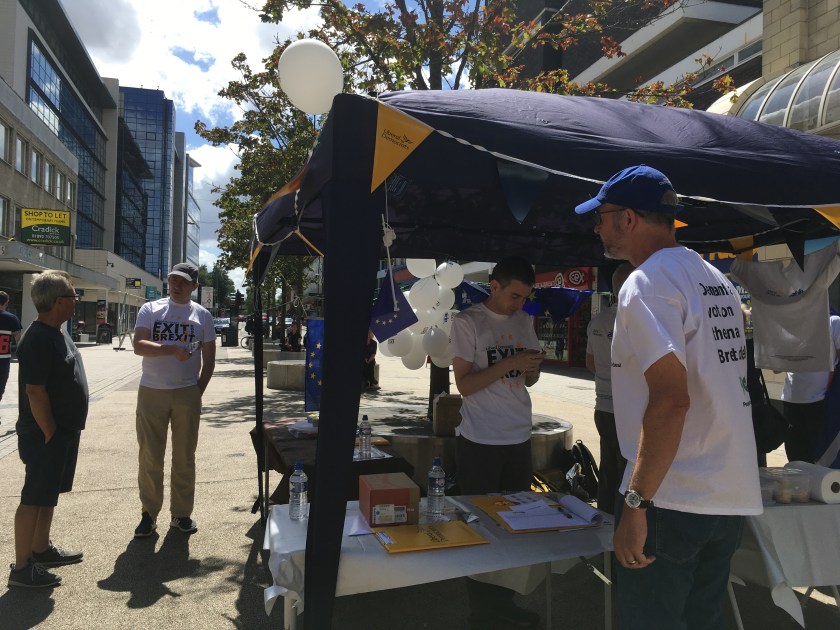
A couple of hours in Redhill Town

IMG_3954A Saturday morning spent campaigning in Redhill is a real eye opener.  A group of us set-up a street stall with free cakes, leaflets galore and a couple of European flags.  We set-up outside the local shopping centre to be seen by as many people as possible.  The heat of the week has gone.  At one point, the wind almost took the whole stall away as the British weather has changed to become stormy.

We collected a lot of signatures for our #PeoplesVote petition.  Whatever you do, please don’t get the wrong impression from what I write here.  The morning was a campaigning success story as so many people came over to our stall.  So, many great people to chat to about the positive things we can do to bring about change.  That said, it’s the difficult conversations that are interesting.  Here’s a few tales from the streets of Redhill.

An old Liberal friend who I hadn’t seen for many years, dead set against the European Union, was a joy to meet.  Yes, we had our differences but there wasn’t that unpleasant animosity that springs forth so easily from some people who supported the Leave vote.

One Labour voter let me know that the EU was a big capitalist conspiracy.  He was a retired railwayman.  To him the EU was responsible for all the tiresome rules and regulations that the railways had to implement.  It was as if taking the EU away would suddenly transform British railways.  Yet, as we know most of the disastrous decisions made by the current Minister responsible for the railways are purely national mistakes.

A conversation with, I would guess an East Surrey UKIP member, was kept on an even keel by our mutual interest in aviation.  He delighted in telling me stories that he though I was too young to know.  I figured out he once worked in the defence industry.  Possibly at Filton in Bristol.  It’s amazing how the bitterness of a decision made in 1965 has lingered so long in the mind.  The cancellation of the British Aircraft Corporation TSR-2 was part of his lament.  It seemed crazy that this was part of his package of reasons for being anti-EU when that decision, and many similar ones, had nothing what so ever to do with Europe.

Three or four times the argument came at me, as if it was an unstoppable force, that: “we’ve had a vote”.  That vote was enough, and we shouldn’t have any more.  A couple of, mostly older men said: “what you are doing is undemocratic”.  I felt myself getting agitated but kept my cool.  I just wonder if the people who say such things have even the slightest idea how their democracy works.  Not even one of them can claim to have stood for election in a real democratic process as many times as I have done.  Yet, they will come at you aggressively with this simple line.

In fact, they get stranger.  One guy used a football analogy that fell flat on its face.  He said: if you played a football game and lost you would have to accept the result – wouldn’t you?  To which I answered: “well, I’m just trying to win the next match as you would expect any good player to do”.  As expected that made him even grumpier.

A middle-aged woman pronounced that the Country was full.  She didn’t want to say what she meant outright but it was clear enough.

A couple of young lads passed me by.  I said: “want one of my leaflets?” and the response was – no we’ve had enough of that – people keep changing their minds.  That’s not encouraging.  The idea that changing your mind is somehow too much to cope with is disconcerting.

One older man repeated the line that he didn’t want to be ruled by the Germans.  I asked what he knew about how the EU worked and if he had been to Germany recently.  I even admitted that I had lived there for 11 years.  That was a bad move on my part.  The immortal line got thrown back at me – if you like it so much why don’t you ******* off back there.  To which the only answer is to smile and walk away.

Remarkably there were things that I found to agree upon with those in Redhill who didn’t share my enthusiasms for a #PeoplesVote.

One: Bring back Spitting Image.  What they could do with today’s dull politicians and Royals.

Two: May’s Government is doing a terrible job – mass unhappiness – nobody gets what they want.

Three: Jeremy Corbyn is the worst official opposition leader in a generation or more.

There’s a generation, most of whom had a referendum vote in 1975, who have lumped all their troubles and fears into one big bag and called it “Europe”.  Its clear, that’s not their real concern but that hardly matters.  Europe has become a proxy for a bucket load of negative emotions and troublesome fears.  Historians will not make sense of this in years to come as we can’t make sense of it now.

Calling for a referendum on the deal that the Government comes up with in the end, has its risks.  Although the pendulum is swinging against the Leave vote, there is still a hard core of disgruntled people who will shoot their own foot rather than think again.  Now, we are a terribly confused Nation.  I’m convinced that after March next year none of the people’s real concerns will have been addressed.  Stay tuned, this saga has a long way to run.

Rules, Rules, Rules

IMG_3794Let’s unbox this rule-taker verses rule-maker dichotomy.  For one it’s NOT a binary choice.  In so far as international aviation safety rule making is concerned I have seen small, well informed organisations have a major impact of new rules and large powerful Countries asleep at the wheel.

It’s an illusion to assume that rulemaking process and procedures are static.  However, this is where political machinations have a significant impact.  It may or may not be the case that the parties to rulemaking fully understand the technical issues under consideration, but it’s nearly always the case that everyone has a view on the process and procedures.

I’ve sat in high-level meetings and listened to most ridiculous things being said about important technical issues and realised the room is divided between those who knew what’s going on and those who didn’t have a clue.   So, its not surprising that the default is that people often focus on process and procedures rather than issues.  Perhaps that’s where Brexit has gone off the rails.

Consensus based rulemaking moves slowly often to the frustration of all involved.  I could say; if you are going to make a thick glue, that binds, it takes a lot of mixing.  Outcomes generally succeed or fail not only subject to the good-will of the participants but based on the hard work and quality of both leadership and secretariat.  Perhaps that’s where Brexit has gone off the rails.

In fact, a secretariat can have the greatest soft power regardless of the disposition of votes amongst the membership of a group.  The great art and skill of finding a set of words that captures the essence of a proposal, standard or report is much underestimated.

Despite having written what I have above, it remains better to have a vote than not to have a vote.  Even if the UK continues to be able in its exercise of soft power its difficult to be convinced that long-term best interests are served by becoming a rule-taker.  International rules are made by Countries working together.  The bigger the coalition you have on your side the better.  Europe working together has much more weight than a fragmented approach from individual Countries.  Considering Mr Trump’s “divide et impera[1]” world view it would be wise to have close working partners.

Today, Britain has set a course for a soft Brexit.  In the short-term that can work.  Over the horizon, its large regional trading blocks that will dominate.  Please EU Member States, throw the UK Government a life-line.  If instability continues, a real chance of another General Election or even a referendum on the deal exists.  That may be needed but its sure going to be a rocky ride.

[1] Divide and rule (or divide and conquer)

Brexit & Aviation 19

It’s that week.  Every two-years the world of aviation flocks to a small-town West of London.  Matched only by Dubai and Paris is an air show where visitors from all over the world congregate to talk about every aspect of civil and military flying.  Visions of the future and the latest products from the major manufacturers all fight for the attention at Farnborough.

This year is different.  In 2020, the Farnborough Air Show maybe taking place in a non-EU State.  The last time that happened was in Farnborough in September 1972[1].  Then, knowing the UK was going to enter the EEC the show was opened to European companies.

I was 12-years old at the time.  It’s fascinating to see the Rolls-Royce powered Lockheed Tri-Star as a “new” aircraft.   My introduction to aviation took place further West.  I distinctly remember being taken to the annual Royal Naval Air Station Yeovilton Air Day around that age.

So, what of aerospace in a post-Brexit Britain?  One thing is for certain; the Air Show organisers will not be closing the show to foreign aircraft or only others who use British parts.  Very few other things are certain.

At the same time, as the Air Show next week the negotiations between the UK and EU will resume in Brussels.   This time with a new British Brexit Minister and with a live UK White Paper on the table.  This is positive news.  However, to make the progress that the travelling public and aviation industry need the negotiators are going to have to move at supersonic speed.

It’s notable from the newsreel video of 1972 the high level of aircraft noise and emissions.  That’s an issue that has changed considerably over more than 40 years.  What was then the; “white heat of technology[2]” is, now totally unacceptable to the public.

That subject should be an area of focus for the negotiators.  The European environment is a common area of interest.  In civil aviation, for example, there’s no point in the UK and EU having different rules and regulations for aircraft noise and emissions.  Agreement on this subject should be sewn-up quickly and simply.

Addressing the global environment will be more than a few exhibits at the Farnborough Air Show.  The “electrification” of aviation is moving at great pace and represents a future market-place worth billion.  To get from A to B, well-funded research projects and flying prototypes are going to be essential.  This is another area of focus for the negotiators.  Continued European cooperation on civil aviation research funding will be the way to guarantee a place in the future.

[1] http://www.aparchive.com/metadata/youtube/bed15cead7354e0097b5001925cc0d65


[2] https://www.theguardian.com/science/political-science/2013/sep/19/harold-wilson-white-heat-technology-speech


Threatening Democracy

Yesterday’s newspapers have a couple of short pieces from hardened Brexiters.  The general theme is; if Brexit is thwarted, in even the slightest then; public’s rage will boil over.  Or we must go all the way otherwise no one will ever vote again.  Yes, it does get that ridiculously hysterical.

Week after week the Brexit supporters’ loose arguments but they trundled on and on.  I can’t remember the last time that they fairly and honestly won a debate without coercion.

Listening to the populist arguments from prominent Brexit supporting MPs, it’s clear they want no relationship with the EU whatsoever in the future.  The mantra “Brexit means Brexit” is still being churned out.  The foolishness of these deceiving arguments is plain to see.  Any Treaty that a Country signs with any other includes obligations and responsibilities.  The idea that we can have a beneficial and positive relationship without any of these is unreal.

It’s true that some people, who rarely if ever vote, suddenly decided to go to the polls in June 2016.  As is often the case, quite a lot were in the mood to give the Government of the day a bloody nose.  Lots went to the ballot assuming their vote would just be a momentary angry protest.  After all everyone had had quite enough of austerity and the blandness of Mr Cameron.

Now, many have recanted and would like to take back their referendum vote.  Our democracy is being threatened by the die-hard Brexit obsessives who fear the fact that a majority of people may have reconsidered.  I believe, this Country is mature enough to have a choice over the deal that is being cobbled together.  It is consistent with our pragmatic traditions.

On a Vote

It has been said that: “The UK electorate is split down the middle, but another vote would make things worse”.  Frankly, that’s not a good argument given the traditionally adversarial nature of UK politics.  You might even say that our whole British political system aims at dividing everyone into one of two camps.

What do I remember about Parliament and the House of Commons? The distance between Government Party and Opposition Party benches is two swords length.  So, don’t give me any of that nonsense about division.  Sure, I’d prefer a more consensual approach to National decision-making but that is not what we have in the UK.

The UK referendum of 1975 was so much easier in that it created a clear winner and a clear looser.  Unfortunately, after so much confusion, muddle and downright lying the 2016 referendum must go done in history as the worst exercise in democracy any Country has engaged in modern times.

Are we just to leave it there and let the British frog[1] be boiled slowly?  Or are we to say – no, enough is enough and act?  I believe, another national referendum is needed to either confirm the decision to leave or to remain a European Union Member State.  Its true there are other ways to move forward and it is a matter of our sovereign Parliament.  Will they or won’t they go for a referendum on the deal?

Let’s consider the three conditions: no referendum, referendum supporting Leave and referendum supporting Remain.

The first case just leaves the sharp divide in place and the frog gets boiled, to use that metaphor again.   However, there’s plenty of potential for a further crisis and the need for a snap General Election.  Nobody gets what they want.

In the second case, where say; in an Autumn referendum the outcome confirms the leave vote, the direction of travel continues but with a lot more resolve.

In the third case, where say; in an Autumn referendum the outcome calls for a correction of direction it can be done without too much pain.

Those who fear a referendum on the deal should think about what’s in the best interests of the whole Country.  Ironically, it’s the period we are passing through that has given most voters a much better understanding of the nature of European Union membership. More than they ever had before 2016.  Knowing what’s at stake and voting accordingly, the result would stick for a good long time.

[1] https://en.wikipedia.org/wiki/Boiling_frog


Bad Petition

It seems the ardent Brexit promoters now want to abolish the House of Lords[1].  I guess this is not an unexpected reaction to their vote in favour of remaining in the Customs Union[2].  Foolishness is rife within a vigorous but small section of the population.  We need to remember that it wasn’t that long ago that these people wanted to get rid of High Court judges and called them the “enemies of the people”.  Some are actively calling for a dictatorship to take over by exclaiming: politicians cannot be relied upon to implement the people’s will.

I have some sympathy with the call to: “Give the electorate a referendum on the abolition of the House of Lords” but only if there was an immediate democratic replacement.  Personally, I think the idea of an elected Senate where senators represent the regions of the Country, is a good idea.  That would be progressive.  What I fear with the latest call form the Brexit fanatics is an abolition of the House of Lords with no replacement and thus an elimination of the balance of powers that is essential to a modern democracy.  Dismantling our British institutions at the same time as pandering to xenophobia is a dreadful mistake.  History tells us that moving in such a direction can have catastrophic outcomes.

If we add up what Brexit promoters have achieved since the 2016 referendum one word comes to mind: shambles.  Fiasco, mess, muddle and disaster are words that could do the job too.

In normal times, the loud shouts and cries from the fringes of politics would command only a passing glimpse.  Something has changed with the national media.   Banner headline are composed more to shock and entertain than to inform.  And they all jump on the same bandwagon with just a few variations of coverage.

When a noisy few run around insulting everyone who disagrees with them, the problem is self-evident.  The House of Lords does need reform but where were the Brexit advocates when this was last seriously debated.  In fact, many of them where on the side of defending privilege, traditions and ancient institutions.

The House of Lords should not be punished for applying common sense.  I only hope the House of Commons will apply similar common sense.

[1] https://petition.parliament.uk/petitions/209433


[2] http://www.bbc.co.uk/news/uk-politics-43812360


Sunny Saturday Morning

IMG_2217It’s one thing to discuss the technicalities of Brexit but there’s nothing like standing in a High Street and talking to people.  Before the day slips from my mind I thought I’d write a few short reflections.

Our weather hasn’t shown much sign of Spring but on Saturday it was almost as if the heavens were smiling on us.  Sunshine brought lots of people out for a stroll, shopping and much else.  It’s so rewarding working with a likeminded team.  A cross-Party group of us met-up in the centre of the Surrey town of Dorking.  Determined to show that there’s a movement for change.

I approach leafleting with a smile and a greeting – would you like a leaflet?  It works.  Yes, one or two people don’t want to be bothered or smile back but that’s normal.  Who knows what’s going on in the lives of those you meet by chance on a Saturday morning.  Being respectful is essential.  First impressions matter so much.  With a badge, some stickers and colleagues around we made it clear that we were campaigning on Europe.  What we find is that the politeness and civility of most people reminds me that there’s a lot worth fighting for in Britain.

On Saturday, I’d guess no more than 1 in 20 of those I leafleted presented a negative view of what we were doing.  From them, not one original new saying came up.  Responses were mostly stock phrases, like: “We’ve voted once” or “I want out” or “the sooner we get out the better”.   Not the basis for conversation.  Generally street campaigning isn’t about arguing with people.  At its best, its more about connecting with supporters and offering information to those with an open mind.

I did engage with one guy who thought one vote was enough.  My counter argument was the fact that we vote every year in local elections and democracy is open to people changing their minds.  Much as I expected, he wasn’t moved by this way of thinking.   With a small minority there’s a kind of belligerence.  Its true of other life situations too.  Pride or stubbornness or absolute blind conviction means that little real discussion is possible.  The strange thing is often we spend a disproportionate amount of time talking about people who behave this way.

Without a shadow of doubt there’s a strong demand for a vote of the deal.  A clear majority of people we meet in Dorking want to have a choice over the Brexit deal.

The call for a #PeoplesVote is gaining momentum.  Lots support the @peoplesvote_uk campaign for the people to have the final say over the #Brexit deal, not politicians.

Wake up the sentinels

When I half remember good advice, it drives me to do a bit of research.  This week, watching all the questions being asked of Facebook, I couldn’t help but recall something I’d read more than 30 years ago.  Yes, going back that far does have relevance because fundamental questions are exactly that; fundamental.

It seems every time technology advances the law follows but several steps behind.  That’s law makers and those who sit in judgement trying to interpret tomes of law need to speed up.  It was starkly apparent to me that Facebook was getting an easy ride, as questioning politicians struggled to keep up.  Few question hit the mark or even attempted to look ahead.

For me, as for many, even research can’t be conducted without a heavy reliance on technology.  So, I searched with the fragments of what I’d remembered.  Typing into Google’s almighty search engine the two words “sleeping sentinels” because that’s what I thought was the name of a book.

Initially, I didn’t find what I wanted but what I did find was intriguing.  I wasn’t previously aware of the story of the “sleeping sentinel”.  A Union Army soldier during the American Civil War.  He fell asleep whilst on duty, was court-martialled and sentenced to be executed.  Harsh treatment indeed.  But after his death sentence was read, a pardon was read thus saving his life.  Lincoln had interceded on Scott’s behalf.

In this tale there’s an indication of the awakening of the idea of a “just culture”.  Today, people with safety related work are expected to report such a case as; falling asleep on the job due to fatigue.  In a “just culture” they should not be punished if others can learn from their experience.

I digress, since my aim was to rediscover an almost forgotten book on law.  Eventually, I came to a reference to a book called: “The Slumbering Sentinels: Law and Human Rights in the Wake of Technology”[1].  This was the paperback I remembered.

One of the tenants of the book is that the law is sleeping while technology is racing ahead.  Clear insight from the 1970s and 80s trying to consider the implications of personal commuters and alike.

Equally important to the case of understanding Social Media is the changing landscape of political campaigning.  Its only now that everyone is discovering the details of what happened in June 2016 in the UK.

Its Friday 13th and the news media is full of conflict and tension, but I hope this material gets well discussed.  It does amount to finding out, after the event, hugely significant facts about the referendum of 2016.

https://www.parliament.uk/business/committees/committees-a-z/commons-select/digital-culture-media-and-sport-committee/news/fake-news-matrix-evidence-17-19/

To quote: “192. If the Commission indeed refrains from even exercising a discretion as to whether to refer a matter to the police or prosecuting authorities until it is satisfied beyond reasonable doubt that an offence has been committed, this in our view would constitute an unlawful fetter on its regulatory discretion.”

What a dilemma.  If the Electoral Commission, police or prosecuting authorities do not respond then they are indeed Slumbering Sentinels.

If they do respond, the case could be made for invalidating the 2016 referendum.  To reassure them, as I have been saying in this article, they will not be the first to wake-up while technology is racing ahead.  It’s difficult to foresee how technology will be misused in the future especially when money is no object.  That said, we can’t ignore the facts.

[1] The Slumbering Sentinels: Law and Human Rights in the Wake of Technology (Pelican) Paperback – November 24, 1983 by C. G. Weeramantry


Our right to a referendum

I have just read “Why a second Brexit referendum is required by law” and find the arguments made in this article compelling[1].

It’s basically saying, any proposed future EU treaty that transfers areas of power, or competences, should be subject to a referendum on that treaty.  The ‘referendum locks’ introduced in sections 2, 3 and 6 of The European Union Act 2011 (EUA) form part of a broader system of control over the making of various decisions related to the EU[2].

The exit agreement that’s being negotiated by Government Ministers will, if successful result in a future UK-EU treaty.  Thus, it follows that that treaty should be subject to a referendum.  That’s not a referendum about staying in the EU or leaving it, but a referendum on the final treaty that deals with the powers and competences of the EU in relation to the UK post the leaving date.  Since there will be a transition period we know that there will be legal obligations to be met by both UK and EU.

I hope, I have understood this situation correctly as it seems eminently logical.  The EUA remains in place to date.  The reasons for the EUA being made law in the first place remain valid.  As this is the case a referendum on the “deal” is thus required by UK law. To change this the Government of the day would have to repeal this EUA and as a result take away any direct say the British people may have over a final deal and transition period.

It’s not a simple passive matter of something lapsing.  Being of 2011, it’s not an out-of-date law.  A repeal of the EUA would be an active and wilful disenfranchisement of the British people.  Quite the extreme opposite of “take back control”.  More a question of we (Conservative Government) have control and there’s no way we will let the people have a say.   Even to the extent of changing the law to stop a referendum taking place.

[1] https://www.prospectmagazine.co.uk/politics/why-a-second-brexit-referendum-is-required-by-law


[2] https://ukconstitutionallaw.org/2012/01/12/mike-gordon-the-european-union-act-2011/


Better Steps

WP_20170804_006What is needed more than anything else now is a good strategy for backing out of Brexit.  It would be ironic if those who criticised the lack of planning for Brexit didn’t have a plan to get out of it.  A road map to turn the ship of State around would help to give confidence to the world.

In the mix are legal niceties, political realities and social upsets but none are insurmountable.

The first of these, legal means, maybe the easiest.  Since there’s so little written to explain what Article 50 intended in terms of detailed process and procedures then invention is possible.  Add to that the fact that those who came up with the original words have expressed the view that the mechanism is reversible.  So, when the moment is right it’s a simple matter for the negotiators to close the books and walk away from the table.

A second factor, the politics, is difficult but day-by-day the whole Brexit road trip is becoming more and more unpopular in the UK.  For a politician worth their salt there must be the sense that, to be on the winning side, the time is right to move away from the hard liners.  To be part of the future it’s time to start making those speeches that spell out what comes next.  Not to be reactive and wait for an almighty crisis but to get out ahead and describe a better future.

On the third point, the social element, the shift could get complicated.  There is no doubt there would be a degree of revolt orchestrated by the diehard supporters of Brexit.   Even if a significant majority clearly show a wish to drop Brexit a powerful, monied and noisy group would kick out.   Unfortunately, that means some conflict may be unavoidable but it would be short lived and sporadic in its nature.

Weighing up the costs and benefits of the above, I believe there’s a clear case to drop Brexit before more damage is done.  The ways and means are not so complicated and are achievable over a couple of years.  How to make all this move forward?  The excepted wisdom of the moment is that a second referendum is needed to test the public mood.   Equally, a General Election could be the trigger for the change.   Alternatively, a realignment of the political parties may be another way to take this step.

Let’s see a confident Britain in Europe and in the rest of the world and do it now.