
Stuck in a deep dark sinkhole

Here’s a cut and paste of an e-mail that just turned up in my mail box.  It’s worth copying just to show how deep the current problems are in the UK.  In reading it must be remembered that a referendum is not binding in the UK.  What’s here is the policy of one Government or even one part of one Government.

Dear ,

The Government has responded to the petition you signed – “Revoke Art.50 if there is no Brexit plan by the 25 of February”.

Government responded:  The Government’s policy is not to revoke Article 50. Instead, we continue to work with Parliament to deliver a deal that ensures we leave the European Union, as planned, on March 29th.  Revoking Article 50 would not respect the vote of the British people in the 2016 referendum.

Almost three quarters of the electorate took part in the referendum and 17.4 million people voted to leave the European Union. This is the highest number of votes cast for anything in UK electoral history and the biggest democratic mandate for a course of action ever directed at any UK Government. This result was then overwhelmingly confirmed by Parliament, who voted with clear and convincing majorities in both of its Houses for the European Union (Notification of Withdrawal) Act. Then, in the 2017 General Election, over 80% of people then also voted for parties committing to respect the result of the referendum and it was the stated policy of both major parties that the decision of the people would be respected.

This Government has therefore been given a clear mandate to implement the will expressed by the electorate in the referendum, and to revoke Article 50 would undermine that mandate.  As it is the responsibility of this Government to deliver the exit that people voted for, and as Parliament is clear that it does not wish to deliver a ‘no deal’, we must secure a deal. However, the Government recognises the views expressed by the House that it cannot support the deal as it currently is, and we are now confident that a deal with changes to the backstop, combined with measures to address concerns over Parliament’s role in the negotiation of the future relationship and commitments on workers’ rights will secure the majority needed in the House to leave the EU with a deal.

The Prime Minister has therefore continued to work with Members across the House to deliver on the decision that the British people took in June 2016 and she will go back to Brussels to secure a deal this House can support.

Department for Exiting the European Union

To comment:

In reference to the words; “biggest democratic mandate” and “given a clear mandate” this is not the case.  A mandate comes from the majority and, as we all know the majority by which the Leave vote won the referendum was a relatively small one.

The term; “respect the result of the referendum” has become meaningless since it has been used to mean more than 101 different things to millions of people across Britain. It’s not known what the result of the referendum indicated in any detail since there was no plan for the outcome.

The reason that Art. 50 may not be revoked is said to be that this week the UK’s PM will go back to the EU in Brussels and secure a deal the UK Parliament can support.  The chance of this outcome being secured in the last 5 weeks that have to run on the clock is tiny.  The political balances within the UK Parliament favour those who wish to see the UK crash out of the EU without a deal.

Finally, the Goverement department making this public statement of policy was created for one purpose.  It would be strange if it answered differently from that above given such a bias.
 

Aviation & Brexit 65

5 weeks and a few days to the end date that was put into legislation for the UK to leave the European Union (EU).  Both Saint David’s and Saint Patrick’s Day fall before the scheduled exit day.  There’s still a small chance that the departure could be called off but, just now, the bookmakers are increasing the odds in favour of a tragic “No Deal” outcome to Brexit.

In every respect negotiation between the 27 EU Member States have gone well.  What’s not going well is when they sit across the table facing the UK.  It’s not at all clear what the UK Government’s policy is this week.  Voices off from Ministers point in several directions at the same time.  On Tuesday, the UK’s Business Secretary[1] told manufacturing leaders that leaving the EU without an agreement would be a “disaster” for the UK and said he recognised the need for clarity “as soon as possible”.   Vagueness at such a late hour doesn’t look good from any direction[2].

Maintaining a position as a world player in the aerospace industry requires substantial investments in research.  During its membership, the UK has been a prominent beneficiary of the EU’s Horizon 2020 programme.  Now, the EU is planning its biggest research and innovation funding programme ever, with a budget of €97.6 billion.  This will be called Horizon Europe.  It will run from 2021-2027.

Trying to match the efforts of the UK’s neighbours might be the ambition of some UK politicians but their current performance doesn’t offer much hope.  Funds will no doubt be tight after any post-Brexit downturn.

The aviation ties between neighbours are the most important.  Over 75% of all UK holidaymakers and 66% of business travellers go to the EU each year.  63% of all tourists and 73% of all business travellers visiting the UK come from EU Member States[3].  Putting barriers in the way of this movement of people just makes both communities poorer.

[1] https://www.politicshome.com/news/uk/foreign-affairs/brexit/news/101966/greg-clark-says-business-no-deal-fears-are-‘project

[2] https://twitter.com/CBItweets/status/1097903644970672131?s=20

[3] https://www.ig.com/uk/news-and-trade-ideas/shares-news/how-will-brexit-impact-airlines-and-the-wider-aviation-industry–180316#information-banner-dismiss


Brexit & Aviation 63

43 days left until Brexit, if it happens[1].  As the UK Parliament continues to vacillate so the European Parliament (EP) has decided.  Yesterday, in Strasbourg the EP voted through a regulation on Brexit and aviation safety.   The European Union (EU) will continue to recognise aviation safety approvals in the UK for at least an interim period in the event of No Deal outcome to Brexit[2].

The withdrawal of the UK from the EU without an agreement affects the validity of certificates and licenses originating from the UK.   A regulation proposed in December last[3], has now been debated in the EP.  Amendment were adopted by the EP on 13 February 2019 on the proposal for a regulation of the EP and of the Council on certain aspects of aviation safety with regard to the withdrawal of the UK from the EU[4].

These measures give UK based aerospace companies a short time to adapt to a new situation.  It gives some grandfather rights to approvals granted before Brexit day.

There will be decisions to be made by companies.  To go for a national approval hoping that a set of bilateral deals will be sorted out in the fullness of time.  To go for a European approval as a “third country” or by move business to an EU Member State.  Or, in fact combinations of these possibilities.

Dither in the UK.  Speedy implementation in the EU.  Draw whatever conclusion you like.

[1] https://howmanydaystill.com/its/brexit-6

[2] https://www.adsgroup.org.uk/blog/eu-aviation-safety-regulation-for-a-no-deal-brexit/

[3] http://www.europarl.europa.eu/RegData/docs_autres_institutions/commission_europeenne/com/2018/0894/COM_COM(2018)0894_EN.pdf

[4] http://www.europarl.europa.eu/sides/getDoc.do?type=TA&language=EN&reference=P8-TA-2019-0107


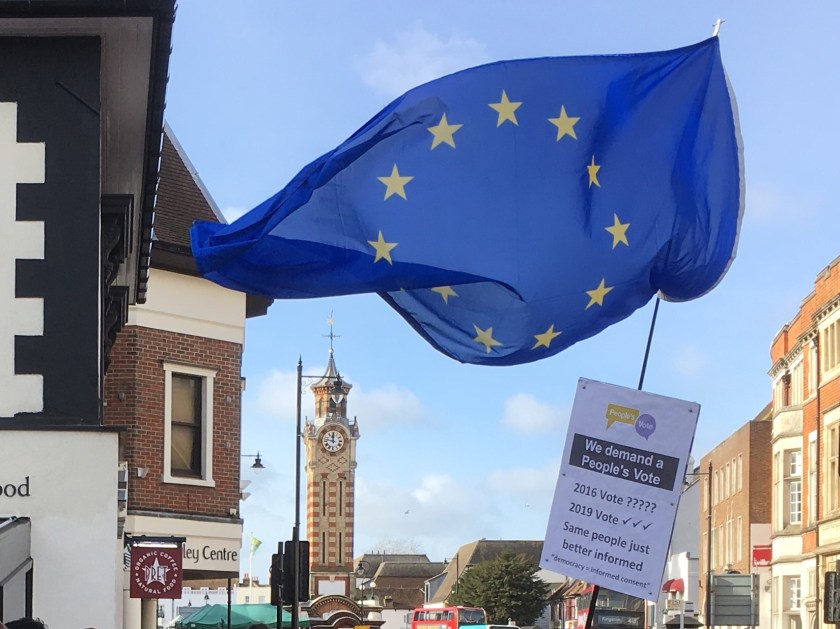
People’s Vote in Epsom

IMG_6372 (2)A good way of judging what’s perception and what’s reality to stand on a street corner campaigning for what you believe in.  This Saturday morning, with a cold wind blowing but sunshine in the sky a group of us stood in the centre of the Surrey town of Epsom.  It’s a well to do town with levels of prosperity that parts of England would love to share.   Being connected to London there are major service industries that ensure Epsom flourishes.  Its not just Derby Day.

The Brexit deal on the table provides no clarity or certainty about the future.  The signs are that Brexit will become a never-ending nightmare if we go through with it.  However, it’s both evidence and emotion that shape our view of the world and no more so than with Brexit.

Regardless of political views, in a public place there are people who engage and there are those that don’t.  On a British High Street in winter, most are busying themselves about their business and are not keen to dwell.  It’s more often that those with stronger views are the ones who take the time to engage in conversation.  My approach is to try not to impede anyone but to make it clear that I’d like to talk.  It’s easier with a leaflet in hand and a simple introduction.  So, I start: “we’re campaign for a People’s Vote – Would you like a leaflet”?  Then it’s a question of quickly gauging any response.  As a flavour of the comebacks that I got here are a few sentences on what happened.

Those who welcomed our campaigning efforts were more than happy to express a view.  A positive warmth and support came to the fore without prompting.  Frequently, there was an astonishment that the Country had got itself into such a ridiculous situation.   Everyone has a story to tell about how Brexit is affecting their lives.  Younger people were concerned that opportunities previous generations had will be cut off.

I got a warm answer from a French woman, but as she whispered – I don’t have a vote.

One middle-aged man seemed sullenly pragmatic about the affair.  His expectations were so low that he anticipated nothing better than an unholy mess.  He was grateful to see us campaigning, but he held out little hope that it would make any difference.  It’s a pessimism and sad resignation that more than a few must feel.

One guy suggested that I go back to Germany if I liked the Europe so much.  When faced with this, politeness is the only way to be.  There’s little I can say in that moment to transform his outlook.  Little Englanders are not new.

I got a couple that told me they were bored with the whole subject.  They had gone past caring what happens next.  It’s like it’s not my problem and another version of the sad resignation I mentioned earlier.

Believe me, I am not being biased when I say this, but the angrier people are Leave supporters.  It’s like they have an inner rage.  One or two will swear without any provocation whatsoever other than just seeing a European symbol.   All you hear is negative slogans right out of the Daily Mail.

Overall, the hours we spent were productive and I’m sure we offered a hope for those with a positive assessment of our role in Europe.  The indication was masses of dots on our chart calling for a People’s Vote.   Concluding, it’s clear that the last couple of years have not healed the wounds of the referendum.  Opinion on the streets is just as divided as it was when I was campaigning in early 2016.  No wonder Parliament is divided when the Country is divided.  It’s only by going back to the people that there will be any resolution to this impasse.

Blue No More

IMG_6349 (2)Today, as a traveller you don’t need to pay excise duty or tax on goods you bring in from the European Union (EU) if you: transport them yourself, will use them yourself or give them away as a gift and have paid duty and tax in the Country where they were purchased.   When arriving home from a trip abroad, we are all accustomed to the “blue” channel at UK airports.  You can bring any reasonable amount of alcohol or tobacco from the EU back to the UK, provide the local duties and taxes have been paid and that they are for personal consumption and not for resale.

That said, the rules governing customs are typically EU law and they are now directly applicable in the UK.  Since the UK intends to leave the European single market and customs union this may get complicated and means that UK law must be changed.

If the outcome of Brexit is “No Deal”, and the UK crashes out of the EU on 29 March 2019 without any agreement in place, it becomes a “Third Country”.   Thus, at a stroke, EU customs laws would no longer apply in the UK and duty between the two markets could be automatically returned.

So, the duty-free allowances are likely to change post-Brexit.  In other words, the allowances may become the same for those returning from either the EU or outside the EU.  This means losing the current more generous conditions, as quoted above.  After Brexit, returning from an EU Country may the same as returning from a non-EU Country like the USA, UAE, Australia, India or Japan.

The days of the “booze cruise” where people go over to France or Belgium and stock-up with a car load drinks for personal consumption may come to an end.  HMRC publishes information for arrivals from outside the EU[1].  That information will no doubt be updated within the next 50 days.

[1] https://www.gov.uk/duty-free-goods/arrivals-from-outside-the-eu


Brexit & Aviation 62

This week the focus has been on Northern Ireland (NI).  It may not be well known by everyone, but NI has a considerable Aerospace sector.  It’s continued success is vital to NI[1].  Aerospace contributes to over a £1bn a year to the NI economy.   It’s a deep-rooted industrial sector too.  I remember visiting Shorts Brothers of Belfast in the 1990s.  Today, Bombardier has a large workforce in NI[2].  From design to manufacture to support work, Bombardier Belfast specialises in major aircraft structures and flight control surfaces in metal and composites.  If the issues concerning Ireland become insoluble then the resulting EU-UK No Deal outcome of negotiations will damage NI and the rest of the UK.

In the UK, there are devolved administrations in Scotland, Wales and NI.  Exiting EU law applies equally across the UK but there’s concern that fragmentation could occur after EU exit.  There are efforts to ensure a common framework, but these don’t yet address aerospace or aviation with respect to UK law.   On leaving the EU single market the UK internal market needs to maintain a level playing field whist recognising devolved powers.

Brexit remains the top immediate risk to the growth of aviation in Europe[3].  Passenger traffic growth across European airports has been relatively high in recent years.  The UK leaving the EU with No Deal could lead to cap on flights and higher prices for customers.   There remains legal and commercial uncertainty for airlines on post-Brexit air travel[4].

At a time when there should be renewed intensity and seriousness to discussions and negotiations, we see the opposite from a succession of UK Members of Parliament.   Attempts to polarise and heighten tension are coming from those who foolishly wish to bring about a No Deal outcome.

Aviation cannot wait for the UK to strike an 11th-hour Brexit deal, so measures are being taken now.  With 50 days to run, time is tight.  Travellers planning business trips and family holidays after 29 March 2019 should do so with some caution.  Checking terms and conditions in detail would be a wise move.

[1] https://www.adsgroup.org.uk/about/ads-offices/northern-ireland/

[2] https://uk.bombardier.com/en/about-us/bombardier-in-country/sites/site.aerospace-belfast.html

[3] ACI Europe director general Olivier Jankovec said: “With less than 60 days left before the UK exits the EU, Brexit remains the top immediate risk.

[4] https://www.iata.org/pressroom/pr/Pages/2019-01-15-01.aspx#__prclt=QqEx89ur


Brexit & Aviation 61

Since there’s little, or no good news but there is news, it’s difficult to know where to start.  Forecasting is a fragile art currently.  We may be able to say that the UK will face a wet and windy week ahead, but we can say little about which political eb or flow that will dominate.  Thus, I’ll stick to what is known.

For one, in an aim to head off a meltdown, simplified customs processes for UK businesses trading with the EU, if the UK leaves the EU without a deal have been published.   Manufacturing, those with a just-in-time supply chain will be relieved to see goods waved through customs with a paper trail following behind.  Aircraft and parts may be allowed in to the UK at a reduced or zero rate of duty.

As the UK leaves the EU and becomes a “third country” it will cease to be part of the fully-liberalised EU aviation market.  To stay legal, knowing which jurisdiction is applicable in aviation regulatory matters is essential[1].  For this having a good understanding of the rules of ownership pertaining in the UK and the EU is a must.

For a month now, EASA has accepted early applications from UK AOC holders for Third Country Operator (TCO) authorisations.  This includes the need to produce a copy of Certificate of Incorporation/Business Registration.

For civil aircraft, it’s a matter of registration and that may not need to change.  There’s no single EU aircraft registry because the EU is not a “State” in respect of ICAO Annexes.  Each EU aircraft is registered in an EU Member State aircraft registry.  There may be implications on where an aircraft maybe kept if that is to be for a considerable period.

For organisations, the rules can be complex and dependent upon the structure of an organisation.  The authorities have issued guidance on this subject.  Where doubts have arisen, European and UK courts have been asked to rule on this subject in the past.  This I raised as a challenge for several large aircraft operators in my Blog 22 and 46.

For the licensing for pilots and engineers, the EU does not issue licences.  In every EU Member State, the national aviation authority issues licences, to standards set down by EASA.   Again, much has been said about the need for some form of recognition between EU and UK if Brexit finally happens.

54 full days remaining and there’s a mixture of options and possibilities on the table without the certainty that surely would be wise.  The burden falls on each and every individual and organisation to make a prediction and take measure to ensure that they can continue to operate.

If there’s a Withdrawal Agreement there’s a degree of certainty.  If there’s No Deal, then several temporary arrangements may not stop a calamitous impact on aviation in Europe[2].

[1] https://info.caa.co.uk/euexit/

[2] https://www.aerosociety.com/news/airbus-chief-warns-of-unbearable-uncertainty-of-no-deal-brexit/?dm_i=4OGU,H72Z,2ZCDRI,1Z8EL,1

Brexit & Aviation 60

Delay is the order of the day.  Now, there’s only 56 days remaining on the Brexit clock.  859 days since this all started with a June day.  One silver lining to the current dark Brexit cloud is that the UK Parliament is saying it won’t support a No-Deal Brexit.  However, there’s nothing to relieve the uncertainty hanging over the whole UK because even this expression of view is being ignored by the UK Government.  The UK Government says it will now redouble its efforts to get a deal.  Let’s hope redoubling is enough or surely it would be wiser to drop the whole project.

EU Council President Tusk, through his spokesman repeated that the Withdrawal Agreement on the table could not be renegotiated.   Next, the 9th February will see Prime Minister May’s 3rd attempt at a version of a Brexit deal supported by the UK Parliament.  Will it be 3 strikes and you are out?

In the latest information to UK citizens travelling to EU Member States every aspect of the advice is a degradation of exiting conditions.  Travelling post-Brexit, there’s only a downside for both passengers and airlines[1].

If No-Deal comes about there’s some highly optimistic commentators who believe that a “side agreement” between the EU and UK could cover some of the purely administrative content of the existing Withdrawal Agreement.  That said, even with this practical suggestion absolutely nothing is assured.

In the aviation regulatory world, it’s reported that the UK Civil Aviation Authority (CAA) is in the process of rebuilding itself after scalling back following the creation of EASA in September 2003.  The UK CAA has said it wants to stay within the EASA system after the UK exits the EU.  However, this possibility is looking unlikly for all the political reasons that are piling up every day.  The UK’s exit from the EU will have a severe impact on the UK aviation industry.

In civil aviation, large organisations have an Emergency Response Plan (ERP).   International standards recommend planning.  It’s normal, once a plan is in place to conduct an exercise to ensure that everyone has a clear understanding of its process and it stands up to rigorous testing.   I’ve been part of several such exercises in Europe.  My experience is that even with the most elegant plan, carefully prepared, the real-life impact of using it is often incredibly revealing.  Situations are constantly evolving, and all parties must move rapidly in order to anticipate risks and adapt accordingly.  Often communication and behaviours turn out differently than expected.

Yes, on both sides preparations are being made for the worst case No-Deal scenario, but they will all be untested.  If more than one crisis occurs at any one time more than double the effort is needed to resolve the situation.   The implementation of any such No Deal plan will not be a matter for one organisation but a continent of 500 million people.   If anyone thinks that will go smoothly, I just have to say that they have no experience of the real world.

[1] https://www.aerosociety.com/news/no-deal-no-flights/

Brexit & Aviation 59

I’d like to congratulate the UK Civil Servants who have been set an impossible task.  The stream of publications for UK nationals living in the European Union (EU), the European Economic Area (EEA) and Switzerland if the UK leaves the EU without a deal on 29 March is impressive.  Basically, they say the UK Government continues to negotiate Brexit even if that’s one sided.  There’s a dose of reality in some of the statements, like: “The rules for travel to most countries in Europe will change if the UK leaves the EU with no deal.”  There’s always a disclaimer asking the reader to note that the information provided is a guide only.   There’s also a reassuring note that; in the event of changes to rules or processes after 29 March 2019, the UK Government will update this page as soon as information is available.

Now, there’s 57 days remaining on the clock.  Informed analysis says that there’s no time left to be able to paper over all the cracks that will appear on Brexit day[1].  UK MP’s are talking about putting in extra hours.  Nevertheless, it would be extraordinary if all the topics that needed to be covered were covered in such a short time[2].  There’s also UK MPs talking of “a technical extension” of Article 50, if a new deal can’t be legislated for in time.  Nothing is fixed.

So, the reality is that we have one of the world’s mature democracies, influential States with a long history is heading into an abyss.  Prime Minister Theresa May’s Brexit plans have been chaotic and dysfunctional from day one.  But there’s been plenty of time to make mistakes, learn from them and then put it right.  Unfortunately, this has not been done, held back by political arrogance.

In the aviation industry one of the great successes over decades has been the ability to make mistakes, learn from them and then put it right.  It’s one the reasons that flying is as safe as it is across the globe.  A culture where people can honestly admit to error and sit down with their colleagues to fix problems is an advanced one.  In the long-term, this approach works to the benefit of everyone concerned.  In aviation, those who are looking for partnerships and business opportunities value stability, a level playing field and the rule of law.

Back in 2016, some campaigners said – not a single job – would be lost due to Brexit.  That statement, and many like it, now appear extremely foolish and dishonest.  To date, the UK’s referendum has delivered nothing to the advantage of UK citizens.  In a graphic illustration of how strangely ridiculous the situation has become, this TV clip from the BBC’s News at Six showing archive footage of Second World War aircraft, joke or not, is in bad taste to say the least[3].

[1] https://www.instituteforgovernment.org.uk/publications/brexit-two-months-go

[2] https://www.standard.co.uk/news/politics/brexit-news-latest-theresa-may-moves-to-scrap-half-term-for-mps-in-panic-over-brexit-a4053946.html

[3] https://www.standard.co.uk/news/politics/bbc-news-gaffe-sees-second-world-war-footage-played-over-theresa-may-brexit-item-a4053676.html


Brexit & Aviation 58

I must confess that I never thought that the situation would become as bad.  To a limited extent, it hasn’t yet got that far – yet.  Some have taken the view that a No Deal Brexit is off the table and exits only as a scary story to push discussions forward.  The problem is that this view is optimistic when considering the performance of the negotiating parties over the last couple of years.

The cold facts are that preparations for a No Deal Brexit outcome are being stepped-up.  Radical Leave supporters are celebrating the prospect of a No Deal Brexit.  This is done without any consideration of the consequences of such an irresponsible approach.

After the failed vote of this week we now have an elaborate lobbying exercise going on, but I don’t see compromise coming out of any cross-Party talks in Westminster.   It’s highly probably that the UK will be a “third country” without any extant arrangements or deals from 30 March 2019, 00:00h (CET).  With 70 days to go this is a tragic situation.

There’s an opportunity on this coming Monday for the UK Prime Minister to turn this around.  But it would mean removing “red lines” that have so constrained discussions.

In the airworthiness world the impact of a No Deal Brexit is being spelt out[1].  There’s no precedent for this situation.

EASA certificate for products, parts and appliances issued to holders in the UK will no longer be considered as certified in accordance with EU rules.

Certificates issued, before the withdrawal date by the UK CAA, in accordance with EU rules will no longer be valid.  Over night, UK engineers would lose the right to sign off EU aircraft.

There’s more that impacts aircraft operations.   I imagine this will prompt a stream of people and organisations contacting EASA to find out what can be done.  None of this work is productive.  None of this work will enhance aviation safety.  None of it would be needed if a comprehensive agreement is forged or Brexit is abandoned.

[1] https://ec.europa.eu/info/sites/info/files/notice_to_stakeholders_brexit_aviation_safety_rev1_final.pdf