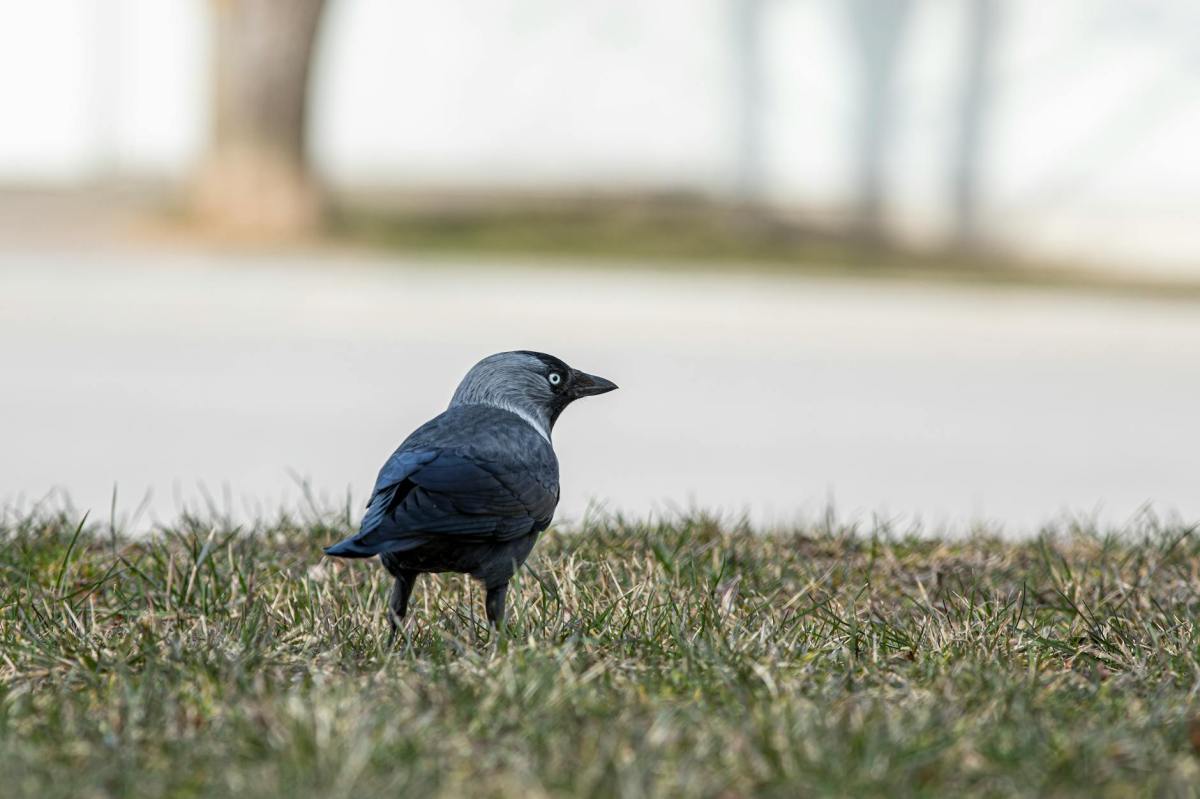
The Intriguing Life of Jackdaws

As the grass turns brown, the sun beats down. Me, I just a lawnmower[1]. Now, that’s probably the daftest lyric that has ever been written in the history of rock. As I look out of the window at the parched grass there’s no way I’d take my lawnmower to it. If I did there would be nothing, but dirt left in its wake. Stubborn deep-rooted weeds and dead moss.

It’s summer. It’s unusually dry. Although, as the sun came up this morning, looking out of the bedroom window, a thin mist covered the ground. That was early. Between 4am and 5am. A thin white mist, low to the ground, must refresh the grass just a little. Most of nature sleeps.

As the morning progresses its not long before one dominant sound fills the air. It’s not the cars on the nearby road. One species of bird has adopted the tall trees, field next door and my garden. They are not a quite bird. To those that know their call is instantly recognisable. Their sound isn’t musical like some birds. It’s an incessant chatter. Loud and repetitious.

Jackdaws are having no trouble despite the dying grass and rock-hard ground. Our community of noisy birds is thriving. I guess their advantage is that they eat just about anything that’s going. Not much concern about predators as they take no care to hide their presence. I’ve seen them happily mocking larger birds. Showing off seems to make them happy.

As far as evolution goes, they have a lot of advantages. Equally agile hopping around on the ground as they are swooping and diving from tall trees. There’s no doubt they have a complex social etiquette. One or two minutes watching how they interact gives this away. Bigger, more mature, birds intimidate the younger ones.

Can’t say I like them much. More that I admire them for being so savvy. Jackdaws look as if they own the place. It’s not my garden. They are saying, we come a go as we please, you can share the space if you like. Sooty black masters of the airspace.

We’ll tolerate each other mainly because we have no other choice. Trying to scare a jackdaw is a fruitless task. They learn quickly. Soon sussing out that they can get the better of you.

As the sun beats down, I lay on my lounger. Listening to the endless chatter. Me, I’m just a bird feeder. Watching as the skies fill with shiny black dots. There for moment and gone the next.


[1] https://genius.com/Genesis-i-know-what-i-like-in-your-wardrobe-lyrics

Local Wildlife

I’m wondering – what is the definition of a marsh? This has been a wet February. It’s now passed having left water, water everywhere. Put my Wellington boots on, and underfoot a squidgy noise comes from the waterlogged ground.

On the plus side, saturated fields are great for the local wildlife. Not so great for simply walking. It’s a season of mud and trodden down grass. Puddles and soggy pools. The water weaves its way through a boggy marsh. It spreads out in a minor flood, covering sedges and fence poles. There’s that word again – marsh. Still wetland.

That said, so many English marshes have been drained to create fertile agricultural land. Over decades fields have been “improved” by engineering drainage to turn swamps into workable farmlands. Sometimes with limited success in the winter.

I grew up on Horsington Marsh. The name that lives on. It’s farmed grassland with much of it liable to annual flooding. A clay valley of marshland formed between a winding brook and a temperamental river. Bow Brook and the River Cale. Both these eventually met up with the River Stour and head on down to the coast in Dorset.

Now, I live looking out on the lower part of the River Lambourn. In shape and form are totally different from the Cale or Stour. The Lambourn is shallow and fast flowing. It’s a chalk river that’s normally crystal clear. Locally, it does spillover into the fields. It’s a superficial flood that soaks riverbank.

The River Lambourn Special Area of Conservation (SAC) is a protected site[1]. Which means that there’s plenty of information on the wildlife habitat and the threats to the river. One of the biggest threats to the river is a water company. Thames Water storm overflows discharge into the river. It makes me wonder what it means to be a protected site.

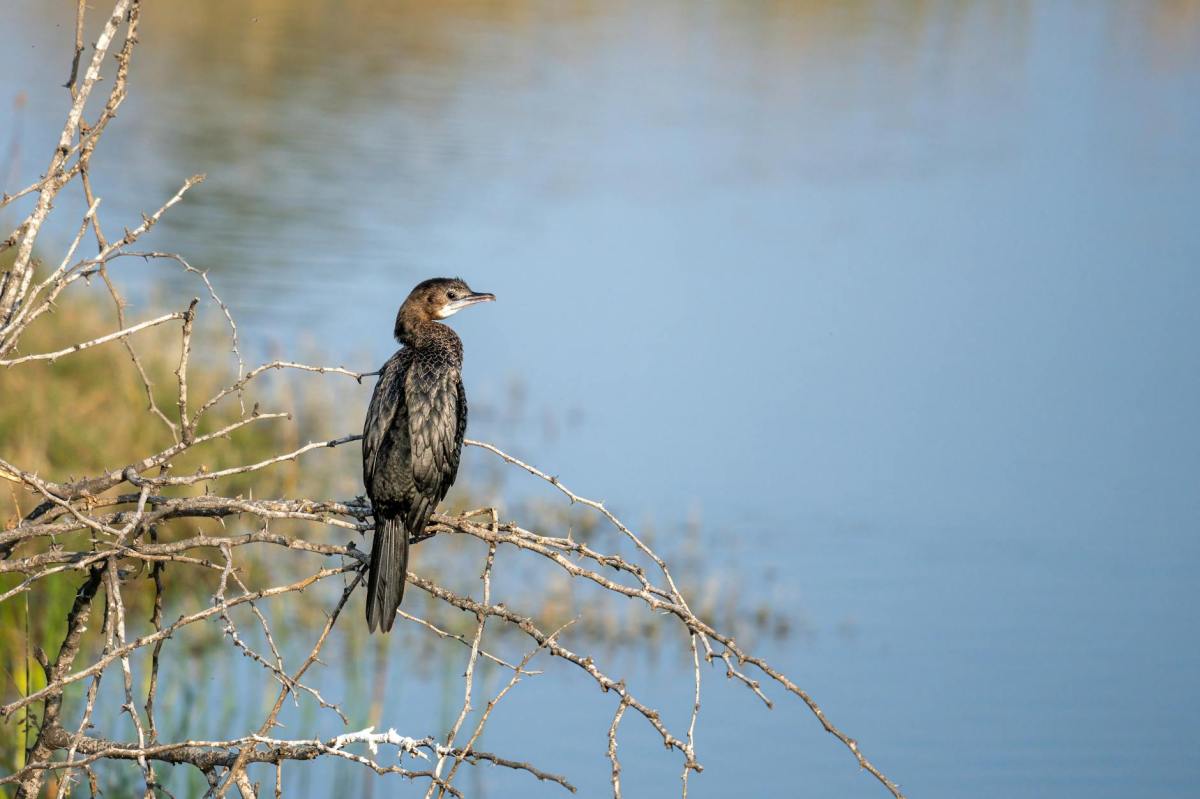
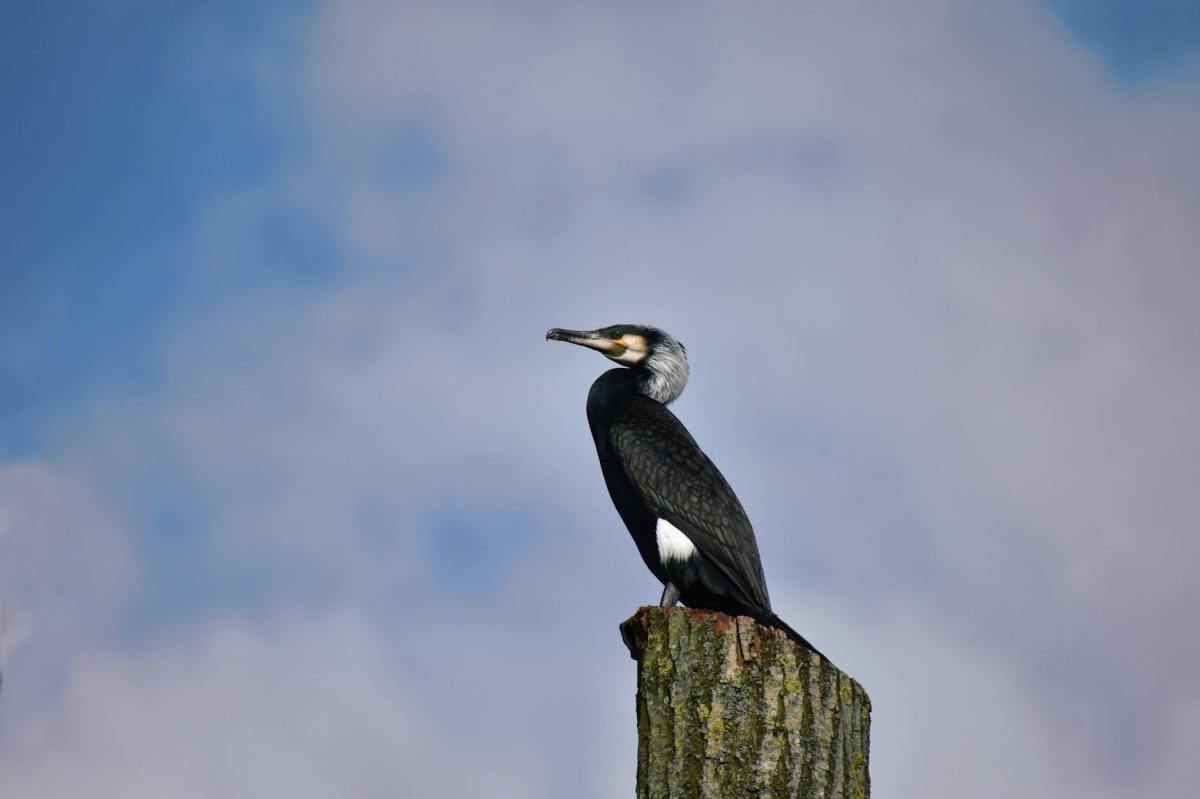
The river has many different fish species. Most of all the Trout and some Grayling. Feasting on these we have Herons and Egrets. This week, I was surprised to see a large Cormorant[2] high up in a tree, wings spread, enjoying the morning sunshine.

So, however marshy the rising ground water and overflowing river might make it, there’s nature just outside the back door.


[1] https://www.westberks.gov.uk/article/41082/River-Lambourn-Special-Area-of-Conservation-SAC

[2] https://www.rspb.org.uk/birds-and-wildlife/cormorant

Snakes

Daily writing prompt
What’s the thing you’re most scared to do? What would it take to get you to do it?

Scary? That’s the moment when Indiana Jones is sealed into a tomb full of snakes. A young Harrison Ford, as Indiana Jones finds himself face to face with his worst nightmare[1]. 100% that would be me. If asked to step into a room full of hissing snakes, I’d run to the furthest hills.

Now, here in the UK, Channel 4 are airing a series called The Fear Clinic[2]. It makes great watching. If you have a strong phobia, you are not alone. Rats, mice or small dogs, I can understand. For me, those don’t kick-off a fear response, but I can understand.

The approach taken by the Amsterdam clinic in the TV series is to “encourage” their clients to face their worst fears. That’s supposed to trigger a cure that lasts. For some people that does seem to be the positive result. I guess we are not shown any destructively negative results of clients confronting their worst nightmares.

If asked to enter a room filled with slithering snakes, I’d be shouting “help” very loudly indeed. Luckly, since I have no need to encounter lots of snakes, I have no need to find a cure for my fully rational fear. The last time there was a snake looking at me, he/she was sitting behind solid glass[3]. Sitting on a tree branch not the least bit concerned about me standing there feeling uncomfortable. Safely I passed by trying not to make eye contact.

Since we are now entering the Year of the Snake, I ought to be careful.


[1] INDIANA JONES: RAIDERS OF THE ARK – The Well of Souls

[2] https://www.channel4.com/programmes/the-fear-clinic-face-your-phobia

[3] https://www.tripadvisor.co.uk/Attraction_Review-g190745-d1575308-Reviews-The_Living_Rainforest-Newbury_Berkshire_England.html

Pheasant

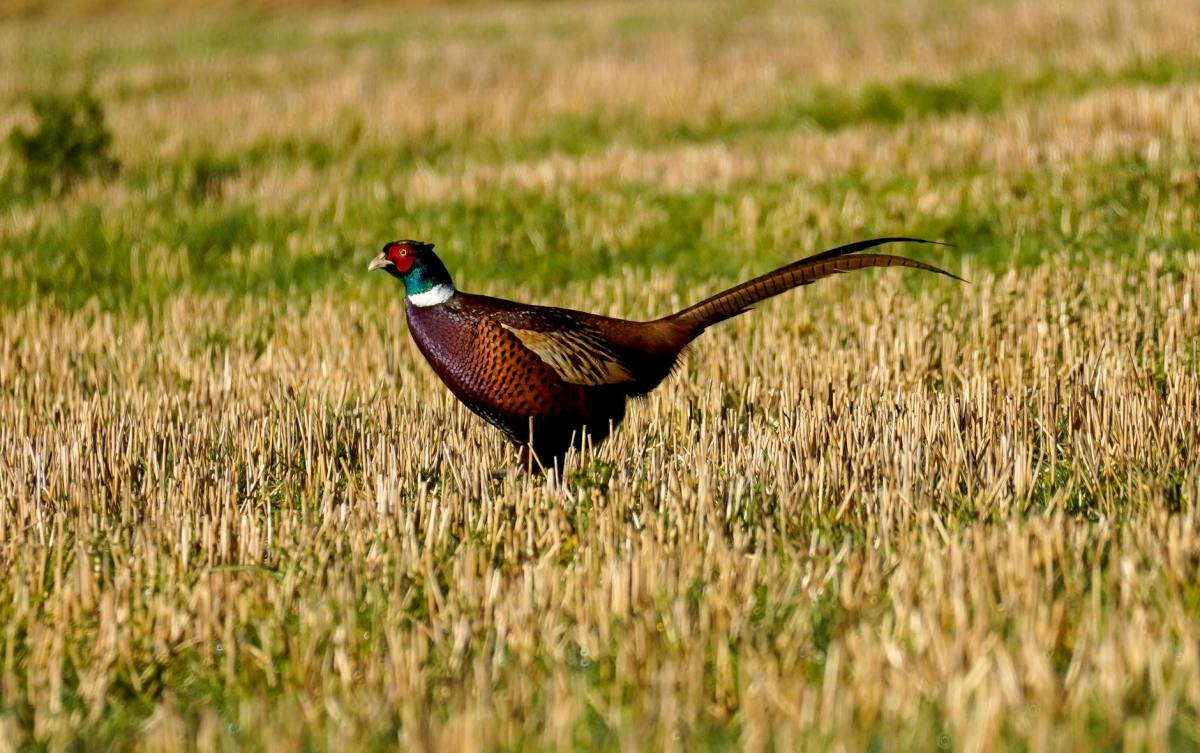
It’s a wonder to me that common Pheasants[1] survive at all in the wild. I guess they are of a certain size that means there are not so many predators in the English countryside. Their greatest predator is us. Males are particularly colourful and stately in appearance. Quite unlike the Canadian Geese who inhabit the riverbank, Pheasants walk like well-dressed gentlemen on their way to the theatre. They rarely take to the air. It’s such an inconvenience. They don’t so much dive and swoop as much as hop and jump.

Here we have a bird that surveys the world from the roof of our small garden shed. He likes the garden fence as much as plodding around on the lawn. Never troubled by the other bird life, it’s as if he’s related to royalty. Male Pheasants are definite show-offs.

A lot of UK Pheasants are reared for shooting. They are “non-native” birds. That doesn’t seem so much like sport to me. It’s more like shooting fish in a barrel. Love that wonderful idiom. The lack of self-awareness exhibited by the male Pheasant that visits us suggests that shooting him would be a pointless exercise. It would just be a way of covering the ground with lead shot.

Now, that springs to mind a traditional tongue twisting rhyme, namely:

I’m not a pheasant plucker,

I’m a pheasant plucker’s son,

But I’ll keep on plucking pheasants

‘Till the pheasant plucker comes.

One thing to try is to say the rhyme slowly and then speed-up each time you repeat it. It’s bad enough for native English speakers to master that one.

That simple English rhyme has some heritage[2]. As a modern idiom the pheasant plucker can become a pleasant, well you fill in the next word. It has an “f” at the start. If we had wandering bands of minstrels in 21st Century England, then I’m sure they would make something of those more challenging words. It would probably be done on an iPad in a blackened-out bedroom and launched on social media first.

Maybe we need a cyberspace version of a cobbled stone village square where such nonsense can be attempted. One that’s not owned by a massive corporate proprietor determined to scrape advertising revenues out of it. A place for off-the-wall acts to test their metal. And not one that’s a desperate scrolling fest for bored fingers. Not so much a Tick and a Tock but a gather round experience, I’ve got something interesting to show you. A curious audience gathers and stays for more than 10 seconds. A lively cultural experience is put-on to delight and amuse.

Let’s just say our structing pheasant inspired this thought. From birdsmith to wordsmith.


[1] https://www.rspb.org.uk/birds-and-wildlife/pheasant
[2] https://www.learnarhyme.com/tongue-twisters/pheasant-plucker

March

The North wind doth blow and we shall have snow[1]. Well, today on the first day of March and it’s more of a gusty North Westerly wind and heavy rain. The snow maybe falling on high ground in the North of England but here in the South the temperature remains mild. Although, the line on the thermometer is slowly descending.

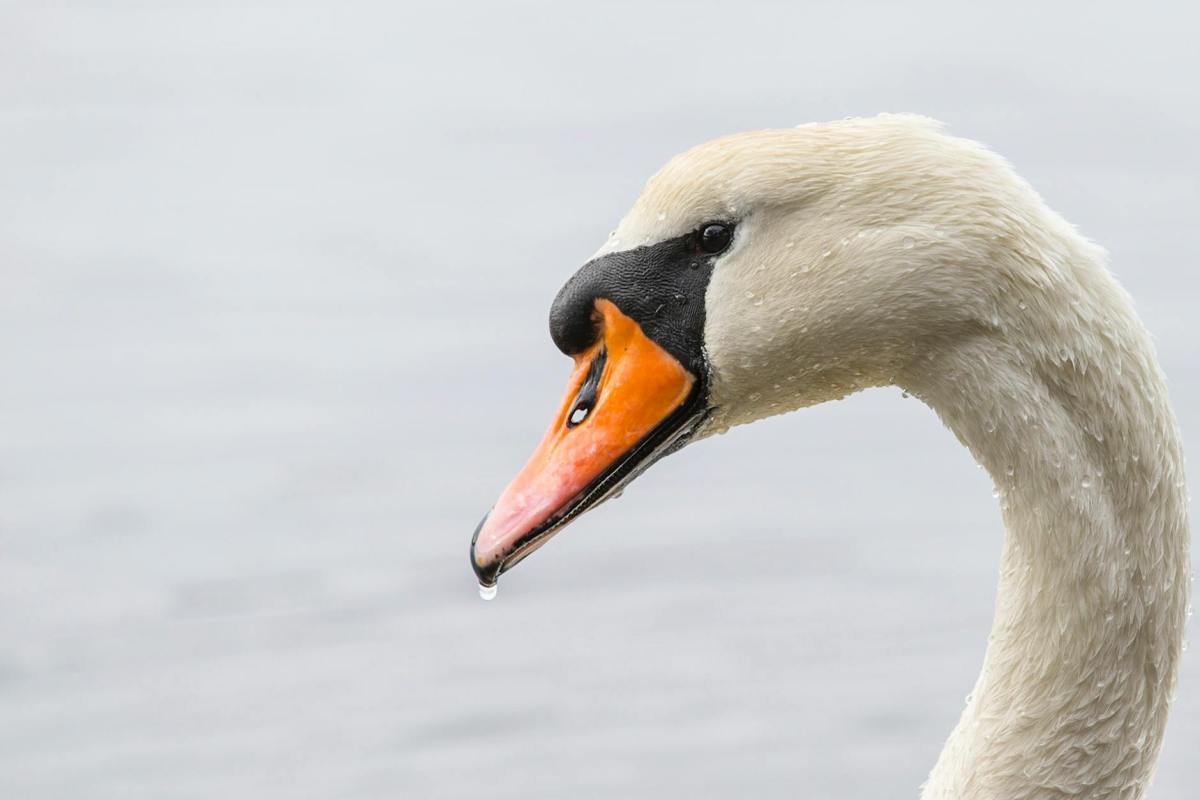
The flood in the small field out back waxes and wanes but is far from drying up. In fact, the extent of the water is greater now than it has been in a while. A lone Swan rests close to the riverbank. Not fussed by the driving rain. That makes me curious, where is its mate? On previous occasions, we have seen a pair of Swans cruising up and down the river Lambourn.

March comes in like a Lion[2]. That’s as true as it ever was of our weather, but will the next part of the saying happen as the month rolls on? Will March leave like a lamb? Winter may still have a sting in its tale. A misty wet March is in prospect.

March is always a month of transition. It certainly is for me. Having a birthday in the middle of the month is quite a good time to clock up another year. I never count winter as being behind us until I’ve put a candle on a cake. There’s an idea for a folksy modern saying.

There one more snowy white bird prancing around at the waters edge this morning. He or she is rather elegant small bird. It’s interesting to note that this bird was first recorded as breeding in Berkshire in 2007. Our visiting Egret[3] is dipping into the grass surveying the flood water with confidence.

Fishing is not just the exclusive rights of the Egret. There’s a slim tall Heron[1] who looks very regal. My guess is that the flood water has created small pools within which some small fish have become trapped. That’s a nice easy meal for a patient Heron. With spindly legs standing in the wet grassland any small fish would not see their fate coming.

As the sun has come up both Swan and Egret have moved on. The flood has been left to the ducks and geese. I don’t mention the Crows, Magpies and Pigeons. Although I just have. The wildlife seen from my window doesn’t mind gusty, wet, and windy anything like as much as I do.


[1] https://www.rspb.org.uk/birds-and-wildlife/grey-heron


[1] https://songsofchildhood.wordpress.com/2011/10/31/the-north-wind-doth-blow/

[2] https://www.theparisreview.org/blog/2015/03/02/folk-wisdom/

[3] https://www.wildlifetrusts.org/wildlife-explorer/birds/herons-egrets-spoonbill-and-crane/little-egret

Wild

Looked out this morning and there was a couple of geese to add to my list of sightings. The flooded field out the back attracts numerous birds and wildlife. Wet grassland is just right for them to be happy. Egyptian geese[1]. A pair was plodding around. Given their different colouration, I assume they were male and female. One was slightly larger than the other. These two steered well clear of the gaggle of grazing Canadian geese. As geese go these are about twice the size of the Egyptians.

Now there are distinct advantages in having webbed feet. Soggy ground and shallow waters are just right for the duck and goose community. As the light rain returns a couple of pairs of Mallards[2] takeover the riverbank. Swimming around each other and dipping and diving as they go. There’s an abundance of food so I expect to see many more waterfowl in coming days.

It rained overnight so there’s no signs that the flood water as receded this morning. There are ripples on the surface of the flood water as the wind is quite strong and gusty. That has a dying effect. So, the waters may easily follow natures calendar and return to the riverbed in the coming weeks. The trees are still winter bare. Up close they look different with buds already to go. March will be a month of change. The colours will start to change.

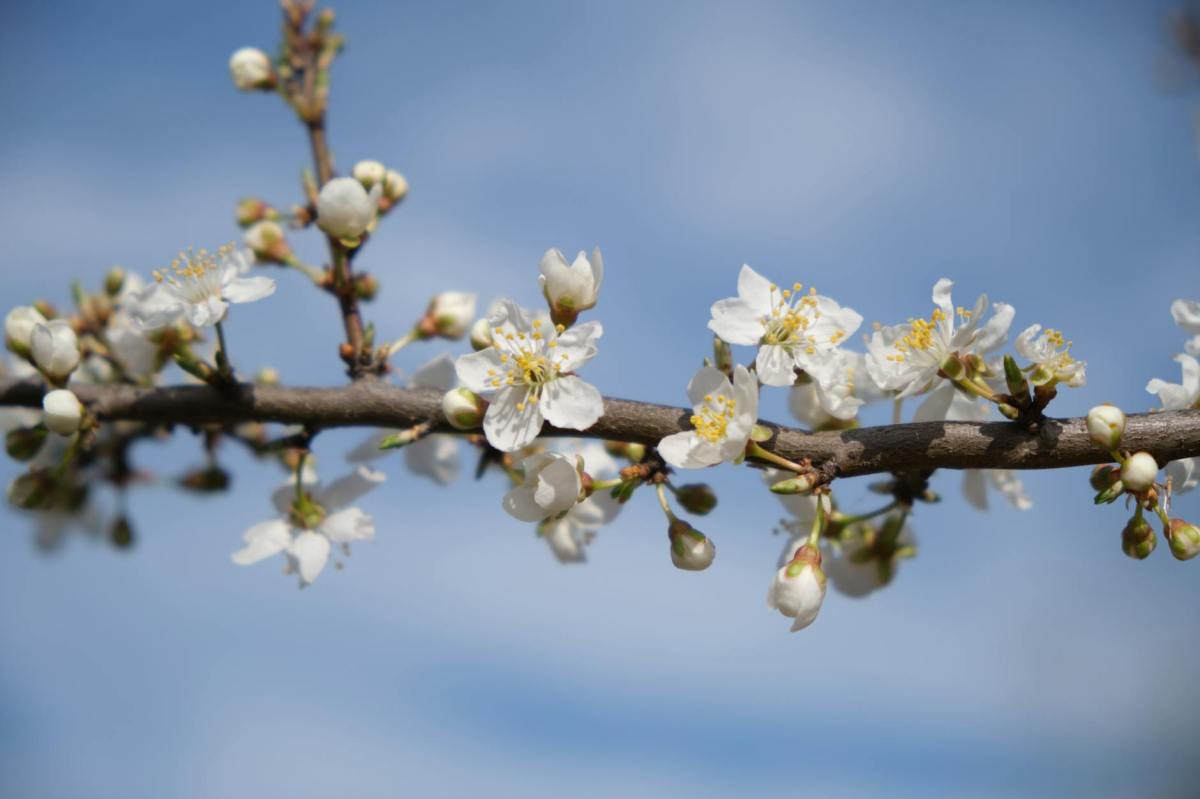
I say these things, but I remember standing in the snow on my March birthday. Winter’s being mild this year. It can still have a sting in its tale if it wants to upset us all. A sudden plunge into ice can still reset the calendar. Snowdrops have almost been and gone. Daffodils are showing at their best. The local hedgerows are full of Blackthorn blooms. That’s early.  

I don’t think I’m confusing the Blackthorn[3] and Hawthorn. The Hawthorn has often been considered a symbol of rebirth. That’s associated with the month of May and Springtime. One comes out before the other and seeing so many white flowers in late-February they must be Blackthorn. Even so, flowering now is a marked indicator that the seasons are changing. Climate change?

The blossom of the two hedgerow thorns is similar in shape and size. When they get buffeted by the wind the ground can get covered by a carpet of bright white petals. The distinction is that the Blackthorn has dark round black berries in the autumn. In fact, I’d refer to the whole thorn bush by the name of the berries, namely Sloes. Birds like them but I’d not recommend tasting them given their sharp bitter nature. The Sloe is better known for what it can become. That’s as English as the hedgerows. Sloe Gin[1] has been round for hundreds of years. It’s well worth a go.


[1] https://www.plymouthgin.com/en/product/plymouth-sloe-gin/


[1] https://www.rspb.org.uk/birds-and-wildlife/egyptian-goose

[2] https://www.rspb.org.uk/birds-and-wildlife/mallard

[3] https://www.woodlandtrust.org.uk/trees-woods-and-wildlife/british-trees/a-z-of-british-trees/blackthorn/