
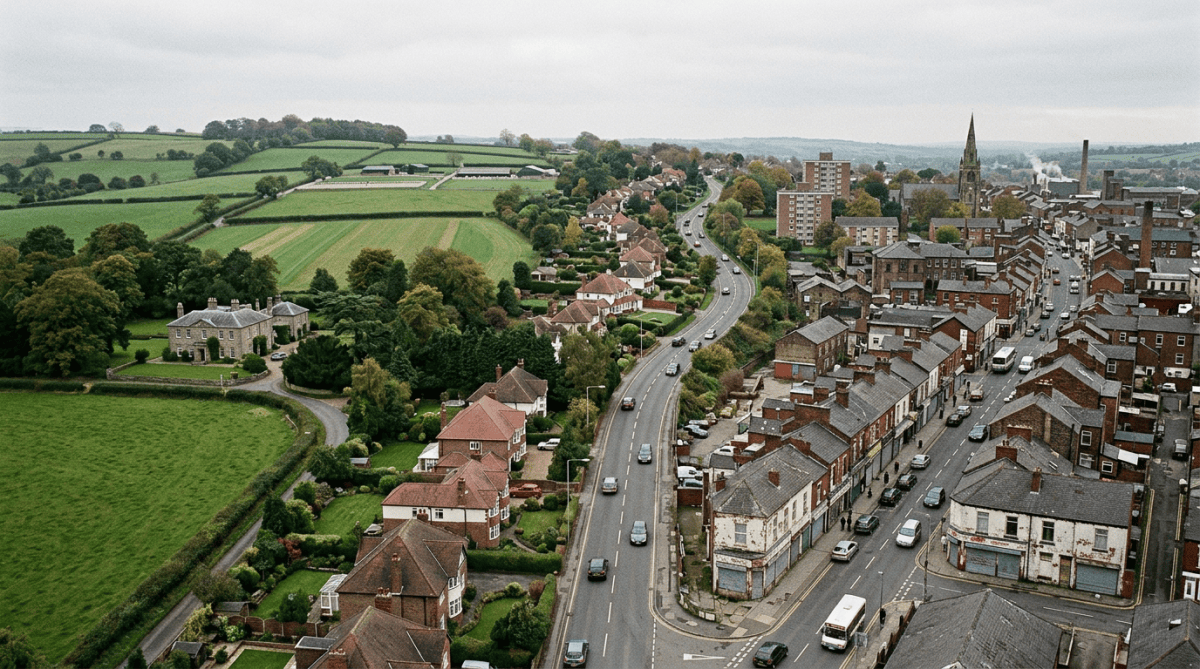
England is a mix of colourful contradictions. Up and down the country it’s possible to see towns orbiting around each other. Constellations of complex heritage. Some on the up and some struggling to find their way in the 21st Century.
For effect I’d call this the posh and non-posh place. Or in a much cruder sense, rundown and gentrified, although that’s looking at the extremes. Each of these orbiting towns has their prosperous and not so prosperous side. Duopolies exist everywhere. They often live cheek by jowl with each other. Close in geography. Distant in life experience of their residents. Sustained by different economies. Treasured or neglected for different reasons.
These colourful contradictions get absorbed into cities as they expand. In South London, it’s intriguing that Dulwich and Peckham are close in geography. Miles apart in life’s experience. Move a few streets and everything changes.
There are a couple of examples that are part of my moving around in the last 40-years. The good old BBC fills TV broadcast hours with endless repeats of Top of the Pops. I’m not being negative about this evening filler; it’s a reminder of the cultural journey the country has taken.
My 1970s duopoly was Sherbourne and Yeovil. One characterised by Goodbye, Mr Chips[1] and the other with that often-found duopoly, aviation, and agriculture.
My 1980s duopoly was Cheltenham and Gloucester. One vibrant regency town and one small historic city with a much lower cost of living.
My 1990s duopoly was Reigate and Redhill. One affluent residential town and one railway town with a sprinkling of industry.
My 2000s duopoly was Cologne and Dusseldorf (Germany). One cathedral city dating from the Roman times and one Rhineland industrial city that drinks a darker beer.
My 2020s duopoly is not so easy to discern. Newbury, where I live, and Reading next door, are both Berkshire[2] towns but one is much larger than the other. Although they share the River Kennet, a motorway, and a Civil War history the two English towns are not that often linked, one being considered more rural and the other more urban.
Why is this my subject? During the week I spent a few hours in Weymouth and then Dorchester, A Dorset duopoly if ever there was one.
How difficult it is to draw lines on a map. It’s one thing to take the legacy of ancient counties and the heritage the Romans, Saxons and Normans left us. The problem is that encompassing places with dissimilar needs imbeds complexities. There’s a geographic element to the politics of this country. Forging a national unity across those boundaries is an ever-present challenge. A seaside town looking for investment needs consideration that’s at variance from an affluent town that’s always been a busy crossroads.
In England, so much public attention is focused on Westminster politics. Day-to-day, what really matters is what is happening in these communities, these towns. Local administrations do their best. Sadly, central government values them as much as it might value a checker on a checkerboard.
[1] https://www.imdb.com/title/tt0064382/
[2] https://en.wikipedia.org/wiki/Berkshire


