
Brexit & Aviation 70

I wrote the first of my Brexit & Aviation series a year ago.  Now, this is the 70th one.  A year ago, there did seem to be some form of honest negotiations going on.  Commentary often considered and reasoned over the pros and cons of different approaches to Brexit.  When I said: “Brexit is going to complicate aviation in Europe.” I didn’t realise the level of understatement those words entailed.   Complexity is one aspect of the problem.  It’s the confusion of not having a sense of direction that doubles the troubles.  It’s the legs that fake news strories get that is concerning.

“It has been quite shocking to get so far in the political process without having any real clarity about the future. That can’t be positive for the economy.”  That’s not my writting but that’s the words of Willie Walsh Chief Executive Officer IAG in their Annual Report.

Last year, the possibility that the UK would retain membership of the European Aviation Safety Agency (EASA) was real.  Now, bit-by-bit this possibility is waning as a predominantly anti-European tone has been set by the current UK Government.  The implications of Third Country status are being played out as preparations continue for a No-Deal Brexit outcome.  Industry is taking measures[1], and planning more, to insulate itself from the hard-line taken by Conservative politicians.  Large costs are being incurred and it isn’t going to be long before those cost get passed on to the paying passenger.  Although strangely there are some bargains offered for flights and holiday packages because prices factor in an incentive to overcome the caution and level of uncertainty people feel.

A year ago, I did say: “There’s a chance of reaching Brexit day with no clear vision of the future”.  My crystal ball must have been working overtime that day.  Lawmakers are not doing their job.  In normal times there’s a rigorous sequence that is followed that tests legislation before it hits the statute book.  The extream brinkmanship of the last year leaves the UK with a huge to-do-list and no time to practically test new legislation before it’s enforced.

There was an expectation that Bilateral Aviation Safety Agreements (BASAs) would be signed between the UK and others.  This would be used to detail the cooperation between the UK and others, including any mutual acceptance of certificates.  Unless I am mistaken, there isn’t much signed between anyone at this moment time.

A great deal of the difficulties that the UK faces are associated with the “red lines” that have been the policy for the UK Government.  These have tied the hands of all those involved in negotiations to such an extent that an impasse was inevitable.  UK Brexit advocates dismissed talk of duplication of activities and costs with no tangible benefits.  Nevertheless, that is the position the UK finds itself in.

Next week, if an Agreement is accepted the UK will have until 31 December 2020 to solve the thorny issues of international aviation.  During that time that UK will have many of the obligations of an EU Member State but no so many rights.   If an Agreement is not accepted then it’s back to the drawing board – again!  The prospect that Brexit will fail is becoming real.  Maybe that’s why the £ has gained value.

I think, the UK House of Commons is likly to reject Prime Minister May’s Deal next Tuesday.  Then on Wednesday it’s likly to reject a No-Deal outcome to Brexit.  An impass in the UK Parliament should then trigger a return to the people of Britain.  With so little time remaining on the clock an extended Article 50 period seems certain.  If I’m wrong in these predictions then I’m still no worse a sage than UK Ministers and MPs in Parliament if the recent International Trade Committee is anything to go by.

[1] https://www.aviation24.be/airlines/ryanair/ryanair-moves-spare-parts-from-the-uk-to-the-eu-in-anticipation-of-a-hard-brexit/
Brexit & Aviation 69

Brexit has entered a surreal phase.  The days pass by, now there’s only 26[1] left and circular stories circulate like a perpetual merry-go-around.   Let’s remind ourselves that UK law, as it’s currently written means the UK’s exit from the European Union (EU) on a fixed date regardless of any provisions made for that event.  When you think about it the legislation is truly ridiculous but that is how MPs in the UK House of Commons voted.

The facts are that the Brexit that the public were sold in June 2016 isn’t available.  It doesn’t exist.  MPs who are describing a Brexit “No-Deal” outcome as short-term risks are being irresponsible.  They are like the criminals who in a storm lure ships onto the rocks in order to plunder[2].  Wrecking a Country’s economy and standing in the world is well underway but there’s still time to stop it.

Aerospace design and manufacturing will be hit severely by this ruining poltical behaviour.  Today, the European Aviation Safety Agency (EASA) is responsible for the issuance of civil aircarft Type Certificates and organisation approvals in the EU Member States.  After its withdrawal, the UK will resume these tasks under its obligations as “State of Design” under the Chicago Convention on International Civil Aviation.  That may sound fine, in of itself.  However, at the formation of EASA the UK was encouraging its technical experts to leave the UK and join the new Agency in Cologne in Germany.  That move was successful and as a result the national expertise on the certification of design and manufacturing was run down.

Detailed regulations cover the issue of aviation safety certificates for aeronautical products, parts and appliances.  These are complex, changing and subject to international agreements.   The expertise necessary to be a leading country in aerospace design and manufacturing is not easily acquired.   So how will the UK meet its obligations as a “State of Design”?  The best guess is that it will “cut and paste” the exiting European rules, regulations and their implementation as best it can.  When technical changes happen it will follow those changes.

Will the UK train up a new generation of national technical experts?  Much of that will depend on the funding made available to do so and any ambitions for the future.  In the past, the fees and charges, paid by industry were used to fund the activities of the technical experts.  That route may not be open post-Brexit since industry will strongly object to paying twice for the same service.

Even if new technical departments are created this is not a light bulb that can be switched on in a moment.  To put new bilateral agreements in place, aviation partners will need proof that new technical departments are capable, competent and properly resourced.  All of the above typically take many years not months or days.  Hence my view that Brexit has entered a surreal phase.  The reality and the fiction are widely different.  A delay is highly likely and eminently wise given the impass and the ever revolving poltical merry go around.

[1] https://interactive.news.sky.com/2017/brexit-countdown/

[2] https://en.m.wikipedia.org/wiki/Wrecking_(shipwreck)


Brexit & Aviation 68

Steve Bell is an acquired taste.  His cartoons are topical but sharp political satire.   I framed a cartoon of his years ago.  It cruelly depicted the endless march of Liberal Democracy.  The way I remember it was seeing lots of important characters striding purposefully on a staircase that looked like a Möbius strip.   Going round and around.  The cutting point being that lots of energy and industrious activity was going nowhere.

This week has been just like that cartoon depiction but for Conservatives and Labour Party’s.  Walk outs, important meetings, speeches and a flurry of activity but there has been little real progress towards a practical Brexit endgame.  Who would go into a room negotiating and beat yourself up in front of the party across the table?

Now, opening on March 14th is the chance that the UK House of Commons could send UK Prime Minister May back to the EU to request an extension to the Article 50 process.   Even so, it’s not clear what that extra time would be used for even if it was agreed by the EU Member States.

The European Parliament (EP) has 4 plenary sessions when it can ratify the UK Withdrawal Agreement before European elections in late May this year.  If this is not approved at one of those EP sessions, it’s unlikely to be voted on until after the Summer.  An Article 50 extension beyond the end of June 2019 suggest that the UK should take part in European Parliament elections[1].  A mix of interrelated events will always make this last-minute change complex but not impossible.

Extra time would seem to be wise given where we are at this moment.  The latest UK Government publication on the implications for business and trade of a No-Deal exit on 29 March 2019, makes stark reading.  It’s written as a summary document and so detail is missing but the message is one of lack of preparedness (no mention of aviation).  With the votes in the UK Parliament delayed there’s little notice for businesses, employees, investors and communities on what may be the biggest economic and trading change they face in a lifetime.

In aviation, people are moving their approvals and licences to other States.   For example, UK licenced engineers are looking to transfer their UK licences to an EASA Member State.  Not everyone will need to do this and there’s no doubt that a UK license will remain of value around the world.

In addition, some provisions are being made to soften the extremes of an abrupt UK withdrawal, but the effects of a No Deal Brexit will be penalising[2][3].  A so-called World Trade Organisation (WTO) No-Deal Brexit doesn’t exist for civil aviation.

[1] European Parliament elections will begin on 23 May and end on 26 May 2019.

[2] https://www.eesc.europa.eu/en/our-work/opinions-information-reports/opinions/aviation-safety-after-brexit

[3] https://www.adsgroup.org.uk/blog/eu-aviation-safety-regulation-for-a-no-deal-brexit/?ref=upflow.co


Any objectivity anymore?

There are UK politicians running around the broadcast studios.  Those advocating a “No Deal” outcome to the current Brexit negotiations are using all their skills to polish gravel in the hope of turning it into diamonds.  Debate has been debased to a frightening degree.

In my career, I spent quite some time in the analysis business.  That’s the world of gathering data and crunching it with the aim of trying to figure out what going on in the “real” world.  This process is essential if the aim is to continually improve something.  Just to over simplify, as is the fashion of the moment, analysis can be broken down into two approaches.

One approach is to collect wide-ranging data and explore it, as best you can and try to distil the story that it’s trying to tell.  It’s to illuminate and discover what is contained within data.  This unbiased objective approach can be more difficult than one might imagine.  It’s the scientific method.  It’s open to peer review and open debate.

The other approach is to start with a set of beliefs or theories.  Bit like an imaginary pulp fiction police detective with a hunch.  Then to dig into the data to see if your preconceived idea can be proven or not.  If not keep quiet or in the extreme case, choose the methods and data that ensures your case is proven.

It’s this second case that seems to be most often applied to Brexit.  Anyone who scrutinises Brexit in an open and objective way is often labelled a saboteur, traitor or mutineer.  The quality of the critical debate we are having is screwed by inflammatory name-calling and blind religious devotion to beliefs and theories.

It’s not unusual for people who take the first approach to find it hard going.  It takes considerable skills of persuasion to demonstrate that an unpopular result is true.  Business books are full of references to a performance-based approach.  Because of the phenomena I’ve described above I’d recommend that a politician or CEO’s reward is never solely based on a measure of “performance”.

Parliament has shown repeatedly that UK politicians are brilliant at deciding to run down rabbit holes.  Wouldn’t it be so much better if a degree of thoughtful objectivity could shine through once or twice.   If a “No Deal” Brexit outcome happens then objectivity has gone out of the window.

Brexit & Aviation 67

I must confess that the detail of aviation environmental policy is not my area of expertise.  Nevertheless, it’s a substantial subject and one of immense importance.  It’s best to note that environmental policy advances at international, regional and national level.  To be truly effective the framework for environmental policy must be adopted within the International Civil Aviation Organisation (ICAO).

This year is an important year for ICAO.   It’s an Assembly year.  Every 3-years an Assembly[1] comprised of all Member States of ICAO meets in Montreal.  During the first 75 years of its existence, ICAO has made an indisputable contribution to the development of worldwide civil aviation.  However, at previous Assemblies, ICAO has had immense problems reaching a consensus on environmental issues.

In the European Union (EU) its agency, the European Aviation Safety Agency (EASA) actively contributes to the ICAO Committee on Aviation Environmental Protection (CAEP) which develops and maintains the international standards for aircraft noise and emissions[2].

With Brexit looming, it remains to be seen what, if any role the UK will have in the future in the development and maintenance of environmental standards for aviation.  That said, there’s more to aviation environmental policy than technical standards.  There’s a useful European Aviation Environmental Report[3] that explains the various mechanisms that are being worked on with respect to aviation environmental policy.

One of the most controversial, for obvious reasons is that of market-based measures[4].  Market-based measures are mechanisms designed to tackle the climate impact of aviation, beyond what operational and technical measures or sustainable aviation fuels can achieve.

In October 2016, the 39th Assembly of ICAO States reconfirmed the objective of stabilising CO2 emissions from international aviation at 2020 levels.  From November 2018, 76 ICAO States volunteered to offset their aviation emissions from 2021 and this represents three quarters of the international aviation activity.

In Europe, the approach has been to adopt an Emissions Trading System (ETS).   ETS and offsetting schemes both address aviation emissions but differ in how they work.  Currently, only flights between airports located in the European Economic Area are included in the EU ETS legislation.  For the UK, the implication being that, post-Brexit it will no longer be covered by such EU legislation.

The UK Government is proposing statutory instruments, or secondary legislation on ETS before the exit date of 29 March 2019.   In the event of a disorderly (“No Deal”) exit from the EU, the UK would not have an agreement in place to continue participating in the EU ETS.  The UK would therefore leave the EU ETS on exit day[5].   The UK’s future approach to carbon pricing is to consider a range of options, including continuing to participate in the EU ETS, a UK ETS (linked or standalone) or a carbon tax.  If the far-right UK Conservative European Research Group (ERG) further get their hands on power there may be no measures on climate change at all.

This lack of clarity and direction are not helpful for aviation operators who need to plan.  With all the time that has passed since the vote it’s sad that all we know is the date of exit and even that is in question.

[1] https://www.icao.int/Meetings/a40/pages/default.aspx

[2] https://www.easa.europa.eu/sites/default/files/dfu/Opinion%20No%2009-2017.pdf

[3] https://www.easa.europa.eu/eaer/

[4] https://www.easa.europa.eu/eaer/topics/market-based-measures

[5] https://assets.publishing.service.gov.uk/media/5c0febf1ed915d0bd3e4da92/081118_MRV_Explanatory_Memorandum_FINAL.pdf


Stuck in a deep dark sinkhole

Here’s a cut and paste of an e-mail that just turned up in my mail box.  It’s worth copying just to show how deep the current problems are in the UK.  In reading it must be remembered that a referendum is not binding in the UK.  What’s here is the policy of one Government or even one part of one Government.

Dear ,

The Government has responded to the petition you signed – “Revoke Art.50 if there is no Brexit plan by the 25 of February”.

Government responded:  The Government’s policy is not to revoke Article 50. Instead, we continue to work with Parliament to deliver a deal that ensures we leave the European Union, as planned, on March 29th.  Revoking Article 50 would not respect the vote of the British people in the 2016 referendum.

Almost three quarters of the electorate took part in the referendum and 17.4 million people voted to leave the European Union. This is the highest number of votes cast for anything in UK electoral history and the biggest democratic mandate for a course of action ever directed at any UK Government. This result was then overwhelmingly confirmed by Parliament, who voted with clear and convincing majorities in both of its Houses for the European Union (Notification of Withdrawal) Act. Then, in the 2017 General Election, over 80% of people then also voted for parties committing to respect the result of the referendum and it was the stated policy of both major parties that the decision of the people would be respected.

This Government has therefore been given a clear mandate to implement the will expressed by the electorate in the referendum, and to revoke Article 50 would undermine that mandate.  As it is the responsibility of this Government to deliver the exit that people voted for, and as Parliament is clear that it does not wish to deliver a ‘no deal’, we must secure a deal. However, the Government recognises the views expressed by the House that it cannot support the deal as it currently is, and we are now confident that a deal with changes to the backstop, combined with measures to address concerns over Parliament’s role in the negotiation of the future relationship and commitments on workers’ rights will secure the majority needed in the House to leave the EU with a deal.

The Prime Minister has therefore continued to work with Members across the House to deliver on the decision that the British people took in June 2016 and she will go back to Brussels to secure a deal this House can support.

Department for Exiting the European Union

To comment:

In reference to the words; “biggest democratic mandate” and “given a clear mandate” this is not the case.  A mandate comes from the majority and, as we all know the majority by which the Leave vote won the referendum was a relatively small one.

The term; “respect the result of the referendum” has become meaningless since it has been used to mean more than 101 different things to millions of people across Britain. It’s not known what the result of the referendum indicated in any detail since there was no plan for the outcome.

The reason that Art. 50 may not be revoked is said to be that this week the UK’s PM will go back to the EU in Brussels and secure a deal the UK Parliament can support.  The chance of this outcome being secured in the last 5 weeks that have to run on the clock is tiny.  The political balances within the UK Parliament favour those who wish to see the UK crash out of the EU without a deal.

Finally, the Goverement department making this public statement of policy was created for one purpose.  It would be strange if it answered differently from that above given such a bias.


Brexit & Aviation 64

It may not be the first casualty but the news about flyBMI is disconcerting.  Continuing uncertainty is going to cause businesses living on the margins to fail.  In that way it’s undoubtably Brexit that is the root causes of the failure.

The East Midlands-based airline that employed over 350 people, said in a statement: “The airline has faced several difficulties, including recent spikes in fuel and carbon costs, the latter arising from the EU’s recent decision to exclude UK airlines from full participation in the Emissions Trading Scheme.”

Given the condition of several smaller regional airlines it’s likely that more could fail.

The ERA (European Regions Airline Association) is a trade association representing the aviation industry.  ERA calls for a wide-reaching reciprocal aviation agreement between the EU and the UK to prevent serious harm to European connectivity[1].

UK Government’s is planning for an alternative in the event of a No-Deal scenario.  There’s no doubt that such an outcome would be devastating to this sector.

Not so long ago, British charter carrier Monarch Airlines left tens of thousands of passengers stranded.  It will be a turbulent year ahead for European airlines.

39 days remain and the path ahead is as misted in fog as it has been for the last two years.  Those who promote a No Deal outcome are inviting more bankruptcy filings.

[1] https://cloud.3dissue.net/9237/9242/9271/11995/?page=10

Brexit & Aviation 63

43 days left until Brexit, if it happens[1].  As the UK Parliament continues to vacillate so the European Parliament (EP) has decided.  Yesterday, in Strasbourg the EP voted through a regulation on Brexit and aviation safety.   The European Union (EU) will continue to recognise aviation safety approvals in the UK for at least an interim period in the event of No Deal outcome to Brexit[2].

The withdrawal of the UK from the EU without an agreement affects the validity of certificates and licenses originating from the UK.   A regulation proposed in December last[3], has now been debated in the EP.  Amendment were adopted by the EP on 13 February 2019 on the proposal for a regulation of the EP and of the Council on certain aspects of aviation safety with regard to the withdrawal of the UK from the EU[4].

These measures give UK based aerospace companies a short time to adapt to a new situation.  It gives some grandfather rights to approvals granted before Brexit day.

There will be decisions to be made by companies.  To go for a national approval hoping that a set of bilateral deals will be sorted out in the fullness of time.  To go for a European approval as a “third country” or by move business to an EU Member State.  Or, in fact combinations of these possibilities.

Dither in the UK.  Speedy implementation in the EU.  Draw whatever conclusion you like.

[1] https://howmanydaystill.com/its/brexit-6

[2] https://www.adsgroup.org.uk/blog/eu-aviation-safety-regulation-for-a-no-deal-brexit/

[3] http://www.europarl.europa.eu/RegData/docs_autres_institutions/commission_europeenne/com/2018/0894/COM_COM(2018)0894_EN.pdf

[4] http://www.europarl.europa.eu/sides/getDoc.do?type=TA&language=EN&reference=P8-TA-2019-0107


People’s Vote in Epsom

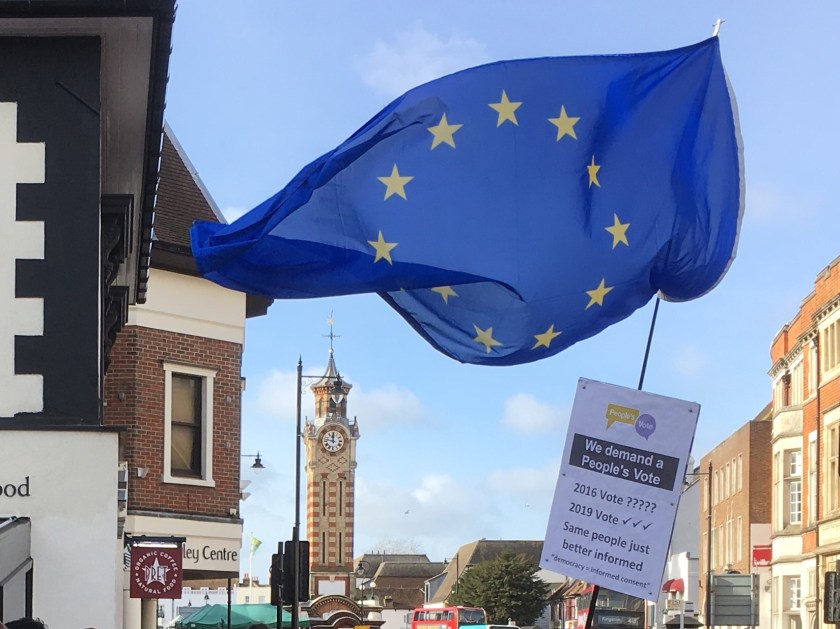
IMG_6372 (2)A good way of judging what’s perception and what’s reality to stand on a street corner campaigning for what you believe in.  This Saturday morning, with a cold wind blowing but sunshine in the sky a group of us stood in the centre of the Surrey town of Epsom.  It’s a well to do town with levels of prosperity that parts of England would love to share.   Being connected to London there are major service industries that ensure Epsom flourishes.  Its not just Derby Day.

The Brexit deal on the table provides no clarity or certainty about the future.  The signs are that Brexit will become a never-ending nightmare if we go through with it.  However, it’s both evidence and emotion that shape our view of the world and no more so than with Brexit.

Regardless of political views, in a public place there are people who engage and there are those that don’t.  On a British High Street in winter, most are busying themselves about their business and are not keen to dwell.  It’s more often that those with stronger views are the ones who take the time to engage in conversation.  My approach is to try not to impede anyone but to make it clear that I’d like to talk.  It’s easier with a leaflet in hand and a simple introduction.  So, I start: “we’re campaign for a People’s Vote – Would you like a leaflet”?  Then it’s a question of quickly gauging any response.  As a flavour of the comebacks that I got here are a few sentences on what happened.

Those who welcomed our campaigning efforts were more than happy to express a view.  A positive warmth and support came to the fore without prompting.  Frequently, there was an astonishment that the Country had got itself into such a ridiculous situation.   Everyone has a story to tell about how Brexit is affecting their lives.  Younger people were concerned that opportunities previous generations had will be cut off.

I got a warm answer from a French woman, but as she whispered – I don’t have a vote.

One middle-aged man seemed sullenly pragmatic about the affair.  His expectations were so low that he anticipated nothing better than an unholy mess.  He was grateful to see us campaigning, but he held out little hope that it would make any difference.  It’s a pessimism and sad resignation that more than a few must feel.

One guy suggested that I go back to Germany if I liked the Europe so much.  When faced with this, politeness is the only way to be.  There’s little I can say in that moment to transform his outlook.  Little Englanders are not new.

I got a couple that told me they were bored with the whole subject.  They had gone past caring what happens next.  It’s like it’s not my problem and another version of the sad resignation I mentioned earlier.

Believe me, I am not being biased when I say this, but the angrier people are Leave supporters.  It’s like they have an inner rage.  One or two will swear without any provocation whatsoever other than just seeing a European symbol.   All you hear is negative slogans right out of the Daily Mail.

Overall, the hours we spent were productive and I’m sure we offered a hope for those with a positive assessment of our role in Europe.  The indication was masses of dots on our chart calling for a People’s Vote.   Concluding, it’s clear that the last couple of years have not healed the wounds of the referendum.  Opinion on the streets is just as divided as it was when I was campaigning in early 2016.  No wonder Parliament is divided when the Country is divided.  It’s only by going back to the people that there will be any resolution to this impasse.

Blue No More

IMG_6349 (2)Today, as a traveller you don’t need to pay excise duty or tax on goods you bring in from the European Union (EU) if you: transport them yourself, will use them yourself or give them away as a gift and have paid duty and tax in the Country where they were purchased.   When arriving home from a trip abroad, we are all accustomed to the “blue” channel at UK airports.  You can bring any reasonable amount of alcohol or tobacco from the EU back to the UK, provide the local duties and taxes have been paid and that they are for personal consumption and not for resale.

That said, the rules governing customs are typically EU law and they are now directly applicable in the UK.  Since the UK intends to leave the European single market and customs union this may get complicated and means that UK law must be changed.

If the outcome of Brexit is “No Deal”, and the UK crashes out of the EU on 29 March 2019 without any agreement in place, it becomes a “Third Country”.   Thus, at a stroke, EU customs laws would no longer apply in the UK and duty between the two markets could be automatically returned.

So, the duty-free allowances are likely to change post-Brexit.  In other words, the allowances may become the same for those returning from either the EU or outside the EU.  This means losing the current more generous conditions, as quoted above.  After Brexit, returning from an EU Country may the same as returning from a non-EU Country like the USA, UAE, Australia, India or Japan.

The days of the “booze cruise” where people go over to France or Belgium and stock-up with a car load drinks for personal consumption may come to an end.  HMRC publishes information for arrivals from outside the EU[1].  That information will no doubt be updated within the next 50 days.

[1] https://www.gov.uk/duty-free-goods/arrivals-from-outside-the-eu