Privilege

How we choose the people who make our laws. That matters. Or at least it should matter.

We are persuaded to think that UK General Elections solve this by putting a ballot in the hands of every eligible voter. Those national elections are called at the behest of the party in power, so there’s an element of choosing the playing field. Also, levels of voter engagement depend a greatly on the current affairs of the moment.

The song goes: “why should we be ballot with the ballot in our hands”[1]. That’s to say that elections should matter in the determination of what happens next. History shows that this is not quite what it seems. The song is a nice sentiment when the ballot makes a real difference. However, for a great number of positions of power and influence there’s no such thing as a ballot.

Basically, the British Prime Minister (PM) has powers that Julius Caesar would have coveted. Elements of the British political system remains feudal. Conferral of honours is part of the power package. There’s no argument that being PM is a demanding job but that shouldn’t be an automatic trigger to bestow gongs and seats on the red benches of Parliament.

The Liz Truss resignation honours list is an abomination.

An affection for honours is much more of a Conservative addiction than any other. It fits so well with a view that statesman come from an elite branch of British society. The over representation of the famous public schools of the country is one indicator. People with certain backgrounds are grossly overrepresented in Parliament. More recently professional political manipulators and bag carriers have been favoured.

Contribution to the political life of the country is code for having helped a particular political party or politician to get where they want to go. To the average citizen there’s little or no relationship between bestowed influential honours and the general public good.

Any appointments process benefits from being accountable and transparent. In this case there isn’t much of either. Publication of a list after the event doesn’t count.

There should be some interest in maintaining public confidence in the system. Well, that’s an assumption I’m making but the evidence shows that there isn’t much interest. Confidentiality surrounds the appointments process. That gives licence to speculation, conspiracy theories and unusual people unexpectedly popping up on lists.

Parliament’s House of Lords is no longer construction exclusively from the landed gentry, but lot of appointees owe allegiance to the status-quo. That status-quo being inherently conservative.

This is a time when people are pulling together plans for the next year. Restructuring ought to be near the top of the priorities. Respecting the merit of meritocracy has some legs. Overriding all, currently, is restoring public confidence in the political system. To not do so will result in troubles ahead. Big troubles.


[1] https://www.nuff.ox.ac.uk/Politics/papers/2005/McLean%20Nou%20Beggars3%20050617.pdf

Autotraffic

Driving back from Christmas. That’s not a Chris Rea song. Although, he did write “Driving home for Christmas[1]” while stuck in heavy traffic. I expect the feelings are similar – moving down the line. It took some time. Redlights flickering everywhere. Looking at the drivers next to me – looking just like me. Looking stoic or miserable or both.

Our carborne irritations were trivial when compared with the conditions in Scotland. We didn’t get 80 mph winds. At least the snail’s pace of the traffic on the main A303 was a snail’s pace. Inch by inch we moved closer to where we wanted to be. No streetlights on the jammed part of the A303, yesterday. The light went up and down with the heavy cloud cover. Colours ranging from gloomy grey to even gloomier dark grey.

Windborne debris, litter, like discarded crisp packets, set off on journeys of their own. Waterfilled potholes blended into the grey of everything. Crushed traffic bollards popped up as if they were growing amongst the sodden grass verges. Occasional motorcyclists took their life in the hands as they weaved amongst dozy drivers.

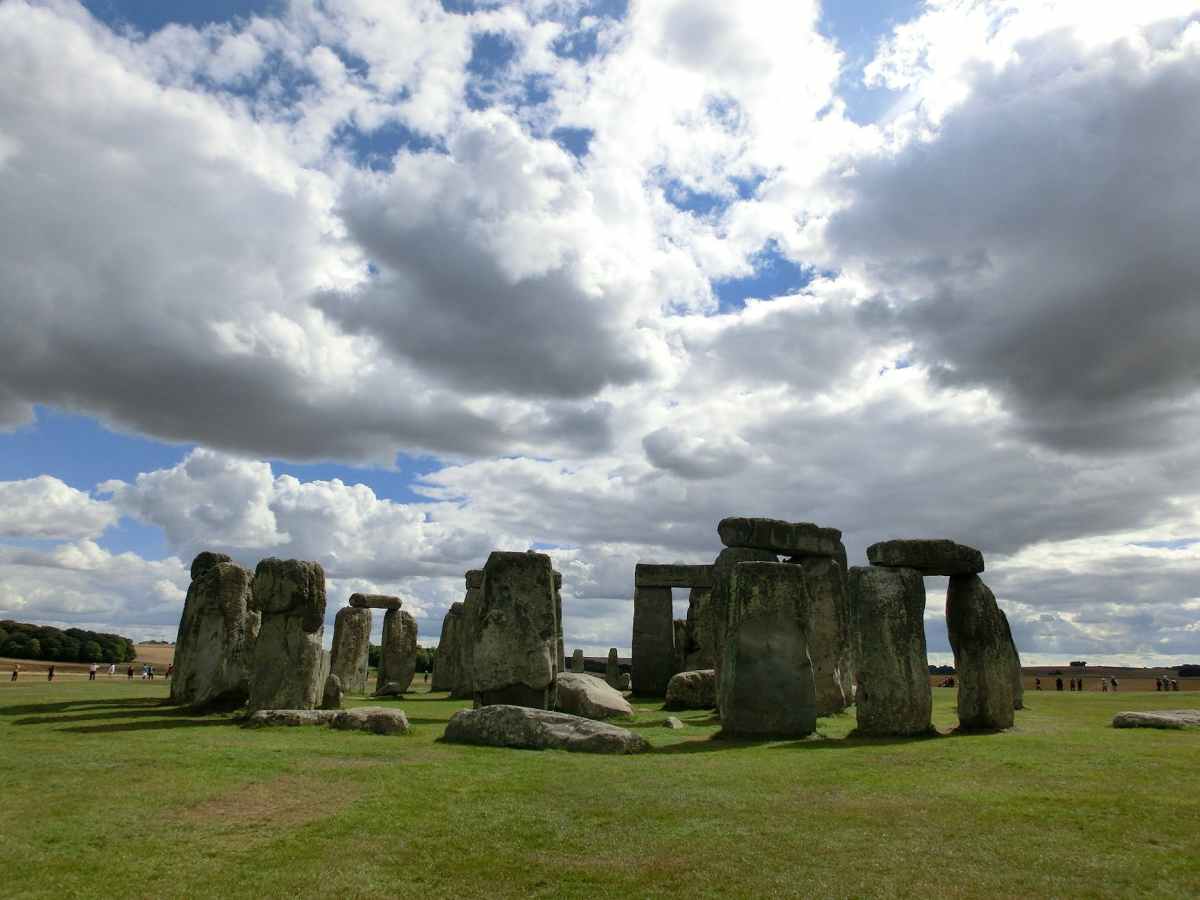
In the stationary moments my mind wandered. Who were those people dressed in the storm gear doing the tourist march around Stonehenge? They were not going to give up one moment of their vacation. What’s a blizzard of rain comparted to a once in a lifetime trip around ancient stones?

I got to thinking – how would this work if half the cars around me were automated? Human behaviour is pretty erratic. Driver temperament goes from kind and generous to intensely mean. From the laidback CofE vicar to the road rage professional. The circumstance of the drivers is hugely different too. One may be surrounded by screaming children while another is lone, absorbed in their favourite podcast. The first is a couple of hours into the worst drive of their entire lives. The second is in no hurry and happy for the day to drift by.

I sincerely hope that the makers and promoters of “driverless” cars take the human factor seriously. We know enough from aviation to know that the interaction between humans and semi-automated machines is exceedingly complex. That’s in situations where operating procedures are tightly controlled and monitored.

It’s one thing for car makers to rattle on about the importance of safety, it’s another for promises to meet the road. I’d say this is particularly true for the average British main road. Given its provenance there’s an excruciating number of variables. A truly dynamic set of variables that increase dramatically with speed. Weather goes from plus thirty summers to minus ten ice packs. Worn white lines come and go. Grass verges overhang the carriage way. Tarmac cracks and puddles compete with mud sloshing across the road in the heavy rain. Magpies dart into the road to munch the carcass of a dead hedgehog. The one that didn’t make it across the road.

Human drivers compensate for all the imperfections because that’s just what we do. It’s amazing even what the worst of us do. On the other hand, machines must characterise every single non-standard situation with accuracy, reliability and at great speed. Next time, I’m driving home for Christmas it will be manual. Likely, for a decade more too.


[1] https://youtu.be/uSjq7x67kzM

Gerrit

Apparently, Gerrit is the Dutch, and Frisian form of the more familiar name Gerard. It’s the name the UK Met Office[1] has given to the winter storm that has just barrelled its way across the country. I don’t normally write about wind and rain, but this storm is worth a short note. Not least because there was plenty of it for me to see as I was stuck in heavy traffic up on Salisbury Plain.

There’s some niggly social media kick-back on this habit of naming of storms. It’s winter after all. Having gloomy warnings pop-up for yucky British winter weather can get a bit tedious. In this case, I did take note of the weather warnings for Wednesday. Fortunately, the strong winds were blowing the right way for me. West to east.

My plan. Yes, I did have a vague travel plan. My plan was to get a major part of my journey, eastward on the main A303, done before the weather turned into heavy rain and strong winds. That well-meaning plan failed. Salisbury Plain[2] is an expanse of open chalkland which is exposed to weather from all directions. Today, I’ve spent too much time watching grey clouds traverse those uplands.

I blame Stonehenge. If prehistoric people hadn’t built it where they did then we’d have no traffic jams. The roads would be free. Those ancient builders must have been Europeans. In fact, they were since countries didn’t exist. Sorry, that’s just me pretending to be a Daily Express reporter.

Sure, enough it’s the stretch of the A303 that passes by Stonehenge that is the worst for traffic build up. Winter or summer. One of the reasons is the shear level of traffic on this main road. It’s a popular route across southern of England but it suffers from a classic road syndrome. The better it gets (condition wise) the more traffic it attracts. Road “improvements” continues to be made, often at great expense and controversy. The encampment of road protestors at Stonehenge has disappeared. That said, I’m absolutely sure their objections to further expansion of the road haven’t gone.

This year, for late December the temperature is remarkably warm. It’s wet too. Warm and wet. Is that what climate change has in-store for us in the south of England? Dull British winter weather is grey with extra grey bits. It can be mighty depressing. Short days don’t help either. Gradually they are getting longer. If only the worst of winter wasn’t still to come.

Whiling the hours away in nose to tail traffic doesn’t help with spirts. The only consolation is to look out at the drama of the landscape and the storm all around. I tend to get stoical about the whole sufferance. I pity those who sit agitated at the wheel trying to squeeze one car length ahead by getting out of roundabouts faster than others. The constant stop-go of taillights is a sure sign of a driver’s irritation. Me, I try to cruise forward inch by inch using as little power as possible.

The idiocy of playing psychological games in heavy traffic makes me wonder if some drivers ought to have a licence. This happens when two lanes merge into one. Me, I obey the one and one rule. Traffic should weave together in fairness to everyone. One from the left and one from the right.

So, bye bye Storm Gerrit. Thanks for bringing the winter wind and rain. The important part of all this is that we got home safely. Later than expected by safe.


[1] https://www.metoffice.gov.uk/about-us/press-office/news/weather-and-climate/2023/storm-gerrit-named

[2] https://en.wikipedia.org/wiki/Salisbury_Plain

Change needed

In so far as voting systems are concerned, it’s often been misleadingly said that Proportional Representation (PR) would result in endless back room deals and politics conducted behind the scenes. This is because different political parties would need to negotiate more often than they need to do so in a purely adversarial system. However, whether that political negotiation is in public or in private isn’t on the ballot.

Today, we have a perfect illustration of the downside of the current First Past The Post (FPTP) voting system in the UK. The results of the UK’s voting system are not a broad representation of the views of the voting public, rather it’s the representation of the factions of the dominant political party. That is dominant in terms of numbers of elected Members of Parliament (PMs).

Instead of negotiations going on between political parties with defined aims and objectives UK citizens have negotiations conducted behind the scenes in back rooms inside a political party.

Rather than tolerating more than one secret “star chamber” of MPs, we ought to be questioning these unstable undemocratic practices. The fragile coalitions within political parties, like the Conservative Party, are completely fragmented and hold wholly different views on important issues.

Surely, it would be much better if different party factions were honestly represented by the own political party. That would give the voting public a fair choice. That would make voting more meaningful. Today, under FPTP the voting public have no idea what they will get. Don’t doubt that statement just recall what has happened in the UK since 2010. The UK’s electoral system is broken. That’s why current opinion polling says that the level of trust in politicians is low and getting lower.

With PR difficult issues are openly discussed. Political parties exist to promote their philosophy. If they are liberal, they are liberal. If they are authoritarian, they are authoritarian. If they are progressive, they are progressive. If they are conservative, with a small “c”, they are conservative. If they are internationalist, they are internationalist. If they are nationalist, they are nationalist.

Today, for the two political parties often taking power in the UK their official names don’t mean a thing. It says little about what they will do when elected to a position of power.

In 2019, the Conservative Party were given a big majority of the seats in Parliament despite only winning 44% of the vote. Yet, MPs from fringe factions will stand-up pontificating about their representation of the people. Constantly, saying that the British people want this or that when such loud assertions are clearly untrue.

The UK’s FPTP system means that millions of public votes are wasted. Large numbers of people are denied a voice, and the make-up of Parliament does not reflect how people cast their votes. The UK’s electoral system is not fit for purpose.

Good News

It’s good to see. Sad, in terms of so many lost years. Now, the UK has rejoined the Horizon Europe and Copernicus programmes with a new agreement with the EU.

The evidence is clear. Most people in the UK have recognised the mistake of Brexit. What public polling there is shows a strong trend going one way and one way for sure. A post-TCA Brexit poll of polls shows a stable rejection of Brexit. The British public worried about the economy, inflation, and the NHS. Brexit is a minority interest[1].

Even those who voted for Brexit, including the current Prime Minister (PM) have come to recognise that the UK needs a new set of agreements with the European Union (EU).

Announced back in September[2], a new customised deal opens the world’s largest research programme to UK scientists, researchers, and businesses. It could be seen as baby steps, but the direction of travel is towards much more collaboration with our closest friends and neighbours across Europe is on the cards[3].

This week, the UK was welcomed back to the Horizon research family. Starting from 1 January 2024, UK citizens will be able to participate in the EU’s research and innovation programme. This is a tremendous victory for common sense and a win-win outcome for global scientific advancement. British researchers and scientists will now be able to apply for grants and projects with certainty.

The UK joins Canada and New Zealand with an association agreement[4]. Other non-EU countries are also negotiating for an association to Horizon Europe. The current version of Horizon Europe began in 2021 and runs until 2027.

I’d written before about how the UK had shot itself in the foot by being so dogmatic about Brexit that it had severed links that it had no need to sever. One day we will look back on the post 2016 madness and wonder what it was all about. Historians and social scientist will write voluminous tones on every aspect of the subject. Textbooks will fill libraries. They will do so to warn of the mistakes that can be made by headline chasing Conservative politicians.

The economy continues to be seen as a most important issue for the country. Reconstructing a productive relationship with our European partners is an absolute must.

Let’s hope this move will reestablish some of the wonderful industrious links between universities across Europe and with other global partners. In the past UK researchers led a high percentage of projects. Life will be different as a non-EU country. Nevertheless, participation in the programme is a great boost. It’s not free but it is worth every penny or cent.


[1] https://www.ipsos.com/en-uk/ipsos-issues-index-september-2023

[2] https://www.gov.uk/government/news/uk-joins-horizon-europe-under-a-new-bespoke-deal

[3] https://www.gov.uk/government/news/landmark-moment-for-scientists-researchers-and-businesses-as-uk-association-to-80-billion-horizon-research-programme-officially-sealed

[4] https://sciencebusiness.net/news/horizon-europe/uk-primed-rebuild-its-standing-eu-research-after-officially-joining-horizon

Half full

Winter Sunday mornings are a good time for mild depression. Awake to grey skies as the bedroom radio clicks into action. Well, that’s one way of looking at the words dribbling out of the airwaves. Bouncing off the bedroom walls and hitting my half awake ears.

It’s billed as a weekly reflections on topical issues from a range of contributors. That’s elementary well-crafted BBC wibble[1]. Range of contributors means radio chums who sit well with the semi-religious Sunday schedule.

If we go back a couple hundred years, a middle-class family would be huddled around a hulking great bible looking for insights and explanations of the world around. Technology, namely radio, gives us the opportunity to squeeze all that into a short morning sermon. Now, the internet means a keen listener can revisit an ephemeral broadcast, any time, and any place.

Sunday morning should, in my mind, mean an articulate 10-minute essay on anything. Yes, anything. Often, it’s a rush to be profound and tickle unwilling asleep brain cells. This can start with controversial words that are then diluted for the breakfast table. Rather than writing a best-selling self-help book that only sells at international airports, Radio 4 drags in a version of deep thought to churn over a subject that’s vaguely topical but not quite. Vaguely philosophical but not quite.

Strangely, I like listening to the laconic warbling of someone like Wil Self[2]. It’s true that I can only do that if the dosage is reasonably thin. An excessive exposure to early and intense thoughts about the human condition can get overwhelming. Especially when sentences are the length of a double decker bus.

Sunday’s awakening is a moment in the week when I can be assailed by adolescent optimism or gravelly pessimism. Bravura passages can run the gamut of the whole of history. Equally, they can dissect a microscopic moment of personal revelation.

I’m going to get Confucian. If I recollect correctly, he has something to say about NOT being obliged to accept gifts that are not given with the best of intentions. It’s a kind of allegory. It’s a good one for the social media age.

Let’s say Suella Braverman does a slot on the BBC’s Point of View. I might be included to turn the radio off. But that’s not a good reaction for me, a person who believes in freedom of speech within civilised and reasonable limits. There’s the rub.

The essence is that it’s one thing to be offered a gift of someone’s great “wisdom” but there’s no obligation on my part to accept it. I think, in this country there’s too much a tradition of not rocking the boat. That’s to accept a gift as a matter of politeness. Even if the gift is quite appalling or bound to be harmful. Some cultures and countries don’t have that problem. I’m a great fan of Dutch bluntness. It’s a classical Britishness that has unwanted repercussions whereby we tolerate that which should be given short shrift.

How did I get to this point? Don’t tell me pessimism is good for us on a damp gloomy Sunday morning. Human events are not mostly random. Agreed randomness is a big part of life but please drop the “mostly”. Understanding probability is a useful skill. Randomness isn’t so random. But don’t let such an understanding led you to think that choice is immaterial.

I will choose. Radio, on or off. Get up now, or slumber.


[1] https://www.bbc.co.uk/programmes/m001t34q

[2] https://www.theneweuropean.co.uk/out-of-their-minds/

B. P.

A forensic dissection of the recent past is highlighting how major decisions are made in the corridors of power. It’s not nice to hear but it is good to hear. Transparency is a benefit of democracy. What we see is not pretty. There’s that saying about politics and making sausages being much the same. We desire results but are shocked if we study how sausages are made.

We easily get trapped in the noisy interchange between personalities. Newspaper headlines draw on our fascination of who said what and when. The more embarrassing the chatter the bolder the headline. The questions how and why are not given as much attention.

Even sampling a little of the reports of the compilation of evidence there’s a trend emerging. Much of this has to do with the way administrators, politicians, and scientist (practitioners and the theoretical) understand each other or don’t.

The classic divided between the Bachelor of Arts, Humanities and Social Sciences (BA) and the Bachelor of Sciences (BSc) is firmly embedded in our society. The divide between Oxbridge and the rest can look like a deep gorge. The divide between those who are instinctive hustlers and gamblers, and analytical reasoning calculators is uncomfortable.

Putting the above to one side, what shines through the submissions of the UK COVID inquiry is an embedded lag between events and a reaction to events. Knowledge with hindsight is wonderful. Time and time again after big events, files are taken down from a dusty shelf and on their pages is a register of risks. Within that the register is a discussion of risk of an event that has just become history. This week we heard a former Prime Minister almost admit that the COVID pandemic wasn’t taken as seriously as it should have been until it nearly killed him.

What does this say about our propensity to plan or take plans seriously? What does it say about becoming overcome or steamrollered by events? What can we do better to be prepared in future?

Lessons learned are fundamental to improving any way of working. It’s a feedback mechanism. Taking what can be derived from a crisis, catastrophe or momentous event and writing it down. Using that to make strong recommendations. Then tracking changes and moving forward to what should be a better prepared state. 

We know we don’t have to wait for bad events to happen before we prepare. Our human imagination provides us with an effective means of anticipation. Tragic in the case of COVID is the ignorance of warnings that previous events had provided. The lesson from SARS[1] were know.

Maybe this is the Cub Scout coming out in me. Yes, that was part of my early upbringing in the village of Somerset. The motto of the British Scout movement[2] has a lot going for it: “Be Prepared”. Much of what goes with that motto is anachronistic, but the essence is immensely valuable.


[1] https://www.who.int/health-topics/severe-acute-respiratory-syndrome#tab=tab_1

[2] https://blog.scoutingmagazine.org/2017/05/08/be-prepared-scout-motto-origin/

Dangerous way to act

Why choose to make a deal with Rwanda the issue that breaks the UK Conservative party? It’s not the biggest issue facing the UK. It’s not the highest priority of voters if we take the opinion polls as an indicator. It’s only a totem for the far-right fringe. What we have is a sign of a stubborn disunity. Almost a fatalistic rush to collapse. An admission that there is only defeat over the horizon.

Clearly, the issue that should be addressed is to competently manage legal immigration. The numbers are orders of magnitude higher than those crossing the channel on small boats. Not only that but the backlog of unprocessed people dwarfs that which could be shipped to a third country.

A Government faces thousands of difficult policy choices every day. At this part of the electoral cycle, focusing down hard on one that is bound to cause disruption, dissent and disillusionment is politically foolish.

Let’s face it, to win a coming UK General Election progress must be shown on the two issues that are top of the concerns of voters. One: a cost-of-living crisis. Getting inflation under control. Two: fixing health and social care. Leading changes to health services and properly funding social care.

So, with the above in mind how is it best to react to the UK Government’s latest attempt to seal a deal with Rwanda. Through a legislative proposal there’s to be a definitive statement that Rwanda is a safe country. This is to be an unquestionable rule. Setting aside other existing laws.

What a dangerous way to act. Opening the door to this type of authoritarian legislative proposal opens the door to all sorts of acts that no one would want to see. Dictatorial nonsense. With the UK Conservative party’s current logic:

Why not a law that says that British rivers are clean. That would solve the problems of sewage discharge – not.

Why not a law that says that climate change is fixed. That would resolve global warming – not.

Why not a law that says that the tide must not come in. Dam – that one has been tried.

At the seashore, when King Canut[1] commanded the tide to stop, we all know the outcome. Since then, his name rather unfairly has become a byword for a delusional attempt to avoid the inevitable. When what he was attempting to do was to demonstrate the limits of his power.

It’s now more likely that my predictions of the date of the next General Election maybe driven by events. The limits of the power of a Prime Minister are most evident when those standing behind him slowly shrink away.


[1] https://www.royal.uk/canute-great-r-1016-1035

GE2024

Let me spectate. I’m no professional commentator, pollster or political pundit but do try to keep myself up to speed with the current affairs. The question in the mind of a lot of people is: when will the next UK General Election take place?

In these days before Christmas, it’s possible the Prime Minister (PM) doesn’t even know the answer to this question. It’s a balance of how strategic or opportunist he will be when it comes to making such big decisions. Most current predictions are that the Conservatives are destined to be defeated. The gap in the national opinion polls is substantial. That makes the decision of timing of an election one that could mark the end of the current PM’s term of office or elevation to Conservative saviour. Currently, political parties are desperately selecting candidates for each constituency. Something is afoot. Better stop there before I get tempted into a pun.

Let’s put aside any consideration of a winter vote. Arctic weather gloom hovers like cold mist. With the prospect of large heating bills upsetting most of the population there’s no politician who will want to accept the blame for that situation. Naturally, they will say that they are working at pace to tame inflation and overseas conflicts are the root of the pain.

The first step on the road ahead is next year’s springtime. Local elections are expected. Every year, they take place on the first Thursday in May. This is when a third, or less of the electorate put a cross in a box. At the same time London’s next mayor will be elected. So, 2nd May 2024 will be like a mini political barometer. Real votes in real ballot boxes are always a better indicator than sampling or sage views.

The European Parliament election is scheduled for 6th to 9th June 2024. You may think this European Union (EU) election has no bearing on the UK, but I beg to differ. If there’s a significant advance of right-wing political parties across Europe, then the impact will be felt in the UK.

The 2020 United States (US) presidential election was quite a show. In prospect, for the 2024 US presidential election is a gripping event despite the weak selection of candidates. That US national election is scheduled for Tuesday, 5th November 2024. Guy Fawkes day[1] in the UK.

Let’s assume the Conservative party will want to hang on, not to the bitter end, but to get as much time elapsed after the pandemic shockwave, Partygate, mini budget madness and the cost-of-living crisis as they can. We are still reeling from the post-Brexit political earthquakes that have trashed confidence and the economy. Will the cost of government be political exile? That all said, people have shifted a long way since last year. The big question is: who do you trust?

The UK’s Labour party opposition should be confident and smiling. However, the opposition probably feels aggrieved having to wait so long for others to fail before getting an opportunity to win a general election. What doesn’t help is that the electorate are now pessimistic about any sustained recovery. Sadly, the public mood is beset with quite a sense of decline-ism.

Traditionally, in the UK, September is party conference season. That leaves October open for an election. But as noted above there’s a news media attention getting clash between what’s happening in the UK and US. Since significant geopolitical tensions are going to be raging throughout 2024, I think that topic may not be an influencing factor on the UK election date question.

Rolling the dice as late as October 2024 has several advantages for the incumbents. If there’s good summertime news, say inflation reduced and a modicum of economic growth the government will claim a great success. The struggle between democracy or autocracy around the globe could give a UK PM a platform on which to make one or two grand gestures. Also, with nearly a year to go, the opportunity for the opposition parties to trip-up increases.

When polls ask is Britain a better place to live than it was ten years ago or a worse place to live than ten years ago the pointer points at worse. It’s hard to imagine this will not impact voter intentions. 

#ukpolitics #ukpolitics #politics #generalelection


[1] https://www.parliament.uk/about/living-heritage/evolutionofparliament/parliamentaryauthority/the-gunpowder-plot-of-1605/overview/people-behind-the-plot/guy-fawkes-/

Ineptitude

Yesterday’s announcement went like this: “The government will also increase the minimum income required for British citizens and those settled in the UK who want their family members to join them.” This Conservative view, that families are a burdening the State persists like a stubborn stain.

The Universal Declaration of Human Right says: The family is the natural and fundamental group unit of society and is entitled to protection by society and the State.

Clearly, by the measures announced, in the case of this UK Government the family is not a fundamental group unit of society. In fact, family members based overseas will be required to separate in the event of a person accepting a low income in the UK. That low income in the UK maybe relatively large when compared with what is available in their home country.

I guess this is fine for lawmakers when considering the level of a Minister or Member of Parliament’s salary and benefits. There’s no impediment that will impact their lives in this respect regardless of the nationality of their partner and children.

What I’m wondering is: what will be the case if a British pensioner, living in a European country, who wishes to return with a partner or children who don’t have British passports? If the increased threshold of £38,700 applies, then that will effectively ban them from returning unless they have a generous pension. It may be the case that they have worked on overseas and accumulated a non-UK pension, but this would be irrelevant if the deciding factors is a UK earnings threshold.

I don’t think there’s much disagreement that those who wish to move to the UK should be able to support themselves. The UK minimum wage is set at £21,673.60 for a 40-hour week. So, is the UK Government saying that no one can support themselves on the UK minimum wage?

Ministers have been quick to deny any responsibility for the chaotic state of the immigration system in the UK. Instead, they pretend that they are adapting to changing circumstances. The fact that they are 100% responsible for the current circumstances is brushed aside.

Having persisted for years with one set of flawed notions Ministers now announce another set of ill-thought-out proposals. The Brexit slogan of Take Back Control did not envisage giving control to a cabal of incompetence. In stark reality, that is what has happened.

The knee jerk reactions and ever shifting sand of the last decade need to come to an end. The British people should not be denied a General Election. More months of more chaos and ineptitude are incredibly damaging.

POST: U-turn. Minimum income requirement will not be increased as much as originally announced. A new threshold will be applied from the spring. A policy designed to exclude people from entry to the UK has been watered down for practical reasons.