Brexit & Aviation 62

This week the focus has been on Northern Ireland (NI).  It may not be well known by everyone, but NI has a considerable Aerospace sector.  It’s continued success is vital to NI[1].  Aerospace contributes to over a £1bn a year to the NI economy.   It’s a deep-rooted industrial sector too.  I remember visiting Shorts Brothers of Belfast in the 1990s.  Today, Bombardier has a large workforce in NI[2].  From design to manufacture to support work, Bombardier Belfast specialises in major aircraft structures and flight control surfaces in metal and composites.  If the issues concerning Ireland become insoluble then the resulting EU-UK No Deal outcome of negotiations will damage NI and the rest of the UK.

In the UK, there are devolved administrations in Scotland, Wales and NI.  Exiting EU law applies equally across the UK but there’s concern that fragmentation could occur after EU exit.  There are efforts to ensure a common framework, but these don’t yet address aerospace or aviation with respect to UK law.   On leaving the EU single market the UK internal market needs to maintain a level playing field whist recognising devolved powers.

Brexit remains the top immediate risk to the growth of aviation in Europe[3].  Passenger traffic growth across European airports has been relatively high in recent years.  The UK leaving the EU with No Deal could lead to cap on flights and higher prices for customers.   There remains legal and commercial uncertainty for airlines on post-Brexit air travel[4].

At a time when there should be renewed intensity and seriousness to discussions and negotiations, we see the opposite from a succession of UK Members of Parliament.   Attempts to polarise and heighten tension are coming from those who foolishly wish to bring about a No Deal outcome.

Aviation cannot wait for the UK to strike an 11th-hour Brexit deal, so measures are being taken now.  With 50 days to run, time is tight.  Travellers planning business trips and family holidays after 29 March 2019 should do so with some caution.  Checking terms and conditions in detail would be a wise move.

[1] https://www.adsgroup.org.uk/about/ads-offices/northern-ireland/

[2] https://uk.bombardier.com/en/about-us/bombardier-in-country/sites/site.aerospace-belfast.html

[3] ACI Europe director general Olivier Jankovec said: “With less than 60 days left before the UK exits the EU, Brexit remains the top immediate risk.

[4] https://www.iata.org/pressroom/pr/Pages/2019-01-15-01.aspx#__prclt=QqEx89ur


Brexit & Aviation 61

Since there’s little, or no good news but there is news, it’s difficult to know where to start.  Forecasting is a fragile art currently.  We may be able to say that the UK will face a wet and windy week ahead, but we can say little about which political eb or flow that will dominate.  Thus, I’ll stick to what is known.

For one, in an aim to head off a meltdown, simplified customs processes for UK businesses trading with the EU, if the UK leaves the EU without a deal have been published.   Manufacturing, those with a just-in-time supply chain will be relieved to see goods waved through customs with a paper trail following behind.  Aircraft and parts may be allowed in to the UK at a reduced or zero rate of duty.

As the UK leaves the EU and becomes a “third country” it will cease to be part of the fully-liberalised EU aviation market.  To stay legal, knowing which jurisdiction is applicable in aviation regulatory matters is essential[1].  For this having a good understanding of the rules of ownership pertaining in the UK and the EU is a must.

For a month now, EASA has accepted early applications from UK AOC holders for Third Country Operator (TCO) authorisations.  This includes the need to produce a copy of Certificate of Incorporation/Business Registration.

For civil aircraft, it’s a matter of registration and that may not need to change.  There’s no single EU aircraft registry because the EU is not a “State” in respect of ICAO Annexes.  Each EU aircraft is registered in an EU Member State aircraft registry.  There may be implications on where an aircraft maybe kept if that is to be for a considerable period.

For organisations, the rules can be complex and dependent upon the structure of an organisation.  The authorities have issued guidance on this subject.  Where doubts have arisen, European and UK courts have been asked to rule on this subject in the past.  This I raised as a challenge for several large aircraft operators in my Blog 22 and 46.

For the licensing for pilots and engineers, the EU does not issue licences.  In every EU Member State, the national aviation authority issues licences, to standards set down by EASA.   Again, much has been said about the need for some form of recognition between EU and UK if Brexit finally happens.

54 full days remaining and there’s a mixture of options and possibilities on the table without the certainty that surely would be wise.  The burden falls on each and every individual and organisation to make a prediction and take measure to ensure that they can continue to operate.

If there’s a Withdrawal Agreement there’s a degree of certainty.  If there’s No Deal, then several temporary arrangements may not stop a calamitous impact on aviation in Europe[2].

[1] https://info.caa.co.uk/euexit/

[2] https://www.aerosociety.com/news/airbus-chief-warns-of-unbearable-uncertainty-of-no-deal-brexit/?dm_i=4OGU,H72Z,2ZCDRI,1Z8EL,1

Brexit & Aviation 60

Delay is the order of the day.  Now, there’s only 56 days remaining on the Brexit clock.  859 days since this all started with a June day.  One silver lining to the current dark Brexit cloud is that the UK Parliament is saying it won’t support a No-Deal Brexit.  However, there’s nothing to relieve the uncertainty hanging over the whole UK because even this expression of view is being ignored by the UK Government.  The UK Government says it will now redouble its efforts to get a deal.  Let’s hope redoubling is enough or surely it would be wiser to drop the whole project.

EU Council President Tusk, through his spokesman repeated that the Withdrawal Agreement on the table could not be renegotiated.   Next, the 9th February will see Prime Minister May’s 3rd attempt at a version of a Brexit deal supported by the UK Parliament.  Will it be 3 strikes and you are out?

In the latest information to UK citizens travelling to EU Member States every aspect of the advice is a degradation of exiting conditions.  Travelling post-Brexit, there’s only a downside for both passengers and airlines[1].

If No-Deal comes about there’s some highly optimistic commentators who believe that a “side agreement” between the EU and UK could cover some of the purely administrative content of the existing Withdrawal Agreement.  That said, even with this practical suggestion absolutely nothing is assured.

In the aviation regulatory world, it’s reported that the UK Civil Aviation Authority (CAA) is in the process of rebuilding itself after scalling back following the creation of EASA in September 2003.  The UK CAA has said it wants to stay within the EASA system after the UK exits the EU.  However, this possibility is looking unlikly for all the political reasons that are piling up every day.  The UK’s exit from the EU will have a severe impact on the UK aviation industry.

In civil aviation, large organisations have an Emergency Response Plan (ERP).   International standards recommend planning.  It’s normal, once a plan is in place to conduct an exercise to ensure that everyone has a clear understanding of its process and it stands up to rigorous testing.   I’ve been part of several such exercises in Europe.  My experience is that even with the most elegant plan, carefully prepared, the real-life impact of using it is often incredibly revealing.  Situations are constantly evolving, and all parties must move rapidly in order to anticipate risks and adapt accordingly.  Often communication and behaviours turn out differently than expected.

Yes, on both sides preparations are being made for the worst case No-Deal scenario, but they will all be untested.  If more than one crisis occurs at any one time more than double the effort is needed to resolve the situation.   The implementation of any such No Deal plan will not be a matter for one organisation but a continent of 500 million people.   If anyone thinks that will go smoothly, I just have to say that they have no experience of the real world.

[1] https://www.aerosociety.com/news/no-deal-no-flights/

Brexit & Aviation 59

I’d like to congratulate the UK Civil Servants who have been set an impossible task.  The stream of publications for UK nationals living in the European Union (EU), the European Economic Area (EEA) and Switzerland if the UK leaves the EU without a deal on 29 March is impressive.  Basically, they say the UK Government continues to negotiate Brexit even if that’s one sided.  There’s a dose of reality in some of the statements, like: “The rules for travel to most countries in Europe will change if the UK leaves the EU with no deal.”  There’s always a disclaimer asking the reader to note that the information provided is a guide only.   There’s also a reassuring note that; in the event of changes to rules or processes after 29 March 2019, the UK Government will update this page as soon as information is available.

Now, there’s 57 days remaining on the clock.  Informed analysis says that there’s no time left to be able to paper over all the cracks that will appear on Brexit day[1].  UK MP’s are talking about putting in extra hours.  Nevertheless, it would be extraordinary if all the topics that needed to be covered were covered in such a short time[2].  There’s also UK MPs talking of “a technical extension” of Article 50, if a new deal can’t be legislated for in time.  Nothing is fixed.

So, the reality is that we have one of the world’s mature democracies, influential States with a long history is heading into an abyss.  Prime Minister Theresa May’s Brexit plans have been chaotic and dysfunctional from day one.  But there’s been plenty of time to make mistakes, learn from them and then put it right.  Unfortunately, this has not been done, held back by political arrogance.

In the aviation industry one of the great successes over decades has been the ability to make mistakes, learn from them and then put it right.  It’s one the reasons that flying is as safe as it is across the globe.  A culture where people can honestly admit to error and sit down with their colleagues to fix problems is an advanced one.  In the long-term, this approach works to the benefit of everyone concerned.  In aviation, those who are looking for partnerships and business opportunities value stability, a level playing field and the rule of law.

Back in 2016, some campaigners said – not a single job – would be lost due to Brexit.  That statement, and many like it, now appear extremely foolish and dishonest.  To date, the UK’s referendum has delivered nothing to the advantage of UK citizens.  In a graphic illustration of how strangely ridiculous the situation has become, this TV clip from the BBC’s News at Six showing archive footage of Second World War aircraft, joke or not, is in bad taste to say the least[3].

[1] https://www.instituteforgovernment.org.uk/publications/brexit-two-months-go

[2] https://www.standard.co.uk/news/politics/brexit-news-latest-theresa-may-moves-to-scrap-half-term-for-mps-in-panic-over-brexit-a4053946.html

[3] https://www.standard.co.uk/news/politics/bbc-news-gaffe-sees-second-world-war-footage-played-over-theresa-may-brexit-item-a4053676.html


Brexit & Aviation 58

I must confess that I never thought that the situation would become as bad.  To a limited extent, it hasn’t yet got that far – yet.  Some have taken the view that a No Deal Brexit is off the table and exits only as a scary story to push discussions forward.  The problem is that this view is optimistic when considering the performance of the negotiating parties over the last couple of years.

The cold facts are that preparations for a No Deal Brexit outcome are being stepped-up.  Radical Leave supporters are celebrating the prospect of a No Deal Brexit.  This is done without any consideration of the consequences of such an irresponsible approach.

After the failed vote of this week we now have an elaborate lobbying exercise going on, but I don’t see compromise coming out of any cross-Party talks in Westminster.   It’s highly probably that the UK will be a “third country” without any extant arrangements or deals from 30 March 2019, 00:00h (CET).  With 70 days to go this is a tragic situation.

There’s an opportunity on this coming Monday for the UK Prime Minister to turn this around.  But it would mean removing “red lines” that have so constrained discussions.

In the airworthiness world the impact of a No Deal Brexit is being spelt out[1].  There’s no precedent for this situation.

EASA certificate for products, parts and appliances issued to holders in the UK will no longer be considered as certified in accordance with EU rules.

Certificates issued, before the withdrawal date by the UK CAA, in accordance with EU rules will no longer be valid.  Over night, UK engineers would lose the right to sign off EU aircraft.

There’s more that impacts aircraft operations.   I imagine this will prompt a stream of people and organisations contacting EASA to find out what can be done.  None of this work is productive.  None of this work will enhance aviation safety.  None of it would be needed if a comprehensive agreement is forged or Brexit is abandoned.

[1] https://ec.europa.eu/info/sites/info/files/notice_to_stakeholders_brexit_aviation_safety_rev1_final.pdf


Brexit & Aviation 57

It’s reported that the Director General of the British Chambers of Commerce said: “There are no more words to describe the frustration, impatience, and growing anger amongst business after two and a half years on a high-stakes political rollercoaster ride that shows no sign of stopping.[1]

I’m sure that those words would be echoed by a great number of people in the aviation sector.

A defeat of 230 votes is massive.  MPs have rejected the Prime Minister’s proposals by the biggest UK Government defeat in modern history.  That ought to be a signal to change direction but we have yet to see if a new approach will be forthcoming.

Beyond the political hoo-ha there’s the need to act.  A great deal of implementing legislation needs to be passed through the UK Parliament, whatever the destination.  Naturally, this is needed if the Article 50 letter is not withdrawn and the whole Brexit process stopped.

The European Union (EU) continues to flourish despite having faced innumerable hard problems thrown at it over many decades.  This is not Greenland[2], this is a large and prosperous Country giving up its membership of the EU.  Thus, the avoidance of the loose-loose scenario, of a No Deal Brexit should be at the top of everyone’s priority list.  Meanwhile large sums of money, that could have been used growing European businesses are being pumped into contingencies.

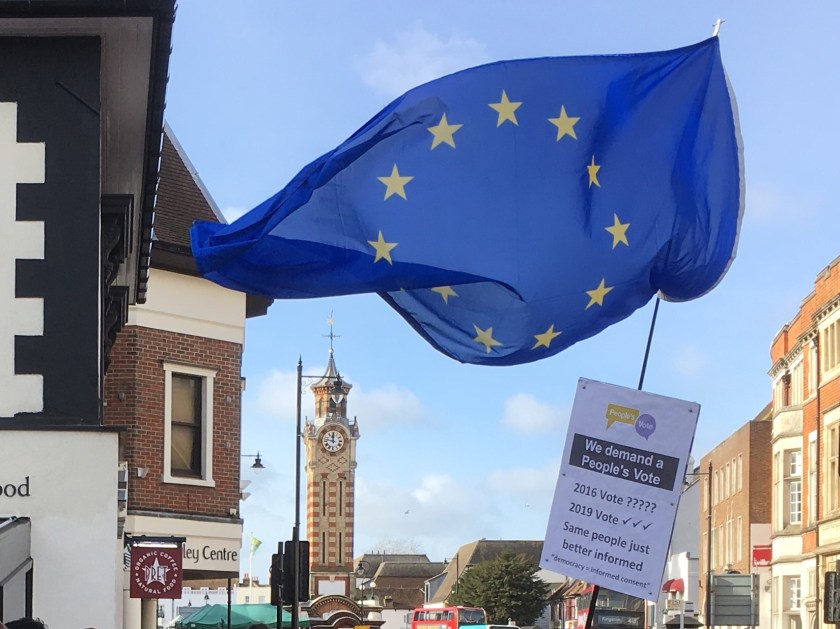
If this Withdraw Agreement (WA) is not acceptable as it stands then it may return as WA2 but don’t expect that to be substantially different from what’s already on the table.  Alternatively, there could be public vote to consider the options.

The e-mail subscriptions to “SkyWise[3]” is useful to stay up-to-date with news, safety alerts, consultations, rule changes and airspace amendments from the UK CAA.  The site has a section for EU exit alerts.

There is useful material out there, but it indicates a poor state of readiness given all the caveats and unknowns that exist.  Just as business leaders are warning, the UK is like a super-tanker heading for the rocks.   72 days isn’t long to put that right.

[1] https://news.sky.com/story/growing-anger-frustration-and-impatience-from-businesses-over-brexit-11608581

[2] https://www.politico.eu/article/greenland-exit-warning-to-britain-brexit-eu-referendum-europe-vote-news-denmark/

[3] http://skywise.caa.co.uk/category/eu-exit/


Brexit & Aviation 55

This week, I flew EasyJet mid-week from Bristol to Glasgow and back.  On the flight back, I noticed that the AIRBUS aircraft we flew on was registered in Austria.  It must be one of the 130 aircraft listed as registered to easyJet Europe Airline GmbH[1].  Now, there’s no single EU aircraft registry but this is an aircraft that is registered in an EU Member State.

The trip got me thinking that such a flight may not be possible after Brexit day in March.  This was an internal flight within the UK (England to Scotland).  In the event of a No-Deal Brexit, the EU has made it clear that UK registered aircraft will not be authorised to make internal flights within the EU.  I presume that the reciprocal will be true.  Otherwise the UK will be giving away rights that it can not excercise in the EU.  Thus, no EU Member State registered aircraft will be authorised to make internal flights within the UK.

I also got to thinking; what will Scotland do in the longer term?  It’s highly likley that the Scotish nation will want to retain the benifits of EU membership.

On Tuesday next, the UK Parliament should be holding a meaningful vote on Prime Minister (PM) Theresa May’s EU withdrawal agreement.  There’s much speculation that British Members of Parliament (MPs) are positioning themselves for the vote to be lost by a large margin.  So, Tuesday, 15 January 2019 could go down in history as a momentous day for British politics.  The reason is clear.  The UK Government has put all its eggs in one basket.  In a crude attempt to apply pressure to MPs, this is seen by many as a Deal or No-Deal situation.  As the clock ticks, MPs voting down the Deal on the table, which may well be amended, is increasing the chance of a No-Deal Brexit.  There’s some strange talk of a “managed” No-Deal but, in fact, there’s no such thing on offer.   The real choice is a mess of a Brexit or No Brexit at all.

Again, the aviation industry[2] is making it clear that such a No-Deal Brexit outcome would be disastrous.  Several UK businesses are already kicking-in their No-Deal contingency plans.  This could mean a great deal of business moving out of the UK and into the EU.  The lost opportunity costs associated with all this muddle and uncertainty must be huge.  Stability is worth a great deal to investors and those who are building businesses across Europe.  Additionally we must remember that the UK maybe leaving the EU, but it is not leaving Europe nor can it.

The benefits of staying in the EU’s Internal Market for Aviation[3] are extremely clear.   It is my hope that a No-Brexit outcome is arrived at.  Parliament will need to explore all the options.  This would certainly be best for travellers, aviators and the industry that supports them in the whole of Europe and beyond.

[1] https://www.austrocontrol.at/en/aviation_agency/aircraft/aircraft_register/search_online

[2] https://www.adsgroup.org.uk/blog/brexit-myth-busting-a-managed-no-deal/

[3] https://ec.europa.eu/transport/modes/air/25years-eu-aviation_en


Crashing Britain

Listening to the renewal of Brexit hostilities there’s one side of the argument upping the anti and the other desperately downplaying.  Ture enough, those of us who have retained out sanity know that they can’t both be right.  A New Year has not brought new wisdom.

In general, the deep trenches of “bias” take a lot of effort to climb out of.  And that’s not just bias on one side or the other, that’s the general phenomena of bias.

As humans, here’s what we do.  In the first case there’s optimism bias.  I often see this in the write-ups of aviation accidents and incidents.

Generally, people overestimate their chances.  It’s often advantageous in that such an approach can make us work harder and see goals as achievable, come what may.  I know not everyone can be above average but who admits to being average?  Brexiters who say: No Deal – No Problem have this in buckets and spades.  Excessive optimism bias is a way to crash and it’s certainly not good if you are a compulsive gambler.

Next on the list is confirmation bias.  Our amazing human capacity to imagine what might happen next is a huge asset.  Unfortunately, there’s a tendency to establish a theory and then find facts, real of imaginary, to confirm that theory.  This is a major danger.  To avoid a crash, it’s often good to have a theory but then retain the willingness to question it.  When time is pressing it may not be so easy to question but question is best.  And if changed or new facts say do something different don’t throw them away for a matter of pride.

The next one is a thinking bias called the Dunning–Kruger effect.  This is not a popular one to talk about.  It’s when people to fail to recognise their own lack of ability.   Numerous general aviation accidents and incidents have this one at the root.  When tested competent students often underestimated their class rank, and the incompetent students overestimated theirs.

I might like to think that I could win an argument with the great statesmen and stateswomen of history, and point out the flaws in their thinking but in truth – No.  Well, my success rate would be low.  Radio talk shows feed on this effect by pitching callers against a well-seasoned politician.  It maybe entertaining but it does help to illuminate a problem.

How to stay safe?  Take an inventory of my own biases.  What sources do I use to come to a view?  Do I understand how my biases formed my view? Yes, that’s the one I speak out on.

Can we all do this and step back from the Brexit crash?  I don’t know.

Paddy Ashdown

That day in Pittville Pump room[1] in Cheltenham was a wakeup call.  It must have been around 1983/4 as Paddy Ashdown had just been elected as the new MP for Yeovil in Somerset.

Sue and I had not long moved to Cheltenham from Bristol.  We thought; let’s go along and hear what he has to say.  In true Paddy style it was a lively night of anecdotes.  Inspiration sprang from his enthusiasm and shear positive optimism.  In effect he was saying to us – look if I can win in Yeovil you can do it here – it’s just hard work, it’s not magic.

That’s leadership by example.  His practical and inspirational guidance, born of his successes, and failures, shone and lit-up the room.  We both joined the Liberal Party there and then.

Over the last 34 years, there have been many memorable moments campaigning and at conferences where Paddy’s light showed the way.  Here’s just a couple of moments that come to mind for no apparent reason.

Eastbourne was a Lib Dem conference venue that I liked.  The town lacked facilities but to be by the sea in a friendly inviting place made up for it.   It was said at the time that we followed Paddy Ashdown just to see where he would take us next.  It was a polite way of saying that; not everyone agreed but we knew he would never be boring.  One of those end of conference speeches aimed to lift the spirts of the assembly ran off at a tangent.  Paddy slipped in a paragraph about the “information super highway” and how it was going to transform our lives.  What on earth is he talking about?  I knew but most of the audience were bemused.  He’d rightly made us think about the impact of technology on the future of our society.  In hindsight, that was great foresight.

Of the many by-election committee rooms where a visit from Paddy was mandatory, there was never one where the troops didn’t feel extra energy and enthusiasm when it happened.  I’ve a picture in my mind of being at the Witney by-election not so long ago[2].  Just about to pick up a packet of leaflets for delivery there he was chatting with anyone and everyone.  Paddy’s words often came from a standard stable of well-worn motivational ways but every time they were delivered with remarkable freshness and impact.  Boosted, I bet I delivered twice as many leaflets.

Paddy’s internationalism arced over every day to day politically theme.  That I respect that as much as a dozen other convictions.  He gave a lifetime of service to this country.  Combining the wonderful art of heralding community politics at the same time as having a global vision.

RIP Paddy – you will ever remain a great inspiration.  I feel sad but know I shouldn’t.  I’m glad you showed us a way to be ambitious, visionary liberals and decent people.

[1] http://www.cheltenhamtownhall.org.uk/visit-us/pittville-pump-room/


[2] https://www.bbc.co.uk/news/uk-politics-37719170


The New British Etiquette

It may be a whimsical observation but “small talk” on this island is changing.  I come to write this after a whole series of pre-Christmas conservations with strangers.  No, I’m not walking the streets talking at anyone and everyone at random.  It’s the day-to-day chit chat had standing in a queue or across a counter or waiting for a train.  There’s one subject hovering like the ghost of Christmas-past.

It’s a bit like that famous: “Daddy, what did YOU do in the Great War?” British recruitment poster from 1915.  That poster has a sobering story when considering that half a million children lost their fathers in WW1.  Early on it aimed to get men to happily sign-up and march off to war.

In a light-hearted way I say: “Sir/Madam, what did YOU do in the great Brexit debate?” Even if I would never dream of asking a stranger that question outright, it is in that back of my mind.   From the reaction of people, it’s obvious to me that the question is in the mind of others too.  The question is starting to condition the way we interact in everyday situations.

There I was in a railway coffee shop, sitting next to a radiator and feeling chilly.  One of the lads clearing tables remarked that the heating was out over the entire station.  They were trying to fix it, but we’d probably got the best spot to sit out of the wind.  Guy sitting next to me, reading the Telegraph, grinned and we struck up a conversation.  That was the moment when I wondered. I couldn’t help it.  It was clear he was reading the latest Brexit story in the newspaper.  He was early retirement age.  He was well dressed.  Did I dare make a comment about how ridiculous the Brexit debate had become?

The New British Etiquette that I’m suggesting exists, is a new sense that helps people quickly assess if small talk is going to be well received and pleasant or turn into an awkward moment or worse.

The upshot of the railway station story was we both agreed that Brexit had become ridiculous.  When he was working fulltime, he’d been a regular commuter.  Now, he was grateful not having to do the daily run into London.  The conversation warmed.

Next occasion I had to test the new sense of etiquette was in a supermarket queue.  Pre-Christmas, and at the wrong time, Sainsburys looked like a scene from a zombie apocalypse movie.  Full baskets and tired shoppers meant standing in-line, straining the patience and slowly moving towards the till.

Looking at the chaos and confusion all around the woman next in-line chatted.  We agreed that we had both underestimated how busy the place was going to be at lunchtime.  Then she said a: “I don’t like to mention the B-word but”.  Knockout, I thought now people are testing the water before even mentioning that subject of Brexit.

She’s right.  What could be worse than being stuck in a queue with someone you have taken an instant dislike too?  It was well worth a couple of words to see if I was friendly or hostile.  We both agreed Brexit is crazy.

Up and down this great land there must be thousands of little conversations like these two.  Carefully and tentatively the topic that is as turbulent as religion or tricky as sex, can only be approached after a simple quiz.  That’s the New British Etiquette.