A short flight

IMG_3762This week my travels took me on a low-cost Ryanair flight from Stansted to Cologne on the banks of the Rhine.  Back in the 1990s, I was involved in the European validation of the generation of the Boeing 737s that the Irish airline uses.  So, it’s interesting for me to fly on, what is now the most popular civil aeroplane in passenger service.  Overall, when comparing the passenger experience on what was an internal European flight with my experience of an internal US flight last week, I’d give Ryanair points of praise.  That’s despite the delayed return flight that was put down to air traffic control and the aircraft carrier like landings.

Viewed from mainland Europe the notion that Britain should flirt with a “no deal” Brexit isn’t credible.  To risk a whole Country’s wellbeing seeking highly speculative benefits and potentially big costs is beyond what sober, sensible and democratic Governments do.  So, many people I have spoken too remain mystified by the state of play of the Brexit negotiations.  Why go for a lose-lose situation when a win-win is the best outcome?

Whatever the outcome of the negotiations, it’s clear that the lives of UK nationals residing in, and travelling to and from, and inside the European Union (EU) are going to be complex.

To get over this, there’s been an increase in the number of people acquiring the citizenship of other EU Countries.  One of the most popular nationalities is German.  I know of Brits who are going through the process, language training and all, and mean to see it through.

Life becomes complex.  There’s a bit of that when it comes to the immigration ques at airport passport control.  Will UK nationals follow the signs with the EU flag and Swiss flag anymore?

Also, I was reminded on the difficulties Americans have using their US driving licences in Germany.  Will Brits undergo the need to take a German driving test if they stay for a while?

Currently, we await the Government’s Brexit White Paper.  One can only hope that the coming days will provide a degree of clarity and unity.  Whitehall will do what it can with an almost impossible task.  So, the words on the page might be “imaginative” to say the least.

However, we have seen meltdowns of UK Governments before and so that maybe on the cards too.  It was Thatcher’s Poll Tax that threw a huge spanner in the works the last time we saw a complete reversal policy.  The late 80s and early 90s were good times for me but the British political landscape was shifting, and the old guard was being replaced.  It’s likely we in a similar period.

Aviation & Brexit 10

I’ve heard some discussion about resurrecting British Civil Airworthiness Requirements (BCARs).  Somewhere in a box, I still have my blue covered copy of Section A.  Back in the early 1990s, this was the airworthiness requirement that we applied to all aircraft for which the UK Civil Aviation Authority (CAA) had primary responsibility.   The document was first published back in July 1989 and has been updated many times.   Embodied in its text are words that once empowered UK airworthiness surveyors of which I was one.  Yes, given the judgements expected of technical staff we were called “surveyors” rather than inspectors or administrators.

Now, BCAR Section A[1] is still applied but only to aircraft that are not part of the European system.  Generally, these are the so called “Annex II” aircraft.  BCAR Section A does not apply to those aircraft that have been the responsibility of the European Aviation Safety Authority (EASA) since 28 September 2003.  Although for a long-time prior to EASA’s formation procedures developed for widespread European cooperation.   It’s worth noting that the structure and form of these national airworthiness procedures is quite different from the current European regulations.  They have a uniquely British heritage as they expanded on the Air Navigation Order (ANO) and its regulations.

So, with Brexit, if the Withdrawal Agreement that is on the table, is accepted, a transitional period will run to the end of 2020.   During this period, it’s assumed that the present rules and procedures will continue to apply as now.  Although there remains the risk that the UK could “fall off the cliff edge,” it isn’t likely that BCARs will be called back into use as they were in the 1990s.

There would be some major difficulties applying the historic procedures to the latest generation of aircraft and keeping agreements with other Counties going at the same time.  That said, it’s possible BCARs could be resurrected but in a new way.  One approach to providing national airworthiness procedures in 2021, would be to cut-and-paste the EASA Implementing Rule Part 21.

There isn’t much to be gained by reproducing all the requirement texts because it would be just as easy to have a one-line legislative statement to adopt the output of the European system.  If new BCARs are created they must be maintained and that task is always bigger than anyone estimates.

Unfortunately, the pervasive impact of popular politicisation may take a hand.  That could result in a complex hybrid of procedures developing where some parts are common and other parts diverge.  If it happens, our post-Brexit era could create the need for a great deal of airworthiness administrative management which naturally has to be paid for by someone.  However, this happens the UK must have a sound, stable and reliable system to deal with the responsibility for Type Approval of aircraft and all that implies.

[1] https://publicapps.caa.co.uk/modalapplication.aspx?appid=11&mode=detail&id=220


Aviation & Brexit 9

So what next?  Amongst the topics to be discussed by the UK and EU will be Transport and building our future relationship after we leave the EU[1].  This does seem broad and general and late when considering the timescales involved.  This comes after UK Government Ministers meet with aviation industry representatives to talk about Brexit[2].  So, at least a view of national aviation interests has been heard by Ministers and officials.

It remains the case that a great number of people are in the dark over Brexit preparations.  The “wait and see” approach is meaning that investments are being held off.  It’s likely, a transition will come in time but its impossible to know its magnitude either for March 2019 or January 2021.  So, for the moment, the general attitude seems to be: everyone for themselves.  Make whatever contingency measure you like as it will not be the Brexit negotiators who will take responsibility for the outcome.

To follow-on with a calm note, I’ll put the question; who remembers 28 September 2003?  It’s the date of an abrupt transition in the world of airworthiness.  It was the time at which the EU Regulation (EC) No 1592/2002 on common rules in the field of civil aviation and establishing a European Aviation Safety Agency (EASA) came into force.

To quote: “The Agency shall undertake the certification tasks incumbent upon it pursuant to Article 15 as from 28 September 2003.”  In one day responsibility transitioned from a national authority to a European Agency.  EASA had to carry out on behalf of Member States the functions and tasks of the State of Design, Manufacture or Registry when related to design approval.

Yes, I remember many dissenting voices clambering to say how that day would bring about chaos and disaster for civil aviation.   Also, I must remark that a considerable number of them were politicians in the UK.  Now, it was a bumpy ride but because of good will on the part of most authorities and organisations the transition worked.

So, what are a few of the differences between now and then?

  • One: It took at least 20 years of planning and the whole Joint Aviation Authorities (JAA) experience so that this first Basic Regulation could enter into force;
  • Two: Happy or unhappy, everyone who needed was pointing in roughly the same direction 15 years ago;
  • Three: International partners were well informed as to what was happening;
  • Four: A sound legal framework defined roles and responsibilities and
  • Five: Dispute resolution mechanisms were clear.

From all this, it can be concluded that it’s more than concerning that we (UK) are where we are, with less than a year to go to leaving the EU.  The lack of clarity in direction and different Government departments with different agendas does not bode well for the next couple of years.

[1] https://www.gov.uk/government/news/topics-for-discussions-on-the-future-framework-at-forthcoming-meetings


[2] https://www.gov.uk/government/news/aviation-industry-welcomes-brexit-roundtable


May Vote

IMG_2351What do the May local elections tell us?  The message is important since this was the biggest test of public opinion since the UK General Election in 2016.  It was real votes in real ballot boxes.  I see the outcome in three parts.

Firstly, two old dinosaurs locked in a never-ending battle.  Both looking bruised and battered.  One wins a bit and the other loses then the other wins a bit and so on into perpetuity.  Stale leadership and tired policies leave both in the doldrums.  The two fossils of British politics: Labour and Conservative Parties.  Neither has a vision for the future.

Secondly, the good news is that the Liberal Democrats are climbing back to represent a real force in British politics.  The Party has a younger spirit than the rest.  Its energetic and hard working.  Big wins represent an endorsement of their position as a Party with ideas and competent deliverer of services.  They are the main ones to see the true folly of Brexit.

Thirdly, it’s also good news to see that UKIP has breathed its final breath.  If there’s any justice, the BBC and the newspapers will now stop paying so much attention to this antiquated relic.  UKIP is no more however much its corpse wriggles.

In addition since I didnt want to say fouthly; the Greens continue to have a patch of ground that they alone occupy.  They do split votes and upset outcomes but that’s all part of our dreadful first past the post system for local elections.

May 2018 may not have been transformational, but it does firmly point a direction.  Yesterday’s Party policies and sound bites are running out of steam.  Neither of the two biggest UK Parties have much to offer except more of the same.  This is not a good situation of a mature Country to be in at a moment when its about to step into the unknown.  It’s time to turn around and set a new direction.

Aviation & Brexit 7

Generalities are all well and good.  In so far as they are constructive and positive they set a direction of travel.  This is pertinent to the words of the UK Government in respect of the future of aviation safety regulation.  If assurances are correct and negotiations are successful, then UK organisations should experience a gradual transition and not a sudden disruption after March 2019.

Unfortunately, there are some square pegs being presented to round holes.  Most of these are associated with the “red lines” that we are told are the policy for the UK Government.  Three are: regulatory autonomy, an end of European Court of Justice (ECJ) jurisdiction and an end to the free of movement of people.

Currently, there seems to be conflicting indications as to any flexibility on these positions.  If they are hard and fixed, then this means an end of participation in European Aviation Safety Agency (EASA).  However, that contradicts the statements from Transport Ministers that the UK wishes to remain an EASA Member State.  So, for civil aviation, will there be a rounding of the square peg?

My focus tends to be on the part of the aviation industry that does; development, design, manufacture, maintenance, repair, and overhaul.  In fact, airworthiness was the original remit for EASA back in 2003.  Since then, that remit has been progressively extended in a way that involves both EASA and the National Aviation Authorities (NAAs).

Today, EASA works on just about all aspects of aviation safety regulation, including; aircraft operations, the licencing of pilots, engineers and air traffic controllers, airports and even environmental noise and emissions.

A full hard Brexit would mean the all internationally required regulatory work would return to the UK.  To meet this the levels of activity, capabilities and resources of the UK CAA would need grow substantially.  This would be true even if the whole exercise was just to rubber stamp foreign certificates and host their auditors.

You might say what a waste of taxpayers’ money.  Maybe not so.  Both EASA and UK CAA work on a cost recovery basis for a large part of their annual funding.  Now, that’s the real rub.  To fund the newly acquired workload UK industry fees and charges would likely increase.  Because industry would continue to be active across Europe then it would then end up paying twice.  Not what the Brexit advocates promised; duplication of activities and costs but with no tangible benefits.

Given this scenario and considering corporate due diligence, international organisations will be looking at the costs, benefits, and risks.  So, what kind of contingencies are being considered?  For some organisations it will be to move their Principal Place of Business and approvals to an EASA Member State.  Defining the term: “Principal place of Business[1]” was one of the tasks taken up in the early days of EASA.  This is to ensure the correct Authority is identified before an application for organisational approval can be accepted and a valid approval issued.

Let’s hope that a firm agreement on continuity will mean this contingency is not needed.

[1] http://publicapps.caa.co.uk/modalapplication.aspx?appid=11&catid=1&id=7872&mode=detail&pagetype=65


Threatening Democracy

Yesterday’s newspapers have a couple of short pieces from hardened Brexiters.  The general theme is; if Brexit is thwarted, in even the slightest then; public’s rage will boil over.  Or we must go all the way otherwise no one will ever vote again.  Yes, it does get that ridiculously hysterical.

Week after week the Brexit supporters’ loose arguments but they trundled on and on.  I can’t remember the last time that they fairly and honestly won a debate without coercion.

Listening to the populist arguments from prominent Brexit supporting MPs, it’s clear they want no relationship with the EU whatsoever in the future.  The mantra “Brexit means Brexit” is still being churned out.  The foolishness of these deceiving arguments is plain to see.  Any Treaty that a Country signs with any other includes obligations and responsibilities.  The idea that we can have a beneficial and positive relationship without any of these is unreal.

It’s true that some people, who rarely if ever vote, suddenly decided to go to the polls in June 2016.  As is often the case, quite a lot were in the mood to give the Government of the day a bloody nose.  Lots went to the ballot assuming their vote would just be a momentary angry protest.  After all everyone had had quite enough of austerity and the blandness of Mr Cameron.

Now, many have recanted and would like to take back their referendum vote.  Our democracy is being threatened by the die-hard Brexit obsessives who fear the fact that a majority of people may have reconsidered.  I believe, this Country is mature enough to have a choice over the deal that is being cobbled together.  It is consistent with our pragmatic traditions.

On a Vote

It has been said that: “The UK electorate is split down the middle, but another vote would make things worse”.  Frankly, that’s not a good argument given the traditionally adversarial nature of UK politics.  You might even say that our whole British political system aims at dividing everyone into one of two camps.

What do I remember about Parliament and the House of Commons? The distance between Government Party and Opposition Party benches is two swords length.  So, don’t give me any of that nonsense about division.  Sure, I’d prefer a more consensual approach to National decision-making but that is not what we have in the UK.

The UK referendum of 1975 was so much easier in that it created a clear winner and a clear looser.  Unfortunately, after so much confusion, muddle and downright lying the 2016 referendum must go done in history as the worst exercise in democracy any Country has engaged in modern times.

Are we just to leave it there and let the British frog[1] be boiled slowly?  Or are we to say – no, enough is enough and act?  I believe, another national referendum is needed to either confirm the decision to leave or to remain a European Union Member State.  Its true there are other ways to move forward and it is a matter of our sovereign Parliament.  Will they or won’t they go for a referendum on the deal?

Let’s consider the three conditions: no referendum, referendum supporting Leave and referendum supporting Remain.

The first case just leaves the sharp divide in place and the frog gets boiled, to use that metaphor again.   However, there’s plenty of potential for a further crisis and the need for a snap General Election.  Nobody gets what they want.

In the second case, where say; in an Autumn referendum the outcome confirms the leave vote, the direction of travel continues but with a lot more resolve.

In the third case, where say; in an Autumn referendum the outcome calls for a correction of direction it can be done without too much pain.

Those who fear a referendum on the deal should think about what’s in the best interests of the whole Country.  Ironically, it’s the period we are passing through that has given most voters a much better understanding of the nature of European Union membership. More than they ever had before 2016.  Knowing what’s at stake and voting accordingly, the result would stick for a good long time.

[1] https://en.wikipedia.org/wiki/Boiling_frog


Bad Petition

It seems the ardent Brexit promoters now want to abolish the House of Lords[1].  I guess this is not an unexpected reaction to their vote in favour of remaining in the Customs Union[2].  Foolishness is rife within a vigorous but small section of the population.  We need to remember that it wasn’t that long ago that these people wanted to get rid of High Court judges and called them the “enemies of the people”.  Some are actively calling for a dictatorship to take over by exclaiming: politicians cannot be relied upon to implement the people’s will.

I have some sympathy with the call to: “Give the electorate a referendum on the abolition of the House of Lords” but only if there was an immediate democratic replacement.  Personally, I think the idea of an elected Senate where senators represent the regions of the Country, is a good idea.  That would be progressive.  What I fear with the latest call form the Brexit fanatics is an abolition of the House of Lords with no replacement and thus an elimination of the balance of powers that is essential to a modern democracy.  Dismantling our British institutions at the same time as pandering to xenophobia is a dreadful mistake.  History tells us that moving in such a direction can have catastrophic outcomes.

If we add up what Brexit promoters have achieved since the 2016 referendum one word comes to mind: shambles.  Fiasco, mess, muddle and disaster are words that could do the job too.

In normal times, the loud shouts and cries from the fringes of politics would command only a passing glimpse.  Something has changed with the national media.   Banner headline are composed more to shock and entertain than to inform.  And they all jump on the same bandwagon with just a few variations of coverage.

When a noisy few run around insulting everyone who disagrees with them, the problem is self-evident.  The House of Lords does need reform but where were the Brexit advocates when this was last seriously debated.  In fact, many of them where on the side of defending privilege, traditions and ancient institutions.

The House of Lords should not be punished for applying common sense.  I only hope the House of Commons will apply similar common sense.

[1] https://petition.parliament.uk/petitions/209433


[2] http://www.bbc.co.uk/news/uk-politics-43812360


Sunny Saturday Morning

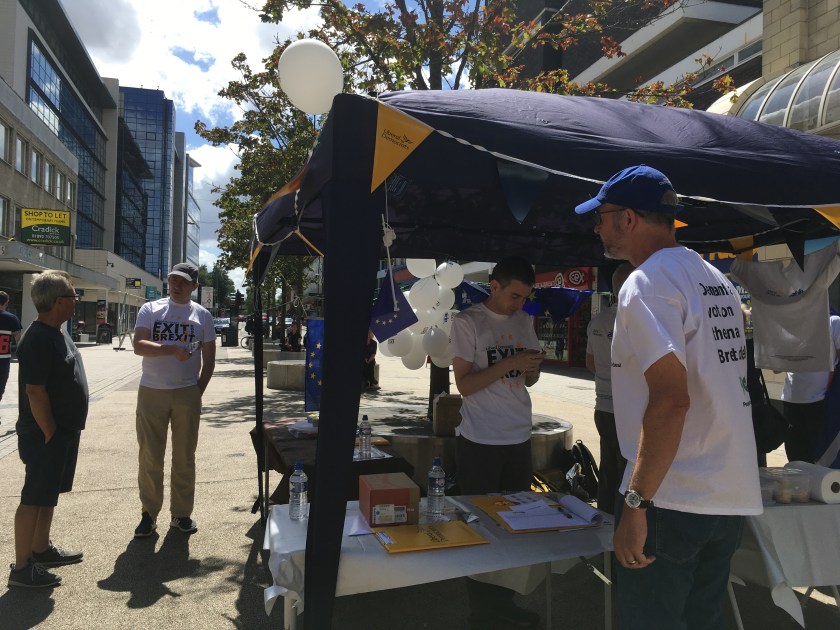
IMG_2217It’s one thing to discuss the technicalities of Brexit but there’s nothing like standing in a High Street and talking to people.  Before the day slips from my mind I thought I’d write a few short reflections.

Our weather hasn’t shown much sign of Spring but on Saturday it was almost as if the heavens were smiling on us.  Sunshine brought lots of people out for a stroll, shopping and much else.  It’s so rewarding working with a likeminded team.  A cross-Party group of us met-up in the centre of the Surrey town of Dorking.  Determined to show that there’s a movement for change.

I approach leafleting with a smile and a greeting – would you like a leaflet?  It works.  Yes, one or two people don’t want to be bothered or smile back but that’s normal.  Who knows what’s going on in the lives of those you meet by chance on a Saturday morning.  Being respectful is essential.  First impressions matter so much.  With a badge, some stickers and colleagues around we made it clear that we were campaigning on Europe.  What we find is that the politeness and civility of most people reminds me that there’s a lot worth fighting for in Britain.

On Saturday, I’d guess no more than 1 in 20 of those I leafleted presented a negative view of what we were doing.  From them, not one original new saying came up.  Responses were mostly stock phrases, like: “We’ve voted once” or “I want out” or “the sooner we get out the better”.   Not the basis for conversation.  Generally street campaigning isn’t about arguing with people.  At its best, its more about connecting with supporters and offering information to those with an open mind.

I did engage with one guy who thought one vote was enough.  My counter argument was the fact that we vote every year in local elections and democracy is open to people changing their minds.  Much as I expected, he wasn’t moved by this way of thinking.   With a small minority there’s a kind of belligerence.  Its true of other life situations too.  Pride or stubbornness or absolute blind conviction means that little real discussion is possible.  The strange thing is often we spend a disproportionate amount of time talking about people who behave this way.

Without a shadow of doubt there’s a strong demand for a vote of the deal.  A clear majority of people we meet in Dorking want to have a choice over the Brexit deal.

The call for a #PeoplesVote is gaining momentum.  Lots support the @peoplesvote_uk campaign for the people to have the final say over the #Brexit deal, not politicians.

Wake up the sentinels

When I half remember good advice, it drives me to do a bit of research.  This week, watching all the questions being asked of Facebook, I couldn’t help but recall something I’d read more than 30 years ago.  Yes, going back that far does have relevance because fundamental questions are exactly that; fundamental.

It seems every time technology advances the law follows but several steps behind.  That’s law makers and those who sit in judgement trying to interpret tomes of law need to speed up.  It was starkly apparent to me that Facebook was getting an easy ride, as questioning politicians struggled to keep up.  Few question hit the mark or even attempted to look ahead.

For me, as for many, even research can’t be conducted without a heavy reliance on technology.  So, I searched with the fragments of what I’d remembered.  Typing into Google’s almighty search engine the two words “sleeping sentinels” because that’s what I thought was the name of a book.

Initially, I didn’t find what I wanted but what I did find was intriguing.  I wasn’t previously aware of the story of the “sleeping sentinel”.  A Union Army soldier during the American Civil War.  He fell asleep whilst on duty, was court-martialled and sentenced to be executed.  Harsh treatment indeed.  But after his death sentence was read, a pardon was read thus saving his life.  Lincoln had interceded on Scott’s behalf.

In this tale there’s an indication of the awakening of the idea of a “just culture”.  Today, people with safety related work are expected to report such a case as; falling asleep on the job due to fatigue.  In a “just culture” they should not be punished if others can learn from their experience.

I digress, since my aim was to rediscover an almost forgotten book on law.  Eventually, I came to a reference to a book called: “The Slumbering Sentinels: Law and Human Rights in the Wake of Technology”[1].  This was the paperback I remembered.

One of the tenants of the book is that the law is sleeping while technology is racing ahead.  Clear insight from the 1970s and 80s trying to consider the implications of personal commuters and alike.

Equally important to the case of understanding Social Media is the changing landscape of political campaigning.  Its only now that everyone is discovering the details of what happened in June 2016 in the UK.

Its Friday 13th and the news media is full of conflict and tension, but I hope this material gets well discussed.  It does amount to finding out, after the event, hugely significant facts about the referendum of 2016.

https://www.parliament.uk/business/committees/committees-a-z/commons-select/digital-culture-media-and-sport-committee/news/fake-news-matrix-evidence-17-19/

To quote: “192. If the Commission indeed refrains from even exercising a discretion as to whether to refer a matter to the police or prosecuting authorities until it is satisfied beyond reasonable doubt that an offence has been committed, this in our view would constitute an unlawful fetter on its regulatory discretion.”

What a dilemma.  If the Electoral Commission, police or prosecuting authorities do not respond then they are indeed Slumbering Sentinels.

If they do respond, the case could be made for invalidating the 2016 referendum.  To reassure them, as I have been saying in this article, they will not be the first to wake-up while technology is racing ahead.  It’s difficult to foresee how technology will be misused in the future especially when money is no object.  That said, we can’t ignore the facts.

[1] The Slumbering Sentinels: Law and Human Rights in the Wake of Technology (Pelican) Paperback – November 24, 1983 by C. G. Weeramantry
