Toronto Regional Jet

The bubbling cauldron of social media is overflowing with comments on the regional jet crash in Toronto. So, far 2025 is starting as 2005. After a period when aviation safety results were admirably good, we now enter a period when events conspire to show us that we should never take aviation safety for granted. Obviously, the question gets asked – is this a statistical blip or is something more concerning happening?

As would be expected the Canadian air accident investigators are gathering data. No doubt there will be preliminary reports. Much evidence is available to help the air accident investigators determine probable cause. This evidence available includes a plethora of video footage. The ubiquity of the mobile phone has led to a situation where videos circulate on social media before they get into the hands of professional investigators.

Speculation on this major accident ranges from the Trumpian – I saw a video therefore I know what happened to the more considered comments about how well the cabin crew did in evacuating the broken aircraft under horrendous conditions.

Certainly, the landing appears to have been a hard one. The weather condition, as seen on the pictures doing the rounds, was windy but not stormy in the sense of poor visibility. Snow cleared from the runway. Surrounded by a landscape of white.

Luckly the aircraft slid down the main runway. That dissipated energy to an extent that most passengers were not badly hurt and therefore able to escape the wreckage. Another fortuitous part of the sequence of events was the absence of a fire at the time of evacuation.

I need to be careful in using the word – fortuitous. The investigators will put together the exact sequence of events but there’s no doubt in my mind that credit should be given to the good design of the aircraft. Generally, accidents and serious incidents are more survivable that people might initially think. This is NOT simple luck. Although, for individuals’ luck may play a part in their fate.

Structures and Cabin safety experts spend their working lives thinking about the – what ifs. The objectives set for aircraft designs maximise the opportunities for survival. Cabin crew can fly for a lifetime and never experience a catastrophic event. When they do their training kicks in, and lives are saved. My thanks are to all those who work tirelessly behind the scenes to ensure that aviation safety isn’t taken for granted. Those who do the serious business.

POST: Agreed. https://edition.cnn.com/2025/02/20/us/flight-attendants-safety-plane-crash/index.html

Challenges Facing Supersonic Flight

Congratulations go to “Boom” for their supersonic jet flight[1]. Civil aerospace hasn’t ventured into this space for some time. Breaking the sound barrier is not an everyday occurrence in the civil world. There may be an international market for such new aircraft as much as there’s a market for fast cars and expensive boats.

However, I do not think a supersonic flight is the future of civil aerospace. It’s not mainstream. The environmental objectives for the future of aviation are ambitious. Generally, that means getting people from A to B in as clean and efficient a manner as is feasible. That does not include going ever faster and faster.

This new aircraft type is likely to be solely made in America. So, it does fit with the current political direction of the administration in the US. A triumph of technology. President Trump’s instinct to get rid of rules and regulations may work in the favour of Boom. However, in the end, the deciding factor will be – will the international marketplace want such a new aircraft type?

I certainly recall amazing ambition of the people who brought us the Eclipse aircraft[2]. Small light jets were going to be everywhere. Like a Silicon Valley revolution for the aerospace industries. That didn’t happen as predicted because the economics didn’t stack up. I don’t recall rules and regulations being the problem.

Even so, BOOM technology will have a hard job meeting international safety and environmental standards. I seem to remember that’s not new for supersonic flight. Even if the advancements made improve noise performance, there’s emissions and contrails to ponder.

There is another consideration too. It’s the problem Advanced Air Mobility (AAM) is facing now. To capitalise on their capabilities, these aircraft technologies require the reorganisation (modernisation) of national airspace. Plus, agreement at international level[3].

Supersonic flight over the world’s oceans may get agreement. Supersonic flight over national territory is a much harder sell. Some fliers may pay to slashing their travel times on-route. Going round and round in a stack, waiting to land, with conventional aircraft all around, will soon dispel any excitement.

Good luck to Boom. If civil use is minimal, no doubt defence applications will be numerous.


[1] https://boomsupersonic.com/

[2] https://www.eclipse.aero/about/

[3] https://www.icao.int/environmental-protection/Pages/default.aspx

Speed

Daily writing prompt
Have you ever unintentionally broken the law?

There was a plain envelope waiting for me when I came through the front door, on Thursday last. It didn’t look like the regular ones that are house bills, statements or unwanted advertising junk. Yes, I’m primitive. I’m still paper based, to a great extent.

When I did get to opening it, my heart sank a little. Now, I hadn’t seen one of those for years and years. Inside was a formal bold printed form. Simple question. Was I the person driving my car on such and such a date, in the place named? They got me. I followed a link to a site that held motorway pictures. These images had gone from my recollection but there they were in curated digital realism. Big electronic signs, in bright red, hanging over the M25 motorway saying 60 miles per hour. Trouble is the calculated speed on the form was not 60.

By a small margin of error, the indicated speed of my car was enough to trigger the plain envelope that was not a welcome addition to my correspondence pile. Unintentionally I’d broken the law. I say unintentionally because I’m in the habit of using the speed limiter on my car to make sure such occurrences don’t happen. On this occasion my lapse is almost certainly going to turn into the need to go on a speed awareness course. Never mind.

Question mark?

Daily writing prompt
If there were a biography about you, what would the title be?

That not an easy one. There are titles that stick for the strangest of reasons. One for me is David Niven’s: “The Moon’s a Balloon”, which is autobiographical. Simple and captures an actor’s life being one of illusions.

Spike Milligan gravestone epitaph could be a title of a life story: “I told you I was ill…”.  Which sums up the unexpected and terminal nature of life. Not to take anything too seriously.

Douglas Adams’s Hitchhiker’s Guide to the Galaxy is a good source of inspiration. I could take: “So Long, and Thanks for All the Fish” and convert it into “Bye, and Thanks for All the Toast”.

There are a lot of titles that big-up their subject on the basis that book sales might be higher if the story is about untold struggle and marvellous achievements. Epic tales can be repetitive even if they are universal.

I don’t know if anyone has used it, but I have in mind the title: “What was all that about?” Imagining that my biography is published after I’ve past. Although, I doubt if such a whimsical publication would hit the streets in our cosmos.

The Future of High Streets

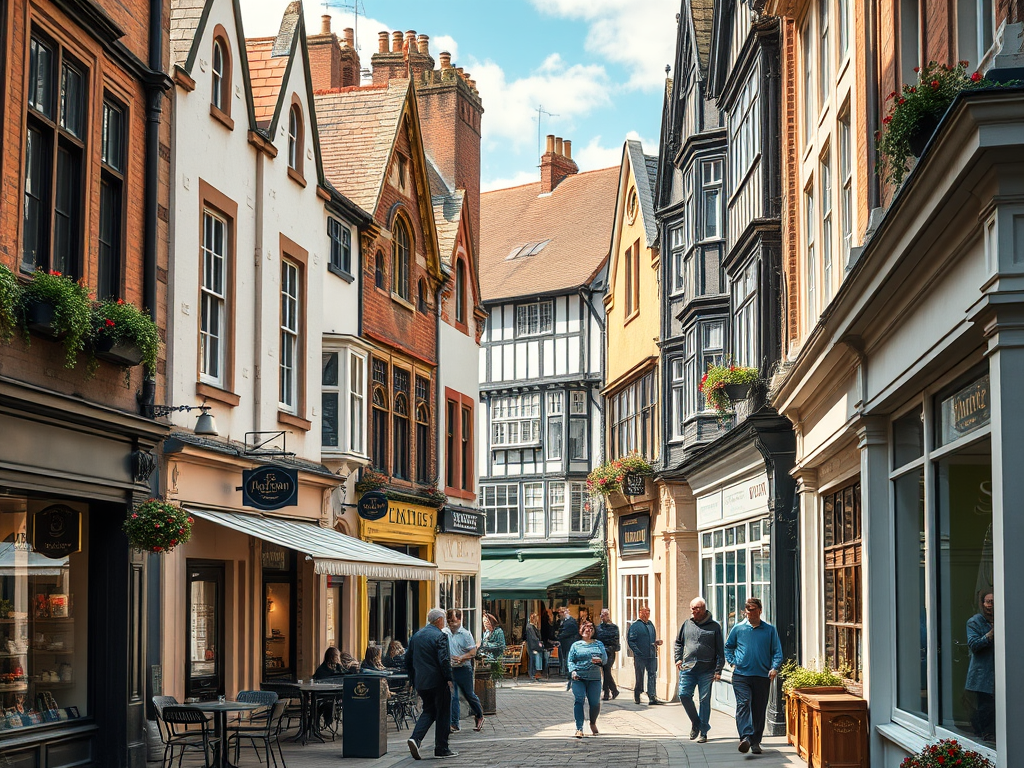
Traveling is great. There’s always something new to try. OK, I’ll add a caveat to that observation. There’s usually something new to try. What I’m focusing on here is our English urban environment. Whether that be the centre of a major city or a main street of a small town. Variety is the spice. Often communing from layers and layers of changes over decades.

What I can’t pretend is that all is well. There are well-known places that have cut out a specialist niche to thrive whatever the tidal wave of changes. However, even they are impacted by the trend for bland uniformity that the commercial world loves so much.

Yes, I might have a delightful afternoon in Oxford or Bath and think all is well. Then a stop in a less well-regarded city or town and the problems becomes clear. The shifting sands of our High Streets is leaving areas blighted by neglect or sanitised by unthinking development.

The function of the High Street is no longer that captured in Victorian photographs. The butcher, the baker and the candlestick maker. This Dickensian Street scene maybe nice to look at as a novelty. It hardly makes sense unless the intention is to preserve a museum like atmosphere.  

Our town planning can still be caught up a sort of Victoriana. Intent on preserving the line of shops that has existed since the traction engine replaced the horse. It’s nice to see, centrally placed, a traditional coaching inn, but even they survive as restaurants serving specialised cuisine or dusty antique shops.

So, what to do? I have a couple of themes. One is community identity. Another is facing the reality of the on-line world, and another is to bring everyday life back into centres.

Avoiding the bland mediocrity of modern design[1] should be up there high on the list. Future generations will castigate us we leave them such dull ordinariness as to make them look away. Every place has a story. It’s not a question of packaging that story up as a museum exhibit. It’s more a question of making a 21st century interpretation of a history.

Embrace the on-line world. It’s not going away. I don’t say hordes of flashing lights and screens the size of houses. No, let’s be a less crass. Free high-speed connections ought to be in the heart of our communities. Innovative thinking like portals[2] between centres offers opportunities. Even if these must be carefully managed. Connecting places creates new experiences.

There’s often a tussle between the wish to bring living spaces back to High Steets and the demands of the night-time economy. People make spaces work. That could be window boxes full of flowers or tables out on cobbled streets on a moon light night. What’s clear is that public transport, infrastructure, and affordable housing are a must.

More effort is needed to square this circle. Make sure a good life can be lived in a centre but at the same time it be welcoming to visitors. That’s tough for designers and planners but that’s where they should aim.


[1] https://www.prospectmagazine.co.uk/essays/42227/the-duel-has-modern-architecture-ruined-britain

[2] https://time.com/6977881/dublin-new-york-city-portal-temporarily-shut-down/

Sun up to Sun down

Daily writing prompt
Describe your most ideal day from beginning to end.

Arise from a slumber as sharp as a nail. Gaze out of the window on a sun filled world. Remain completely stoical about the morning’s News. Drink that first cup of tea whilst marvelling at a crazy Squirrel upside down on our bird table. Open to the notion that it’s possible to learn something new as the day pans out.

Have a plan to do tasks entirely of my own choosing however meaningless that might be. Tick-off those tasks with a smug satisfaction as the six-o’clock News looms. Sit back without a care. Chat about whatever it is that bubbles to the surface. Slowly subside into a comfy armchair. Realise how fortunate it is to live in a part of the world not blighted by conflict.

Snakes

Daily writing prompt
What’s the thing you’re most scared to do? What would it take to get you to do it?

Scary? That’s the moment when Indiana Jones is sealed into a tomb full of snakes. A young Harrison Ford, as Indiana Jones finds himself face to face with his worst nightmare[1]. 100% that would be me. If asked to step into a room full of hissing snakes, I’d run to the furthest hills.

Now, here in the UK, Channel 4 are airing a series called The Fear Clinic[2]. It makes great watching. If you have a strong phobia, you are not alone. Rats, mice or small dogs, I can understand. For me, those don’t kick-off a fear response, but I can understand.

The approach taken by the Amsterdam clinic in the TV series is to “encourage” their clients to face their worst fears. That’s supposed to trigger a cure that lasts. For some people that does seem to be the positive result. I guess we are not shown any destructively negative results of clients confronting their worst nightmares.

If asked to enter a room filled with slithering snakes, I’d be shouting “help” very loudly indeed. Luckly, since I have no need to encounter lots of snakes, I have no need to find a cure for my fully rational fear. The last time there was a snake looking at me, he/she was sitting behind solid glass[3]. Sitting on a tree branch not the least bit concerned about me standing there feeling uncomfortable. Safely I passed by trying not to make eye contact.

Since we are now entering the Year of the Snake, I ought to be careful.


[1] INDIANA JONES: RAIDERS OF THE ARK – The Well of Souls

[2] https://www.channel4.com/programmes/the-fear-clinic-face-your-phobia

[3] https://www.tripadvisor.co.uk/Attraction_Review-g190745-d1575308-Reviews-The_Living_Rainforest-Newbury_Berkshire_England.html

Economic Growth in Post-Brexit UK: A Call to Action

I do remember when there was a British newspaper called The Daily Telegraph. It represented establishment views. Was rather stuffy and what you might expect a certain type of middle-class accountant or lawyer to be reading on their commute to work.

It has become a pamphlet for the alt-right, supporters of oligarchies and whacky think-tanks pumped full of money from climate change deniers and overseas sources.

The sort of right-thinking people who gifted us with Liz Truss as Prime Minister. I shouldn’t be so dismissive because as recent history has shown these daily publications still have influence.

Now, Labour’s Chancellor of the Exchequer is shouting growth, growth, growth from the rafters. Not that her cry is an entirely bad one, it’s just that she is saying this with mufflers on her ears.

The Chancellor is right that the most important issue of the moment is the economy. There are a lot of people pointing out that a quick way to improve the UK’s economic situation is to knock down the barriers we have erected with mainland Europe. Next door is a huge market for our products and services.

Labour was telling us to believe in Brexit and that they could make it work. Most people know that this was last year’s meaningless words spread about before an election. Polling now shows that most people favour closer ties with our neighbours[1].

In some senses there’s little change. People are more likely to see the Lib Dems as anti-Brexit and the Conservatives as pro-Brexit. They remain unsure about Labour’s position. So, when the call goes out from the Lib Dems for closer economic ties with the European Union (EU) a whole host of predicable nonsense is said and published in newspapers like The Daily Telegraph.

Labour’s dithering makes the possibility of growth, growth, growth seem as unreliable as their protestations of love for Brexit before last year’s election.

The direction of travel is mighty obvious. Brexit has failed. Corrective action is long overdue. Forward thinking politicians really need to step-up and fight for a prosperous and economically successful Europe. One that includes us.

Labour has this term of government to make its mark. If it doesn’t then the possibility of extreme political elements getting a foothold in the UK are significant. Dithering for 5-years will be the biggest mistake after that of 2016. Corrective action may have a political cost in the immediate short-term, but the long-term benefits are there for all to see.


[1] https://yougov.co.uk/topics/politics/trackers/how-the-government-is-handling-the-issue-of-brexit-in-the-uk

Hot tin roof

At Christmas, conversations across the dinner table flow in all sorts of different directions. Once or twice, they do evoke memories that resonate. Days in the 1960s and 70s that are half remembered and maybe embellished.

It’s a steel three-bay Dutch Barn that brings us together. This old barn still stands but is more than likely riddled with rust and decay. It no longer does what it did during my childhood. That is holding hundreds of hay bales.

One of the regular farm duties was to give the barn a complete coating of “red oxide” paint. That’s the galvanised roof structure and not the tall steel columns that kept everything in place.

Up to the 1970s, lead was added to some red oxide paints. On refection, hours spent spreading this gloopy liquid about the corrugated barn roof was probably hazardous. The consolation being that this painting job was done on a completely exposed roof. That’s about as open air a job as any painting job can get. I remember the paint dried very quickly. That could be annoying.

The barn ran roughly East – West, with the lean-to section being exposed to the full force of any wind from the North. Getting up on the barn roof was easy. One side of the barn had a full-length lean-to section. It didn’t take much of a ladder to climb onto the lower part of the lean-to roof. The slope was steep enough to require a degree of care but the bolts that held the galvanised sheets in place helped add some grip for our boots.

My childhood experiments were ridiculous. They made eminent sense that the time. One involved making a parachute out of used black polyethene hay rick covering and baler twine and testing it by jumping off the barn lean-to roof. Remarkably this never resulted in any broken bones. I can only think that was down to the soft, muddy grass that I landed on. More mud than grass a lot of the time.

A completely different story is about filling the hay barn. Doing what it was designed to do. That’s store hay bales for the winter. Now, imagine the middle of summer. Blazing sunshine. A hot tin roof and the awkward spaces under it. Dry air, dust and noise everywhere. Working to self-imposed deadlines to get the hay in before the weather changed.

Today, mechanisation has taken the shear drudgery out of the annual ritual of haymaking. Most of the work is done sitting on a tractor. That might even be air-conditioned.

Let’s say, I’m talking about 1975, or a year either side. My dad, brother and I would be staking the hay bales in the barn. My mum would be on a loaded trailer putting the bales on an elevator. One by one. For the first five or six layers of hay bales we’d have an open space to work in. My brother and I would compete by showing off how far we could throw the bales as they came off the elevator. As we went up, layer by layer so the job got tougher and tougher. There was less space to work in. The heat and dust became almost overpowered.

Those are the moments I remember. Sweating like no sauna can make anyone sweat. As each hay bale came up, we’d have to think more carefully about where to put it. Stooped as we were compressed against the barn roof. That’s when our thoughts were to get the job done as quickly as possible. In these intense conditions, the thought of only having to do this job once a year and prospect of ice cream were just about enough to get us through.

+/- leadership

Daily writing prompt
What makes a good leader?

I’m past expecting “good”. There’re a million management books that pamper the art of perfection. Buy another book on management and the keys to success are assured. Like hell they are. There’s certainly more than enough advice about what makes a good leader.

Why don’t we focus on being a normal human leader? Let’s just say that we are all flawed. It’s embedded in Christianity with the biblical phrase – let’s he who is without sin throw the first stone. A great imperative but easily ignored by a bad leader.

I’d say a good leader is one that doesn’t consciously act as a bad leader. What do I mean? Here’s a snippet of the worst of the most mediocre managers I’ve worked for over the decades.

A traitor. A head who will have a group hug to agree a line on a difficult subject before going into an important meeting. Then as the meeting progresses poorly, throws his team members under the bus to save his own skin. When the going gets tough, the tough get going.

A showman. A polished head who drips with confidence and hutzpah. Says and does anything that raises their profile above any of his team. Always takes credit when things go well. Always in the picture. Ready for a quote. Rarely wavers or sees any damage done.

An emperor. An attractive head who initially engages and embraces his team members. Has a strong intellect. Learns all he can of their ideas and experiences. Uses that knowledge to his own advantage. Then demotes or discards or rides rough shod over his former colleagues.

A good leader maybe flawed. But “good” does not pursues the three above. Now, let’s turn to a positive reflection. Here’s three categories to look for.

A mentor. When you meet a head and your first thought is – I want to be like them. I want to know what they know. That’s the time when “good” becomes real. Here’s a learning opportunity to be grabbed with both hands.

A motivator. There are heads who walk into a room and the whole atmosphere changes. They stand at a podium and with a few words change the agenda. Never dull and predicable. They tackle the gritty questions of why and how.

A doer. That head who doesn’t just spout fine words. Through their reputation and list of achievements they show that positive change can happen. They can lead a team to achieve more than the sum of the parts.