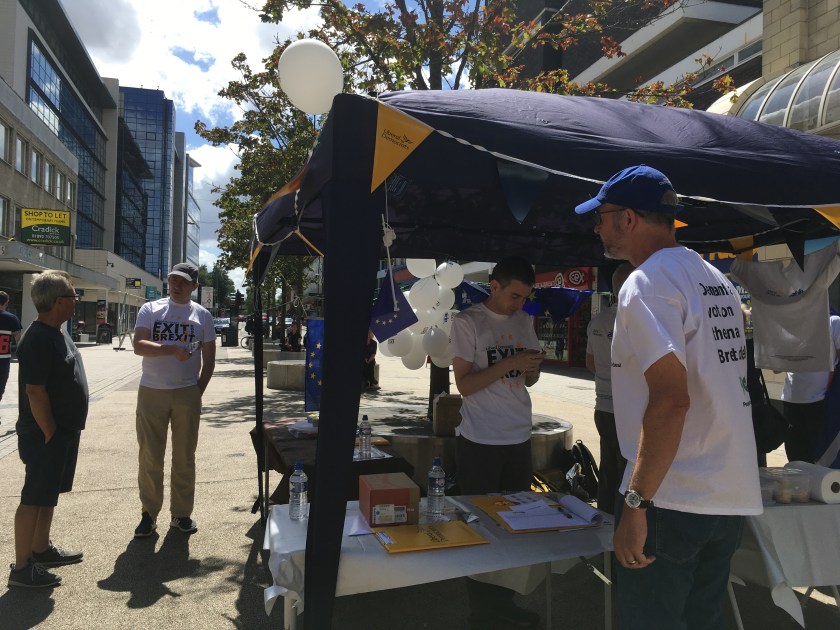
 A Saturday morning spent campaigning in Redhill is a real eye opener. A group of us set-up a street stall with free cakes, leaflets galore and a couple of European flags. We set-up outside the local shopping centre to be seen by as many people as possible. The heat of the week has gone. At one point, the wind almost took the whole stall away as the British weather has changed to become stormy.
We collected a lot of signatures for our #PeoplesVote petition. Whatever you do, please don’t get the wrong impression from what I write here. The morning was a campaigning success story as so many people came over to our stall. So, many great people to chat to about the positive things we can do to bring about change. That said, it’s the difficult conversations that are interesting. Here’s a few tales from the streets of Redhill.
An old Liberal friend who I hadn’t seen for many years, dead set against the European Union, was a joy to meet. Yes, we had our differences but there wasn’t that unpleasant animosity that springs forth so easily from some people who supported the Leave vote.
One Labour voter let me know that the EU was a big capitalist conspiracy. He was a retired railwayman. To him the EU was responsible for all the tiresome rules and regulations that the railways had to implement. It was as if taking the EU away would suddenly transform British railways. Yet, as we know most of the disastrous decisions made by the current Minister responsible for the railways are purely national mistakes.
A conversation with, I would guess an East Surrey UKIP member, was kept on an even keel by our mutual interest in aviation. He delighted in telling me stories that he though I was too young to know. I figured out he once worked in the defence industry. Possibly at Filton in Bristol. It’s amazing how the bitterness of a decision made in 1965 has lingered so long in the mind. The cancellation of the British Aircraft Corporation TSR-2 was part of his lament. It seemed crazy that this was part of his package of reasons for being anti-EU when that decision, and many similar ones, had nothing what so ever to do with Europe.
Three or four times the argument came at me, as if it was an unstoppable force, that: “we’ve had a vote”. That vote was enough, and we shouldn’t have any more. A couple of, mostly older men said: “what you are doing is undemocratic”. I felt myself getting agitated but kept my cool. I just wonder if the people who say such things have even the slightest idea how their democracy works. Not even one of them can claim to have stood for election in a real democratic process as many times as I have done. Yet, they will come at you aggressively with this simple line.
In fact, they get stranger. One guy used a football analogy that fell flat on its face. He said: if you played a football game and lost you would have to accept the result – wouldn’t you? To which I answered: “well, I’m just trying to win the next match as you would expect any good player to do”. As expected that made him even grumpier.
A middle-aged woman pronounced that the Country was full. She didn’t want to say what she meant outright but it was clear enough.
A couple of young lads passed me by. I said: “want one of my leaflets?” and the response was – no we’ve had enough of that – people keep changing their minds. That’s not encouraging. The idea that changing your mind is somehow too much to cope with is disconcerting.
One older man repeated the line that he didn’t want to be ruled by the Germans. I asked what he knew about how the EU worked and if he had been to Germany recently. I even admitted that I had lived there for 11 years. That was a bad move on my part. The immortal line got thrown back at me – if you like it so much why don’t you ******* off back there. To which the only answer is to smile and walk away.
Remarkably there were things that I found to agree upon with those in Redhill who didn’t share my enthusiasms for a #PeoplesVote.
One: Bring back Spitting Image. What they could do with today’s dull politicians and Royals.
Two: May’s Government is doing a terrible job – mass unhappiness – nobody gets what they want.
Three: Jeremy Corbyn is the worst official opposition leader in a generation or more.
There’s a generation, most of whom had a referendum vote in 1975, who have lumped all their troubles and fears into one big bag and called it “Europe”. Its clear, that’s not their real concern but that hardly matters. Europe has become a proxy for a bucket load of negative emotions and troublesome fears. Historians will not make sense of this in years to come as we can’t make sense of it now.
Calling for a referendum on the deal that the Government comes up with in the end, has its risks. Although the pendulum is swinging against the Leave vote, there is still a hard core of disgruntled people who will shoot their own foot rather than think again. Now, we are a terribly confused Nation. I’m convinced that after March next year none of the people’s real concerns will have been addressed. Stay tuned, this saga has a long way to run.

 Let’s unbox this rule-taker verses rule-maker dichotomy. For one it’s NOT a binary choice. In so far as international aviation safety rule making is concerned I have seen small, well informed organisations have a major impact of new rules and large powerful Countries asleep at the wheel.
