
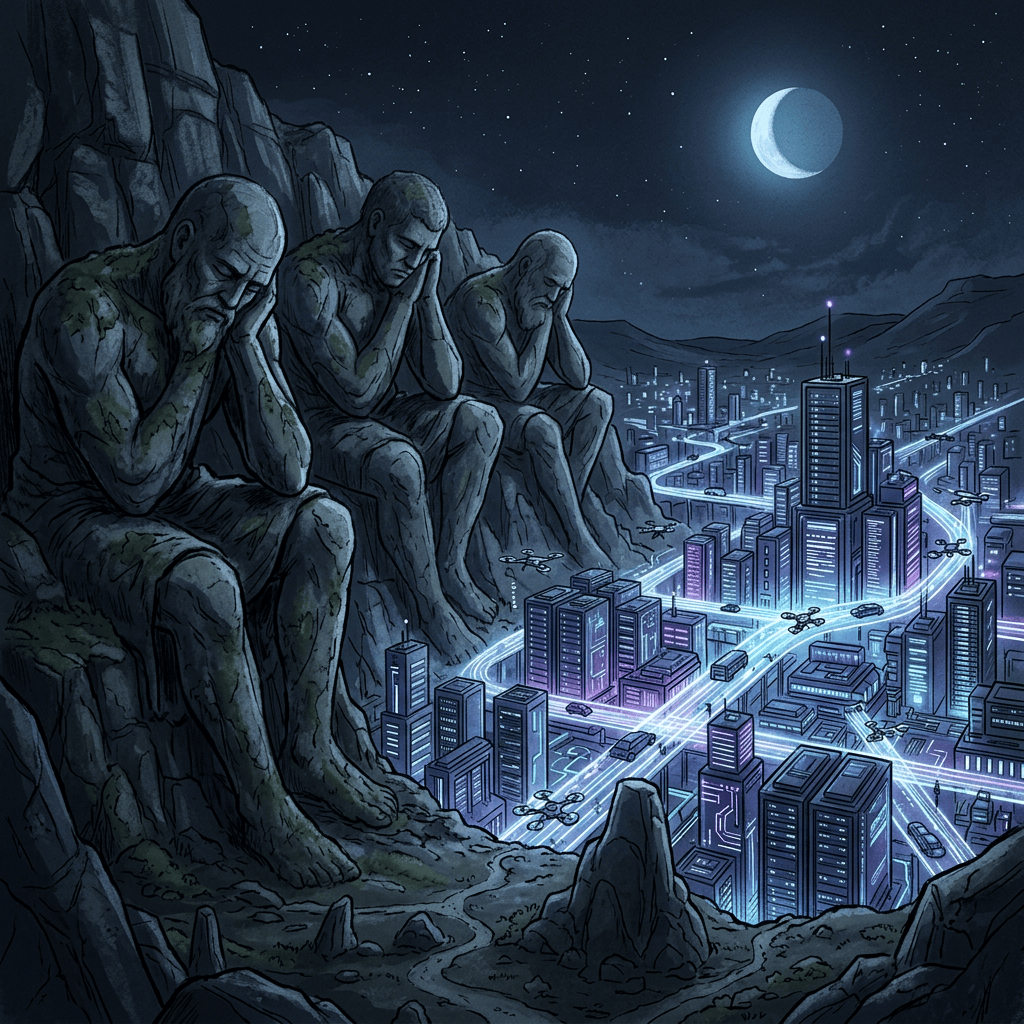
Much talk of the end of times doesn’t make for the end of times[1]. It’s true to say that commentators have taken time on their keyboards to ponder on the apocalypse. It isn’t the first time the subject has occupied the public mind. I could say that the four horsemen of the apocalypse have been around since biblical times. They have, and now there’s a couple more of them riding around the globe.
In my lifetime, the atomic age, the jet age, being wiped out by bombs and a following nuclear winter was brightly coloured there on the chart of probability. Far too high up that chart. Then the Cold War ended and a period of moderate sensibility seemed to exist. That didn’t last long. Chewing over the masses of accumulated planetary climate data created another headache. This time, but at a slower pace, climate change became one of the horsemen. No doubt the popularity of apocalyptic science fiction and science reality comes from a deep insecurity. A realisation that the evolution of space and time is way beyond human control.
Playing my vinyl that’s been sitting in a box for too many years, I’m listening to one of my favourite David Bowie tracks. “Five Years[2]” is the ultimate apocalyptic disaster song. It asks the listener to imagine the News coming over that we’ve only 5-years left on Earth. What would happen in such a situation? Would we all scream and run around like chickens with no heads?
Now I must ask, is that a good lead into one or two words about Artificial Intelligence (AI)? Those working on this technology seem to be getting nervous about that technology which they have cherished, developed and promoted. Let’s first say that AI is not new. When I graduated, in the 1980s, it was one of those esoteric subjects that was only for those wanting to do a PhD in an obscure part of the world. Not more than 20-years ago, given that aviation research was part of my remit, academics lobbied me because they thought a complex neural network should be able to predict the next major accident in aviation. That is fed with enough safety data. They may have been ahead of their time.
What has surprised a lot of people is the speed with which industry has gone from academic research to live digital systems that exhibit astonishing abilities. Access wide open too.
I don’t know if there’s a Moore’s Law[3] for AI. There doesn’t need to be one. The observation is that every week there’s News of even more powerful technology being made available. The disruptors are disrupting themselves before the rest of us have a clue what’s happening. As David Bowie would sing: “my brain hurts a lot.” Here’s what I think is problematic.
One. Concentrated Ownership. This innovation, and its potential power are in the hands of few people and States. Specialised expertise and infrastructure are prized intellectual property.
Two. Forecasting Dilemma. Projections are fuzzy, to say the least. Who can be believed? A simple curve on a graph doesn’t cut it. Step transitions are more than likely.
Three. Sleeping Sentinels. Regulatory lag is normal. Rules and regulators take time to mature. It’s just that, in this case, this lag may be disastrous. And some prefer to sleep.
Four. Legacy Thinking. Imagining AI’s future to be a version of past progress is woefully inadequate. It’s a new game when machines exceed human intelligence.
I do not believe that the world will end in five years but it maybe unrecognisable from today’s world. AI will create as many problems as it solves. Surely the powers that be need to step back and think about how the next decade will pan out.
[1] https://www.theguardian.com/us-news/2026/sep/02/jd-vance-god-podcast-end-times

