The River

What a contrast. From plus 12 earlier in the week to minus 2. There’s a sheet of white frost covering the fields this morning. The flood water shimmers in the morning sun. Not cold enough to ice over as the water tries to escape back to the river.

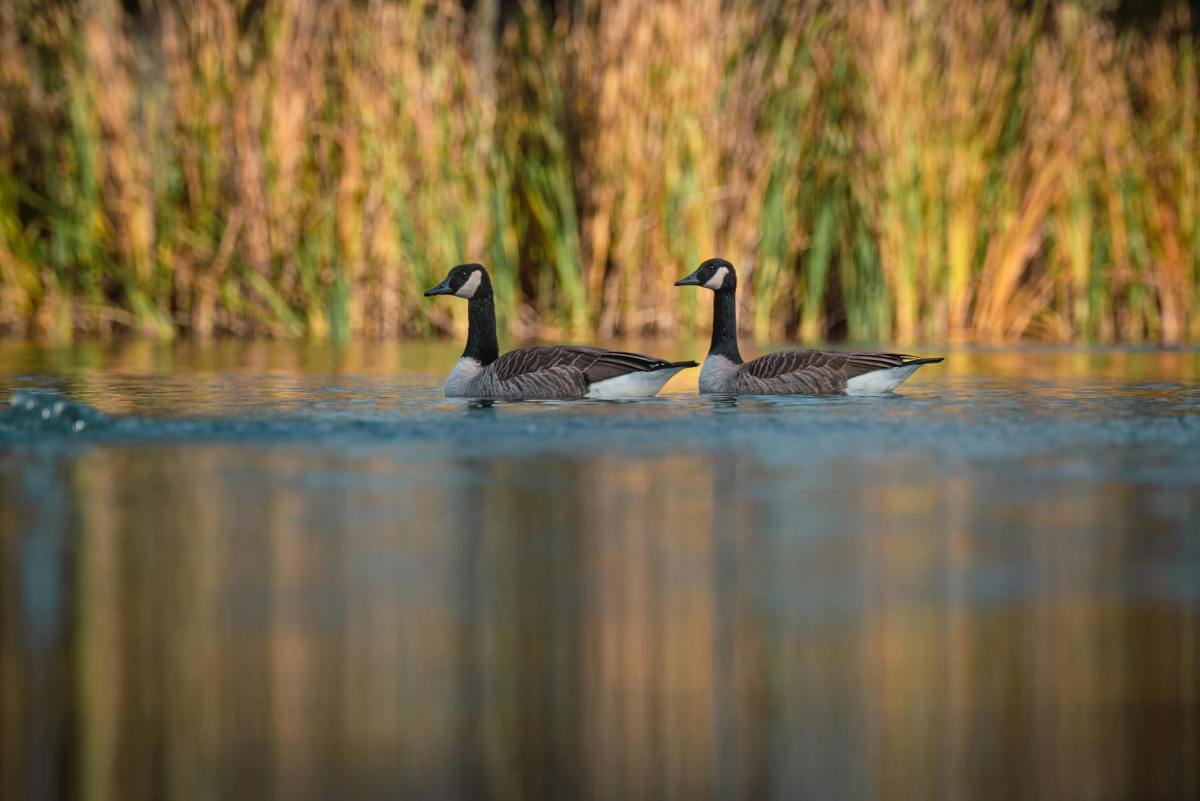
I get woken-up to the sound of the 18 or so Canadian Geese who make the boggy grassland next to the River Lambourn[1] their feeding ground. I can understand how they get so big as they graze from dawn to dusk. Their take-off from the water is a long one as they flap furiously to get their great mass airborne. It’s quite a sight as they fly in formation.

These formidable geese are not alone. A few Mallards stray into their territory. For the most part they all seem to get along fine. Plenty of food for everyone. Little grass islands form where the water swirls around. I named one of them duck island.

The geology here is Valley Gravel according to the council’s local plan. I’m not sure what that means but I guess the riverbank will drain fast when the flood water abates. Standing on the ancient bridge on the Oxford Road, I can see that the river Lambourn is shallow and fast running.

I say ancient bridge given the Priory on the other side of the river. The north side. That bridge site certainly dates to the 16th Century. The road must have a long history as it leaves Newbury town and enters the village and environs of the castle of Donnington[2].

I’m imagining the role the area played in the 17th Century. The site of the English Civil War battle, the Second Battle of Newbury. The castle was held by Royalists. It was under siege from the Roundheads camped on this side of the river. The south side.

From what I’ve read so far, the siege was a long one. When it was broken, the defending forces were allowed to escape in honour of the brave fight that they had put up. For whatever reason, in 1646, Parliament voted to demolish the canon damaged castle. Today, only the grounds and gatehouse of the castle remains standing.

It’s nice to be able to look out of my kitchen window and see on the hill such a significant part of English history. The ruin sits on the horizon looking north. Often both the rising and setting sun light it up.


[1] https://www.kennetcatchment.org/catchment/lambourn/

[2] https://www.english-heritage.org.uk/visit/places/donnington-castle/

14-years

All political parties have factions.  If the aim is to corral all liberals, social democrats, conservatives, or socialists and keep them under one roof it’s always going to be a hard job. Even as we speculate about the shelf-life of the traditional political ideologies, they remain powerful.

Liberals can be particularly difficult in this respect. It has been said that getting liberals to go in one direction is like trying to herd cats.  However, that picture is a dubious one in times when great injustices must be addressed, or a good cause strongly fires campaigning spirits.

What’s fascinating is the decline and fall of “normal” conservatism. That mild mannered compromise between self-interest, traditional values and deference has slowly fallen apart. It could be because of its poor fit with modern society but it’s more likely to be because it has ripped itself apart from within. Factions have strengthened and the core beliefs that formerly bonded people together have fractured. Brexit may have been both symptom and cause.

There’s the case that populism has been radically amplified by modern media. A crescendo of views and all we hear and see is the peaks and troughs. Anything in the middle is drowned out.

So, the current Prime Minister’s (PM), let’s remember we’ve had a few, calls for unity. It’s a trumpet sounding in an anechoic chamber. Not likely to be heard, except by himself and those standing next to him. Their smiles are professional smiles. Their hopes are forlorn.

Analogies are fun. Another one came up this week as the Parliamentary byelection results appeared. The British electorate could be compared to a sea going super tanker. That is, being big and having so much momentum, changing direction takes a long time. Once that direction has set there’s not much that can be done in the short-term. That national super tanker maybe going slightly left of centre whatever happens. Of course, a crude analogy isn’t necessarily true. It’s more of a prediction of what might happen if pivotal events do not intervene. That’s easy to say. It’s less easy to anticipate such dramatic earthshaking events.

One thing I can feel confident about is that this is not a re-run of 2019. No way. Nor is it a re-run of 1997. A vital ingredient is missing. We have no charismatic political leaders. Vision is in short supply.

Facebook has a habit of throwing up pictures from the past. One it threw my way this week was of me standing in Crawley town looking every bit a parliamentary candidate. That was 2010. I looked at the image and thought – if only I’d had some inclining of what was to come in the next 14-years.

If only I’d anticipated how badly the coalition would turn out for liberalism. If only I’d anticipated what foolish gamblers Cameron and Clegg were in thinking a national referendum would silence the Europhobic hordes. If only the Labour Party hadn’t gone on a doomed left-wing romp. If only the reality of Johnson’s unfitness for office had sunk in earlier.

Looking back provides lessons. It doesn’t predict what will happen next. We all to often get hooked on linear projections based on where we stand now. Forecasting is as much a mystery as ever it has been. That said, I think doing the maths is better than looking at the tea leaves or seaweed. A narrative for the future could read – don’t think “that’ll never happen,” think change is natures way of keeping us on our toes.

Here’s a prophecy. This one has good and bad. Long talked about and feared by those who milk the status quo, Proportional Representation (PR) will be implemented for national elections in the UK in the next 14-years. The dated model of big tent political parties will crumble. Ballot papers in years to come will have something for everyone. So, what’s bad about that transformation? Populism will not die. It will just eke out an existence in many new forms.

QT

Over the years the BBCs Question Time (QT) debate programme[1] has played an important part in political discussions. It was a must watch for political activists and students at all levels. In fact, anyone interested in understanding the political views that permeate the country.

Unfortunately, the programme has declined to become a dull backwater for viewing if there’s nothing else on. The format is locked in to an awkward seeking of balance at the expense of an inquiry into the reasons and justifications for widely different views. There’s little in the way of vigorous cross-examination or investigation into the core values of the speakers.

I don’t want to blame the person who chairs the debate or the BBC for hanging on to the QT heritage. The programme has played an important part in the life of the country, in the past.

I don’t want to be one of those social media complainers for whom any deviation from the age of Robin Day is a blasphemy. Those black and white days are a wonderful snapshot of a long-lost era. The relationship between the public and their politicians has changes beyond recognition.

There’s no doubt that we have all become somewhat more superficial than may have been the case in the past. Politics has become something that is marketed to us as a commodity. It shouldn’t be that paper thin.

At its best such a debate programme gets to the fundamentals. If it merely tracks yesterday’s headlines the results are predicably shallow. Audience and panel members simply echo what we already know. What we’ve already heard elsewhere throughout the day.

What I want to know is more of the why and less of the what.

Say, a social liberal politician objects strongly to a dilution of human rights and a hard right leaning conservative welcomes such a dilution. We may already know that’s the positions they have adopted and campaigned on but are those positions of convenience or core beliefs?

Exploring what panel members really think and what they might really do is surly more interesting than allowing them to play to the audience, at home or in the room. I want an objective chair to put the panel members under pressure to uncover any deceptions. Deference born of an obsession with balance is as bad that born of class or impoverishment.

One of the parts of the format that seems unquestionable is the requirement to answer questions posed by members of the public. The audience is supposed to represent the members of the public not in the room. They rarely do. I’d much rather see a town square type format. That’s where the members of the public engaged are not so pre-selected or self-selecting. Walk out into a typical high street and randomly ask what question do you want answered? Do it live.

QT needs a major shakeup. It’s not quite dead. Its revitalisation is possible, but it needs to get off its current path.


[1] https://www.bbc.co.uk/programmes/b006t1q9

Housing

It was astonishing to listen to a Conservative Minister this morning. My diet of News and current affairs always starts with the Today programme on BBC Radio 4. Lee Rowley MP was everything you would expect from a former management consultant turned poltico.

Basically, the man is in denial. Everything is fine and all we need is one or two tweaks. Housing problems, only happen in Labour run areas. Everything is peaches and cream. Converting offices and shops into dwellings is perfectly fine. High prices for small cubes without windows – what’s the problem?

Then Mr Rowley wiggled around in his seat when asked outright: what’s the aim? How many houses will the latest proposal delivery? The answer was evasive. It’s not about numbers so the Minister said. Policies without a measure of success or failure are like sentences without meaning. This Minister couldn’t stand on the record of Ministers gone by, so he waffled.

The Minister for Housing is the person in the UK Government responsible for national housing policy. So, after 14 years in power we might expect us, the public, to be reaping the benefits of the seeds sown at the start of a term of Government. Nothing like that is remotely true. Initiative launched now are framed as if a unique and radical new approach is being taken to improve a dire record. Ignoring that the record is that of the current Government.

I don’t want to forgive the Minister, but he has only been in the job since November last. Chopping and changing Ministers is a habit of this Conservative Government. It’s almost like they hot desk, a few weeks here and then a few weeks there. Never enough to get much done.

UK housing, planning, and building is in a poor state. The demand far outstrips supply. Prices are ridiculous. Typically, the percentage of a young person’s income spent on accommodation is horrendous. Rents are high and first-time house buyers are finding it harder and harder. Tenancies are insecure and landlords are giving up.

Although, I remember having to endure high interest rates, at least housing was affordable in the mid-1980s. On a moderate income a mortgage could be secured for about 2 to 3 times annual income. My first brick built two up, two down, was a big step but it was affordable.

I believe this is going to be a General Election issue. Or it should be. It’s time for young people to come out and vote. It’s time for their voice to be heard. It’s time for a major shake-up in the way housing is provided in the UK. Policies enacted in recent years have punished those at the bottom of the ladder.

That’s my thought for the day. Change is vital.

POST: In his BBC radio programme, Tim Harford explains the statistics used in political debate and the News. The Minister above was comparing apples and pears, as is so often the case, when talking about the social housing that has been built[1]. Comparing the period before the Conservatives came to power with the period afterwards, using different metrics is a deception.


[1] https://www.bbc.co.uk/sounds/play/m001w86h

Drive

Listening to talk radio passes the miles of spray as I thundered down the motorway in the heavy rain. Oddly, going West to East seems somehow to be “down” although that makes no sense at all. Today, the M4 looked at its least attractive.

Inherently, those who take the time to phone in to radio stations are a self-selecting group of people who have been themselves been selected by the station’s editors. Afterall, who wants a dull silence or an abusive incoherent rant? That’s what social media is for (smile).

I’m guilty as a listener of quick stereotyping. I’m human. Radio voices do give a hint of education and personality. Unfortunately, my irrational biases are not too different from a lot of people. That association of a middle English accent-less voice as being “intelligent” is so easy to make. Contrasted that person with a broad regional accent, God forbid, West Country, then it’s all to easy to think smock and pitchfork.

What I’m recalling is a man speaking in the poshest London accent one can imagine. The subject was flip flops (flippy floppy[1]) that opposition politicians are doing as they change their policies. Is it national News that circumstances change and policies change accordingly? Apparently, it is.

He was saying that he had intended to vote Labour in the forthcoming UK General Election because he wanted change. It’s time for a change. Now, recent announcements had put him off. The radio host asked him who he was going to vote for when the election finally came. His answer was not inspiring; the devil you know, he said. My reaction was one of destain. I wanted to shout at the radio; you mean after all the screw-ups this lot have made you would still want them back in power!

I thought how can an intelligent person, maybe that was a leap too far, stick with the devil you know, when you know that devil is so grossly incompetent? Their overall performance has been poor. It’s a mystery but is that’s a common view? Is the taste for change so weak?

That sort of spur of the minute instinctive reaction is quite legitimate. Afterall, it’s a secret ballot. So, if that’s the way a person feels then that’s the way they will go. Comfort blanket politics.

My problem is that the whole notion of accountability goes out of the window if people constantly stick with the “devil you know” regardless of what they have done. If choosing differently is always considered to be too risky then no one will ever know if things can get better (to paraphrase a slogan from a past election[2]).

There’s some political mendacity here too. If we go back to the 2016 referendum, it was decidedly risky to vote for Brexit. That didn’t stop tub thumping right-wing politicians from pushing the risky option. Now, those same right-wing politicians want to cling to power so they are advocating exactly the opposite. That’s to encourage the electorate to think that change is far too risky. I can image a new political slogan saying – Yes, we are awful but we say we are not so awful as all the others. Dick Emery[3] would be proud.


[1] https://youtu.be/CFNML_MGq-M

[2] https://youtu.be/V6QhAZckY8w

[3] https://www.theguardian.com/tv-and-radio/2020/jan/03/dick-emery-dies-archive-1983

Space

Eutelsat OneWeb is a growing global connected community. That’s what the publicity says. Once upon a time I wrote about OneWeb. I wrote about it in the context of Brexit.

One of the touted benefits of Brexit was autonomy, in other words, British innovation leading the way to benefit Britain above all others. It’s that aggressive assertion of sovereignty that was at the core of Brexit. Remember, it wasn’t so long ago that this was part of Brexiters fantasies? 

In the Brexit turbulence the UK Government walked away from the EU’s Galileo programme. The UK no longer participates in the European Galileo or EGNOS programmes[1].

Then in 2020 the UK changed its original post-Brexit position and scraped building a national alternative to the Galileo satellite system[2]. At that time, Business Secretary Alok Sharma offered around $500 million of UK public money to acquire part of an organisation in trouble, called OneWeb.

OneWeb is a commercial Low Earth Orbit (LEO) satellite constellation now with an element of Government ownership. It’s network of satellites doesn’t have a global positioning capability, like Galileo.

To get its satellite network up and running, an expensive business, OneWeb merged with French company Eutelstat. Today, if we look at the 2020 investment made with public money the financial situation doesn’t look good. That doesn’t mean to say that things will not turn around in future years[3].

The Times newspaper has taken a nationalist view of the circumstance[4]. It’s a point that the intellectual property is not in the hands of the UK Government, but the investment could still turn out to be a useful long-term commercial bet. It’s gambling with public money.

As an aside, I’ve been looking at buying a new dishwasher for the kitchen. It’s made me aware of a capability that I had no idea had been developed. Namely, the connection of dishwashers via the web. I think this is what is called the Internet of Things (IoT). So, imagine that, British dishwashers connected by space as a Brexit potential benefit.

However, if there’s a change in the UK Government’s political direction after the next General Election there’s a strong possibility that the UK will return to the EU’s Galileo programme with some manner of partnership. When we get to 2026, we may look back on the decade behind as a vacuum, much like the vacuum of space. A time when an uncertain direction cost a great deal.


[1] https://www.gov.uk/guidance/uk-involvement-in-the-eu-space-programme

[2] https://www.politico.eu/article/uk-scraps-plan-to-build-global-satellite-navigation-system-to-replace-galileo/

[3] https://www.politicshome.com/thehouse/article/oneweb-uks-gamble-satellite-startup-pay-off

[4] https://www.thetimes.co.uk/article/656bd77c-c106-47c3-840b-674e9efc4f0e

Food

Food security matters. Much like energy security matters. Much like access to basic commodities. There are fundamental matters of supply that must not be ignored. International trade is a two-way street. But it must be a two-way street on the level. It’s possible to imagine a set of scales where there’s a balance between both sides. Maintaining that balance is a dynamic business.

It’s easy to understand how aggrieved farmers in Europe feel if they are subject to unfair competition. It’s the same in the UK. If say, meat comes into the UK, produced at a lower standard than domestic produced meat, and that undercuts farmers prices, that’s unfair and unwise.

News doesn’t just concern agriculture. Over the last weeks discussion about the UK’s ability to produce basic commodities, like steel, has occupied minds. Imports maybe cheaper. The trouble is that countries jeopardise domestic security and merely offload environmental concerns by increasing dependency on others beyond certain points. A sensible balance must be struck.

Political, marked trade imbalances are a nightmare. British farmers may not be so overtly militant as some on continental Europe, but they have a strong interest in influencing what laws say. Bandwagon jumping politicians from the far-right and far-left are taking advantage of the discontent that exists. None of these empty barrels have answers. That doesn’t stop them making a lot of noise.

Post-COVID, in all sorts of industries, there’s been, and still is, significant supply chain problems. For example, the price of farm machinery has gone through the roof. Although general inflation appears to be slowly coming down the hike that has happened, has happened. It’s bedded in.

Looking at the gap between input prices and outputs shows an unhealthy situation[1]. Producers have been squeezed. Their margins have been squeezed. It’s certainly not a good time to be a milk producer[2]. Even with optimism for the longer-term, today’s bills still need to be paid.

In the UK, there’s an often written about concern surrounding the power of the established major supermarkets[3]. These are almost monopolistic in their position in the marketplace. On the walls of their food warehouses pictures of smiling farmers and clean, shiny tractors are all the rage.

Because so much food goes through the doors of the supermarkets, if farmers want to protest, they are probably a better target than the UK Government. Alternatively, British farmers may need to work to reduce the influence of the middlemen. Going direct to the customer may not be for everyone but more could be done.

In a General Election year, it unlikely that politicians will pick a fight with British farmers. Their ears may prick-up for a short while. That’s a good time to make the case for domestic production.


[1] https://www.gov.uk/government/statistics/agricultural-price-indices/agricultural-price-indices-united-kingdom-november-2023

[2] https://www.nfuonline.com/updates-and-information/dairy-producers-braced-for-an-uncertain-future-nfu-survey-reveals/

[3] https://www.statista.com/statistics/280208/grocery-market-share-in-the-united-kingdom-uk/

Look ahead

Much as I support the UK Government’s position on hormone injected beef, the exit from negotiations on trade have wide implications. Maintaining the regulations that ban the use of hormones in beef is a good move for farmers and consumers.

However, for cheese exports the collapse of talks is tragic. Zero to 200% is one hell of a tariff jump. The UK will be in a worse position with respect to trade than it was pre-referendum. That’s with a strong ally, namely Canada[1]. Brexit has made us worse-off.

Yet, the Brexit supporters that remain, still herald Brexit as a wonder. Logic plays no part in their thinking. It’s easy to respond in an angry way to this self-inflicted blindness. It does no good. The stubborn streak in those who have dug a big hole is a thick one. And the hole is getting ever bigger.

Clearly, there’s no urgency on the part of Canada[2]. On the UK side the urgency is much greater. The need to stimulate growth to bring about a recovery in the British economy is much needed. Sadly, the legacy of a decision made in 2016 has made created a weak negotiating position.

For a long time, the UK has been given a soft landing due to transitional arrangements. Now, these arrangements are drying up. Far from the propaganda of the Brexiters, trade deals are not easy.

The problem is a reference back to the past is like crying over spilt milk[3]. How to go forward when the relationship between different States has been significantly changed is no simple matter. The situation is not irrecoverable but the avenues that can be explored are limited.

So, I caution of a never-ending lament. Brexit will need to be rectified. The means to do it are tortuous and may take a long time. The means to undo the mistakes of the past may face opposition from many quarters. One of the predictions for the European elections, this year, are that there will be a swing to the political right. Several right-wing political parties across Europe are on the ascendancy.

Instinctively these right leaning political parties are likely to less internationalist and more focused on immediate domestic concerns. So, third parties, like the UK, may not be high on Europe’s future agenda. On the UK side the major political parties have gone quite on Europe. There’s plenty of campaigning on international issues, like climate change and military conflict but little on enhanced working together.

There are many national news stories where solutions are best arrived at by greater communication, cooperation, and coordination. This year, so far, the signs are that these three “c” are going to take a back seat. Ironic, isn’t it. Facing greater international challenges than for decades, States choose to look inward. This myopia will continue until leaders speak positively of the future. Vision is needed.


[1] https://www.reuters.com/markets/canada-britain-pausing-free-trade-agreement-talks-2024-01-25/

[2] https://www.cbc.ca/news/politics/canada-uk-trade-cheese-1.7094817

[3] https://www.collinsdictionary.com/dictionary/english/cry-over-spilt-milk

Bland & Blue

How do we get the politicians we do? There’s no originality in that monster question. If we look across the Atlantic the most political peculiar fight is going on. A couple of elder gentlemen running as fast as they are able. I have to say that with solemnity as I’m in my sixties. The United States (US) has a fight no one seems to want, brought about by an inability to plan successions.

In Britain, I look around and see a country full of capable and talented people and then compare them with the political choices in front of us. Big choices are going to be needed this year. The limited choice is as peculiar as any. It’s maddening.

This week, a full gloss blue leaflet popped through our letterbox. Now, I’ve no objection to people putting traditional political messages through the letterbox. One of my favourite sayings is from a long-gone Cornish politician of great merit. If you have something to say, put it on a piece of paper and stuff it through the letterbox. David Penhaligon[1] would make that a mantra. It was about community politics. It was about talking about the local issues that were of most concern to local people. Focusing on what matters.

Anyway, the folded A4 headshot that came through my door looked more like an advert for dentistry than a local political message. Gleaming smiles are fine. When they gleam so much and so wide, I’m reminded of the jailed politician in the second Paddington Bear movie[2]. More of the same and can I count on your vote? No meaningful substance.

The fictional Peruvian bear who travels to London in search of a home would have swiftly been sent to Rwanda by this mob. Paddington’s admirable and lovable qualities wouldn’t last ten minutes in real 21st century Britain.

I’m assuming this was a paid political leaflet distribution. The Post Office (PO) gave us two copies in two days. Along with some pizza adverts. This is not material carefully delivered by dedicated local party activists. No, it’s a commercial distribution. Remarkable when considering that Reigate’s constituency is a “safe seat”, where the past results for the Conservatives hardly need counting. Just measure the length of the ballot pile on the table.

These expensive colour leaflet distributions happen long before an election is called so that the costs don’t have to be counted in the election expenses of the candidate.

What’s surprising is that this shiny blue leaflet didn’t have a single potholes picture. That’s where the candidate or prospective candidate stands over a pothole and points. Implication being that they will solve that problem. No pictures of flood waters or the attendant sewage outfalls that have become fashionable on political leaflets. No pictures of traffic hazards or schools that need money spent on upkeep. No pictures of abandoned plans to improve local railway services. Just bland page fillers.

Nothing from other Parliamentary candidates – yet. Let’s hope they have something to say.


[1] https://en.wikipedia.org/wiki/David_Penhaligon

[2] https://en.wikipedia.org/wiki/Paddington_2

Hero to Zero

How to go hero to zero in 30 seconds. I hired a large van for a week. From a company that had done a good job for me in the past. I had a lot of confidence in their offer. Fine their location had changed. Once the company was in Redhill in Surrey. The office was easy walking distance from my house. Now, they have an office in the small town of Dorking. So, it’s a short train ride away.

The Surrey towns of Reigate and Dorking are separated by about 8 miles. They both sit under the North Downs. The main A25 road links the two towns and probably has done for centuries. Without delays that’s about 20 minutes door to door. Normally.

Moving house is one of the most stressful events in life. That’s what we are currently about. It’s a move further West. It’s a move to take us away from the dreadful mess that the M25 motorway has become in the last couple of decades. From 3 lanes to 4 lanes, it’s got worse not better. Why do we think we can build our way out of traffic jams?

So, for the last week I’ve been driving a large van backwards and forwards from Reigate to Newbury. The hired van was everything I needed. Only about 7000 miles on the clock and plenty of space. If I had one niggle it was the need for a reversing camera. Beepers are just not enough.

The rental company, named after a famous starship, that went where no man has gone before, was topping my hero list. What I needed when I needed it and at a good price. With only a minor inconvenience when picking-up and dropping-off. Or, so I though.

Named storms are popular this year. Driving through one of them is no fun. Traffic slows and the inevitable bump or blown down tree holds everyone up. Nothing moves the way it does on a sunny day. It’s times like these when planning can be more guess work than science. Whatever a satnav calculates.

In my wisdom I thought – let’s try a cross country route home. Get off the habit of using the M4 and M25 motorways. Programmed the satnav and away I went. Leaving Newbury lunchtime thinking that getting the van back to the rental company by 5pm would be no sweat.

My route took me from Newbury to Basingstoke and then to the M3 motorway. Then towards London and coming off the motorway to take the Blackwater valley route to the Hogs Back. Those references are for Surrey residents because they will know what I’m talking about. Trundling along the Hogs Back I then hit the main A3 into Guildford. Now, my logic went like this. I’ll avoid the Wisley junction reconstruction or permanent hold-up by taking the main A25 all the way back to Reigate. So, I did. All going well until I reached the closure of that main road[1]. At that point I was committed to getting back to Reigate to unload my packing boxes. Can’t carry them on the train.

When road closures happen in Surrey, at rush hour the mess is insane. The diversion I took up over the North Downs and back down again onto the A217 road was miserably slow. What’s worse is that I knew I had to turn around and go back to Dorking to return the rental van. The clock was ticking. 

Anyway, enduring the tedious frustration of doing a short journey, by miles, over a long time wore away at my generally cheerful disposition. Thus, I was glad to get back to the rental company office in Dorking only about 20 minutes late, after 5pm.

I was committed to leaving the van and taking the train home. That trading estate rental office closes at 5pm. A dark and empty parking space was free, but nowhere could I see anywhere to drop the van’s keys? It seems inconceivable to me that an international rental company would not have a key drop. I searched the plot. There was nowhere. All there was an unhelpful notice on the door of the company’s office. So, I locked the van, kept the keys, and walked to the train station. Idea being to return the keys as soon as the office reopened next morning. Seemed logical.

Next morning, I got up early and set off for Dorking. Sadly, the closure of the A25 was still an on-going problem. All the rush hour traffic had the same issue to contend with on their way to work. This is why I’m happy to be leaving Surrey. A short journey turns into a tedious trek at the drop of a hat. The county’s roads are unable to cope with the levels of traffic. But, as planned I get to the Dorking office of the rental company at 8am when the office opened. Enterprise were still in my hero category as the van was inspected and the mileage typed into a company handheld device. I would have given them 10 out of 10. Job done.

In the warm, in the rental office, just as I thought the paperwork had been done – hold on a moment it’s charging you an extra day for a late return. Computers do these sorts of things. They have no awareness of the world other than the numbers they crunch. Unthinking beasts.

I’ll have a word with my manager. Those were the words spoken. Me being me, I though that’ll be no problem given the effort I’ve made to return the keys. Let’s face it if there was a drop box last night they would be doing exactly as they are now. Van returned in 100% condition and keys in hand.

Then to my surprise the office manager, who insisted on using my first name, says no we are going to have to change you for an extra day. In 30 seconds, Enterprise went from being my number one van rental choice to a huge bottomless zero. I argued the logic of my position and the unforeseen local conditions that prevailed. I outlined the best efforts that I’d made.

Then I got the most galling response – it’s company policy. I suggested that the office manager might use a little judgement or digression in this case. I hit nothing but a stone wall. The computer says so. The charge is the charge. No deviation possible. It’s astonishing that an office manager can’t make a reasonable judgement. If that’s Enterprise company policy I don’t want that kind of service. Other companies are available.

What didn’t help either was the prospect of the return journey in my car knowing that the main Reigate Road was closed. As per my prediction the short journey home again was awful.

Hero to zero – Enterprise. Hero to zero in 30-seconds. My future business will go elsewhere.

POST: This quote from the Enterprise website is meaningless. “We understand that things don’t always go to plan so, if you are running a few minutes late we won’t charge you for an extra day, we give you a grace period of up to 29 minutes to cover unforeseen delays“.

Part 2.

Change is always welcome. The above rental made me think twice about using the services of Enterprise. In my new town, they have a much more easy to get to office. It’s a 20 minute walk from the house. So, I ate my pride and booked a big van for a couple of days. The job was much the same as before. It’s all part of a house move that is lasting far too long.

Here I am renting from Enterprise Rent-A-Car once more. This time I’ll drop the label “zero”. From picking up the van to dropping it off everything worked as it should. My large commercial van took a heavy book case and a king sized bed from Reigate to Newbury without a hitch.


[1] https://www.getsurrey.co.uk/news/surrey-news/live-a25-traffic-updates-after-28495765