Summer Reminiscence

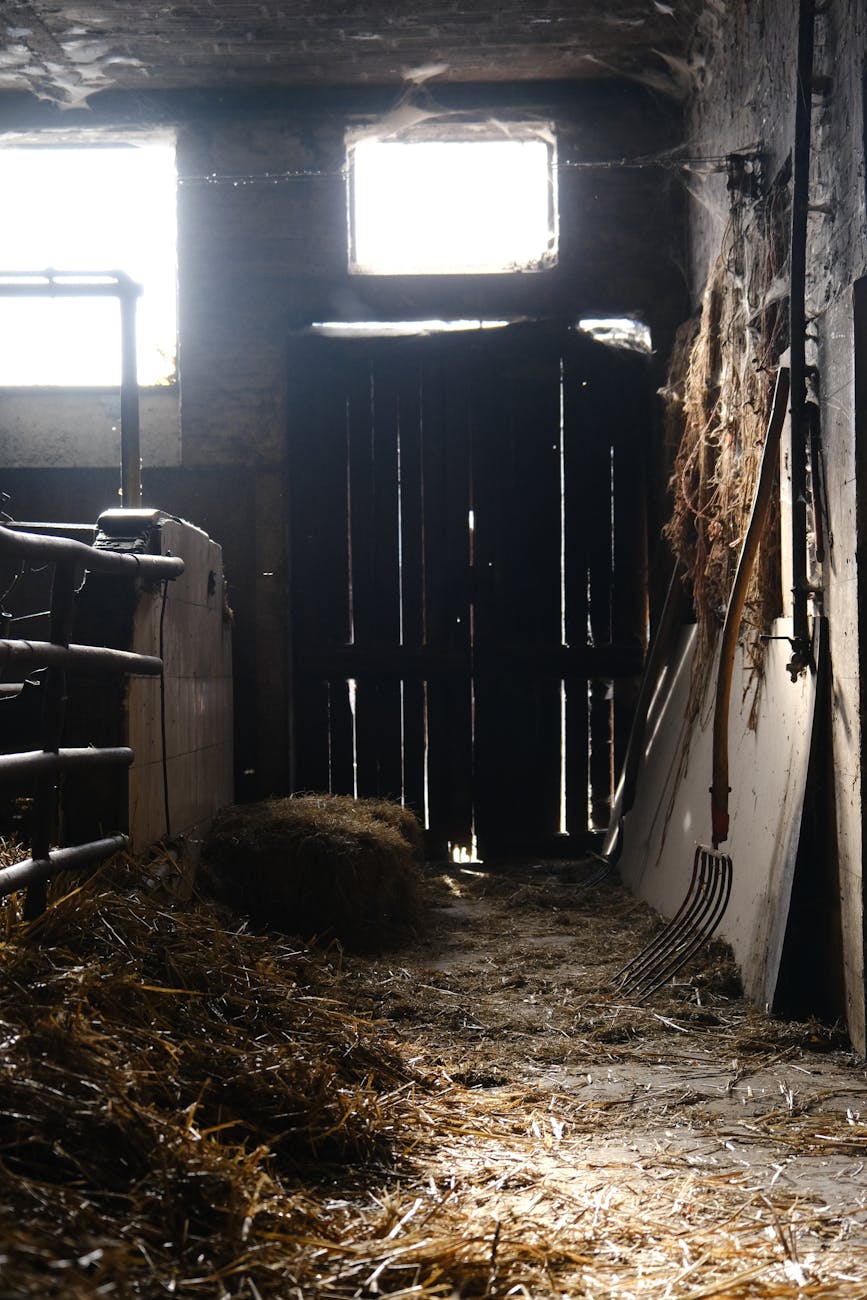
After a long winter of heaping straw on top of straw, the layer of bedding could be 3-feet high with ease. There was hardly a space where calves, or larger cattle hadn’t over wintered. That was the West Country farmyard where I grew up.

Roughly square in shape, with cow stalls along the northern side and the cart shed in the westerly corner. These traditional stone-built buildings were made for a different era. Opposite the farmhouse there was a modern steel framed building that my father put up.

A story of livestock farming is written in these buildings. That transition from the intensive use of human labour to a more machinery dependent system. Going from cramped timber and local stone buildings to sheeted large span open spaces. One long lived and of great character, often listed and the other solely utilitarian, making life simpler.

A pick and wheelbarrow. Cleaning out was one annual manual task. My brother and I would push endless wheelbarrows of dung out into the yard. There wasn’t the machinery to get into the tight spaces of the confined old buildings. Our job was to dig out the masses of compressed dung. Then it could be attacked by our Ford 4000 tractor[1] in the yard.

Now, such hard to access areas of a cattle shed are confronted by a skid-steer[2]. Days spent with a pick and wheelbarrow are exceptional. There’s no comparison with the 1970s.

Here, it’s not this monotonous labour that I’m wanting to write about. Rather more outdoor farm work. Work that was a bit more fun on a steaming hot day.

One of the other summer jobs I had as a boy was cleaning out water tanks. We had a couple of large concrete and brick cattle troughs that hosted a mass of algae and all sorts of accumulated debris. Summer was a time to clean them out. The sheds would be empty of cattle.

We didn’t have a swimming pool. I think you can guess where I’m going with this recollection. Having scrubbed a season’s worth of growth off the walls of the biggest tank, the smooth concrete walls were then revelled. We did a thorough job because this cleaning process didn’t get done all that often.

In the mists of the summer heat and with the yard empty of cattle, this tank was a place for a dip. Chilled water, straight out of the mains supply, as the tank refilled added to the fun. So, we became the fish in the cow trough. At least for a summer day.


[1] https://heritagemachines.com/guides/buying-guide/fantastic-ford-force-4000/
[2] https://www.bobcat.com/na/en

Spectacular Sighting

There’s steep hills. Some more interesting than others, you might say. In my youth this one was known for the road that climbed the hill. That’s the B3081, if you want the detail. It’s an opportunity to journey through wonderful English countryside. The area being Cranborne Chase, a protected landscape.

Zigzag hill was great fun for us as children. Probably not so much fun for my parents as our jet black Wolseley16/60 strained to get around the corners and climb to the top. The car packed with the six of us. This was a route we’d take to get from home to Bournemouth, and the seaside.

On the way, I remember the finger post signs to Compton Abbas Airfield[1]. My thought being what an interesting place for an airfield, right up here high on the chalk hills. Looking down on the surrounding Dorset countryside and the town of Shaftsbury.

Normally, I have to go to flying displays to see historic aircraft fly. This Sunday afternoon, I travelled no further than my back door. Sitting outback in the steaming 30C-degree summer weather all I had to do was look-up. Not that I’d planned to look skyward.

That doesn’t happen every day. First there was a distant rumbling sound. Then it developed into the hum of multiple piston engines. It’s only when the distinctive sight of a Lancaster bomber appeared over the roof of my house did all become clear what was happening.

As soon as I fixed my eyes on the aircraft it was already off over the garden and out across the neighbouring field. This was Avro Lancaster PA474 passing right overhead[2]. It was heading off in a north easterly direction at a notably low altitude. Quote a spectacular sight.

I had to do a little research once the aircraft had disappeared over the horizon. Looking at what was happening on Sunday, I assume it was flying back from Compton Abbas Airshow[3] to its home in Lincolnshire. Given the high summer weather, this was a great day for flying.

This Second World War heavy bomber first flew in 1941. It’s part of the Battle of Britain Memorial Flight (BBMF), based at RAF Coningsby. It’s the only Avro Lancaster that remains airworthy and flying in the UK. It’s only recently returned to the air after a tragic accident involving the BBMF.

Later in the day, off in the distance, looking north, three other historic aircraft trundled across the sky. After dark, with the heavens clear, I caught the Perseid meteor shower. So, for watchers of the skies, 11th August was a noteworthy day.


[1] https://www.comptonairfield.com/

[2] https://www.bbc.co.uk/news/articles/clyg7e7x319o

[3] https://comptonabbasairshow.co.uk/participants/

The River’s Arms

It’s now called the River’s Arms Close. A scattering of relatively new houses. That’s all that remains of a rough working public house that I knew well in my youth. Not indoors. In the bars. I never visited more than the paved courtyard outside the pub. Afterall, I am talking about me at the age of 12 or 13ish. Until now, looking it up, I’d remembered the pub as being called The Railway.

This pub was just across the road from the entrance to what was then Sturminster Newton cattle market[1]. A huge agricultural market. It was on Station Road. Even then, the railway station and its steam trains had long gone. They must have gone in 1965/66. Then a political axe fell on rural railway lines. On a Monday, the town was a busy place. That was market day.

Scruffiness was a badge of honour. Galvanised steel sheeted buildings and tatty block-built sheds were the order of the day. The feast for the eye was not the buildings, more the people. The noise was overwhelming. Smells were on the rich side too.

This comes to mind because I moved a large and heavy plastic planter containing a healthy blackcurrant bush. Green leaves and wood. My crop of blackcurrants had been eaten by birds earlier in the year. This week’s plan was to find a suitable spot in the garden to transplant the bush ready for next year.

Here’s the connection. It’s to do with fruits. Local produce. In the 1960s, to earn money of our own, my brothers and I would go blackberry picking. There were times when Somerset hedgerows were teaming with mases of blackberries. They still are in a lot of places. We’d fill to the brim used plastic containers. Recycling ice-cream containers. Trying not to squish the delicate fruit.

On market day the courtyard outside the pub would become an auction ground. People would bring local produce and miscellaneous junk in the hope of getting a fair price. Everything would be spread out over the floor outside. Fruit, veg, eggs and strange ironwork and old tools. Around lunchtime a sale would take place. Informal and unpredictable. A huddle of farmers, townsfolk and on watchers. Nevertheless, all the small items were carefully booked in and booked out. For our containers of blackberries, or later in the year field mushrooms, we’d get just less than a pound, if we were lucky. That was in “new money.”

It’s July, so we are not into that season yet. It’s creeping up on us. Fruit trees are starting to look as if they are going to produce a good crop. Blackberries are slowly forming. A time of fruitfulness is coming. That season of harvest is just over the horizon.

Exposure to markets, and their volatility, is as much a life lesson as the benefits of organic produce. In that small Dorset country town, the ebb and flow of market day were as integral to life as the water that flowed in the river. Today, much of that rhythm is history. A new rhythm is running. We go from coffee shop to posh bakery to the purveyors of expensive imports.

Our dependency on national supermarkets and large-scale logistics is mainstream. The heavy lorries that carry food are not full of local produce going to a local market. They come from remote fulfilment centres on main trunk roads. They dwarf the road traffic of the past.

It’s silly to think that we can step back. Times were rougher and cruder but there’s merit in giving thought to the better bits. Today, there’s little incentive for a boy with a recycled container full of fresh blackberries.


[1] https://www.somersetlive.co.uk/news/local-news/sturminster-newtons-bell-toll-today-148980

New Day

The UK’s recent elections saw a surge in candidates and new political forces, challenging voters to make informed choices.

We had a surfeit of manifestos that said, this is what we will do if you give us power. Today, we have a stronger commitment, in the form of a speech, saying this is what we will do now you have you given us power. You can’t say you haven’t been warned. Or more positively, at least someone is focusing on the issues that are of concern rather than the nonsense of the preceding administration.

Democracy is about choosing. For the next 5-years a choice has been made. OK, that’s assuming there’s no calamities that bring the new Labour Government to its knees.

At this moment, please give a thought to those who made that national democratic choice possible. I know, I was one of them. 4,515 candidates[1] stood for election to the UK’s Parliament in July 2024. In 2019, there were 3,327 candidates who stood in the General Election. So, this year the crop of candidates was much bigger and thus choice wider. No constituency in the UK had fewer than five candidates standing.

This crop of candidates is to fill 650 seats in the House of Commons (HoCs)[2]. That’s using the word “seat” to mean Parliamentary constituency. Which there are not on the green benches. The HoC chamber cannot accommodate all the Members of Parliament (MPs) that are elected. It’s rather a strange situation in modern times.

More candidates and more volatility. A lot of the strong political ties that people have exhibited in former generations have been broken. In future the UK’s electorate must put more effort into deciding who to vote for on polling day. We see a move in political forces that is new.

I salute you. All 3,865 candidates who have plenty of time to reflect on their experience. Yes, there were a small cohort of eccentrics, but they didn’t get the news coverage that they once did. The Official Monster Raving Loony Party raised twenty-two candidates.

Local identity did play a part. There was a Yorkshire Party, Lincolnshire Independents Lincolnshire First candidate, Portsmouth Independent Party South Devon Alliance, and a sprinkling of similar others.

Since 1985. the deposit in elections to the HoCs has been £500. This is only refunded if the election candidate gets more than 5% of the votes cast. I don’t yet know how many of the 3,865 candidates lost their deposits.

The loss of a deposit by a candidate maybe regarded as an embarrassment. I don’t think it is at all. It takes a certain kind of resolve to put yourself up in front of the electorate. Regardless of the outcome that commitment ought to be applauded. It’s certain; not free of costs in respect of the individual candidate. I’d defend having a deposit as one means of preventing abuse of the electoral system. That said, it should never be higher than it is now and maybe the threshold ought to be halved to 2.5%.


[1] https://commonslibrary.parliament.uk/who-stood-in-the-2024-general-election/

[2] https://members.parliament.uk/parties/commons

Rethinking the House of Lords: Toward a Balanced and Democratic Approach

Good to hear that there’s a prospect of House of Lords reform in next week’s Kings speech. Change is on the agenda.

It’s astonishing that “hereditary” is a valid qualification for the job as a legislator. I’ve nothing against the individuals involved. Especially those who try to do the best they can. Put all that to one side, there’s a huge gulf between what’s normal in normal life and what’s normal in the Place of Westminster. It’s time to consider merit as more important than who your parents were.

The removal of hereditary peers should be just a first step. One of the most egregious unfairnesses is that way the HoL gets topped-up with political cronies a regular basis. We’ve institutionalised political tribalism in the second chamber. Ennobling people for dubious reasons has become a habit of Prime Ministers. Making contributions to political Party funds should not be a ticket to the HoLs.

There’s the religious element too. Whereas there’s a lot to be said for a level or moral guidance to be given to Peers there’s little justification for them to have votes in the HoL. I’m not denying the important part region plays in many people’s lives. What I am saying is that the laws that affect every citizen shouldn’t be shaped by a small cohort of clerics. Two countries have religious clerics in places of legislative power, and they are UK and Iran. That doesn’t sit well with me, and no doubt most people.

One change maybe controversial given that it smacks of discrimination and that is the setting of an age threshold. If Peers are given a compulsory retirement at the age of 80, it may meet an objective of getting the overall number of Peers down. What disconcerting is the implication that beyond the age of 80 a Peer’s potential contribution is less valuable.

I don’t agree that the compulsory retirement age for the HoL should be set at the state pension age. For some people age does mark a dimming of their intellect but for others they can be as sharp as a pin. The only easy option is a fixed threshold, but it should be a temporary measure.

Ideally, the size of the HoL should be fixed. Ideally, the size of both chambers should be similar. Not just because that number line-up but because the political weight should be set closer to a balance. I do assume in this formula that every Peer is a working Peer.

It’s been pointed out that in its current state the HoL makes it the second largest political chamber in the world. It’s reached ridiculous proportions for a country of our size.

Modest changes can only be a start. There’s the real need for permanent restructuring. Parliament’s second chamber must be replaced with a democratic upper house. One model would be an elected upper house with two members elected per UK region based on current/proposed metro mayoral regions or former regions used for electing MEPs.

Even the chamber’s name must go. It’s not good that we have legislators lording over us. Those sitting on the red benches are not superior beings. They are privileged. One would hope for them to be humble given that great privilege. Afterall they should be there to serve us. To serve the country.

No Sprint

The last couple of days have seen a new UK Parliament take shape. Beaming smiles from an intake of rearing to go new Members of Parliament (MPs). There’s lashings of energy and enthusiasm. Every problem is to be looked at afresh. No problem is too big to tackle, even if some problems may take while to cure. Horizons stretch ahead full of oceans of possibilities.

Back in May 1993, I was a freshly elected young County Councillor. It was such a magic moment. One evening, at County Hall for the first time sitting in a room with 29 colleagues. For the first time the Council being No Overall Control (NOC). One room full of a mix of battle-hardened pros and fresh faces. A manifesto in hand and magic in the air.

Today, there are 72 Liberal Democrat MPs. Yes, 72 MPs. I can imagine, without looking at the press pictures what that may feel like. A wonderful feeling of hope, ambition and warmth. A little trepidation. Thoughts like: what will be my role in this epic journey? Those with small electoral majorities might be focused not only on their role in the team but how they will secure more than one term of office.

Politics is a precarious way of life. Any electoral success is certainly never to be taken for granted. This UK General Election has shown that in spades. Volatility amongst the voting population is probably higher than it has ever been. That impulsiveness sits in the background of the overall wish to throw out the mediocre incumbents.

At least for the honeymoon period, often characterised as the first 100 days, the new government and new effective opposition will be given a period of grace. It’s a time when everyone wishes the nation to succeed and prosper in the direction that is set.

A modern UK Prime Minister has a great deal of power in the first period of their office. On this occasion, those that lost, Conservatives will be struggling to rebuild their shattered party. Whether they bury Thatcherism or reincarnate it, they will be in turmoil for a considerable while. They may even strike up an extreme ideology and march off into the political wilderness.

Liberalism is in rude health. The 72 Liberal Democrat MPs will surely work with conviction and proudly hold their principles aloft.

It’s not the first time that I’ve referenced the Stoics. I am reminded that despite the joys of the moment and the races that have been won, the battle of ideas never stops or starts. There are peaks and troughs of optimism and pessimism. There are opportunities taken and lost. There are times of progressive advance and there’s inevitable push backs. He’s no longer with us, in fact if he was still around, he’d be nearly 100 years old. Labour MP Tony Benn was wrong on Europe but often wise about the UK Parliament. I agree with his view of Parliament in this respect, however flawed it may be: “Through talk, we tamed kings, restrained tyrants, averted revolution.” Long may that continue. There’s no finality in politics; there is always another step to take.

His maxim for MPs to operate on two levels makes a lot of sense. One is to be an agent of practical action and the other is to operate in the realm of ideas. Not so easy to do. Nevertheless, democracy is healthier if both delivery and values are never strangers.

Rapid

Such a rapid change. In days we go from one governmental regium to another. The government of the UK has changed. It’s now dramatically different from what it was only a couple of days ago. It’s not overstating the case to say dramatic. On a relatively modest percentage of the overall national vote the Labour Party has been handed all the leavers of power.

The UK’s main electoral system is not proportional. It tends to exaggerate and distort performance. Lifting those who do well in the national vote numbers but suppressing those who are supported by smaller overall percentages. Interestingly, the Liberal Democrats, who have always been in favour of a proportional representation electoral system, have an approximate match between the number of seats won and the number of votes cast across the country.

Sticking with the positives, this rapid change does mean policy resets are possible. One significant example is the immediate scrapping of the policy mess that the previous government had got itself into over immigration.

Accepting a fresh start has a upside. However, the difficulty that can present itself is the challenge to continuity. Lots of new faces with new responsibilities. Lots of people learning the ropes. One answer to that challenge is to say that the civil service provides a seamless continuity. The mandarins in Whitehall guide the ship of State through the transition. Not only that but many of the people coming into power have been preparing for this opportunity for a long time.

The difficulty is that the mismatch between the national percentages of the General Election vote and the number of Westminster seats held is there for all to see. It’s a stark indicator of the reality of people’s wishes verses the outcome of a process.

I was a counting agent standing in a sports hall until the early morning totting-up an estimate of the vote for a political party. Pen in hand watching officers carefully unfold paper ballots. In a world of smart phones and tablets there’s something very retro about looking at piles of black and white paper for hours.

One aspect of First Past The Post (FPTP) is the theoretical simplicity of the counting process. Naturally, it’s far from simple. One cross, in one box is well within the capability of every kind of voter. However, it’s crude in terms of what it says about the voter’s views. It forces everyone to make stark choices. There’s no accommodation of preference. Say, you are a person who’s essentially conservative or socialist but can’t stand that Party in its current form, you are forced to leap to vote, if you vote at all, for a political candidate that may not be your natural choice.

So, society ought to ask itself, do we value the result of the electoral process most? Or do we value the expression of the individual preference the most? There’s an inevitability to the answer to that question, if the horizon set is a long one. Where so much of what we now do is addressed by algorithms designed to distil our individual preferences how can we stick with a paper based last century electoral system that ignores preference?

Change will come one day. The difficulty is that if the UK’s FPTP electoral system offers no incentive to the winning Party to change it, so we will be bound to stick with it. Well, at least for the next few years.

Next Day

It’s that moment when I pile-up used elastic bands, I know the election is over. The recycling bin is full, and I must remember to put it out on Sunday night. Sorting out one or two mementos to keep. Saying “Thank You” to a few important people. Watching the analysis of the results.

The UK General Election results are declared. Once again, everyone knows the lay of the land. That national barometer of politics has indicated the weather for the next few years. I never say, next 5-years, given what has happened in the recent past.

Has the election’s outcome sorted out how we feel and think about the big issues facing us? Up to a small point. It’s reality. The issues that faced us yesterday are now going to be sitting in the in-tray of the incoming administration. What we can hope for, is that the administration will be competent, or at least a great deal more competent that its predecessor.

Having been up until well past 3am, my facilities for making insightful comments are somewhat lacking. There is a headful of moments that have flashed by in the last 24 hours. Delightful, taxing and slightly strange moments. Like the person who said – don’t worry I am going to vote. I’ll be there tomorrow. As if the polling stations are always open if you will them to be so.

There’s also this embedded expectation that a candidate should think the same way a resident thinks. I know it’s often labelled representative democracy. But if every candidate thinks the same way as every one of over 70,000 individuals, then they are going to have a mental overload the like of which is unimaginable. Frankly, we don’t have a representative democracy. Members of Parliament are not delegates. Nevertheless, the basic expectation sticks.

For a Liberal Democrat, like me the evening and morning was full of reasons to cheer. So, many constituencies turned away from the Conservatives and towards the Liberal Democrats. I will be, in respect of one set of figures, downbeat. Looking at the aggregate numbers of votes for each political party across the whole country there’s a message. It’s not a nice one.

Just as in France the right-wing populists are clocking up votes so are the same types of people clocking them up in the UK. For once the First Past The Post (FPTP) electoral systems has had a relatively positive impact. Spread thinly across England, the populists haven’t been able to win a lot of parliamentary seats. The Greens are in the same place. The difference between the two is that the right-wing populists have accumulated more national vote share. That’s scary.

One other notable thought is about nationalism. Given the way the poll has panned out, nationalists are going to be on the back foot for a long time. The United Kingdom isn’t in jeopardy. Their leavers of influence are somewhat reduced.

Now, I’m fumbling around trying to get back to where I was before this summer election was called. Bet Sunak regrets his choice of dates. All those things that got put-off can no longer be put-off. Time to put out the trash and get back to “normal”.

Service

The subject of national service, and its reintroduction is part of a memorable Yes, Prime Minister. “He thinks it’s a vote winner[1]” and so, apparently does our current PM.

This sketch is a wonderful example of how someone can be hood-winked into saying “yes” to something regardless of circumstances, or the foolishness of the idea. It’s comedy genius. Sadly, it’s reality in this early stage of campaigning for this UK General Election.

Conservative PM Sunak’s knee-jerk proposal to reinstate national service falls apart like a toilet roll falling in a bath of cold water. Layer by layer the logic crumbles, with any scrutiny.

For one, how come £4 billion can be found at an instant for something previously ignored. Frankly, anything that resembled civic service has been consistently rundown over the last decade[2]. Not to mention the massive rundown in youth services over a couple of decades.

It might be wise to ask if the UK military want such a new system of national service. One that hosts around 30,000 young people a year. The answer so far is – absolutely “no”. At a time when our professional services are stretched, it seems ridiculous to ask them to take on the task of administering and running a scheme that is extremely unlikely to boost their combat readiness and overall effectiveness.

I’m old enough to have been told a long list of anecdotes from those people who had to do national services in the 1960s. I worked with many of them in the 1980s and 90s. The stories are often humorous, eccentric and riddled with tales of timewasting schemes that were invented to keep young men occupied and out of trouble. Well, out of big trouble.

National service doesn’t offer a life of adventure. More like peeling potatoes, picking fruit and driving scruffy delivery vans around. Although such schemes may benefit a very few, for the vast majority would be spinning wheels and filling time. Wating to put time served behind them before getting stuck into a career of their choice. For a few young people, who could already be on the path to a criminal career, giving them weapons training isn’t a good idea.

Mr Sunak is betraying his fickle nature. He’s a desperate politician inclined to grab at something shiny. Magpie like. Retro policies, perhaps picked-up watching classic TV series from the past, are not the way forward for a country keen to make a new start.

We will not see Mr Sunak running a flower stall outside Waterloo Station if he fails to secure re-election. The post of UK PM will be filed quickly. More likely to see him on a sunny beach in California soon. I wonder if he’s packed his suntan lotion.

POST 1: The last thing we need to do now is to take young people out of existing apprenticeship and training schemes. The demand for young engineers and technologists is high. It would be far more constructive to offer sponsorships and subsistence support to applying and existing students rather than vague one-year gimmicks.

POST 2: Even The Daily Mail is commenting on how this proposal was sprung on unsuspecting candidates and Ministers without warning. Maybe the lobbying of parents prepping their offspring for Oxbridge, and alike is echoing loudly. Clearly, no one thought through the real life implications of a mandatory national service scheme for all 18-year olds.


[1] https://www.youtube.com/watch?v=ahgjEjJkZks

[2] https://schoolsweek.co.uk/national-citizen-service-cuts-ties-with-largest-provider/

View

As I looked out of the kitchen window, this morning a face started back at me. It wasn’t a human face. Thank God. Silhouetted against the ultra-green spring grass of the field at the back of our house was the face of our new neighbours. Their shiny black coats and notably short standing is distinctive. One stately bull, two cows and two claves. A contented family group.

Just as the flood water has receded, and the ground hardened so the grass has shot-up in an instant. It’s a rough pasture but there’s plenty of grass for five cattle to munch away at. My calculation is that the small field out back is about seven acres is size. So, they have plenty of space to roam around all day long. A riverbank on one side. Large shady trees on the main road side. To the southside of the field about five houses, including ours. Some refer to this arrangement as conservation grazing. These cattle are complementary to the wildlife that inhabits this next-door greenspace.

It was funny to watch the Canada Geese get to realise that they have to share the field. There’s as many as 18 of them nibbling away at the grass. At first, they were spooked by the cattle, and their natural curiosity. Soon the two parties decided to ignore each other and get on with life.

Dexters are the smallest native breed of cattle in the British Isles[1]. They are often seen at agricultural shows[2]. They are a breed of cattle that are easier to keep on a small holding than some of the larger and more demanding breeds of cattle. That said, I am told that they can be temperamental and stubborn. However charming the black Dexter bull may look, I don’t think I would argue with him for one minute. He looks quite capable of repelling anyone he doesn’t know or thinks to be friendly.

Interestingly, these cattle are a native breed at risk. At least they are listed in the existing government guidance[3]. This situation does attract a supplement of a certain amount per area grazed. So, there is a useful incentive within the countryside stewardship scheme. This is subject to a whole set of conditions but that’s quite common for such grant schemes.

Frankly, I don’t think there’s any chance that Dexters will become extinct in the next hundred years. For one there’s the attractiveness of the breed. For another, Dexter beef is a quality product. True they are not “commercial” in the sense of being suitable for supermarket shelves.

In the last week, it’s nice to see our new neighbours settle in. They seem to be more than happy with their summer pastures. Seeing the two young claves run around with their tails in the air is a pure delight. They are having fun without a care in the world. The geese, ducks, moor hens, jackdaws, roe deer and red kites are all happy to share the small field and riverbank. Not forgetting the occasional swan. It’s a proper country scene.


[1] https://www.dextercattle.co.uk/

[2] https://www.stackyard.com/orgs/agricultural_shows/dates.html

[3] https://www.gov.uk/government/publications/uk-native-animal-breeds-at-risk-list