Society & Innovation

Yesterday, I drove up the main A303[1] in the stifling last summer heat. It was a windless sticky 30C. I drove past the road sign that says Micheldever Station[2]. By the way, “up” meaning heading towards London. Going “up” to London isn’t an unusual West County way of expressing that trip.

On that busy highway there are few, if any noticeable road signs that point towards a railway station. I’ve often wondered why that one was deemed so necessary. It’s not a tourist attraction, like the Watercress line[3] is in that part of the world. It’s an ordinary everyday railway station.

The small English hamlet known as Micheldever Station is a bit of an oddity. It’s the sort of place that could have been the location for The Avengers or The Saint, the popular British TV series of the 1960s. It’s in the green and pleasant countryside of Hampshire and about 10 miles north of Winchester city. An area that’s as conservative as can be.

Micheldever Station has a curious technological history. In 1895, it was the starting point for the first automobile journey in Britain. At that time a British Act of Parliament required that all self-propelled vehicles on public roads must travel at no more than 4 miles per hour and to be preceded by a man waving a red flag. In 1805, highly sensible. There’s no way that those infernal new machines should be allowed to scare the horses.

Not everyone thinks such thoughts while thundering along the A303 at 70 miles per hour. However, to me, ever since I got my first driving license at the age of 16, it’s been my most familiar of arterial roads. So, much traffic passes that way there’s never a time when it can’t be heard.

Well, we have come a long way in 138 years. Now, we are getting nervous about the safety of driverless cars, and no one even questions having a self-propelled vehicle on public owned roads. If they do, the likelihood of transforming that formula into something else is astronomically small. I can’t think of a bad time to write on the subject of: “Innovation and Its Enemies[4].” In fact, what may have graced a Victorian bookshelf can have some resonance today.

Next year, we will see commercial flights taken in electrically powered air-taxies. Without a shadow of a doubt these flights will arouse some vocal public resistance. We can take that from the history of technology. The airborne version of the man waving a red flag could raise its ugly head. I don’t say throw caution to the wind, but we need to be mindful of the natural propensity to object.

Striking a societal balance will not be easy. It would be a fool who says it will be. Slowly but surely, we will need to become accustomed to advanced new forms of mobility. Sticking a fair balance between the utility of these new machines and any burden they may place upon us will be a mighty tricky job.

I wake-up to the noise of the residential road outside. People commuting to work. The local trains send a rumble through the air. I don’t want to wake-up to the sound of an air-taxi hovering outside my window. Given the research[5] and technology under development, none of us should have to tolerate an increase in noise. Mobility and quality of life shouldn’t always be in conflict.


[1] https://youtu.be/C0sL3_NKPao

[2] https://www.southwesternrailway.com/travelling-with-us/at-the-station/micheldever

[3] https://watercressline.co.uk/

[4] https://global.oup.com/academic/product/innovation-and-its-enemies-9780190467036?cc=us&lang=en&


[5] https://ntrs.nasa.gov/citations/20210014173

Horizon

There’s been a couple of false dawns. Now, the morning’s News is that the UK will rejoin the European Horizon programme. The EU’s Horizon Europe Framework Programme (HORIZON) provides grant funding for research priority topics for the years 2021-2027.

The recognition that there’s a common interest in research across Europe is welcome. There are important areas of investigation that go well beyond the resources available to any one country. Benefiting from collaboration is a win-win.

Access to Horizon Europe will be a great opportunity for UK aerospace[1]. It has been in the past and surly will be in the future. Of the billions available there’s a good chunk for funding opportunities for aerospace research and technology. This funding is particularly focused on greening aviation.

Such subjects as the competitiveness and digital transformation in aviation are addressed too. Advancing the regions capabilities in a digital approach to aerospace design, development and manufacturing will be invaluable to UK industry. Artificial Intelligence (AI) used for Machine Learning (ML) and complex modelling are the tools that will be deployed throughout the global industrial environment.

Europe can pioneer the first hydrogen-powered commercial aircraft. The major role the UK can play in advancing this aim is self-evident. Ambition, capabilities, and expertise reside here. The magnification of this to tackle what are enormous challenges can only be a good move.

Projects like ENABLEH2[2] provide a pathway to the introduction of liquid H2 for civil aviation. These projects are not easy, but they do provide a long-term environmental and sustainability advantages. Access to these projects can minimise duplication and the dangers of spending valuable resources on pursuing blind alleys.

Research is not just a matter of hard technology. Without the new skills that are required to meet the targets for a green transition it will fail. Investments in upskilling and reskilling opportunities are equally important to enabling change.

The principles of propulsion of hydrogen and electric systems need to be taught at every level. It’s not academics in lab coats that will keep civil aviation flying on a day-by-day basis. Training programmes for a new generation of manufacturing and maintenance engineers will need to be put in place. Research will underpin that work. 


[1] https://www.ati.org.uk/news/access-to-horizon-europe/

[2] https://www.enableh2.eu/

Reform

The words: “A long time ago in a galaxy far, far away….” – who doesn’t know those words? They come to mind in my thoughts of the last few years.

I caught a “Have I Got a Bit More News for You” on TV[1] last night. I think it was only from May last year but the world it described was miles from the situation of today. By the way, I must be of a certain age given that I’m still watching TV. I put the iPhone and iPad down for ten minutes. The box in the living room still has a place even if the day they pension-off Ian Hislop and Paul Merton can’t be far off.

Fine, there was some enduring themes that just keep giving and giving. Personalities pop-up with new roles even if reputations were long since trashed. What’s moving on is that feeling of being in a post-COVID world and the good bits of the Elizabethan era. The signs saying keep a distance from the next person are fading. Discussion about QEII is now about memorials and statues.

In less than a decade, the global reputation of the UK has seen some remarkable turbulence. I’m not being romantic about some time when everything worked smoothly. It never did. Governance is a difficult business. Turbulence is a permanent feature even if it doesn’t always star in the everyday News.

What should be enduring is a frankness and ability to acknowledge when mistakes have been made. To reflect and learn from experience is a wonderful human ability. It likely that if this didn’t exist then neither would we. Every step forward that’s made is often on the backs of many failures.

The pre-2016 era, what we could call a time relative civility, fraternity, and sanity, was not immune from turbulence. What was better was the mechanisms available to address that turbulence. The space available for dialogue was much bigger.

Brexit, for our country has been the biggest blunder we have has made in a lifetime. As predicted, Brexit’s reality has made the UK a paradise for speculators, spivs, and smugglers. Brexit has imposed extra costs and border restrictions on goods. It’s wrecked freedom of movement. It’s encouraged petty finger pointing on every major difficult subject.

Brexit pledges are now broken with such regularity that it’s impossible to count them all. Whether it’s a downgrading of the environment or attacks on employment rules or fake political storms they are too numerous to mention.  

This blog started in a long time ago in a country far, far away, or at least it feels that way. My view remains that we need to be at the heart of Europe to succeed in the future. To do that we need to make some big changes at home. I’m no great fan of Rory Stewart[2] but he’s right to engage with populism and take on the need for constitutional change.


[1] https://www.bbc.co.uk/iplayer/episodes/b00877q4/have-i-got-a-bit-more-news-for-you

[2] https://www.barbican.org.uk/whats-on/2023/event/an-evening-with-rory-stewart

RAAC

Reinforced autoclaved aerated concrete (RAAC) is making the News in the UK. An unknown number of buildings are deemed dangerous because of the aging of this material[1]. RAAC has a limited lifespan. It’s inferior to standard concrete but lightweight and low-cost at the start of its life. It was typically used in precast panels in walls, roofs and sometimes floors.

The UK Government says it has been aware of RAAC in public sector buildings, including schools, since 1994. Warnings from the Health and Safety Executive (HSE) says that RAAC could – collapse with little or no notice. This “bubbly” form of concrete can creep and deflect over time, and this can be aggravated by water penetration. So, regular inspection and maintenance are vital to keep this material safe. Especially in a country known for its inclement weather.

It’s reasonable to say there lies a problem. The public estate has been through a period of austerity. One of the first tasks to get cut back, when funds are short is regular maintenance. Now, I am making some assumptions in this respect, but they are reasonable. Public sector spending has been under significant pressure for a long time.

The other dogmatic notion that has hindered a solution to this building problem is centralisation. There was a time when local authorities managed schools. They still do but in smaller numbers. Centralised funding has decreased the power of local people to address problems with the school estate.

Aging buildings have something in common with aging structures in aviation. There’s always a demand to keep going for as long as possible. There’s always the difficulty of determining the safety margin that is acceptable. There’s always a pressure on maintenance costs.

Believe it or not aircraft structures do fail[2]. There’s a tendency to forget this source of incidents and accidents but they never go away[3]. What happens in industries where safety is a priority is investigation, feedback and learning from incidents and accidents. The aim being to ensure that there’s no repeat of known failures. Rules and regulations change to address known problems.

The vulnerability to moisture and the limited lifespan of RAAC should have been a loud wake-up call. No doubt it was for some well-managed, well-resourced enlightened organisations. Central Government has bulked at the cost of fixing this known building safety problem. A culture of delaying the fixing of difficult problems has won.

In civil aviation there’s a powerful tool called an Airworthiness Directive (AD). It’s not something that an aircraft operator can ignore or put on the back burner. The AD can mandate inspections and changes to an aircraft when an unsafe condition exists.

In the schools cases in the News, the impression is given that Government Ministers have dragged their heels and only acted at the last possible moment. Maybe the construction industry and public estate needs a strong regulator that can issue mandatory directives. Known unsafe conditions should not be left unaddressed or significantly delayed.


[1] https://www.local.gov.uk/topics/housing-and-planning/information-reinforced-autoclaved-aerated-concrete-raac

[2] https://www.faa.gov/lessons_learned/transport_airplane/accidents/N73711

[3] https://www.faa.gov/lessons_learned/transport_airplane/accidents/TC-JAV

Learn by testing

Back in the mid-1980s, aircraft system integration was part of my stock-in-trade. Project managing the integration of a safety critical system into a large new helicopter. It was a challenging but rewarding job. Rewarding in that there was a successful new aircraft at the end of the day.

For big and expensive development projects there are a great number of risks. The technical ones focus on functionality, performance, and safety. The commercial ones focus on getting the job done on-time and at a reasonable price. Project managers are in the middle of that sandwich.

Naturally, the expectations of corporate managers in the companies that take on these big challenges is that systems and equipment integration can be done to the book. Quickly and without unexpected outcomes. The practical reality is that people must be well prepared and extremely lucky not to encounter setbacks and resets. It’s not just test failures and anomalies that must be investigated and addressed. Systems integrators are working on shifting sand. The more that is known about overall aircraft flight test performance and customers preferences so technical specifications change.

With cockpit display systems, in the early days, that was often feedback from customer pilots who called for changes to the colour, size or shape of the symbology that was displayed on their screens. What can seem a simple post-flight debriefing remark could then turn into a huge change programme.

That was particularly true of safety critical software-based systems. Equipment suppliers may have advanced their design to a state where much of the expensive design validation and verification was complete. Then a system integrator comes up with a whole set of change that need to be done without additional costs and delivered super-fast. Once a flight test programme gets going it can’t be stopped without serious implications. It’s a highly dynamic situation[1].

I’m writing this blog in reaction to the news coming from Vertical Aerospace. Their VX4 prototype aircraft was involved in an flight test incident that did a lot of damage[2]. There’s no doubt this incident can provide data to feedback into the design, performance, and safety of future versions of their aircraft[3]. Integrating complex hardware and software is hard but the rewards are great.

“Excellence is never an accident. It is always the result of high intention, sincere effort, and intelligent execution.” – Aristotle


[1] https://youtu.be/Gb_eta4mZkc

[2] https://evtolinsights.com/2023/08/vertical-aerospace-identifies-propeller-as-root-cause-of-august-9-vx4-incident/

[3] https://investor.vertical-aerospace.com/news/news-details/2023/Vertical-Aerospaces-VX4-Programme-Moves-to-the-Next-Phase/default.aspx

NATS

A “technical issue” has caused UK National Air Traffic Services, NATS to impose air traffic flow restrictions[1]. They did not close UK airspace. This was not a repeat of the volcanic ash events of early 2010. Going from a fully automated system to a fully manual system had the dramatic impact that might be expected. The consequences, on one of the busiest weekends in the holiday calendar were extremely significant. Huge numbers of people have had their travel disrupted. Restricting the air traffic system ensured that aviation safety was maintained. The costs came to the UK’s air traffic handling capacity and that meant delays and cancelled flights.

Although the failures that caused the air traffic restriction were quickly resolved the time to recover from this incident meant it had a long tail. Lots of spoilt holidays and messed up travel plans.

It is normal for an Air Traffic Service (ATS) provider to undertake a common cause failure analysis. This is to identify multiple failures that may result from one event. So, the early public explanations coming from NATS of the causes of this major incident are surprising. Across the globe, contingency planning is a requirement for ATS. The requirement for the development, promulgation and application of contingency plans is called up in international standards, namely ICAO Annex 11.

So, the story that a single piece of flight data brought down the traffic handling capacity of a safety related system, to such a low level, is difficult to accept. It’s evident that there is redundancy in the systems of NATS, but it seems to be woefully inadequate when faced with reality. ATS comprise of people, procedures, and systems. Each has a role to play. Safety of operations comes first in priority and then air traffic handling capacity. What we know about even highly trained people and data entry is that human error is an everyday issue. System design and implementation needs to be robust enough to accommodate this fact. So, again attributing such a highly disruptive event to one set of incorrect data inputs does not chime with good practice or basic aviation safety management. It is concerning that one action can bring down a major network in this way.

EUROCONTROL would have had been sent a “rogue” flight plan in the same way as UK NATS. Brussels does not seem to have had the problems of the UK.

It is early days in respect of any detailed technical investigation. Drawing conclusions, whatever is said in public by senior officials may not be the best thing to do.

Calls for compensation have a good basis for proceeding. The holiday flight chaos across Europe comes down to one single failure, if initial reports are correct. That can not be acceptable. The incident left thousands stranded abroad with high costs to pay to get home.

Before privatisation, there was a time when the UK Civil Aviation Authority (CAA), ran the nation’s air traffic services[2]. It had a poor reputation at the time. I remember a popular newspaper cartoon saying – and now for some clowns from the CAA. They were entertaining delayed passengers.

UK NATS has done much good work to manage a safe expansion in air traffic and address many changes in technology, it would be a shame if this sad incident marks a decline in overall network performance.

NOTE 1: And this topical cartoon from the Daily Mail in April 2002: https://www.pinterest.es/pin/497577458805993023/

NOTE 2: A report on the incident is to be sent to the regulator, UK CAA on Monday, 6th September. Transport secretary to see Nats’ ATC meltdown report next week | Travel Weekly

NOTE 3: The likelihood of one in 15 million sounds like a low number but it’s not “incredibly rare” by any definition. Certainty when there are around 6000 flights a day in the UK. A duplicate error occurring is a basic error that could be anticipated.


[1] https://www.bbc.co.uk/news/live/uk-66644343

[2] https://commonslibrary.parliament.uk/research-briefings/sn01309/

New Walk

It’s a step to the left and then a step to the right. It’s not quite the “Time Warp” that featured in the 1970s rock musical: The Rocky Horror Show.

It’s a little mini dance that people do every day in the streets of Britain. I found myself doing it over the weekend. It’s that moment when you realise that you have lost a sense of what’s around you. A tiny drift away from where you intended to go. Then a step to correct, and look-up and set-off again towards your destination. A wiggle on the pavement.

Maybe this walk didn’t exist before 2006. Well, that is all but in the most exceptional situations. Hand-held devices are not entirely new. What’s much more frequent now is the compulsion to look at the small screen.

The colours, the constant demand for attention, the tickling of our curiosity, the mobile phone has it all. In fact, its dam silly to continue to call our devices “phones.” The primary purpose of these handy devices has long since passed from being able to make telephone calls from any location.

We call them a “mobile”, but the Germans call them a “handy”. An American will call them a cell phone. Given the way we use these ubiquitous hand-held devices, I think the Germans have got it right. The whole essence of the thing is its utility.

Now, if we are fixated with heads down there’s a lot that can go wrong. This has been the source of numerous aviation accidents. Looking up and checking visual references remains a fundamental part of flying. The basics of “see and avoid” are drummed into every new flyer.

On the pavement us poor humans are evolving in a world of every more connected technology. In our heads we have a perception of the world around us as we walk the urban streets. That’s made up of sights, sounds, and even smells. Our brains gather information and then do some spatial and temporal filtering before making sense of where we are and what we need to do to get where we want to go. The eyes, and image processing in the brain are on the top of the list of our normal priorities.

Heads-down attention is drawn to the small screen and away from our surroundings. Staring at the small screen draws us into the content of an e-mail, or a text message, or a cuddly cat picture running around social media. Luckily our other senses are keeping track of the world around us.

The textbook case is where we start to drift in our three-dimensional environment. Not much. It’s a step to the left and not a step to the right. Suddenly there’s a need to correct. Our ever-active brains pick up on the misstep. That’s where our tiny dance comes in and nobody but us may notice.

I’m talking about something that’s almost trivial. Hardly noticeable. However, there are far too many cases where fatalities have resulted from missteps[1]. There’s some evidence that bumping into people and objects is most likely. Slips and falls follow those incidents.

I’ll bet not much is known about the vast number of micro-events like my tiny mobile phone dance. Now, there’s a topic of study for a student of visual perception. 


[1] https://www.ncbi.nlm.nih.gov/pmc/articles/PMC6034962/

Even more H2

There’s a couple of Hydrogen related topics that are worth a moment. One is super conductors and the other is fire.

Heavy complex equipment like the magnets for particle accelerators use superconductors[1]. When there’s space and a need for powerful magnetics, materials with special physical properties, at extreme cold temperatures find a good use.

Talk of room-temperature superconductors is far from what it seems. Such a wonderful innovation is a million miles from any practical applications, if it exists at all. There’s no theory of high-temperature superconductivity, but there’s quite a few physicists who would like to find one[2].

Aviation researchers search for high temperature superconductors for electrical propulsion with extraordinary performance is on. The likelihood of success is low, and the timeframes are very long.

When an aircraft is flying at high altitude, the cabin altitude is maintained for the safety and comfort of passengers and crew. Air compressors, valves, sensors, and controllers make sure that cabin pressure remains at equivalent to an altitude of about 8,000 feet, and lower in some cases. So, any kind of simply flammable gasses or materials inside an aircraft cabin are a definite no no. It’s a big hazard.

In flight, the positive pressure should keep leaking gas out of the cabin. That is as long as the sources of fresh air for the cabin are keep well away from potential leaks.

That’s where Hydrogen gas can present trouble. Leaks can be common in dynamic Hydrogen systems. Storage tanks must be very strong to resist pressures and insulated to keep cold, at around –250°C. Escaping H2 gas is tiny. If that’s vented overboard then the risk of explosion or fire is significantly lowered. Knowing the exact flows of liquid or gas is a must.

However, if the gas finds its way into a pressurise cabin that basic option is limited. Not only that but detecting low concentrations of the gas in the first place is mighty difficult. Its odourless but at least Hydrogen isn’t poisonous.

The big safety issue is that the gas has a very wide flammability range (4 – 70% H2 in air mixture)[3]. Yes, H2 needs a spark to ignite. A typical aircraft cabin environment will easily provide that event. Dry air and static electricity will do it even if other sources will not.

To compound difficulties, if H2 does ignite, and not explode, then its flame may not be visible to the human eye. The flame is almost colourless. Certainly, not what most people think of as a gas flame. Gas and flame detectors could be installed in aircraft cabins and baggage compartments. Audible and visual alarms could be generated but what would be the associated crew actions?

All the above requires detailed consideration in aircraft safety assessments. The move away from prescriptive regulatory requirements means each specific aircraft configuration must be addressed. There are no generic lessons to learn from past aviation accidents and incidents.

Although, I think these puzzles can be solved it’s a huge leap from here to there.

POST: Yes, Hydrogen is not for every application. Small scale aviation is better served by electrification Five Hydrogen Myths – Busted. – RMI


[1] https://home.cern/science/engineering/superconductivity

[2] https://www.science.org/doi/epdf/10.1126/science.adk2105

[3] https://h2tools.org/bestpractices/hydrogen-flames

More H2

I think this came at me both ways as a schoolboy. Both from chemistry and physics. In our 1960s chemistry lab, Bunsen burners, flasks and array of hazardous substances were the norm. Physics seemed more cerebral. Still, the hands-on side of teaching still meant some practical experimentation. That’s the part that most engrossed me.

Electrolysis starred in two mostly harmless experiments. The colourful one was about copper sulfate[1] and the other was about splitting water into its component parts. Getting Oxygen (O2) and Hydrogen (H2) gas by electrolysis[2] is mighty simple and one of those wonders of nature.

Electrolysis is a way of producing carbon-free Hydrogen from renewable and nuclear resources. Despite the apparent straightforwardness of the process, it’s quite tricky to industrialise on a large scale. One key factor to the future use of Hydrogen is getting the cost per Kg down[3].

Let’s presume that this is a solvable problem and cheap and plentiful gas supplies will be up and running by 2030. That’s not so far off given its 2023. There will surely be a market for ample supplies given the multitude of applications for Hydrogen. Will it be a global market? It needs to be.

It’s a talking point. Hydrogen fuel is one of the viable fuels for aviation. Generating power and returning it to water in the atmosphere is an attractive idea. The process meets carbon-free ambitions even if it does have lots of complications.

On average, a Boeing 737-800 uses about 5,000 lbs (2268 kg) of conventional fuel per flight hour[4]. Cryogenic Hydrogen has lower energy density. That means much more on-board fuel storage will be needed to go as far or fly as long as a current day common commercial jet aircraft.

Designing an aircraft configuration that can accommodate these facts can be done but what of the space that remains for the payload? As it does today, on-board fuel storage will need to meet stringent safety requirements.

Adding this up, it may not be the technical issues that make this difficult. Although they are difficult the technical issues can be addressed. However, will the overall package that results be economically viable? If costs are increased by a factor of, say 5, will this provide for a commercial air transport system that is like the current one?

We may have to accept that carbon-free flying reverts to the 1960s[5]. What I mean is that, instead of low-cost flights hopping here, there, and everywhere for £100, the future maybe one where long-haul flying is a relative luxury or an expensive business need.


[1] https://www.bbc.co.uk/bitesize/guides/zgn8b82/revision/3

[2] https://www.bbc.co.uk/bitesize/guides/zv2yb82/revision/1

[3] https://www.statista.com/statistics/1220812/global-hydrogen-production-cost-forecast-by-scenario/

[4] http://www.b737.org.uk/fuel.htm

[5] https://www.skyscanner.com.au/news/airlines/the-golden-age-of-plane-travel-what-flying-was-like-in-the-1950s-and-1960s-compared-to-now

First Flight

I didn’t have a gap year. That’s a year a student takes off their studies. It was a fashionable rite of passage. These days a gap year is often associated with an opportunity to gain extra skills and experiences to add to a CV. Going back to the early 1980s, after all we still had local authority educational grants, a gap year was associated with travel and adventure.

What I did have was employment. As a sponsored student, I had an income whilst working and a bursary. So, although my student grant was highly variable. My parents were self-employed. I was reasonably independent and well off for the average undergraduate student. That was a benefit of being in demand in the engineering world. Not only that but in the recession struck West Midlands our student cost of living was within our means. With a care in spending and cash-and-carry[1] shopping it was possible to put money aside.

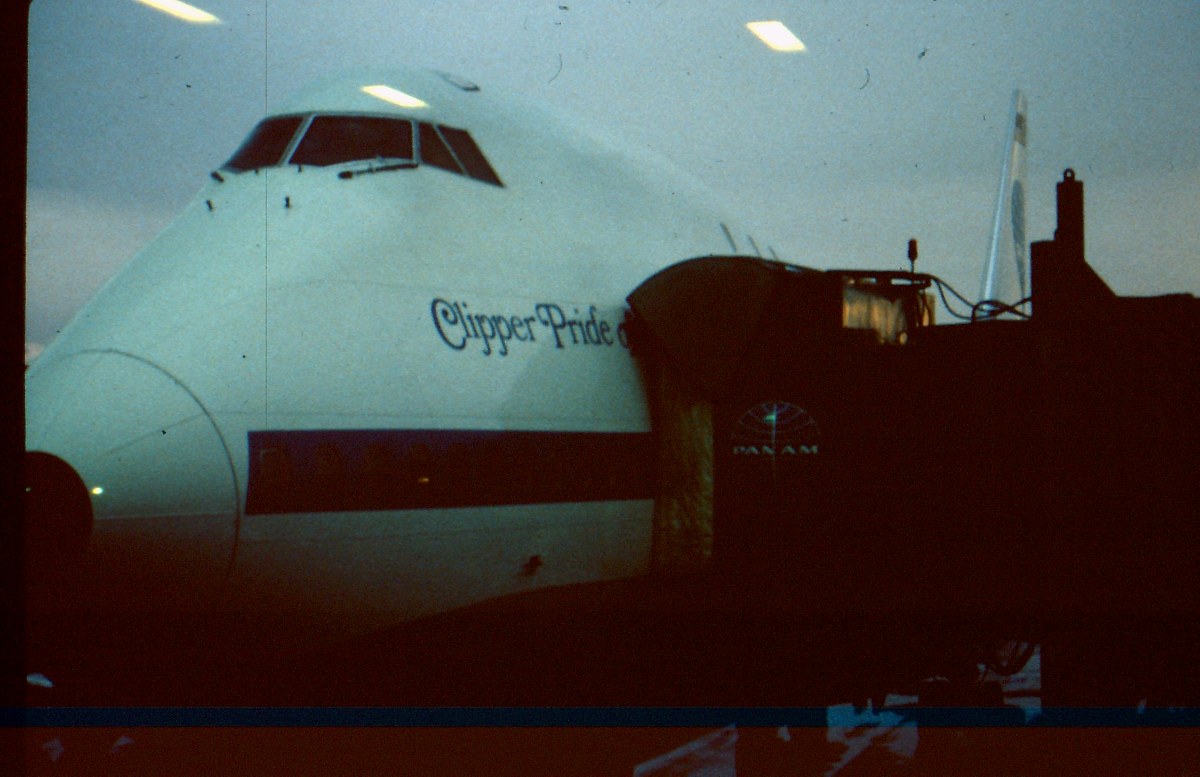
It was August 1981, when I took my first passenger flight from London Heathrow (LHR). It wasn’t a modest hop over to France or a Greek sunny beach but a Pan Am transatlantic international adventure to Seattle (SEA). Long-haul, a long way in a classic Boeing 747. Flight PA 123 out and PA 122 back.

This trip came to mind yesterday lunchtime as I was sitting in a stark modern Starbucks coffee shop. Yes, there was a time when such places were exciting, special, new and off-beat.

In a way this journey did enhance my education studies. One part of the trip was a visit to a steel factory in Los Angeles (Plessey Precision Metals). Now, that was educational. The boss who showed me around was forthcoming about where their labour came from and the working conditions.

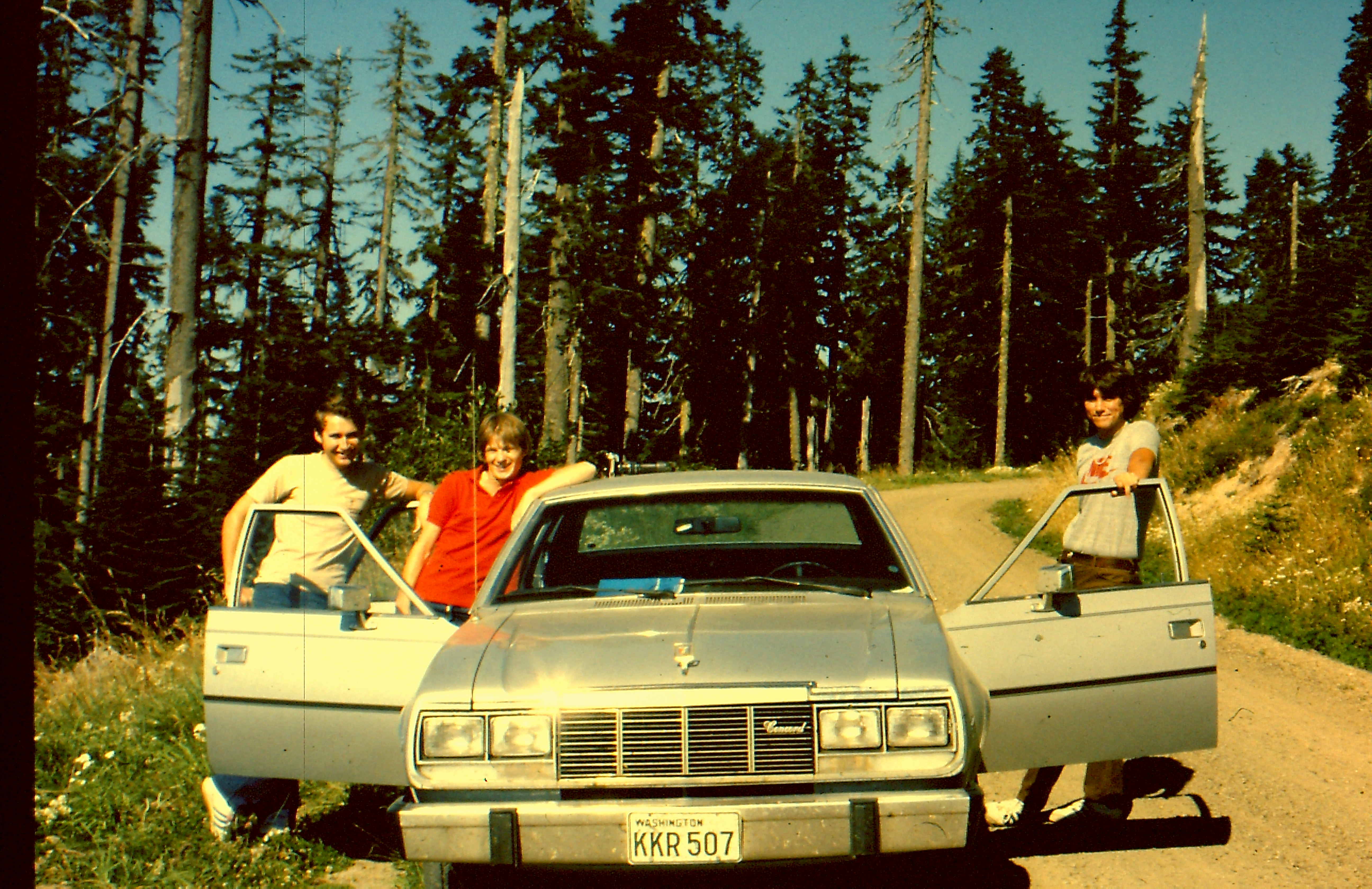
Four of us Coventry students went on this great American adventure. Basically, the plan was to arrive and depart from Seattle but to drive up and down the West Coast. It was a fly /drive package. By sharing the driving and staying in the cheapest motels we travelled a long way for our money. In massive contrast to the present day, the pound – dollar was at about 2.4.

42 years ago, the world was a different place. Although, breakfast at Dennys probably hasn’t changed. It was the year President Ronald Reagan sacked thousands of striking air-traffic controllers when they ignored his order to return to work. What a year to be flying.

Driving an AMC Concord[2] well over 6000 miles our trip was non-stop. A day here, a day there and, if my memory serves me right, a night sleeping in the car. That was in the mist over San Francisco.

Mount St. Helens had erupted in March 1980. We drove the rental car as close as we could to the areas of devastation to have a look for ourselves. It was dramatic. Trees felled like matchsticks. Grey dirt and dust covering the land. Signs of the eruption stretched far and wide.

If you can marshal the time and the money, have some good friends and are 21 years old, I can’t think of a better recommendation.


[1] That’s when my taste for peanut butter developed.

[2] https://en.wikipedia.org/wiki/AMC_Concord