NATS

A “technical issue” has caused UK National Air Traffic Services, NATS to impose air traffic flow restrictions[1]. They did not close UK airspace. This was not a repeat of the volcanic ash events of early 2010. Going from a fully automated system to a fully manual system had the dramatic impact that might be expected. The consequences, on one of the busiest weekends in the holiday calendar were extremely significant. Huge numbers of people have had their travel disrupted. Restricting the air traffic system ensured that aviation safety was maintained. The costs came to the UK’s air traffic handling capacity and that meant delays and cancelled flights.

Although the failures that caused the air traffic restriction were quickly resolved the time to recover from this incident meant it had a long tail. Lots of spoilt holidays and messed up travel plans.

It is normal for an Air Traffic Service (ATS) provider to undertake a common cause failure analysis. This is to identify multiple failures that may result from one event. So, the early public explanations coming from NATS of the causes of this major incident are surprising. Across the globe, contingency planning is a requirement for ATS. The requirement for the development, promulgation and application of contingency plans is called up in international standards, namely ICAO Annex 11.

So, the story that a single piece of flight data brought down the traffic handling capacity of a safety related system, to such a low level, is difficult to accept. It’s evident that there is redundancy in the systems of NATS, but it seems to be woefully inadequate when faced with reality. ATS comprise of people, procedures, and systems. Each has a role to play. Safety of operations comes first in priority and then air traffic handling capacity. What we know about even highly trained people and data entry is that human error is an everyday issue. System design and implementation needs to be robust enough to accommodate this fact. So, again attributing such a highly disruptive event to one set of incorrect data inputs does not chime with good practice or basic aviation safety management. It is concerning that one action can bring down a major network in this way.

EUROCONTROL would have had been sent a “rogue” flight plan in the same way as UK NATS. Brussels does not seem to have had the problems of the UK.

It is early days in respect of any detailed technical investigation. Drawing conclusions, whatever is said in public by senior officials may not be the best thing to do.

Calls for compensation have a good basis for proceeding. The holiday flight chaos across Europe comes down to one single failure, if initial reports are correct. That can not be acceptable. The incident left thousands stranded abroad with high costs to pay to get home.

Before privatisation, there was a time when the UK Civil Aviation Authority (CAA), ran the nation’s air traffic services[2]. It had a poor reputation at the time. I remember a popular newspaper cartoon saying – and now for some clowns from the CAA. They were entertaining delayed passengers.

UK NATS has done much good work to manage a safe expansion in air traffic and address many changes in technology, it would be a shame if this sad incident marks a decline in overall network performance.

NOTE 1: And this topical cartoon from the Daily Mail in April 2002: https://www.pinterest.es/pin/497577458805993023/

NOTE 2: A report on the incident is to be sent to the regulator, UK CAA on Monday, 6th September. Transport secretary to see Nats’ ATC meltdown report next week | Travel Weekly

NOTE 3: The likelihood of one in 15 million sounds like a low number but it’s not “incredibly rare” by any definition. Certainty when there are around 6000 flights a day in the UK. A duplicate error occurring is a basic error that could be anticipated.


[1] https://www.bbc.co.uk/news/live/uk-66644343

[2] https://commonslibrary.parliament.uk/research-briefings/sn01309/

New Walk

It’s a step to the left and then a step to the right. It’s not quite the “Time Warp” that featured in the 1970s rock musical: The Rocky Horror Show.

It’s a little mini dance that people do every day in the streets of Britain. I found myself doing it over the weekend. It’s that moment when you realise that you have lost a sense of what’s around you. A tiny drift away from where you intended to go. Then a step to correct, and look-up and set-off again towards your destination. A wiggle on the pavement.

Maybe this walk didn’t exist before 2006. Well, that is all but in the most exceptional situations. Hand-held devices are not entirely new. What’s much more frequent now is the compulsion to look at the small screen.

The colours, the constant demand for attention, the tickling of our curiosity, the mobile phone has it all. In fact, its dam silly to continue to call our devices “phones.” The primary purpose of these handy devices has long since passed from being able to make telephone calls from any location.

We call them a “mobile”, but the Germans call them a “handy”. An American will call them a cell phone. Given the way we use these ubiquitous hand-held devices, I think the Germans have got it right. The whole essence of the thing is its utility.

Now, if we are fixated with heads down there’s a lot that can go wrong. This has been the source of numerous aviation accidents. Looking up and checking visual references remains a fundamental part of flying. The basics of “see and avoid” are drummed into every new flyer.

On the pavement us poor humans are evolving in a world of every more connected technology. In our heads we have a perception of the world around us as we walk the urban streets. That’s made up of sights, sounds, and even smells. Our brains gather information and then do some spatial and temporal filtering before making sense of where we are and what we need to do to get where we want to go. The eyes, and image processing in the brain are on the top of the list of our normal priorities.

Heads-down attention is drawn to the small screen and away from our surroundings. Staring at the small screen draws us into the content of an e-mail, or a text message, or a cuddly cat picture running around social media. Luckily our other senses are keeping track of the world around us.

The textbook case is where we start to drift in our three-dimensional environment. Not much. It’s a step to the left and not a step to the right. Suddenly there’s a need to correct. Our ever-active brains pick up on the misstep. That’s where our tiny dance comes in and nobody but us may notice.

I’m talking about something that’s almost trivial. Hardly noticeable. However, there are far too many cases where fatalities have resulted from missteps[1]. There’s some evidence that bumping into people and objects is most likely. Slips and falls follow those incidents.

I’ll bet not much is known about the vast number of micro-events like my tiny mobile phone dance. Now, there’s a topic of study for a student of visual perception. 


[1] https://www.ncbi.nlm.nih.gov/pmc/articles/PMC6034962/

Even more H2

There’s a couple of Hydrogen related topics that are worth a moment. One is super conductors and the other is fire.

Heavy complex equipment like the magnets for particle accelerators use superconductors[1]. When there’s space and a need for powerful magnetics, materials with special physical properties, at extreme cold temperatures find a good use.

Talk of room-temperature superconductors is far from what it seems. Such a wonderful innovation is a million miles from any practical applications, if it exists at all. There’s no theory of high-temperature superconductivity, but there’s quite a few physicists who would like to find one[2].

Aviation researchers search for high temperature superconductors for electrical propulsion with extraordinary performance is on. The likelihood of success is low, and the timeframes are very long.

When an aircraft is flying at high altitude, the cabin altitude is maintained for the safety and comfort of passengers and crew. Air compressors, valves, sensors, and controllers make sure that cabin pressure remains at equivalent to an altitude of about 8,000 feet, and lower in some cases. So, any kind of simply flammable gasses or materials inside an aircraft cabin are a definite no no. It’s a big hazard.

In flight, the positive pressure should keep leaking gas out of the cabin. That is as long as the sources of fresh air for the cabin are keep well away from potential leaks.

That’s where Hydrogen gas can present trouble. Leaks can be common in dynamic Hydrogen systems. Storage tanks must be very strong to resist pressures and insulated to keep cold, at around –250°C. Escaping H2 gas is tiny. If that’s vented overboard then the risk of explosion or fire is significantly lowered. Knowing the exact flows of liquid or gas is a must.

However, if the gas finds its way into a pressurise cabin that basic option is limited. Not only that but detecting low concentrations of the gas in the first place is mighty difficult. Its odourless but at least Hydrogen isn’t poisonous.

The big safety issue is that the gas has a very wide flammability range (4 – 70% H2 in air mixture)[3]. Yes, H2 needs a spark to ignite. A typical aircraft cabin environment will easily provide that event. Dry air and static electricity will do it even if other sources will not.

To compound difficulties, if H2 does ignite, and not explode, then its flame may not be visible to the human eye. The flame is almost colourless. Certainly, not what most people think of as a gas flame. Gas and flame detectors could be installed in aircraft cabins and baggage compartments. Audible and visual alarms could be generated but what would be the associated crew actions?

All the above requires detailed consideration in aircraft safety assessments. The move away from prescriptive regulatory requirements means each specific aircraft configuration must be addressed. There are no generic lessons to learn from past aviation accidents and incidents.

Although, I think these puzzles can be solved it’s a huge leap from here to there.

POST: Yes, Hydrogen is not for every application. Small scale aviation is better served by electrification Five Hydrogen Myths – Busted. – RMI


[1] https://home.cern/science/engineering/superconductivity

[2] https://www.science.org/doi/epdf/10.1126/science.adk2105

[3] https://h2tools.org/bestpractices/hydrogen-flames

More H2

I think this came at me both ways as a schoolboy. Both from chemistry and physics. In our 1960s chemistry lab, Bunsen burners, flasks and array of hazardous substances were the norm. Physics seemed more cerebral. Still, the hands-on side of teaching still meant some practical experimentation. That’s the part that most engrossed me.

Electrolysis starred in two mostly harmless experiments. The colourful one was about copper sulfate[1] and the other was about splitting water into its component parts. Getting Oxygen (O2) and Hydrogen (H2) gas by electrolysis[2] is mighty simple and one of those wonders of nature.

Electrolysis is a way of producing carbon-free Hydrogen from renewable and nuclear resources. Despite the apparent straightforwardness of the process, it’s quite tricky to industrialise on a large scale. One key factor to the future use of Hydrogen is getting the cost per Kg down[3].

Let’s presume that this is a solvable problem and cheap and plentiful gas supplies will be up and running by 2030. That’s not so far off given its 2023. There will surely be a market for ample supplies given the multitude of applications for Hydrogen. Will it be a global market? It needs to be.

It’s a talking point. Hydrogen fuel is one of the viable fuels for aviation. Generating power and returning it to water in the atmosphere is an attractive idea. The process meets carbon-free ambitions even if it does have lots of complications.

On average, a Boeing 737-800 uses about 5,000 lbs (2268 kg) of conventional fuel per flight hour[4]. Cryogenic Hydrogen has lower energy density. That means much more on-board fuel storage will be needed to go as far or fly as long as a current day common commercial jet aircraft.

Designing an aircraft configuration that can accommodate these facts can be done but what of the space that remains for the payload? As it does today, on-board fuel storage will need to meet stringent safety requirements.

Adding this up, it may not be the technical issues that make this difficult. Although they are difficult the technical issues can be addressed. However, will the overall package that results be economically viable? If costs are increased by a factor of, say 5, will this provide for a commercial air transport system that is like the current one?

We may have to accept that carbon-free flying reverts to the 1960s[5]. What I mean is that, instead of low-cost flights hopping here, there, and everywhere for £100, the future maybe one where long-haul flying is a relative luxury or an expensive business need.


[1] https://www.bbc.co.uk/bitesize/guides/zgn8b82/revision/3

[2] https://www.bbc.co.uk/bitesize/guides/zv2yb82/revision/1

[3] https://www.statista.com/statistics/1220812/global-hydrogen-production-cost-forecast-by-scenario/

[4] http://www.b737.org.uk/fuel.htm

[5] https://www.skyscanner.com.au/news/airlines/the-golden-age-of-plane-travel-what-flying-was-like-in-the-1950s-and-1960s-compared-to-now

First Flight

I didn’t have a gap year. That’s a year a student takes off their studies. It was a fashionable rite of passage. These days a gap year is often associated with an opportunity to gain extra skills and experiences to add to a CV. Going back to the early 1980s, after all we still had local authority educational grants, a gap year was associated with travel and adventure.

What I did have was employment. As a sponsored student, I had an income whilst working and a bursary. So, although my student grant was highly variable. My parents were self-employed. I was reasonably independent and well off for the average undergraduate student. That was a benefit of being in demand in the engineering world. Not only that but in the recession struck West Midlands our student cost of living was within our means. With a care in spending and cash-and-carry[1] shopping it was possible to put money aside.

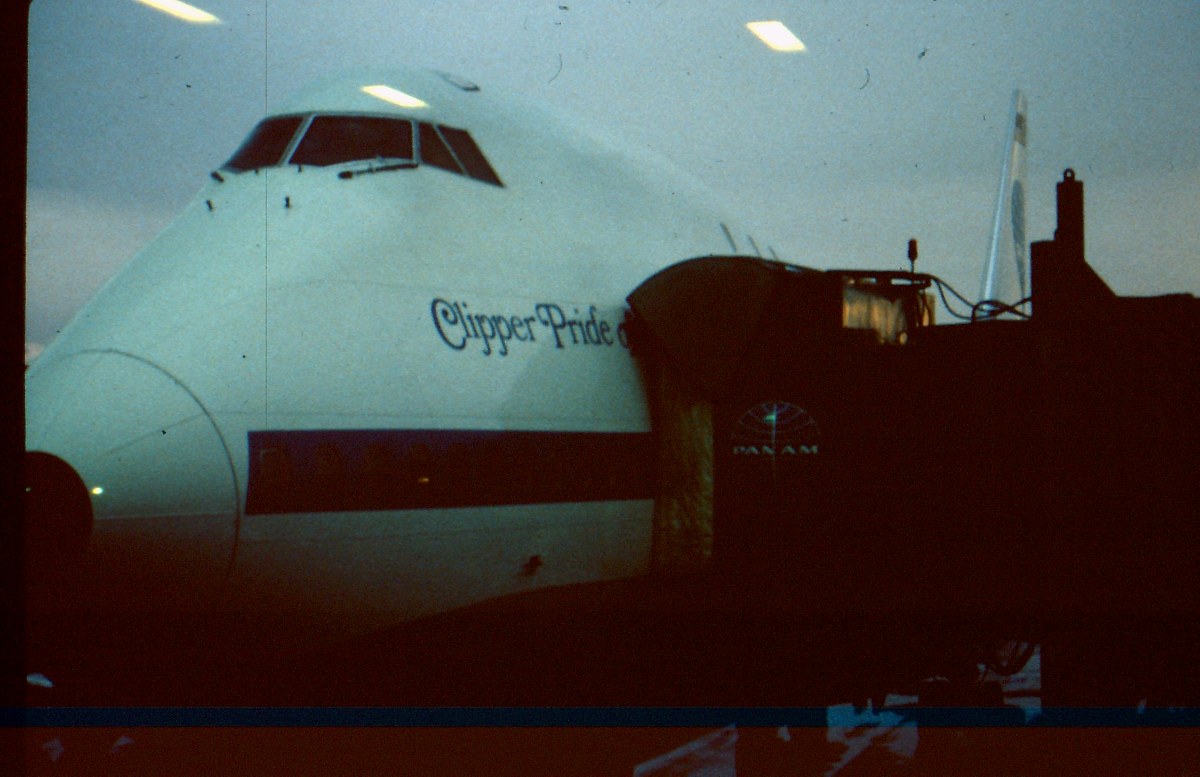
It was August 1981, when I took my first passenger flight from London Heathrow (LHR). It wasn’t a modest hop over to France or a Greek sunny beach but a Pan Am transatlantic international adventure to Seattle (SEA). Long-haul, a long way in a classic Boeing 747. Flight PA 123 out and PA 122 back.

This trip came to mind yesterday lunchtime as I was sitting in a stark modern Starbucks coffee shop. Yes, there was a time when such places were exciting, special, new and off-beat.

In a way this journey did enhance my education studies. One part of the trip was a visit to a steel factory in Los Angeles (Plessey Precision Metals). Now, that was educational. The boss who showed me around was forthcoming about where their labour came from and the working conditions.

Four of us Coventry students went on this great American adventure. Basically, the plan was to arrive and depart from Seattle but to drive up and down the West Coast. It was a fly /drive package. By sharing the driving and staying in the cheapest motels we travelled a long way for our money. In massive contrast to the present day, the pound – dollar was at about 2.4.

42 years ago, the world was a different place. Although, breakfast at Dennys probably hasn’t changed. It was the year President Ronald Reagan sacked thousands of striking air-traffic controllers when they ignored his order to return to work. What a year to be flying.

Driving an AMC Concord[2] well over 6000 miles our trip was non-stop. A day here, a day there and, if my memory serves me right, a night sleeping in the car. That was in the mist over San Francisco.

Mount St. Helens had erupted in March 1980. We drove the rental car as close as we could to the areas of devastation to have a look for ourselves. It was dramatic. Trees felled like matchsticks. Grey dirt and dust covering the land. Signs of the eruption stretched far and wide.

If you can marshal the time and the money, have some good friends and are 21 years old, I can’t think of a better recommendation.


[1] That’s when my taste for peanut butter developed.

[2] https://en.wikipedia.org/wiki/AMC_Concord

Electric Flight

Hype has its place. Being positive while buffeted by the inevitable ups and downs of life is purposeful and necessary. What’s not true, and might be the impression, is that electric aviation is easy. When forging ahead to build a future, that is not yet realised, there’s a need to maintain confidence. However, being blinded by the light doesn’t help when it comes to tackling difficult problems. Proof-of-concept is just that.

The big positives of electric aviation are the environmental benefits. Electric aviation is spawning many new types of aircraft and the possibilities of new types of operation. So, there’s no doubt that this is an exciting time to be an aviation enthusiast. What a great time to be in aerospace design and manufacturing. Here we are at the start of a new era[1].

My point is that high power electrics, and their control are not “simple” or intrinsically safe in ways other types of aircraft are not. I know that’s a double negative. Better I say that high power electrics, operated in a harsh airborne environment have their own complexities, especially in control and failure management. Fostering an illusion that the time between having an idea and getting it into service can be done in the blink of an eye is dangerous.

The design, development and production of advanced aircraft power distribution, control and avionics systems is not for the faint hearted. Handling large amounts of electrical power doesn’t have the outward evidence of large spinning mechanical systems but never underestimate the real power involved. Power is power.

The eVTOL aircraft in development deploy innovative design strategies. There’s a lot that’s new. Especially all together in one flying vehicle. Everyone wants fully electric and hybrid-electric aircraft with usable range and payload capacity. So, the race is one. Companies are productising the designs for electric motors of powers of greater than 10kW/kg[2] with high efficiency and impressive reliable. These systems will demand suitable care and attention when they get out into the operating world.

A 500kW motor will go up with one hell of a bang and fire when it fails. The avionics may shut it down, but everything will have to work smoothy as designed every day, not just in-flight but on the ground too. Suppressing an electrical fire isn’t the same as a conventional fuel fire either. To fix these machines the care needed will be great. 1000 Volt connections capable of supplying high power can kill.

Not wishing to be focussed on the problems but here I go. Another major problem is the number of qualified engineers, with knowledge and experience who can work in this area. The companies who know how to do this demanding work are desperately searching for new people to join their ranks.

Educators are starting to consider these demands as they plan for the future. Sadly, there’s not so many of them across the globe who are so foward looking.

The global aviation industry needs to step-up and train people like crazy. The demand for Subject Matter Experts (SMEs) is self-evident. That’s true in design, production, and maintenance. Post COVID budgets maybe stretched but without the big-time investments in people as well as machinery success will be nothing but an illusion.

POST1 : Or 150 kW motors when you have many of them going at once. Rolls-Royce Electrical Testing eVTOL Lift Motor | Aviation Week Network

POST 2: Getting ready Preparing Your Airport for Electric Aircraft and Hydrogen Technologies | The National Academies Press


[1] https://smg-consulting.com/advanced-air-mobility

[2] https://www.electricmotorengineering.com/h3x-new-investments-for-the-sustainable-aviation/

H2 is difficult

I mentioned Hydrogen as an option for aviation. The use of Hydrogen to either power jet engines or to power fuel cells to provide electricity is a real technical option. Although the person I was talking to was engaged in environmental work, they shrugged their shoulders when I mentioned Hydrogen. They were certainly not impressed by these possibilities despite our agreement on the urgent need for de-carbonisation.

I can understand why there’s a level of cynicisms. On my part, it’s like the X-Files[1]. Fox Mulder was the believer and Dana Scully the sceptic. Broadly, I want to believe.

Today’s, liquid fuels can be explosive in certain conditions. However, it takes a considerable effort to create the conditions whereby a devastating explosion can occur. The Boeing 747-100 that was Trans World Airlines Flight 800 (TWA 800)[2] exploded, broke up in the air and fell into the Atlantic Ocean in 1996. This was an example of a worst-case scenario. 230 people were lost in that fatal accident. Now, the ignition of a flammable fuel/air mixture in aircraft tanks is better prevented by design and operational procedures.

If Hydrogen is to be viable in civil aviation such hazardous conditions will be harder to prevent. A flammable hydrogen/air mixture can be ignited much more easily than conventional liquid fuels. Such dangerous situations can be prevented but the measure to do so will require robust design and stringent operational procedures.

Several development programmes are underway, making practical Hydrogen powered aircraft viable. A range of aircraft configurations are possible. From hybrid generator and electric motor set-ups to combustion-based propulsion. This work is moving from academic research into commercial possibilities.

There little read across between the behaviour of conventional hydrocarbon liquid fuels and liquid Hydrogen. This would be evident in any serious incident or accident scenario. Let us imagine the case of British Airways Flight 38, in 2006, a Boeing 777-236 that came down at the end of a runway at London Heathrow[3]. A significant amount of fuel leaked from the aircraft after it came to rest, but there was no fire. There were no fatalities.

The breakup of liquid Hydrogen tanks or plumbing in such a scenario would almost certainly result in a significant fire. The mitigating impact of that fire is the lightness of the gas. Instead of liquid fuel pooling on the ground, Hydrogen would burn upward. However, any explosion could be devastating.

So, for large aircraft design the provisions to protect liquid Hydrogen tanks and plumbing must be extensive and extremely robust. This would have to be maintained, as such throughout the whole operational life of the aircraft. These requirements would be onerous.

Keeping crew and passengers well away from Hydrogen infrastructure will be a must.

POST 1: Crashworthiness doesn’t get much of a look-in. Without it there’s going to be a problem over the horizon. https://www.ati.org.uk/flyzero-reports/

POST 2: At least for eVTOL aircraft some work is being done. https://ieeexplore.ieee.org/document/10011735


[1] https://www.imdb.com/title/tt0106179/

[2] https://www.history.com/news/twa-flight-800-crash-investigation

[3] https://assets.publishing.service.gov.uk/media/5422ec32e5274a13170000ed/S1-2008_G-YMMM.pdf

Local air

There are cases of synergy. That’s where aviation and local authorities have a mutual interest. This often centres around the economic prosperity of an area. Relationships can be complex, difficult, and fraught with volatility. There are plenty of housing and industrial estates that cover the ground of former airfields. Like the railways that closed under Beeching’s axe[1].

Public interest was dominant 50-years ago, but privatisation dramatically changed relationships. Sustaining profitability through good times and bad have proven to be more than some locations could support. There’s so many combinations and permutations but fewer and fewer active commercial airfields in the UK.

London Manston Airport is an airport that only just clings on to existence. In 2013, the Welsh Government acquired Cardiff Airport. So, some aviation facilities have returned to public ownership and run as an arm’s length business. A few airports are given support to ensure connections exists between remote parts of the UK. Highlands and Islands Airports is an example.

Advanced Air Mobility (AAM) is coming. This is the extensive use of electric vertical take-off and landing aircraft (eVTOLs). AAM is an innovative concept that will require Vertiports and integration into busy airspace. To make the economics work a lot of routes will be in, and over urban areas.

My view is that AAM will only succeed in the UK if aviation and local authorities come together and embrace it. That is going to be a massive challenge whatever national government does.

In the case of local authorities with a mission of protecting the interests of residents this has often meant objecting to aviation developments. I go back to proposals of 30-years ago to make Redhill Aerodrome a feeder to London Gatwick Airport[2]. This was well and truly shot down by local interests. In fact, rightly so given the complex twists and turns it would have made in the airspace.

AAM needs the harmonisation of standards to ensure interoperability anywhere in the country. There are one or two UK local authorities that are already embracing the potential opportunities of this new form of flying. Coventry City Council is taking on the challenge[3]. It’s welcoming the development of the ground infrastructure for “air taxis” and delivery drones.

By the way, my view is that introducing the subject as “flying cars” or “air taxis” is not a good idea. This creates images from science fiction that may not resemble the reality of these new air services.


[1] https://www.networkrail.co.uk/who-we-are/our-history/making-the-connection/dr-beechings-axe/

[2]https://john-w-vincent.com/wp-content/uploads/2023/08/bf3ec-clear_for_take_off.pdf

[3] https://www.coventry.gov.uk/news/article/4232/world-first-hub-for-flying-taxis-air-one-opens-in-coventry-uk-heralding-a-new-age-of-zero-emission-transport

Weight

Projects aiming to electrify aviation are numerous. This is one strand to the vigorous effort to reduce the environmental impact of civil aviation. Clearly, feasible aircraft that do not use combustion are an attractive possibility. This step shows signs of being practical for the smaller sizes of aircraft.

Along the research road there are several hurdles that need to be overcome. One centres around the source of airborne power that is used. State-of-the-art battery technology is heavy. The combinations of materials used, and the modest power densities available result in the need for bulky batteries.

For any vehicle based on electric propulsion a chief challenge is not only to carry a useful load but to carry its own power source. These issues are evident in the introduction of electric road vehicles. They are by no means insurmountable, but they are quite different from conventional combustion engineered vehicles.

The density of conventional liquid fuels means that we get a big bang for your buck[1]. Not only that but as a flight progresses so the weight of fuel to be carried by an aircraft reduces. That’s two major pluses for kerosene. The major negative remains the environmental impact of its use.

Both electricity and conventional liquid fuels have a huge plus. The ground infrastructure needed to move them from A to B is well understood and not onerously expensive. It’s no good considering an aircraft design entirely in isolation. Any useful vehicle needs to be able to be re-powered easily, not too frequently and without breaking the bank[2].

Back to the subject of weight. It really is a number one concern. I recall a certain large helicopter design were the effort put into weight reduction was considerable. Design engineers were rushing around trying to shave-off even a tiny fraction of weight from every bit of kit. At one stage it was mooted that designers should remove all the handles from the avionics boxes in the e-bay of the aircraft. That was dismissed after further thought about how that idea would impact aircraft maintenance. However, suppliers were urged think again about equipment handling.

This extensive exercise happened because less aircraft weight equated to more aircraft payload. That simple equation was a massive commercial driver. It could be the difference between being competitive in the marketplace or being overtaken by others.

Aviation will always face this problem. Aircraft design is sensitive to weight. Not only does this mean maximum power at minimum weight, but this mean that what power that is available must be used in the most efficient manner possible.

So, is there a huge international investment in power electronics for aviation? Yes, it does come down to semiconductors. Now, there’s a lot of piggybacking[3] from the automotive industries. In my view that’s NOT good enough. [Sorry, about the idiom overload].


[1] https://dictionary.cambridge.org/dictionary/english/bang-for-the-buck

[2] https://dictionary.cambridge.org/dictionary/english/break-the-bank

[3] https://dictionary.cambridge.org/dictionary/english/piggybacking

Safety is poltical

It’s a surprisingly controversial statement. It’s particularly difficult for those working in traditionally technical specialisations to come to openly acknowledge “politics” in their work. By raising the subject, it’s almost as if one had stepped in something unpleasant.

I recall the period when a new aviation agency was being established. That’s in the dawn of this new century. EASA, the European Aviation Safety Agency came into operation in 2003, but the debate about its shape and form occupied many of the preceding years. Politicians, administrators, technocrats, and industry were vocal about the direction to take.

The impact of liberalising European civil aviation, that stated in the 1970s, was primarily a political drive. It envisaged both a commercial and social benefits. Separating the operation of aviation from the vagaries of political personalities seemed to offer a future that would be led by the customers needs.  

The general acceptance that State control of businesses, like airlines and manufacturers, had a stifling effect, limiting innovation and opportunity was questioned but not so much by those with the power to make changes. Momentum pushing liberalisation was given a boost by the apparent successes of businesses, like Southwest airlines[1] in the US. Freddie Laker had a big influence in the UK[2].

In these decades of transformation aviation safety has always been heralded as a priority. Whoever is speaking, that’s the line that is taken. Safety is number one. What industry has experienced is a decades long transition from the ways and mean of trying to control safety to an approach more based on managing potential outcomes. This is characterised in a shift from mostly prescriptive rules and regulations to other more adaptive approaches.

Back to the proposition that safety is political. There are several ways to address this as an exercise of analysis. There’s a mammoth amount of historical evidence to draw upon. However, my thoughts are more to do with anecdote and lived experience.

Number one is that our institutions are shaped by political decision-making. This is to varying degrees, from year to year, but international bodies, national ministries, administration, authorities, agencies, committees, learned bodies, all depend upon political support. If they do not muster and sustain this support, they will wither and die.

Number two, change is a constant, failures happen but safety achievement depends on a consistency, dependability, and stability. Maintaining public confidence. There lies a dissonance that must be reconciled. Governments and politicians instinctively insulate themselves in such cases and so the notion of “independent” regulation is promoted.

Number three, arguments for liberalisation or intervention do not stop. The perpetual seesaw of cutting “red tape” and tightening rules and regulation may settle for a while even if these are always in movement. This can be driven by events. The proximity of fatal accidents is always a significant political driver. Domestic fatalities, where consequences are borne locally, will have much more impact than similar events 1000 miles away.

Does any of this matter? Afterall it’s a context that exists, de-facto. It’s no good saying: stop the world I want to get off.

Yes, it does matter. Accepting that safety is political helps dispel some of the myths that persist.

A prerequisite to safety success is provision of adequate resources. Constantly cutting a budget has consequences. A blind drive for efficiency that doesn’t effectively measure performance invites failure. Much as lack of planning invites failure. Reality bites.

It’s reasonable to question of investigatory or regulatory “independence” from time-to-time. The reasons for safety decision-making can be purely objective and technical. Questioning that “purity” need not be impugning politicians, administrators, or managers in their motivations. Shedding light on contextual factors can help learning and avoidance of future failures.

Accepting the perpetual political seesaw of debate can help a great deal in meeting safety goals. What this means is the importance of timing. Making a proposal to tighten a rule concerning a known deficiency can meet a stone wall. Making the same proposal after an accident, involving that deficiency, can go much better. Evidence that is compelling can change minds. This is reality.


[1] https://www.southwest.com/about-southwest/#aboutUs

[2] https://simpleflying.com/laker-airways-brief-history/