Hero to Zero

How to go hero to zero in 30 seconds. I hired a large van for a week. From a company that had done a good job for me in the past. I had a lot of confidence in their offer. Fine their location had changed. Once the company was in Redhill in Surrey. The office was easy walking distance from my house. Now, they have an office in the small town of Dorking. So, it’s a short train ride away.

The Surrey towns of Reigate and Dorking are separated by about 8 miles. They both sit under the North Downs. The main A25 road links the two towns and probably has done for centuries. Without delays that’s about 20 minutes door to door. Normally.

Moving house is one of the most stressful events in life. That’s what we are currently about. It’s a move further West. It’s a move to take us away from the dreadful mess that the M25 motorway has become in the last couple of decades. From 3 lanes to 4 lanes, it’s got worse not better. Why do we think we can build our way out of traffic jams?

So, for the last week I’ve been driving a large van backwards and forwards from Reigate to Newbury. The hired van was everything I needed. Only about 7000 miles on the clock and plenty of space. If I had one niggle it was the need for a reversing camera. Beepers are just not enough.

The rental company, named after a famous starship, that went where no man has gone before, was topping my hero list. What I needed when I needed it and at a good price. With only a minor inconvenience when picking-up and dropping-off. Or, so I though.

Named storms are popular this year. Driving through one of them is no fun. Traffic slows and the inevitable bump or blown down tree holds everyone up. Nothing moves the way it does on a sunny day. It’s times like these when planning can be more guess work than science. Whatever a satnav calculates.

In my wisdom I thought – let’s try a cross country route home. Get off the habit of using the M4 and M25 motorways. Programmed the satnav and away I went. Leaving Newbury lunchtime thinking that getting the van back to the rental company by 5pm would be no sweat.

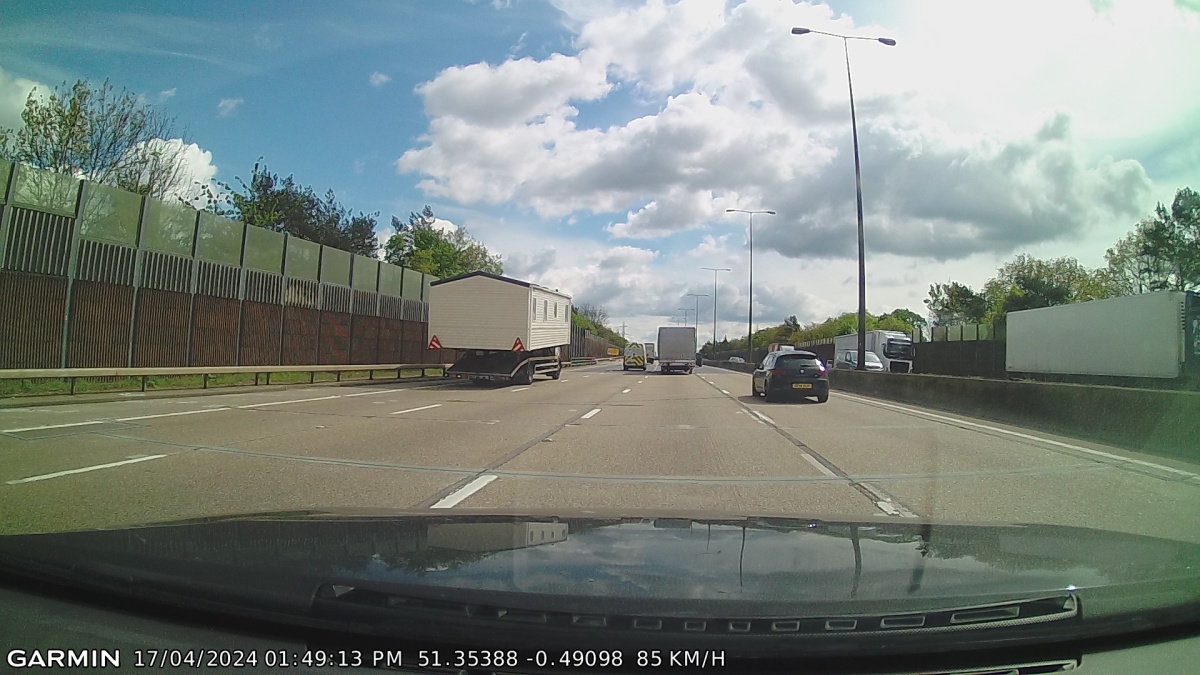
My route took me from Newbury to Basingstoke and then to the M3 motorway. Then towards London and coming off the motorway to take the Blackwater valley route to the Hogs Back. Those references are for Surrey residents because they will know what I’m talking about. Trundling along the Hogs Back I then hit the main A3 into Guildford. Now, my logic went like this. I’ll avoid the Wisley junction reconstruction or permanent hold-up by taking the main A25 all the way back to Reigate. So, I did. All going well until I reached the closure of that main road[1]. At that point I was committed to getting back to Reigate to unload my packing boxes. Can’t carry them on the train.

When road closures happen in Surrey, at rush hour the mess is insane. The diversion I took up over the North Downs and back down again onto the A217 road was miserably slow. What’s worse is that I knew I had to turn around and go back to Dorking to return the rental van. The clock was ticking. 

Anyway, enduring the tedious frustration of doing a short journey, by miles, over a long time wore away at my generally cheerful disposition. Thus, I was glad to get back to the rental company office in Dorking only about 20 minutes late, after 5pm.

I was committed to leaving the van and taking the train home. That trading estate rental office closes at 5pm. A dark and empty parking space was free, but nowhere could I see anywhere to drop the van’s keys? It seems inconceivable to me that an international rental company would not have a key drop. I searched the plot. There was nowhere. All there was an unhelpful notice on the door of the company’s office. So, I locked the van, kept the keys, and walked to the train station. Idea being to return the keys as soon as the office reopened next morning. Seemed logical.

Next morning, I got up early and set off for Dorking. Sadly, the closure of the A25 was still an on-going problem. All the rush hour traffic had the same issue to contend with on their way to work. This is why I’m happy to be leaving Surrey. A short journey turns into a tedious trek at the drop of a hat. The county’s roads are unable to cope with the levels of traffic. But, as planned I get to the Dorking office of the rental company at 8am when the office opened. Enterprise were still in my hero category as the van was inspected and the mileage typed into a company handheld device. I would have given them 10 out of 10. Job done.

In the warm, in the rental office, just as I thought the paperwork had been done – hold on a moment it’s charging you an extra day for a late return. Computers do these sorts of things. They have no awareness of the world other than the numbers they crunch. Unthinking beasts.

I’ll have a word with my manager. Those were the words spoken. Me being me, I though that’ll be no problem given the effort I’ve made to return the keys. Let’s face it if there was a drop box last night they would be doing exactly as they are now. Van returned in 100% condition and keys in hand.

Then to my surprise the office manager, who insisted on using my first name, says no we are going to have to change you for an extra day. In 30 seconds, Enterprise went from being my number one van rental choice to a huge bottomless zero. I argued the logic of my position and the unforeseen local conditions that prevailed. I outlined the best efforts that I’d made.

Then I got the most galling response – it’s company policy. I suggested that the office manager might use a little judgement or digression in this case. I hit nothing but a stone wall. The computer says so. The charge is the charge. No deviation possible. It’s astonishing that an office manager can’t make a reasonable judgement. If that’s Enterprise company policy I don’t want that kind of service. Other companies are available.

What didn’t help either was the prospect of the return journey in my car knowing that the main Reigate Road was closed. As per my prediction the short journey home again was awful.

Hero to zero – Enterprise. Hero to zero in 30-seconds. My future business will go elsewhere.

POST: This quote from the Enterprise website is meaningless. “We understand that things don’t always go to plan so, if you are running a few minutes late we won’t charge you for an extra day, we give you a grace period of up to 29 minutes to cover unforeseen delays“.

Part 2.

Change is always welcome. The above rental made me think twice about using the services of Enterprise. In my new town, they have a much more easy to get to office. It’s a 20 minute walk from the house. So, I ate my pride and booked a big van for a couple of days. The job was much the same as before. It’s all part of a house move that is lasting far too long.

Here I am renting from Enterprise Rent-A-Car once more. This time I’ll drop the label “zero”. From picking up the van to dropping it off everything worked as it should. My large commercial van took a heavy book case and a king sized bed from Reigate to Newbury without a hitch.


[1] https://www.getsurrey.co.uk/news/surrey-news/live-a25-traffic-updates-after-28495765

Global

Our everyday life is built on an assumption of freedom of navigation. It’s not always easy to relate to this reality but there it is. Goods move around the globe. I illustrated this uncomfortable fact the other day by saying let’s just sit down and look around. Observe the room.

Sitting in my living room. How many items came to us by ship? Over the ocean. All the electronic goods for sure. The furniture? Some yes and some no. The carpet, maybe not. The curtains, the material for sure. Books? Some yes and some no. Radiators? Surely, made in the UK. However, even the items that were manufactured in the UK needed materials that were imported. Strip away all the imported goods and materials and there’s not much left. The cupboard would be bare.

Now, look at what I’m wearing. My clothes all got here by container ship. I’m not wearing up market attire only everyday wear. Down to my underwear it’s imported. If I did an inventory of my wardrobe there’s not much that was made here.

Take the cup of tea in my hand. Well, the cup might be domestically manufactured but the tea doesn’t grow here. True the milk in my tea is well and truly English. No sugar. I never take sugar.

My point is clear. The days when everything in an Englishman’s home was manufactured in the England have long gone. That day was a long time ago. Almost a pre-industrial period. Our imperial past was such that imported goods have always been a huge part of everyday life.

Today’s automatic assumption of the freedom of navigation stems from post-war settlements. Agreements and institutions flourished in the post-war period. They created and reinforced conventions that assured freedoms of navigation by air and sea. Something we all too easily take for granted. Almost totally ignore.

Since Reagan and Thatcher, it would be hard to find an international management school that didn’t emphasis the benefits liberalised markets and global supply chains.

Post-war the world went from a period when freedom of navigation that was secured by air forces and gunboats to a period when it was secured by agreement and mutual interest. Obviously, the subject is not entire so simple since conflict has always been occurring somewhere on the globe.

National sovereignty remains at the core of the agreements that exist. There is no such thing as world government and international law can be brittle to say the least. Amongst those who benefit from it, there’s a strong interest in upholding and protecting freedom of navigation. Those acts that disrupt or challenge freedom of navigation will always meet a response.

So, this week’s developments to protect international shipping routes through the Red Sea should come as no surprise. It’s a different matter as to whether they are right or wrong. Or whether the military action that has been taken will work.

Our western tendency to expect a rational response to a rational action maybe flawed. However, the aggressor in this case has interests that may not make any sense to us.

Chat

Yesterday afternoon, at the till in a major supermarket and the man in front of me was getting stressed. I was standing in line waiting without a care in the world. In front of the man, in front of me, the till assistant, or checkout operator, dependent on how you see it, and a customer were locked in day-to-day conversation. Just being sociable. From what I could hear that customer may have once worked in that supermarket at some time.

The man in front of me was getting grumpy. He turned back and muttered his disdain for the shop’s staff because they were holding him up. Their everyday conversation was an afront to him. They were wasting his valuable time. Not overly aggressive but he had an agitation that often comes from a degree of unwelcome stress. He was in a hurry or at least heavily felt the pressure of time.

When I got to the till the assistant asked: What did he say? I quickly paraphrased what was said. Conscious that I had no desire to inflame the situation that had now passed by. Reactions can be unpredictable. We live in an era of polarisation.

The gentleman working at the till was into small talk. He clearly loved to chat to customers. Then for me he put that in context. He said that when it gets to about ten, in the evening, people are more than happy to talk as they pack their shopping. With some people it’s the only conversation they have in a day. He was proud that staff were encouraged to be warm and friendly.

Now, there’s a contrast. The life of Mr busy, busy, busy verses the life of the forgotten. That division is at the heart of one of society’s biggest troubles. A tribe that is over-employed, anxious, and living on the edge and a tribe that is lost, lonely and forgotten.

One prone to exasperation and being impatient. The other desperate for social contact and empathy. How on earth did we construct a society that tries to work on that level? Not only that but supermarket managers are desperately trying to automate everything[1]. Already there’s three types of automation in that you can do your own till check in a couple of different ways.

The milk of human kindness shouldn’t be sneered at. Wow. You see how quickly I reverted to Shakespeare without even knowing it. That simple phrase has its origins in the play Macbeth. The play that I was forced to read at school. The play that did nothing much to lift my appallingly bad grades at English. To Lady Macbeth, the “milk of human kindness” was objectionable. To her real men had no need of it. We all know where that led. Don’t go there.

So, next time you are standing in a short que, stomping your feet, imagining the clock spinning around, give it a rest. If you find yourself thinking this is too much, I can’t deal with it anymore, do a double take. Relax. Breath slowly. Dig deep and discover some small talk. It might be more meaningful than you first think.

On another subject. I agree with Graham Nash[2]. A day in the life[3] is a truly great song. It’s life as a musical tapestry. The song wanders around the mind using hardly any words but painting a picture all the way up to the sky. I’ll not heaping yet more praise on The Beatles, they’ve enough for several centuries. That said, May 1967 was a magical moment. Even if I did only know it with toy cars and in short trousers. It’s not the daily news but I’ll bet there’s probably now more holes in Britain’s roads than ever.


[1] https://www.bbc.com/worklife/article/20170619-how-long-will-it-take-for-your-job-to-be-automated

[2] https://en.wikipedia.org/wiki/Graham_Nash

[3] https://genius.com/The-beatles-a-day-in-the-life-lyrics

Beware

There is some corrupt b****** out there in INTERNET land. They would dip their hand in your pockets and take whatever they can in a second. It’s downright evil. The wild-west element of the INTERNET has never gone away. It’s a global problem.

I’ve never had a Netflix account. Maybe that’s unusual. It would be nice to have one but, personally I’m not convinced that the costs are warranted. Not today. I’m slow to step on the streaming bandwagon. I still have a pile of DVDs and CDs. Yes, I’m a primitive. In some things an early adopter but when it comes to services that require regular payments, I’m cautious.

As regular as clockwork junk e-mails turn-up saying that I need to update my payment details, or my Netflix account will be suspended. Followed by an exclamation mark. On closer inspection they are amateurish cons. In fact, it’s good that the junk mail filter can see through them as they come in.

This kind of fishing is criminal. Somewhere there’s a group on con artists thinking up ever more devious ways of taking money from people. The amateurish ones may not be a threat to me, but I wonder how many people they do catch. Even one in a hundred thousand would net a nice return for virtually zero outlay.

It may be the case that lots of people think that they are not so stupid as to fall for these blatant entrapments. What’s concerning is that cybercrime is becoming ever more inventive. We’ve yet to see what developments in intelligent algorithms will do to this landscape.

The best advice around is to never ever, I mean never ever, give personal payment details in response to an unwanted request. Most honest organisations make a point of saying that they will never request bank details in unsolicited e-mails. Unjustified urgency and a threatening tone are another sign that something is wrong.

Electronic means, namely the digital economy is not as robust as the traditional over the counter transaction. Organisations are aware of this fact. Warnings saying that they will not take responsibility if money is transferred to an incorrect bank account are commonplace.

The digital economy has been a boom for the major banks. High Streets up and down the country now have grand imposing buildings that are coffee shops, restaurants and, in the case of my town a kitchen showroom. Banks have retreated from face-to-face relationships. The responsibility for being aware of the potential for cybercrime has been firmly placed on the shoulders of the individual.

Talking to people remains important. Certainly, if a request for payment seems strange or unexpected there’s no substitute for picking up the phone, however tedious that process can be. Notes, and paper records still matter or, at least, they still matter to me.

NOTE: Useful information can be found here http://www.actionfraud.police.uk/

Enough

I’m not a supporter of the Labour party leader but his call for change is surely one that is echoing through every street of the land. By the way, good choice for a location to make a national New Year speech[1]. And all the Conservatives could do in response is make populists claim that he’s a populist whilst doing nothing other than being populist. Populism eating itself. Populists accusing others of being populists. Admitting the flaws in what they do whilst trying to paint those flaws on others.

No, Prime Minister Sunak procrastination is not the way forward. He’s without core principles, hanging on to exploit whatever comes along. There’s zero authenticity only maximum opportunism.

Liberal Democrat party calls for a General Election are spot on. The reality is that we are destined to have a year’s worth of election campaigning ahead if the election date if not called for the spring.

Liberal Democrats “Tory Removal Service” may signal a love for publicity gimmicks but getting national attention when the media landscape is polarised is not a simple business.

Leader Ed Davey is showing that there is an alternative to the worn-out outdated political parties[2]. It’s a challenge to the British electorate. Do you want the stale ding-dong of national political debate to go on disappointing forever? We can do better. We can mend a political system that has been fundamentally broken for an age.

Rather than feathering the beds of supporters we need a government commitment to equality. Rather than short-termism we need a government that takes the long view. Rather than shunning our neighbours we need a government that embraces internationalism.

Yesterday’s resignation of Conservative MP Chris Skidmore[3] appears much like a rat leaving a sinking ship but it’s more important than that classic media interpretation of events.

Skidmore addressed the issue of short-termism head on. He’s resigning citing the on-going legislation to boost North Sea oil and gas drilling. Next week, the UK Parliament returns to consider an Offshore Petroleum Licensing Bill. This Conservative Government’s move is a kick in the teeth to the country’s green credentials. He states, I can no longer stand by. The climate crisis that we face is too important to politicise or to ignore.

Promoting the production of new oil and gas sources is a backward move. Yes, we need energy security but that should be a driver to invest in electrification and reducing energy waste. There’s a list of policy moves that could return the UK to a position of leadership on climate change.

2024 is likely to see the current Conservative administration flaking like peeling paint as it slowly decays. We do not need opportunistic papering over the cracks. It would be so much better for the whole country if they stood aside – soon.


[1] https://www.bbc.co.uk/news/uk-politics-67880324

[2] https://www.libdems.org.uk/news/article/new-year-2024

[3] https://news.sky.com/story/tory-mp-chris-skidmore-to-stand-down-over-bill-that-promotes-production-of-new-oil-and-gas-13042746

The Will

We’ve entered the first days of a New Year. Traditionally, it’s a time for reflection and speculation.

Looking back at the path behind.  Looking forward at the unmade path ahead. Four and twenty years into the new millennium perhaps it’s not so enjoyable to look back. To be reminded of the travails of the last decade, in particular, isn’t that helpful. We can go back to feel good moments, like 2012 and the London Olympics[1]. Sadly, there hasn’t been enough of these moments of unity and common purpose. Unscrupulous politicians have become fixated on dividing people.

This year, the opportunities to change all that are staring us in the face. It’s an Olympic year[2]. Choices abound. Elections mark an opportunity to carve a new path ahead. Doomsayers are totalling up the conflicts in the world. Listing the threats. Calling our attention to our weaknesses. This is one side of the coin. I’d rather highlight the other side of the coin.

As much as humanity is well capable of breaking things it’s getting ever better at fixing things. We may be slow in recognising climate change, but it’s spurring innovation on a massive level.

Despite the aging demographic in this country, the world is more youthful. That worldwide youth is gaining better education, in numbers unimaginable in past millennia.

The Human vs. Machine narrative is a false one. The choice is ours as to what to do with technology. We need to take that responsibility. The means to do so are available to us if we choose to us them.

Health outcomes, at a global level are improving. Our understanding of the afflictions of humanity is advancing to meet the challenge. Our responsiveness to new threats is improving.

So, don’t look down at your feet. Look up, look forward and prepare for a better future.

There’s also a stubborn noise in our political debate. Every request is for more money. The thesis is that the problem, whatever it is, will be solved by more money. Sometimes that’s the way to go. Investing in science and research has been shown to work. It clearly helps to have a well-trained and well-motivated workforce. However, this sum isn’t digital. In other words: More Money = solution. Less Money = failure. In a lot of cases, it’s not money that is the missing component.

Much of what I’ve observed fits a different equation. Namely, sustained political will equals progress. Lack of political will equals stagnation. And political will deployed like a blunderbuss equals disappointment and waste. I’m talking of a version of “A House Divided Cannot Stand.” The issue is how to differentiate and not how to divide. They are different.

The British high-speed rail debate is a sad example. Sustained political will can deliver. Poor management, shilly-shallying and constantly shuffling the pack, which is what has happened, lays the tracks to failure and waste in the long term.

2024 can be a year when we take back control of our destiny. Commitment to building a better country. A generous and inclusive society that brings people together. We have the will.


[1] https://www.londonolympics2012.com/

[2] https://www.paris2024.org/en/

Eurostar

More than a few times the thought that climate change will impact transport has been raised. Not so much as transport impacting climate change but the two go hand in hand. Whereas the assumptions built into roads, rails and airports were of their time, time doesn’t stand still.

More frequent heavy rain and raised tides, and the flooding associated with them, are to be expected. To hear that the rail tracks between London and the Channel Tunnel have been underwater shouldn’t be too much of a shock. Flooding is a worldwide threat to public transport systems. In London, over the last couple of days, flooded tunnels brought travel chaos. Millions of gallons of water were not where they were supposed to be.

We can get used to disruption caused by strong winds and torrential rain sweeping across the country. The question to ask is – should we? I always wonder as soon as I see the word: “unprecedented” in a public statement. Huge volumes of water may not have been predicted to overwhelm the pumping systems designed to keep them under control, but now we know. It makes me think we are going to hear the word “unprecedented” a lot more in future.

This city centre to coastline railway is relatively new[1]. It cost £6.84 billion and opened in November 2007. Most travel commentators would say that it has been a great success. I was looking forward to the day that the German train company, Deutsche Bahn was to implement plans for a London to Frankfurt train service. Sadly, that project was shelved in 2018. I wonder why[2]? That “B” word again.

The subject of these comment, the Thames Tunnel is over 3km long. The rail lines dive beneath the river from the counties of Essex to Kent. This High-Speed rail tunnel goes under the river near Fiddler’s Reach. This part of the River Thames, much like most of the tidal river, was once busy with commercial shipping. It’s been the site of unfortunate events before[3].

Further upstream is the Thames Barrier. A truly magnificent structure. The barrier protects central London against a storm surge. It works well. However, it will eventually need to be replaced. The inexorable tide, no pun intended, is moving just one way.

Risk is a multifaceted factor: operational, economic, social, political, safety, security. Did current risk assessments foresee a likelihood of flooding? I don’t know. The safe running of High-Speed trains through underwater tunnels should be subject to risk assessment. I’m sure it is.

Eurostar has experienced a set back as 2023 comes to an end. Eurostar services are again running as normal. But this weather-related event highlights the fact that climate change will impact transport systems. If the thought has not found its way onto the desk of a civil servant, it might be as well to do a high-level audit of the nations transport infrastructure.

Either that or get used to using the word “unprecedented” a lot more.


[1] High Speed 1 (HS1) is a 109.9-kilometre high-speed railway linking London with the Channel Tunnel.

[2] https://www.independent.co.uk/news/uk/politics/london-frankfurt-cologne-train-deutsche-bahn-db-eurostar-cancelled-shelved-a8394806.html

[3] https://www.britainfromabove.org.uk/en/image/EAW143996

Privilege

How we choose the people who make our laws. That matters. Or at least it should matter.

We are persuaded to think that UK General Elections solve this by putting a ballot in the hands of every eligible voter. Those national elections are called at the behest of the party in power, so there’s an element of choosing the playing field. Also, levels of voter engagement depend a greatly on the current affairs of the moment.

The song goes: “why should we be ballot with the ballot in our hands”[1]. That’s to say that elections should matter in the determination of what happens next. History shows that this is not quite what it seems. The song is a nice sentiment when the ballot makes a real difference. However, for a great number of positions of power and influence there’s no such thing as a ballot.

Basically, the British Prime Minister (PM) has powers that Julius Caesar would have coveted. Elements of the British political system remains feudal. Conferral of honours is part of the power package. There’s no argument that being PM is a demanding job but that shouldn’t be an automatic trigger to bestow gongs and seats on the red benches of Parliament.

The Liz Truss resignation honours list is an abomination.

An affection for honours is much more of a Conservative addiction than any other. It fits so well with a view that statesman come from an elite branch of British society. The over representation of the famous public schools of the country is one indicator. People with certain backgrounds are grossly overrepresented in Parliament. More recently professional political manipulators and bag carriers have been favoured.

Contribution to the political life of the country is code for having helped a particular political party or politician to get where they want to go. To the average citizen there’s little or no relationship between bestowed influential honours and the general public good.

Any appointments process benefits from being accountable and transparent. In this case there isn’t much of either. Publication of a list after the event doesn’t count.

There should be some interest in maintaining public confidence in the system. Well, that’s an assumption I’m making but the evidence shows that there isn’t much interest. Confidentiality surrounds the appointments process. That gives licence to speculation, conspiracy theories and unusual people unexpectedly popping up on lists.

Parliament’s House of Lords is no longer construction exclusively from the landed gentry, but lot of appointees owe allegiance to the status-quo. That status-quo being inherently conservative.

This is a time when people are pulling together plans for the next year. Restructuring ought to be near the top of the priorities. Respecting the merit of meritocracy has some legs. Overriding all, currently, is restoring public confidence in the political system. To not do so will result in troubles ahead. Big troubles.


[1] https://www.nuff.ox.ac.uk/Politics/papers/2005/McLean%20Nou%20Beggars3%20050617.pdf

Election

US President Donald Trump a second time around. Now, there’s a thought to concentrate minds.

It was our summer holiday in 2015. Doesn’t seem all that long ago. In July, we took a British Airways flight out of London Heathrow to Boston[1]. Picked up a car and drove. This may have been my last flight on a jumbo, a Boeing 747-400 before COVID struck and pensioned them off[2].

It was a terrific adventure as we had about 10 days to explore New England and the Hudson Valley. Sue and I had done a similar trip before but this time we had a well-thought-out itinerary that took us to new places. A couple of nights here and a couple of nights there, as we drove through the beautiful countryside in the sunshine.

This is not a travelog. A part of the story of the trip is of arriving at a motel after a long day, switching on a scruffy TV and watching practically whatever comes on first. On this road trip, often, the News was first. The News had a focus on the selection process for Republican candidates for the coming Presidential race. That’s the November 2016 United States presidential election.

The News was really like a scene from The Usual Suspects[3]. A line of suited and booted candidates vying for position, looking uncomfortable and one strange turbulent outlier. It was as if an alien had landed at a bank clerks’ convention. Commentators were going out of their way to say that the outlier didn’t have what it took to win a grown-up race. Of course, you know who I’m taking about.

As we went from motel to motel it became apparent from the viewing that we snatched that the Republican selection was not a normal one. The orthodox candidates had no idea how to deal with a bawdy cocky Donald Trump. The idea that Trump might serve as the 45th president of the United States was way off the chart. This media personality, come self-proclaimed successful businessman was hammering away at the mild-mannered dull opposition somewhat like a man with a chainsaw might attack a chicken coop. Still commentators derided the idea that he might win.

Let’s just say we have all learnt a lot since mid-2015. There are few people who can claim to have predicted what was to happen for the next 8-years. That is with 2017 to 2021, with Trump installed as the most powerful man on Earth. It sends shivers down my spine thinking about it. That said, the golf courses of world probably gained a lot and social media has never looked back.

The habit of spewing out constant streams of falsehoods and odious propaganda worked first-time around. Aided and abetted by shadowy media forces and with loads of funding the real estate man won. Surprisingly, all of this is alive and kicking in 2023. Ready for the same outcome.

Millions of people believed Trump, and guess what, they still do. By urging his supporters to march on Capitol Hill, when the last election result was being certified, he showed what he might do next. An insurgency, the like of which the United States hasn’t ever seen. The Usual Suspects maybe two movies in one. 2016 and 2024 maybe two elections with one outcome. It doesn’t seem like the law, however it’s interpreted, will prevent him standing for public office.


[1] BOS Boston United States, Logan International

[2] https://www.stroudnewsandjournal.co.uk/news/18590175.boeing-747-jumbo-jet-graveyard-gloucestershire/

[3] https://www.imdb.com/title/tt0114814

Next Decade Aviation

Here, I thought I’d speculate on what’s coming our way. That’s looking at the next ten-years.

Although this maybe contradictory to my earlier writings the subject is by no means all or nothing. Aviation is a technology-based means of mobility. Without the technology component there is no flight. Aviation a youthful industry when compared with ships, roads, and rail.

On the other hand, people are at the heart of the aviation system. That’s particularly true in assuring its stability, safety, and security. People create, innovate and fix systems when they fail. People make go-no go decisions. People protect systems from attack.

Commercial aviation maybe a youthful industry but it has an inbuilt conservatism. It’s the characteristic of not wishing to change when systems are working well. This has both and upside and downside.

A maturity of rules, regulations, processes, and procedures comes about by continuous improvement. By people learning. However, it’s often the case that industry does not reflect the society that it serves. People are excluded or walk away when expectations are dashed.

Across the globe, the future of the aviation workforce depends upon change. There again is a rub. People operating in a successful system rarely welcome change. Especially, if the drivers for that change come from outside the tight knit community of aviation professionals.

The first decades of the jet-age were characterised by a sense of adventure, glamour, and pride. As commercial aviation became available to a wider traveling public there was a gradual opening to professional entrants from most sections of society, even if that was predominantly male.

Now, big company traditional career paths are more an exception rather than the norm. Aviation competes with other industries at a time of rapid digital transformation. This has the impact of opening a wide range of options to potential professional entrants. In the coming decade the trend is going to advance.

A successful aviation industry organisation looks for skills and behaviours as much as it looks for raw technical talent. Assuring stability, safety, and security means having a responsible attitude, an instinct to challenge and question.

Today in the post-pandemic world, the industry is going through a period some people have called the “great resignation”. A generation have walked away from the pressure and stresses of the crisis. Industry behaviour, in a rush to cut costs, exasperated this by treating people exceptionally poorly.

For a sustainable future, commercial aviation needs to work to eliminate the hire and fire cycle. The global aviation industry needs to think and act differently. Aviation needs to get off the trap of the “similar-to-me” effect found in hiring. When a selection bias dominates potential professional entrants are put off. Talented young people are likely to choose meritocratic employment where rewards are there for achievement and commitment regardless of non-relevant factors.

Some work will be replaced by automation. However, retaining aviation people with people skills, regardless of background, will be invaluable in the next decade.