Labour’s IHT Policy: A Threat to Family Farms?

Labour is driving down a road it’s driven before. It’s a shame when the two biggest political parties in Britain are so captured by their past that they can no more look forward than a duck can master arithmetic.

Post Second World War the country was broke. Rising taxes were inevitable to pay down debt. The British State was far more directly involved in everyday economic decisions than it is now.

Inheritance Tax (IHT) got its status as a loathed tax partially because of the necessary actions of the post-1945 Government. At that time, “estate duty” was increased to 80%. This generated increase tax revenue but led to the breakup of large country estates up and down Britain. Ironically, the breakup of country estates created an opportunity for some tenant farmers. As the estates were sold off in lots so tenants could become owners, if they could raise the finance.

So, you might say farmers paying IHT at 20% isn’t so bad by comparison. The amount of generated increase tax revenue isn’t much. With one hand the Government is subsidising farmers and with the other hand it’s taking a cut of their lifetime acquired assets.

Another side of the coin is the cost-of-living crisis. Certainly, winter heating costs have been a matter of great concern for a lot of people. Food too is an absolutely essential expense. Hence, the growth of food banks in every part of the country. This shouldn’t be accepted as the norm.

All of this is happening at a time when the nation’s supermarkets are making healthy profits. Keeping cheap food on the shelves with, in some cases, the philosophy of sell it cheap and pile it high. Industrialised and highly processed food coming in at the lowest prices to the customer. At the other end of the supply chain, forcing down farm gate prices.

You would think that getting national food production, the job done by farmers, right would be an imperative for Government. You would think that a regular dialogue with farmers might be quite important. Wouldn’t you?

The problem with Labour’s 20% IHT and the threshold of 1 million is that it’s not going to have much impact of those who own large country estates to avoid other taxes, like CGT. It’s not going to have much impact on large corporate agricultural enterprises. It may not even have much overall impact on land prices. Afterall, they don’t make it anymore.

But it’s going to clobber small and medium sized enterprises, very often family farms. It will clobber far more than the Treasury’s last-minute calculations say[1]. The reason is clear. The profitability of family farming has been dire over recent years. Add a new tax bill and selling-up will be the most attractive option for many potential next generation farmers.

Then the question must be asked what’s it all about? What are the values underpinning this policy? There I go back to the start. Does Labour perceive these working people as “rich”. Their logic may go, why shouldn’t the rich pay more after the Conservative Government that they supported has made such a mess of the country? One way of seeing where we are.

Trouble is that they have aimed at the wrong target.


[1] https://www.channel4.com/news/how-many-farmers-will-have-to-pay-inheritance-tax

UK Farmers’ Unrest: Budget Shock and Political Implications

Yesterday, central London was full of British farmers. Far more than was anticipated. It’s a countryside revolt. Or at least the seed corn of unrest. It needs to be addressed quickly.

The UK Government Budget sprung an unexpected shock on farmers. Newly elected, everyone expected them to try to correct the spending mess left by their predecessors. However, few expected them to make-up last minute figures to do something they said they wouldn’t do.

Lots of family farmers could be singing the classic Beatles song “Yesterday”. Troubles seemed so far away before the general election. Now, they seem here to stay.

Like androids, and the Tories before them, Labour Members of Parliament (MPs) are trotting out lines prepared for them by their masters. The political excuse trotted out robotically is that the theoretical threshold for taxation is £3 million and not £1 million as everyone is saying. Therefore, they say, fewer farm businesses will be impacted by their new death tax.

When something goes wrong in Government one of the best strategies is to address the facts immediately, apologies for any error, take the temporary hit and move on quickly. Stonewalling and wibbling is an extremely poor approach.

For a start, many farmers will not be able to take-up the tax reliefs Labour MPs are talking about. Farming is a hazardous profession. Sadly, unexpected deaths are not unusual. If such an event occurs this could then result in compounded tragedy, that is the death of a family business too.

Farmers are pointing out that significantly wealthy people will still use land purchase to avoid tax. They will have complex and detailed tax planning services at their fingertips.

Agricultural land values have increased dramatically in recent decades. Yes, there is an issue to be addressed with respect to land value. Housing development land is an astronomical price. It’s one of the drivers that is making house prices unaffordable for many people.

Labour needs to recognise that it’s not food producers who are driving these negative phenomena. It’s not small and medium sized family farms who are the problem makers.

Not only is this new inheritance tax very poor politics by Labour, but it’s also not going to crack the problem that they might wisely wish to crack. I’d say, think again. At least consult.

Ignoring Climate Change?

In a way, I’m not immune from a little hypocrisy. Petrol prices go up and I’m not going to jump for joy. Prices go down. I’m not suddenly thinking that’s just going to encourage more consumption. No, I’m looking at the pound in my pocket. It will cost me less to fill up the tank.

There was a whole swath of apocalyptic tales of the world in the 1970s. The “oil crisis” of 1973 should have been a warning. Humanity might have taken the opportunity to look at the trends related to oil and gas consumption. There might have been a more sustained reaction.

Instead, alternative lifestyles, renewable energy projects and energy conservation were thought of as quaint novelties or scientific curiosities that would never really catch on. The political addiction to short-termism overrode consideration of substantial change. Increased exploration led to new sources of oil and gas being found.

Today, we should know better. The fight against climate change has a decade of talk behind it. Humanity knows that the link exists between burning hydrocarbon and a changing global climate. We are ignorant no more. Now, I almost wish I hadn’t written that last sentence.

Across the pond there’s a powerful nation. One that influences the behaviour of 100s of other nations. The US is the largest producer of oil and gas in the world. However, until the last few weeks it had recognised that maybe that isn’t a good formula for the future.

Back to that dollar in the pocket. Despite the US being a powerful nation many its people didn’t feel that way. All politics is local. When filling up with gas gets more expensive people do not jump for joy. In fact, there’s that human tendance to romanticise the past and remember when everything was cheaper. Life was easier. Can’t we go back?

It’s being reported that US President elect Trump’s choice for energy secretary is going to be like turning the clocks back. Prospect is that the fight against climate change is going to get a back seat. At least for the next 4-years.

Does this spell global disaster? Well, it certainly is a great big lost opportunity. Just like here in the UK, Brexit ignited the tendance to romanticise the past. It looks as if the same phenomena have taken root in the US. Burning more and more hydrocarbons is like a sugar rush. A boom to begin then followed by exhaustion. I expect after this presidential term the results will be one of regret. Just like Brexit. A wonderment – why on earth did we do that?

Still, there’s an opportunity for other countries to race ahead with advanced and alternative technologies to reduce energy dependency. It’s hard to think and act long-term. I’m confident it can be done. If it’s done successfully the prize will be great.

New Form of Monarchy in 2024?

An observation. There’s something strange going on across the Atlantic. You see, I have found inspiration in the story of America’s revolutionary struggle. The writings of Thomas Paine stirring up a radical movement. The strong desire to be independent of the rule of Kings and Queens. There’s a lot to be said for freeing a nation from imperial tyranny.

The Declaration of Independence in 1776 is a bold statement. Rejecting the royal authority of George III to set a new nation on an independent path. It proved to be a dynamic and prosperous democratic path. One that people across the world looked on with admiration.

It’s true that the United States has had its own dynasties. Powerful families and influential individuals that have shaped its history. However, since its independence, none of them have ruled as a monarch. None have wheeled massive power without checks and balances.

Yet here we are in 2024, and a form of pseudo monarch stands ready to take the reigns of power. Sure, democracy has played its part in putting one man in control. That, in of itself, is not unknown in the history books. The question to ask is when does a Republic tip over and become something quite different from what it has been?

I hope my observations are an exaggeration. It’s all to easy to see the News that commentators want us to see. I’ve often found that it’s most difficult to see things as they actual are as opposed to how they are shaped by personal beliefs and fleeting desires. Objectivity isn’t so easy.

This much can be said, the next four years are going to be turbulent ones. There’s a certainty in that conclusion. Even with the Atlantic in the way, just as the Jetstream brings us changeable weather, so unsettling waves of transformation will hit our shores.

The latest commentary coming from supporters of the new Trump regium in the US is one of polarisation. It’s the traditional stick-up. Choose between us and them. Our populous island off the shore of continental Europe must be squeezed into a choice between the US and the EU.

This monosyllabic way of framing a debate gets swallowed by the media. Overall, it’s nonsense. There’s no way that both will not be important for as far over the horizon as anyone can see. Both are going through periods of disruption. For once, domestically, the UK seems relatively stable. That’s putting aside the past damage done by Brexit and a Conservative government that fell into total disrepair. Yes, the UK can plot its path knowing that some internal consistency can be expected.

Everything I’ve written here is overshadowed by issues of global concern. Overshadowed being the sad reality. Climate change will not wait for the dust to settle from ardent disruptors. The planet’s atmosphere knows nothing of the exploits of prominent personalities. We desperately need to rediscover common interests and act on common concerns.

Illusion of Sovereignty

Desperate for something to say because their arguments have been shot down in flames, those who continue to support Brexit raise the subject of sovereignty. It’s as big a red herring as you are likely to find. That said, the notion of complete autonomy does have a resonance with one part of the political class.

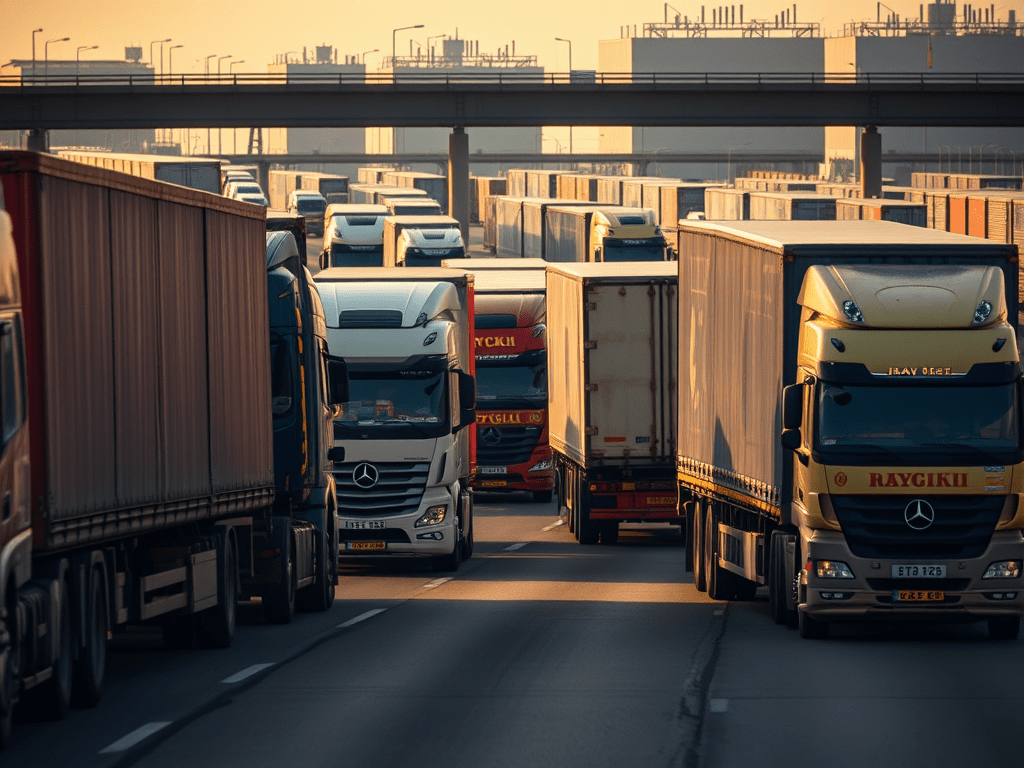
One example of reality being different from political rhetoric is one I regularly see. I’m driving more than I have done in a while. Mostly, on the M4, M3 and M25 motorways. In this country some freight goes by rail, but the overwhelming amount of freight goes by road.

A sign of our times has been the construction of massive warehouses close to motorway junctions. Strategic non-motorway routes too. I do mean massive steel sheds. Counting the number of football fields covered by these structures doesn’t help. I’ll bet some of them can been seen from space.

Back to the British roads. 6-wheelers, 8-wheelers, 12-wheelers, big heavy trucks often showing the wear and tear from journeying great distances depend on the motorway system. A constant flow of heavy goods moves day and night.

Looking at the trucks, some have UK registration plates, some have UK registration plates thrown over their original plates. Most drive under the registration plates of a country of origin or wherever their commercial operations are based. Each plate tells a story. LT is Lithuania. PL is Poland. H is Hungary. NL is Netherlands. D is Germany.

So, every day we have tens of thousands of trucks maintained and operated to standards set by the European Union (EU) on our roads. They are left-hand-drive. Their speedometers are in kilometres per hour.

It occurs to me – what does “sovereignty” mean when everyday looks like a day driving?

For sure, no British inspector checks the condition of each one of these trucks on a regular basis. For sure, truck driver’s hours are only occasionally checked. For sure, maintenance records are locked away in a filing cabinet.

In the world of absolute sovereignty none of this should be allowed. In fact, much of the above-described transport operations are continuing as they did before Brexit but with extra paperwork attached. Extra costs.

It’s an observation. It’s easily made when stuck between a couple of heavy goods vehicles on the motorway. Pragmatism may have led to a blind eye being turned to reality. We shouldn’t delude ourselves that Brexit has delivered anything useful in this respect.

Why the UK Should Rejoin

Fine, I’m happy to admit that my march, with thousands of others, through the streets of London on Saturday was not everyone’s cup of tea. There are a lot of people who support the idea of a return to European Union (EU) membership but are reluctant to raise the issue just now.

Often cited is the wave of right-wing politicians who are gaining ground in Europe’s larger countries. It’s as if they are going through their own Brexit like political moment but without anyone of any consequence advocating throwing away their EU membership.

Maybe the UK is ahead in this respect. We’ve been through the confusion and turbulence of the political right-wing eccentrics moment in the sun. They were never mainstream. However, they did hold the reins of power for some disastrous years. Thank God they are now behind us.

I have marched year-after-year because it’s the right thing to do. Tens of thousands from all over the UK have done the same as me. Millions if the numbers added-up from 2016 onward. Our future can be based on cooperation and mutual interests. Ideologically driven conflict and disruption have brought nothing but a lose – lose outcome.

So, what are the arguments for the rejoin movement? It’s all very well to shout at the thing we don’t like. Now, is the time to make the sound solid arguments for the thing we favour.

Let’s take trade for a start. The last UK Government wallowed in gushes of self-praise every time they signed an agreement with any country that was not European. Conservative Members of Parliament wanted to tower over the world like imperial overseers. It was an illusion.

Most of the so called “new” deals that were signed were simply a rollover that meant no change. In fact, more was given away than was gained. All in a desperate attempt to show progress. British farming was effectively shafted by Ministers.

One of the most touted possible “streets paved with gold[1]” was the prospect of a super new trade deal with the United States (US). Under President Trump, the prospect of an advantageous UK-US trade deal was an illusion.

Ironically, a claimed success was the joining of a regional trade block. I know it’s crazy that leaving a gigantic trade block on the UK’s doorstep was followed by joining one covering the Pacific. Yes, the other side of the world. Not only that but the projected gains are minuscule.

EU membership offers, as it did before, access to enormous trade benefits by comparison with what has been achieved since 2016. The numbers speak for themselves.

If the new Labour Government continues with a form of the fibs told during the “Get Brexit Done” phase, then trouble lies ahead. Next door, the UK has the world’s largest trading block. The value to the British economy of Single Market membership exceeds a mishmash of remote and small deals. There’s a positive way forward and it’s staring us in the face.

POST: It’s worth noting that the 1960 European Free Trade Association (EFTA ) was created, to promote free trade and economic integration included: Austria, Denmark, Norway, Portugal, Sweden, Switzerland and the United Kingdom.


[1] https://dictionary.cambridge.org/dictionary/english/streets-are-paved-with-gold

National Rejoin March: Unity for a European Future

The European Movement[1] has been around for 75-years. Yesterday, I was surrounded by a good number of their membership. That, and many Liberal Democrats. People, young and old, from communities up and down Britain. There were lots of people from the creative industries, so badly hit by Brexit. In fact, there were people of every political background marching through the streets of central London.

Everybody had gathered in central London with the aim of reversing the tragedy that is Brexit. I say “is” and not “was” because the disaster continues to have marked repercussions on everyday life. Reclaiming the freedoms that we once had has brought people together in large numbers.

On Saturday, pro-European campaigners made their way from Park Lane to Parliament Square for the third annual National Rejoin March (NRM)[2]. The weather smiled on the gathering. It couldn’t have been better in the light of torrential rain and the endless storms of past days. The sunshine and blue skies warmed my sprit.

The occasional chant of “Boll*cks to Brexit” has been replaced by Reset, Repair, Rejoin. As is the tradition of these events, posters ranged from the more obvious slogans, like #BinBrexit to the imaginative and sometimes bizarre. The group dressed in eye catching elephant costumes had a point to make. The elephant in the room being the protesters theme.

Standing next to me, one young lad asked his mate why he had decided to be on this rejoin march. I thought his response most was appt: “Because I want to be on the right side of history”. To me that just about sums it up. Brexit is an aberration. Eventually, after a great deal of to-and-fro the strong likelihood is that the UK will rejoin the European Union (EU), or its successor. Everything we know points in that direction. It may take a decade. It may take more.

The Labour Party won the 4th July UK General Election, and while it pledged not to reopen the main parts of Britain’s deal to leave the EU, does claim to want a significant reset. So far, the indications are that this policy line is typical political rhetoric, and little more. But it must be said that this is the early days of a new British government. If their claim to want growth in the economy to fuel spending on public services is honest, they would be mighty foolish to discount rejoining the European Single Market.

Thousands gathered in London. This will go on year after year. The diminishing number of objectors, who chant from the sidelines, remind me of the “Dead Parrot Sketch”[3]. For all intents and purposes all the arguments for Brexit have perished, much like the poor parrot. Even when that’s an obvious fact there are still those few people who will defend it to the hilt. As we walked down St James’s Street a well dressed bloke in a side street seemed most agitated. Shouted abuses and ran off. I looked around. We all shrugged our shoulders. I certainly thought – what a sad man.

I’m sure Britain can reclaim its place in Europe. It will take resolve and continuous effort but, as has been pointed out, this campaign is on the right side of history.


[1] www.europeanmovement.co.uk

[2] https://uk.news.yahoo.com/protesters-call-uk-rejoin-european-154046221.html?

[3] https://youtu.be/vZw35VUBdzo

Last Night

Nice to see a flood of blue at the BBC PROMS last night. I’m not just talking about the wonderful Angel Blue[1]. I was not there. Watched the whole performance at home on the TV this year.

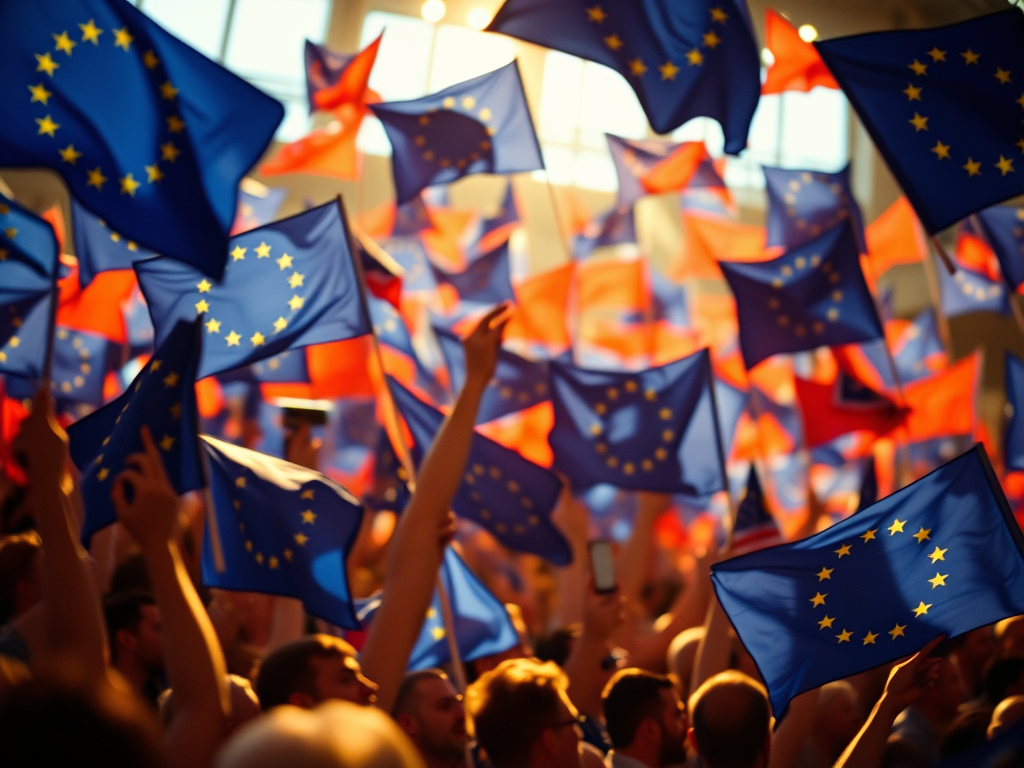
It’s great to hear that GB News went apoplectic. To quote: “The Last Night of the Proms has been swamped in controversy yet again after a sea of EU flags were spotted being flown by event-goers – despite imposing a ban on “protest flags” ahead of time.”

For one, there’s no controversy. For two, there was no protest flags. For three, there’s always all sorts of flags. Making up stuff is the sad habit of bored journalists with space to fill. If I can call them journalist. Click bait writers – now that’s just off-the-shelf hype makers.

Look. In a free country and let’s face it, that’s what the singing in the Royal Albert Hall is about. Land of hope and glory. If the this year’s BBC Prom goers want to hold up EU flags, it’s entirely up to them. No one is forcing them to do so. It wasn’t a mandate from on high.

I was disappointed not to see more flags. My experience of having been at the Last Night twice is that one fun thing to do is to figure out what some of the more obscure flags mean or where they represent. A Caribbean country, Devon, Cornwall, Isle of Man, or a remote Scottish Island. And lots of friendly countries, like the US. Well, dependent on the current presidential race.

Right-wing commentators often push a line that is prescriptive with respect to their opponents but take the view that they should be able to do whatever they like in the name of freedom. I believe that there’s no part of the right of politics that doesn’t hold this self-serving view.

It’s like the often-quoted view of the Conservative Party elite. They take the line that their people are born to rule. It’s not a joke. This week, it’s mighty interesting to read the reflections on recent events coming from Lord Brady[2].

The country is so incredibly fortunate now it has shaken off the fading embers of 14 years of Conservative Party misrule. Who knows what dreadful havoc would have ensued if they had retained power. It’s a much better autumn that might have been.

This is the time to re-think Britain’s relationship with our near neighbours. For a start, all aspects of unnecessary negativity and the dogma of Brexit need to be put asunder. No more ridiculous caveats on every policy and speech just to appease a right-wing media. No more neurotic ducking and diving to keep the outer extremes on-side.

Brexit was a rubbish idea. It was heavily sold by charlatans. It has failed. Corrective action is long overdue. I do not know what shape that corrective action will take but it needs to be immediate and sincere. And with a long-term perspective in mind.

POST: The next generation have the right idea Gen Z leads drive to reverse Brexit in new poll on EU referendum | The Independent


[1] https://angeljoyblue.com/

[2] https://www.independent.co.uk/news/uk/politics/sunak-election-brady-confidence-letters-tory-b2612966.html

Solar farms

New Government signs off solar farms. Not everyone happy.

It would be good if we could all agree that the UK needs to recognise the importance of locally produced food and drink. There’re large environmental gains to be made by reducing the distance between production and consumption. Thousands of heavy trucks thunder up and down the inadequate road infrastructure in the UK. Colossal amounts of food waste get thrown away from supermarkets. Questionable preservatives enable supply chains to grow longer and longer. There’s are bad trends.

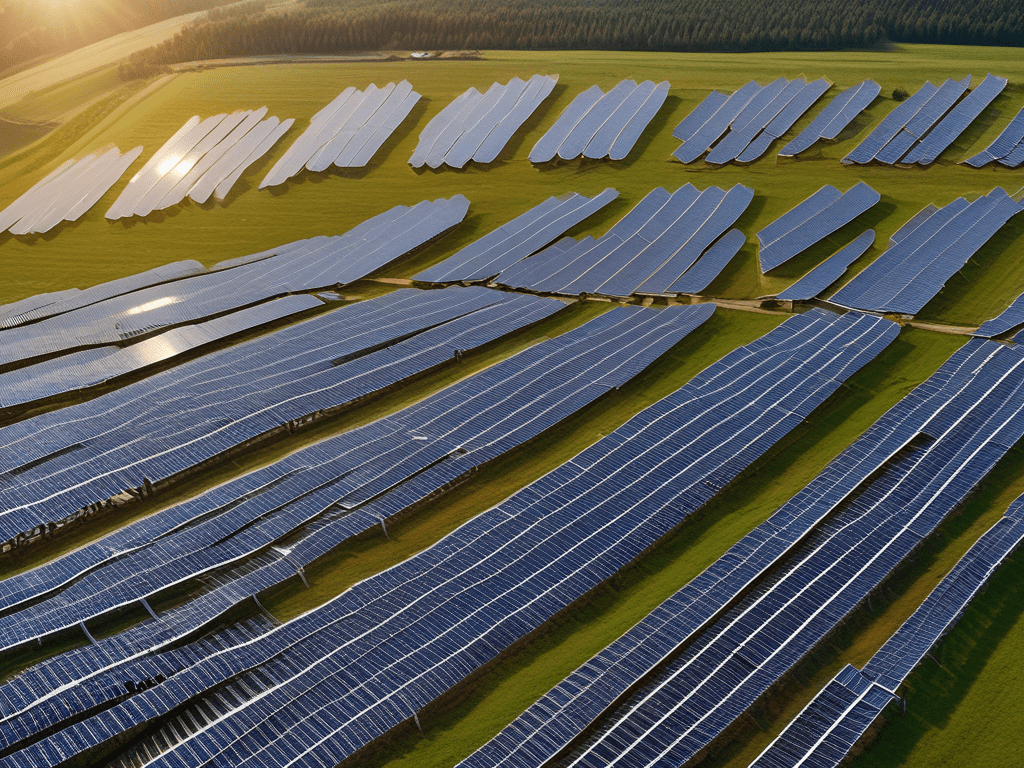
On a related subject, I do have a problem with proposals for large solar arrays that will take out productive farmland. However, that is by no means an objection to large solar arrays, or onshore wind farms for that matter.

It’s not as if we have always been so precious about what we do with our glorious countryside. One observation I’d make is that there has been a huge increase in the urbanisation of the countryside in my lifetime. Areas that were either wild or exclusively used for agriculture are now pony paddocks, car parks, golf courses, housing estates, out-of-town shopping warehouse, fulfillment centres[1], and bypasses. In 50-years, there’s little that remains untouched.

I’d sing “They paved paradise and put up a parking lot” if I could. We really do need to think carefully about what we industrialise and what we preserve and protect.

For me large solar arrays are in the same category as acres of poly tunnels. Both serve a fundamental purpose, and both are structure that can be relatively easily removed. Keeping the lights on and eating fresh food are both part of society’s basic needs.

So, I’m not going to raise an eyebrow at new Minister Ed Miliband approving 3 large solar arrays[2]:No shock but no blank cheque either. No jumping on a political bandwagon to condemn the immediate decision.  

It’s likely the decision was sitting on the former Conservative Minister’s desk. Is this a case of difficult decisions deliberately delayed because of an election? We may never know. It would be a bit disingenuous for such politicians to complain now. Wouldn’t it?

Let’s get it right. Failure to decarbonise our national energy system is a contribution to global warming we can’t afford to make. Long-term that global warming will impact food production.

In years to come it will be interesting to see what research flags up with respect to solar farms and biodiversity in an area. There’s some chance that the results will not be entirely negative. There’s all that sheltered and undisturbed soil under the array structures. A habitat for wildlife.

Choosing between what might seem as the lesser of two evils is often the situation a politician finds themselves in. Afterall, that’s the role they must play in a democracy. The outcome may not be popular in the short-term, but a balance must be struck.

Maybe we should reverse some of the urbanisation of the countryside. Return some little used roads to nature. Demolish unused industrial units. Put back the hedges that have been lost. Rewild one or two golf courses. It’s something to consider when building new infrastructure.


[1] Fulfillment centres enables outsourcing, warehousing and shipping. This is for online businesses to have the physical space to store stuff.  

[2] https://www.bbc.co.uk/news/articles/c4ng6036vgqo

Two Issues

It’s all to play for, as they say. The UK General Election starting pistol has been fired. Politicians are out of the gate. We are in for six weeks of intense competition for every place where the poll result isn’t a horribly foregone conclusion. Even in some of those places there’s a renewed sense that anything is possible. So, far gone is the public image of the Conservatives that Westminster constituencies, formerly thought to be a wilderness of opposition parties are now possibilities.

What are, yes, I know it’s not new to say so, the elephants in the room? The political parties seem set on what they want to talk about but it’s not a couple of remarkably big issues.

One is Brexit, and its overall impact and the other is Social Care. Two massive pressing issues that politicians are ducking and weaving to avoid. Discussions about the UK’s economy should not happen without discussing Brexit effects. On the other issue, the big truth is that the population of the UK is aging. Yet, we really don’t like talking about it.

One point of agreement is that we need the UK economy to do better. That’s a conditional on generating the funds needed to be able to repair the damage done over the last decade. The overall performance of the UK economy during the Conservative period in power has been undeniably poor. A big part of that poor performance comes from the disruption caused to the UK’s primary marketplace by Brexit. It has been a self-inflicted wound.

On Social Care the Conservatives made a succession of promises. If we look at their record on delivery, there’s nothing to show. Local government has been beaten up over the last decade. Report after report has shown ways forward for social care. Sadly, politicians in power have not been brave enough to push hard enough to implement recommendations that can ease the heavy burden placed on many families.

In my view, our best hope on these two issues is to back the Liberal Democrats. The Conservatives have demonstrated their inability to address these issues. Labour has been timid on both. Fearful that the tabloid newspapers will attack them at a critical moment.

There’s an excellent case for rebuilding the UK’s relationship with the European Union. Single Market membership wouldn’t happen overnight but surely, it’s the direction to head in. The free flow of trade, in a marketplace that is so large, and on our country’s, doorstep would boost the UK’s economy overnight.

For the sake of a few billion of public spending. Set in the context that annual government spending of a thousand billion, then priority action could be taken on Social Care. The difference this would make in helping those in extreme difficulty would be enormous.

I dare say MP Micheal Gove, who is standing down at this election, is right. It’s time for a younger generation to take up leadership roles and to sort out the mistakes that have been made over the last decade. Our liberal democracy needs to get back on track.