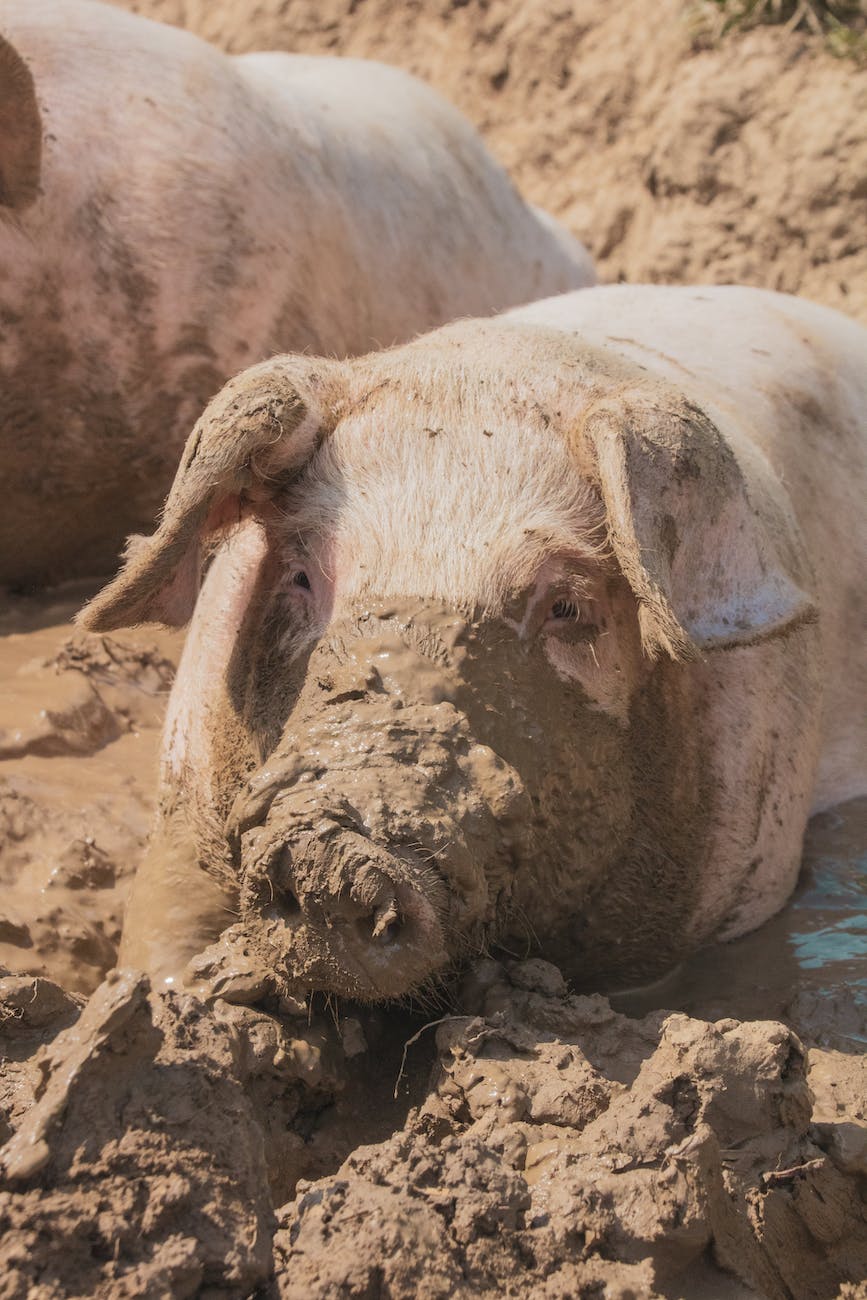
Cider pigs

Out the back of the farmhouse was a scruffy orchard. It was through the east facing garden, then over an awkward cobbled together fence. The orchard was an L-shape with a soggy wet depression in the middle. The trees at the top end of the orchard had long since gone by the time of my childhood. The lower part of the orchard was populated with the most venerable but neglected cider apple trees. Never pruned with that crusty, mossy look of years of struggle against the elements.

There was no money in growing cider apples in the 1960s and besides the ones that still stood were probably originally grown for homemade home consumed cider. The orchard was a piggery.  Several well-made timber pig huts stood in the field. Except for one. In a corner there was strange construction made of used railway sleepers, arranged vertically, and covered with a round tin roof. It was the only hut that was not moveable. A rough concrete floor kept the railway sleepers in place.

Now, that was a good set-up. There’s a thing that most pigs like and it’s ripe cider apples. Trouble is that they don’t know when to stop. So, when they fell, we had to find something to do with them by the bucket load. For us boys, that wasn’t a problem. Cider apple[1] wars were a feature of the autumn.

If I’d taken a shine to farming in those early years, it would have been keeping pigs. That orchard was always as carved up as a fresh battle ground. Nothing more satisfying to a happy pig than rooting through the dirt. In good weather making our way across the ground was easy. In bad weather getting stuck in the sticky clay mud was guaranteed. The thick mud was ideal in the summer. Wallows would form so the pigs could do what they do best when it gets hot.

All that said, I can’t imagine domesticated pigs in any other setting than outdoors. As I drive around, it makes me pleased to see so many examples of outdoor reared animals. Pigs are inquisitive and intelligent animals that deserve the freedom to roam around in an open space.

At one time or another, I kept a British Saddleback[2], a Landrace[3], and a Large White[4] pig.  The Large White pigs could be a handful if the pig took a disliking to you. Saddlebacks were the best when it came to temperament. Agreeable, content, and excellent mothers.

My brothers and I were being tutored in animal husbandry from a young age. The principle aim was not to pamper a pet but to look after the pigs with the aim of having as big a litter of piglets as possible. That’s where profit lay. We kept records of the cost of the pig food, bedding needs and everything that went into our mini farming enterprises.

Encouraged by my parents, my brother and I were often in competition.  I remember once sitting up late into the evening with a sow and being so proud of having helped 14 piglets into the world alive. This could be a hazardous business in a confined space of a small pig hut. The job was making sure the piglets found their way to their mother’s teat and didn’t get squashed on the way. If they let out a loud squeal the sow could move and could unwittingly squash one of the litter.

In my mind, Somerset cider is tied with pigs. The two go hand in hand.


[1] https://ciderappletrees.co.uk/

[2] https://www.britishpigs.org.uk/british-saddleback

[3] https://www.britishpigs.org.uk/british-landrace

[4] https://www.britishpigs.org.uk/large-white

Light touch folly

Light touch regulation. Now, there’s a senseless folly. It’s a green light to bad actors wherever they operate. It’s like building a medieval castle’s walls half as thick as planned to save money in the belief that enemies are too stupid to work it out. Saying that the public good far less important than the speed of developments is unwise to say the least.

The INTERNET arrived in the UK in the late 1980s. Now, it seems strange to recount. Clunky Personal Commuters (PCs) and basic e-mail were the hight of sophistication as we moved from an office of typewriters and Tipp-Ex to the simple word processor[1]. Generations will marvel at the primitive nature of our former working lives. Getting scissors and cutting out paper text and pasting it into a better place in a draft document. Tippexing out errors and scribbling notes in the spaces between sentences. Yet, that’s what we did when first certifying many of the commercial airliners in regular use across the globe (Boeing 777. Airbus A320). Desktop computers took centre stage early in the 1990s, but administrations were amid a transition. Clickable icons hit screens in 1990. Gradually and progressively new ways of working evolved.

Microsoft Windows 95 and the INTERNET were heralded as the dawn of a new age. Not much thought was given to PCs being used for criminal or malicious purposes. No more thought than the use of a typewriter to commit crime. That doesn’t mean such considerations were ignored it just means that they were deemed a lower-level importance.

In 2023, everyday there’s a new warning about scammers. Even fake warnings about scammers coming from scammers with the aim of scamming. Identifying whose real and whose a fake is becoming ever more difficult. Being asked to update subscriptions that were never opened in the first places is a good indicator that there’s some dirty work afoot. Notices that accounts are about to be blocked referring to accounts that don’t exist is another.

In 30-years the INTERNET has taken on the good and bad of the greater world. It hasn’t become a safer place. In fact, it’s become a bit like the Wild West[2].

Our digital space continues to evolve but has nowhere near reached its potential. It’s like those great western plains where waggons headed out looking for rich new lands. In any towns on the way the shop fronts are gleaming and inviting but if you look around the back there’s a desperate attempt to keep bad actors at bay.

Only a fraction of the suspicious, emails, texts, and messages get reported. People unconsciously pile up a digital legacy and rarely clean out the trash that accumulates. A rich messiness of personal information can lie hidden to the eyes but just bellow the digital surface.

When politicians and technocrats talk of “light touch regulation” it’s as if none of this matters. In the race to be first in technology, public protection is given a light touch. This can’t be a good way to go.


[1] Still available – Tipp-Ex Rapid, Correction Fluid Bottle, High Quality Correction Fluid, Excellent Coverage, 20ml, Pack of 3, white.

[2] https://en.wikipedia.org/wiki/American_frontier

Pointless Brexit

Democracy’s malleable frame. I don’t recall the people of the UK being given a referendum on joining a trade block in the Pacific. Nice thou it is to have good relations with trading nations across the globe it seems strange that the other side of the world is seen as good and next door is seen as bad. It’s like a person looking through a telescope through the wrong end.

Back on 23rd June 2016, voters in the UK were asked if Britain should leave the EU. No one really knew what “leave” meant as all sorts of, what now turns out to be blatant lies were told to the public. The words “customs union” were not spoken in 2016. If they were it was in a tone of – don’t worry about all that, we hold all the cards, nothing will change.

Today, UK sectors from fishing to aviation, farming to science report being bogged down in ever more red tape, struggling to recruit staff, and racking up losses. Sure, Brexit is not the only trouble in the world, but it was avoidable unlike the pandemic and Putin’s war.

We (UK) became a country that imposed sanctions on itself. A unique situation in Europe. If some people are surprised, we have significant problems the really ought to examine what happened in 2016. It’s a textbook example of how not to do thing. The events will probably be taught in schools and universities for generations to come as a case of national self-harm.

Democracy is invaluable but when a government dilutes a massive question into a simple YES or NO, they dilute democracy too. It’s the territory that demigods thrive in. Mainly because this approach encourages the polarisation that then drives ever more outlandish claims about opponents. The truth gets buried under a hail of campaign propaganda, prejudice, and misinformation.

What Brexit has stimulated. A growth sector, I might say. Is the blame game. Now, when things go wrong, UK politicians can always blame those across the other side of the Channel. Standing on the cliffs in Dover its easy to survey the mess and point a finger out to sea.

If some people’s motivation for voting for Brexit was to control borders and stopping immigration the failures are so obvious that they hardly need to be pointed out. Yet, politicians persist with they myth that a solution is just around the corner if only UK laws were made ever more draconian. A heavier hand, criminalisation and the blame game are not solutions. These acts will merely continue the round of calamities and failures.

Brexit has unlocked a grand scale of idiocy. The solution is to consign this dogma to the past.

Radio on the hill

We take radio for granted. I’m listening to it, now. That magic of information transferred through the “ether[1]” at the speed of light and without wires. This mystery was unravelled first in the 19th century. Experimentation and mathematics provided insights into electromagnetics.

The practical applications of radio waves were soon recognised. The possibility of fast information transfer between A and B had implications for the communications and the battlefield.

It’s unfortunate to say that warfare often causes science to advance rapidly. The urgency to understand more is driven by strong needs. That phrase “needs must” comes to mind. We experienced this during the COVID pandemic. Science accelerated to meet the challenge.

It wasn’t until after he failed as an artist that Samuel Morse transformed communications by inventing the telegraph with his dots and dashes. There’s a telegraph gallery with a reproductions of Morse’s early equipment at the Locust Grove Estate[2] in Poughkeepsie. I’d recommend it.

The electromagnetic telegraph used wires to connect A and B. Clearly, that’s not useful if the aim is to connect an aircraft with the ground.

The imperative to make air-ground communication possible came from the first world war. Aviation’s role in warfare came to the fore. Not just in surveillance of the enemy but offensive actions too. Experimentation with airborne radio involved heavy batteries and early spark transmitters. Making such crude equipment usable was an immense challenge. 

Why am I writing about this subject? This week, on a whim I visited the museum at Biggen Hill. The Biggin Hill Museum[3] tells the story the pivotal role played by the fighter station in the second world war. The lesser-known story is the origins of the station.

It’s one of Britain’s oldest aerodromes and sits high up on the hills south of London. Biggin Hill is one of the highest points in that area, rising to over 210 metres (690 ft) above sea level. 

It’s transformation from agricultural fields to a research station (south camp) took place in 1916 and 1917. Its purpose was to explore the scientific and technical innovations of that time. Wireless in particular.  141 Squadron of the Royal Flying Corps (RFC) was based at Biggin Hill and equipped with Bristol Fighters.[9] RFC were the first to take use of wireless telegraphy to assist with artillery targeting.

These were the years before the Royal Air Force (RAF) was formed.

100 years later, in early 2019, the Biggin Hill Museum opened its doors to the public. It’s a small museum but well worth a visit. I found the stories of the early development of airborne radio communications fascinating. So much we take for granted had to be invented, tested, and developed from the most elemental components.

POST 1: Now, I wish I’d be able to attand this lecture – Isle of Wight Branch: The Development of Airborne Wireless for the R.F.C. (aerosociety.com)

POST 2: The bigger story marconiheritage.org/ww1-air.html


[1] https://www.britannica.com/science/ether-theoretical-substance

[2] https://www.lgny.org/home

[3] https://bigginhillmuseum.com/

Comms

The long history of data communications between air and ground has had numerous stops and starts. It’s not new to use digital communications while flying around the globe. That said, it has not been cheap, and traditional systems have evolved only slowly. If we think Controller Pilot Data Link Communications (CPDLC)[1] is quite whizzy. It’s not. It belongs to a Windows 95 generation. Clunky messages and limited applications.

The sluggishness of adoption of digital communications in commercial aviation has been for several reasons. For one, standardised, certified, and maintainable systems and equipment have been expensive. It’s not just the purchase and installation but the connection charges that mount-up.

Unsurprisingly, aircraft operators have moved cautiously unless they can identify an income stream to be developed from airborne communication. That’s one reason why the passengers accessing the internet from their seats can have better connections than the two-crew in the cockpit.

Larger nations’ military flyers don’t have a problem spending money on airborne networking. For them it’s an integral part of being able to operate effectively. In the civil world, each part of the aviation system must make an economic contribution or be essential to safety to make the cut.

The regulatory material applicable to Airborne Communications, Navigation and Surveillance (CS-ACNS)[2] can be found in publications coming from the aviation authorities. This material has the purpose of ensuring a high level of safety and aircraft interoperability. Much of this generally applicable material has evolved slowly over the last 30-years.

Now, it’s good to ask – is this collection of legacy aviation system going to be changed by the new technologies that are rapidly coming on-stream this year? Or are the current mandatory equipage requirements likely to stay the same but be greatly enhanced by cheaper, faster, and lower latency digital connections?

This year, Starlink[3] is offering high-speed, in-flight internet connections with global connectivity. This company is not the only one developing Low Earth Orbit (LEO)[4] satellite communications. There are technical questions to be asked in respect of safety, performance, and interoperability but it’s a good bet that these new services will very capable and what’s more, not so expensive[5].

It’s time for airborne communications to step into the internet age.

NOTE: The author was a part of the EUROCAE/RTCA Special Committee 169 that created Minimum Operational Performance Standards for ATC Two-Way Data Link Communications back in the 1990s.

POST 1: Elon Musk’s Starlink Internet Service Coming to US Airlines; Free WiFi (businessinsider.com)

POST 2: With the mandate of VDLM2 we evolve at the pace of a snail. Internet Protocol (IP) Data Link may not be suitable for all uses but there’s a lot more that can be done.


[1] https://skybrary.aero/articles/controller-pilot-data-link-communications-cpdlc

[2] https://www.easa.europa.eu/en/document-library/easy-access-rules/easy-access-rules-airborne-communications-navigation-and

[3] https://www.starlink.com/

[4] https://www.esa.int/ESA_Multimedia/Images/2020/03/Low_Earth_orbit

[5] https://arstechnica.com/information-technology/2022/10/starlink-unveils-airplane-service-musk-says-its-like-using-internet-at-home/

3-years on

Today, the weakest arguments are being used to sustain Brexit. Still the advocates of Brexit call for deregulation, slashing taxes but more Government borrowing. The Truss formula, despite its disastrous effect remains popular amongst Brexit supporters.

Britain, having left the EU Customs Union and Single Market, has agreed roll-over trade deals with some countries. However, there has been no huge boost to trade as Brexit advocates claimed there would be after the 2016 vote. Brexit negotiations drag on and on. It’s perpetual motion. Maybe there’s a fix to the Northern Ireland difficulties. Maybe not.

If you are inclined, you can always blame everything on the Government’s pandemic response. As politicians are apt to do, there are quite a few avenues open to excuse away the negative impact of Brexit.

The lies told during the UK referendum campaign of 2016 will not go away.

On the 3-year anniversary of leaving the EU, pollsters have been out and about to gauge public opinion. It seems that apart from some parliamentary constituencies in Lincolnshire, others show a majority think Brexit wasn’t a good idea. 54% say Britain was wrong to leave the EU[1][2].

We don’t not know exactly when the next UK General Election will be, but political parties are gearing up for the fight to come. Because of the dreadful First Past the Post (FPTP) electoral system the UK’s opposition parties have a hill to climb in the race for Westminster. Again, referencing the current polls, even with that hill to climb there’s a high likelihood that change is on the way.

The end of this Brexit Government will not come soon enough. Look at the state the country is in. The longer this Conservative party remains in power the more damage will be done.

NOTE: The United Kingdom withdrew from the European Union on 31 January 2020. Based on the Withdrawal Agreement that had been ratified by both the EU and the UK, a transitional period during which EU law continued to apply in the United Kingdom ended on 31 December 2020.

POST: Ardent Brexit supporters are saying: we have to give it more time. Judging our economic position after 3-years isn’t enough to draw conclusions. This is like saying that having made a bad investment, it’s best to stick with the bad investment. Some people may agree with this type of argument. I say it’s foolish. The Brexit referendum has done damage. It will only be repaired by reversing a destructive and much regretted decision.


[1] https://unherd.com/2023/01/introducing-unherd-britain-2023/

[2] https://www.independent.co.uk/news/uk/politics/brexit-regrets-map-uk-b2272117.html

Fatal accident in Nepal

My condolences to all those people who have been affected by the catastrophic aircraft accident in Nepal. On-board the ATR 72 aircraft operated by Nepal’s Yeti Airlines were 72 people – 4 crew members and 68 passengers.

The aircraft took off from Kathmandu at 10:33 (local time) on Sunday. At around 11:00, while on approach to the airport the twin-engine ATR 72 crashed into a riverbed gorge located between the former airport (VNPK) and new international airport (VNPR). Nepal’s Civil Aviation Authority said the aircraft last contacted the airport at 10:50. There are no reports of distress calls from the aircraft before the accident.

As only a short time has elapsed, it’s good to hear that the accident flight recorders have been discovered[1]. It is reported that they are to be sent to France for replay and analysis.

Sadly, Nepal has a grim record in respect of fatal air accidents. There have been 42 fatal air accidents since 1946[2]. Poor weather and hazardous terrain can often be a problem in this nation. However, in the case of this tragic flight, video circulating on social media indicates clear skies at the time of the accident.

Nepal became a member of International Civil Aviation Organisation (ICAO) back in 1960. Nepal’s improvement in safety measures and compliance with international standards was recognised by ICAO in 2018. However, Nepal remains on the EU Air Safety List.

Prior to the accident, Yeti Airlines has 6 ATR 72 aircrafts, aged between 11 and 15 years old.

The new international Pokhara Airport[3], was inaugurated on the 1st January, this year by Nepal’s Prime Minister. This was seen as a significant step to boost tourism in the region. The airport project was a cooperation as part of China’s Belt and Road Initiative (BRI)[4]. The new international airport was built to replace the city’s former airport, located 1.6 nm to the West. Flights were gradually being transferring to the new airport facility[5].

The Civil Aviation Authority of Nepal (CAAN) has checked the airworthiness of the ATR aircraft on its register. No technical faults have been found[6].

POST: Teams of aviation experts, including those from ATR and EASA are on their way to Nepal to help in the accident investigation French team starts probe into Nepal plane crash (msn.com)


[1] https://www.reuters.com/world/asia-pacific/search-resumes-four-people-missing-nepal-after-deadly-air-crash-2023-01-16/

[2] according to Flight Safety Foundation data

[3] http://pokharaairport.com.np/

[4] https://www.telegraphindia.com/world/nepals-pokhara-airport-was-inaugurated-two-weeks-ago-and-built-with-chinese-assistance/cid/1910031

[5] https://aviationweek.com/air-transport/safety-ops-regulation/yeti-airlines-atr-72-crash-nepal-kills-least-68

[6] https://nepalnews.com/s/nation/caan-carries-out-technical-tests-on-all-atr-aircraft-operational

Poor law making

If you thought the Truss era was an aberration, and that the UK’s Conservative Party had learned a lesson, then please think again. Wheels set in motion by the ideologue Jacob Rees-Mogg MP are still spinning.

The Retained European Union Law (Revocation and Reform) Bill is trundling its way through the UK Parliament. The Government Bill will next be prepared for its 3rd reading in the House of Commons[1]. The Conservative Government has brought forward this Bill to revoke, reform or revise all the remaining law in the UK that was formerly derived from the UK’s membership of the EU. This turns on its head the normal approach to changing UK legislation. Revocation is automatic unless there’s an intervention by a Minister.

UK civil aviation depends on several thousand pages of legislation derived from EU law[2]. Much of this law was created with considerable contributions from the UK. There’s hardly any if any advocates for automatic revocation of current aviation legislation. Even the thought of this action sends a shiver down the spin of aviation professionals. Generations of them have worked to harmonise rules and regulations to ensure that this most international of industries works efficiently.

Unless amended, the Government’s EU Retained Law (Revocation and Reform) Bill[3] could turn out to be an absolute disaster. Even those who have an irrational wish to eliminate any and every past, present, or future link to Europe must come up with a practical alternative and do this in an incredibly short time. Without a consistent, stable, and effective framework civil aviation in the UK will grind to a halt. Again, even those who have an unsound need to change for change’s sake will be hitting a vital industry hard, as it is only just getting back on its feet after the COVID pandemic and now setting out to meet tough environmental standards.

It’s going to be interesting to see what happens when this poor Bill reaches the House of Lords. Once again, the country will be relying on the upper house to add some common sense to this draft law.  

POST 1: The 3rd reading debate makes it clear that the Government is unsure which laws are covered by the Bill. If the Ministers responsible for this legislation do not themselves know its extent, how can anyone expect civil servants working on this legislation to know the full extent of change? A most strange state of affairs Retained EU Law (Revocation and Reform) Bill (Third si – Hansard – UK Parliament

POST 2: Retained EU law lays down rules for the airworthiness and environmental certification of aircraft and related products, parts and appliances, as well as for the certification of design and production organisations in the UK Commission Regulation (EU) No 748/2012 of 3 August 2012 laying down implementing rules for the airworthiness and environmental certification of aircraft and related products, parts and appliances, as well as for the certification of design and production organisations (recast) (Text with EEA relevance) (legislation.gov.uk)

POST 3: Retained EU Law Bill is being debated in the House of Lords on Monday, 6 February.


[1] https://bills.parliament.uk/bills/3340

[2] https://www.eiag.org.uk/paper/future-retained-eu-law/

[3] https://www.gov.uk/government/news/the-retained-eu-law-revocation-and-reform-bill-2022

SPO 2

An instant reaction to Single Pilot Operations (SPO) is like the instant reaction to completely autonomous flight. “I’m not getting on an aircraft without a pilot!” Then to justify that reaction fatal accidents of the past are cited. Typically, this is to remind everyone of the tragic Germanwings accident[1]. It was 24 March 2015, that an Airbus A320 was crashed deliberately killing all onboard.  

However, it’s wise to remember that the likelihood of incapacitation[2] is much greater than that of the malicious behaviour of the pilot in command. Cases of malicious behaviour leading to a catastrophic outcome are truly shocking but extremely rare.

One fatal accident, that is still disputed is EgyptAir Flight 990[3] that killed 217 people in 1999. The possibility of inflight pilot suicide is unnerving, since on the face of it there is little any of the aircraft’s cabin crew or passengers can do to stop it.

This could be a future opportunity to use automation to prevent these scenarios occurring. Afterall the aircraft knows where it is and that a sustained high-speed dive towards the ground is not normally intended. A safety system exists to do this[4], but its outputs are not connected to the aircraft’s flight controls.

Humans being adaptable, extremely creative and capable of highly irrational actions, it’s unlikely that malicious behaviour resulting in aviation accidents will ever be reduced to zero. This is said regardless of the procedures or technology involved. The fate of flight MH 370 remains a mystery.

Thus, the prominent safety issue in respect of SPO is pilot incapacitation. Where the pilot in command is no longer able to perform as expected. That is, if the aircraft flown is not capable of safely landing itself. The objective always being safe continued flight and landing.

I’ve had the “1% Rule” rule explained to me by a notable aviation doctor, but I must admit I didn’t fully take it in. So far, the rule has stood the test of time. When the pilot in command of a Czech Airlines aircraft collapsed and died on route from Warsaw to Prague in 2012, the co-pilot took over and everyone got home safely.

Any automated co-pilot must be at least as capable as a human co-pilot in all aspects of operation of an aircraft. The key word here being “all”. It’s not enough to have the functions necessary to undertake safe continued flight and landing. Task such as communicating with the cabin crew and passengers must also be considered. Including preparation for an emergency landing.


[1] https://www.bbc.co.uk/news/world-europe-32072218

[2] http://www.avmed.in/2012/02/pilot-incapacitation-debate-on-assessment-1-rule-etc/

[3] https://www.theguardian.com/world/2002/mar/16/duncancampbell

[4] https://skybrary.aero/articles/terrain-avoidance-and-warning-system-taws

Single Pilot Operations

Single Pilot Operations is not new. What’s new is considering this way of working for everyday public transport operations of large aircraft

Research is of fundamental importance. It seems obvious to say so given the benefits it has given us. When proposals come forward to exploit new technologies there needs to be that moment when everyone steps back and takes a long hard look at the implications of its use.

In basic technical research it’s not the most important consideration is to focus on the drivers for change. They can be multifarious: economic, environmental, social, safety, security, political, and maybe just a matter of preference. Policy directions are taken by the industry and governments not constrained by what is happening now as much as what might happen tomorrow.

Research has delivered incredible safety improvements in aviation. This is not only in the basic design and construction of aircraft but all aspects of their operation. So, to see that the European Union Aviation Safety Agency (EASA) sponsoring research to study the implications of aircraft Single Pilot Operations[1] is a wholly good measure.

My history goes back to the early days of fly-by-wire aircraft systems. This is where the mechanical and physical connection between an aircraft pilot’s actions and the control surfaces that determine flight are replaced by digital computers. Back in the 1980s, a great deal of research and experimental flying proved the technology to make fly-by-wire work. It first found favour with the military. One reason being that an aircraft’s capability could be extended well beyond what was formerly reached. This change was introduced with caution, analysis, testing and much detailed risk assessment.

At the time, there was a significant body of professional pessimists who predicted a diminishment of aviation safety. Today, four decades on, studies show that even as air traffic has increased so civil aviation safety has improved. A momentous achievement. An achievement that has, in part, been because of the well-regulated adoption of advanced technologies. 

It is important to look at potential changes with an open mind. It’s easy to come to an instant opinion and dismiss proposals before a detailed study has been conducted. The detailed technical research can then be part of the challenge and response that is necessary to before approval of any major change. First difficult questions need to be tabled and thoroughly investigated.


[1] https://www.easa.europa.eu/en/research-projects/emco-sipo-extended-minimum-crew-operations-single-pilot-operations-safety-risk