Call me a motorhead if you like. It’s the cars and bikes of my youth. I suppose they are associated with good memories. It’s the freedom of the road. In the 1970s-80s that was still a freedom. Summer jams hadn’t crushed the spirt of motoring.
It’s nice to hark back to the analogue era. Long before digital engine controllers made engines practically untouchable. Looking at the basic BMC “A” series engine. Everything was fixable. No degree in engineering required. A 15-year-old could do it.
Now, the Austin A35 van has been elevated to the hall of fame. Without it how would Wallace and Gromit[1] ever foil their nemesis? It’s iconic shape is unmistakable.
The van we owned as a field car had a former life as a chicken shed. Some friends and I bought it from a schoolteacher who’d put it back together. We raced it around the open fields. The rugged little engine held-up long before the bodywork fell apart.
Shame we didn’t see the value in it. 50-years on they are much valued[2]. But I don’t think I’d spend ten grand on one.
British Prime Minister Keir Starmer’s dive to an incredibly low level of popularity is notable. In fact, it’s a bit more than that. It’s record breaking.
A commonly held view seems to be that we elected the Labour Party government in July as the least bad choice. The Tory years had got so utterly terrible that even their devoted supporters bulked at giving them yet another term in office. Combine that with an inexplicable inability to frame a simple story about what Labour stands for and the problem is less surprising.
Keir Starmer is no fool. He’s an intelligent and experienced politician. He’s taken the hard knocks. He’s climbed the slippery pole. But, and there’s a but, something doesn’t jell.
I my humble opinion, the ingredients missing or in excess are categorised like so.
Charisma. It’s so much easier if leader has that indefinable quality. I remember this of Paddy Ashdown. One: you know when they are in the room. No question. People look. Two: they never lack inspiring ideas. Even if they could be off-the-wall. Three: what they say makes an impact.
Eloquence: That ability to coin words and phrases that resonate with lots of everyday people (not just supporters). To speak persuasively, in a way that says we are going on a great journey together. Scripted or not, fluency that appears natural and unforced. Lightness of touch.
Managerialism: Everyone expects confident, capable, competent governance (although we rarely get it). However, we don’t want to see it live on the mainstage, all the time. That phrase about political policy and making sausages is a good one. Lots of people like sausages but few like to know how they are made.
Now, the question I have is: are the “local difficulties” of present fixable?
2025 is going to be a roller coaster of a year. We have washed away any residual millennial mysticism that hit the world in 2000. A whole generation has slipped by. Babies born as London’s Millennium dome was both viewed both with amazement and distain, have jobs that didn’t exist as the fireworks went off.
The so called “smart” phone, and tablets have carved a way into our lives that’s deep and unmovable. Even if the next leap in technology will surely leave them as obsolete.
So, what’s the narrative for 2025 – 2050? Will we sink into the quicksand of nostalgia or herald a new era full of promise? I don’t know. I’ll just keep topping up my glass to ensure it’s half full.
Jeju Air Flight 7C2216, arriving from the Thai capital of Bangkok, at South Korea’s Muan Airport (MWX), crashed at around 9am local time (00:00 GMT/UTC) on Sunday, 29 December 2024.
My condolences to the families and loved ones of those who died or were injured in this fatal aircraft accident.
Pictures of the Jeju Air Boeing 737-800 landing[1] show that no landing gear can be seen deployed. A video image shows the aircraft skidding down the runway at high speed. The aircraft is wings level. It is reported the aircraft overrunning the runway and colliding with a wall or ramp. The video image does suggest that the aircraft engine thrust reversers were deployed. This is wrong. Weight on wheels is needed for deployment.
MWX runway 19 has a Landing Distance Available (LDA) of 2800 m. The local visibility was reported as 9000m and the wind speed at 2kt.
Was the pilot in command trying to go around? The accident flight recordings should answer this question. That is from the aircraft Flight Data Recorder (FDR) and Cockpit Voice Recorder (CVR).
This remains a hope. Reports are that the FDR has been damaged. This should not be a surprise given the nature of the impact it suffered. However, both FDR and CVR are designed and tested to survive extreme cases.
The South Korean Ministry of Land, Infrastructure and Transport says that the accident flight and voice recorders have been recovered[2].
Jeju Air is a popular South Korean low-cost airline. The airline was established in 2005.
A full independent accident investigation will no doubt take place. That is in accordance with the standards and recommended practices of ICAO Annex 13.
Current media speculation surrounding possible causes of this Boeing 737 accident do not offer any satisfactory explanation for the sequence of events. For example, it would be astonishing if the root cause of the accident was a bird strike or multiple bird strike shortly before landing. The aircraft has several means to deploy its main undercarriage.
It is likely that safety culture, controller and pilot training, and airport facilities are bigger factors in this fatal accident than the fact that it involved the loss of a Boeing 737-800 aircraft.
NOTE: Boeing 737 “If the gear fails to extend properly or hydraulic system A is lost, the gear can be manually extended by pulling the manual gear extension handles, located in the flight deck.” Landing Gear
POST: The impact test in the applicable technical standards EUROCAE ED55 (FDR) and ED56A (CVR) are demanding. The recorder’s crash protected memory module is fired out of a canon into a shaped target to simulate an accident scenario. It must be readable afterwards.
A lot of wibble is written on the presumption that the older you get the more conservative you get. Whilst this may be true a number of people it’s by no means a rule. Meanwhile media moguls trade on this prehistoric assumption as much as they possibly can.
Even this simple question on politics is open to challenge. Every year the political landscape shifts. What might seem to be conservative a decade ago can now be painted as lefty liberal. So, do you and I change or does the world change around us? Naturally, both.
Again, put the British tabloids and social media aside. They run a shabby soap opera every day. All is not what it seems. Asked “Which political ideologies do Britons have a positive view of?[1]” the results are surprisingly refreshing. Top of the poll comes – environmentalism.
I guess, I am still a believer in the political “bell curve”. The great majority of people are neither tub thumping red necks or wishy-washy socialist spongers. Certainly, that’s what I’ve always found on the doorstep during elections. Valuing family, friends, community, work and having enough to live on without dreading the next bill, that’s a good start.
Yes, my views on a multitude of complex issues have changed but my values remain liberal. Live and let live. Do no harm (if you can avoid it). Encourage everyone to reach their potential. Look at the world with hope and not despair. Avoid gloom mongers.
And I still get a kick out of the story of the boy and the starfish. If you feel you can’t do anything to change the world and it’s all gets too much, think on these few words:
No matter how warm and comfortable, it’s that predicable human factor that’s the difficult one to deal with. Yes, I can say I want natural light, countryside views, just the right temperature and humidity and only pleasant noises. This can all be easily upset.
Distractions are the big one. Love that moment in The Shining when Jack Nicholson sits at his typewriter. Even worse when we all find out what he was typing.
Luckily, my distractions are not that of a towering spooky mountainside hotel. They are social media, my coffee cup, a ring at the door, taking the bins out or some useless attention getting device that should have been switched off ages ago. Even writing these few sentences while I’m supposed to be writing a presentation.
Give me a private space with only a couple of nice distractions. Nothing that goes beep like my German washing machine.
Finding aircraft wreckage in the deep ocean is possible. However, it requires a degree of good fortune. Most of all, it requires the searcher to look in the right places. Lots of other factors come into play, particularly if the ocean floor is uneven or mountainous.
The primary tool for imaging the ocean floor is SONAR. That’s using the propagation of sound in water. SONAR can be of two types. One is called “passive” and the other called “active”.
The first case is like using a microphone to listen to what’s going on around. Of course, the device used is named appropriately: a hydrophone. It’s a device tuned to work in water and not air. Afterall, sound travels much faster in a liquid than it does in air.
Passive SONAR depends on the object of interest making a noise. Just like we have directional microphones so we can have directional hydrophones.
Passive SONAR is only useful if the aircraft wreckage is making a noise. Since in the case of Flight MH370, the battery powered underwater location beacons attached to the accident flight recorders have long since stopped working this kind of SONAR isn’t going to be much use.
Active SONAR is analogous to RADAR. That is where a pulse of high frequency sound is sent out through a body of water. Then sensitive hydrophones pick up a reflection of that pulse. It is detected and all sorts of miraculous digital signal processing is done with the acoustic signal, and an image is then formed. From that displayed image the human eye or sophisticated algorithms can make sense of what they are looking at on the sea floor.
Active SONAR can give both range and bearing (direction). Timing the sound pluses from their transmission to reception can give a way of calculating range. Or distance from the object providing a reflection. Bats know how to do this as they navigate the dark.
In sea water, there are complications. Sound does not always travel in a straight line in sea water. The speed of sound in water depends on salinity, temperature and pressure. All three of these factors can be measured and compensated for in the SONAR signal processing that I mentioned above. Helpfully at ocean depths beyond a kilometre the calculations become easier.
The average depth of the Indian Ocean is over 3 kilometres. It’s mountainous underwater too. So, what are the chances of finding flight MH370 on the ocean floor after 10-years[1]? This prospect goes back to my earlier comment. It requires the searcher to look in the right places.
Just imagine encountering the Grand Canyon for the first time. It’s nighttime. An important object is lost in the canyon. You only have the vaguest theories as to where the object has come to rest. With a handheld touch you go out to search. What are the chances of finding the object?
There are several factors that are in your favour. One, you know what the object might look like or, at least, in part. Two, the easy search locations (flat/smooth) may be covered relatively quickly. Three, certain areas of the rocky canyon have already been searched. Still the odds are against finding the lost object without a high degree of good fortune.
I wish the new planned searchers much good future[2].
NOTE 1: one of my student apprentice projects was to design and build a Sing-Around Velocimeter for use in relatively shallow sea water[3]. It worked but was cumbersome in comparison with the simple throw away devices used for temperature depth profiling.
NOTE 2: To get down to the ocean depths required it’s a side-scan sonar that may be used. This active sonar system consists of a towed transducer array that can be set to work at different depths. Imaging objects on the seafloor and underwater terrain is done as a towed array moves slowly forward through the water. The scanning part is the acoustic beam sweeps left and right. Each scan builds up part of an image.
In operation, as the frequency of the sound in water goes up so does the resolution of a potential image but, at the same time, the range of the sonar system goes down. Thus, a sonar system used for surveying may have low and high frequency settings. Unlike sound in air, here high frequency means above 500kHz.
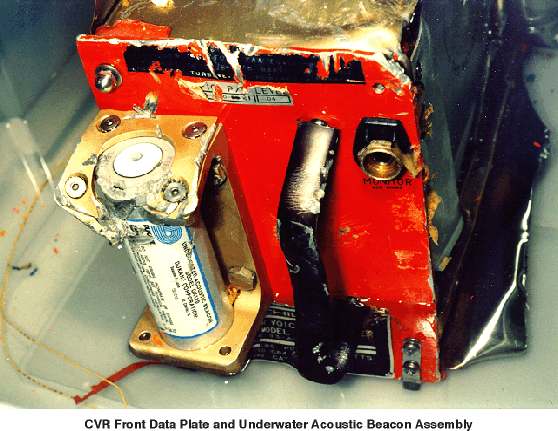
NOTE 3: What will an aircraft accident recorder look like after a decade in the deep ocean? It might have survived well given the nature of the dark cold pressured environment. This picture is of an accident recorder recovered from relatively shallow sea water (Swiss Air Flight 111).
A self-appraisal of one’s performance in this realm isn’t the best guild. That said, I don’t, on the whole, have regular coffee table conversation with friends and family about my own ability to judge others. Or at least that’s my experience.
It’s true we mark our own homework all the time. Building up mental pictures of other people. Framing them with good or bad qualities. It’s an internalised soap opera. This on-going series can be populated with stereotypes. Although, I try my very best to be fair and objective.
I’ll turn to Burns for a moment: “O wad some Pow’r the giftie gie us/To see ourselves as others see us.[1]” Burns says we need to start with seeing ourselves as others see us. Then, knowing ourselves, moving on we can try to see others as they really are. That path might be easier.
What’s simplest to recollect are personal judgement failures. That’s when I’ve got my judgement wrong or partially wrong. Case in point is were an individual’s intelligence was notable, but their social skills turned out to lamentable. I gave them far too much credit for thoughtfulness and wisdom. Turned out they completely lacked.
Am I a good judge of character? In this, I can’t be too poor. Surviving this long says something.
Everybody likes a good analogy. I don’t know if this one qualifies. We communicate by saying this thing is like this other thing. The first one being easier to understand than the one second. It’s a basic part of storytelling.
Who understands how government and its institutions grow? I’ve no doubt there are huge textbooks full of detailed analysis and complicated theories. Sitting on dusty library shelves. Written by knowledgeable and venerable academics.
I’m coming from a background that’s more practical. One of having mixed with and worked in bureaucratic structures built to serve a public good. Bureaucracies that have both traditional administrative and technical elements.
Here goes. Government, or rather the administrations, institutions and services are like a large oak tree. It’s kind of human pyramid in the sense that there’s a top and bottom. An upside-down tree minus the roots.
Oak trees are long lived. They have branches that are substantial so that they can carry a heavy load and suffer the battering of the wind and rain. Out on the furthest limbs they are young, spindly and vulnerable.
Today’s media is full of stories of what might come. There’s a new year in prospect. Across the Atlantic a new President is about to take-up office. Speculation is rife. One part of that speculation concerns the future of the large administration that is the federal state.
The Presidents favourite billionaire has ideas to take a chainsaw to the tree of administration. Generally speaking, a chainsaw isn’t the best tool for the job, but it certainly is scary. Maybe that’s the point. Keeping a huge, embedded administration on its toes.
My point, and I have one, which is more than I can say for Rory Stewart, a former minister, talking on the BBC this morning. My point is that pruning a tree requires the pruner to be competent. That’s having the attitude, skill and experience needed to make a good job of it.
Lopping off limbs of a working administration with the sole aim of saving money isn’t such a sound idea. Each branch has a purpose. It’s as well to have a comprehensive understanding of what that purpose is before the pruning starts. From that understanding can come a sound reason to prune.
Ideally, pruning should be good for the tree and good for everyone who depends upon it. Weak branches that suck-up energy even though their days are numbered should become firewood. Fledgling young branches that are heading out to explore new territory may need encouragement and support.
So, it is with government. There’s a lot of truth in Parkinson’s Law[1]. He knew a thing or two about bureaucracies. The clever bit is finding out where this phenomenon has taken off. Where the tree has grown way out of balance.
Will Musk be competent in pruning? Who knows. One thing is for sure. The potential for loping off a branch that is vital to health, wealth and happiness is all too real. Let’s watch and see.
[1] the law – “Work expands to fill the available time”
The unthinkable happened in 2014. One major international airline suffered two catastrophic accidents. These tragic events ran contrary to all the trends in historic aircraft accident data.
In March, flight MH370 disappeared. In July, flight MH17 was shot down. In both cases there were no survivors from these international flights. This remains an unprecedented situation. It is a sobering consideration that such dreadful events were possible in a mature international framework of civil aircraft operations and regulation.
A decade on the pain of those who lost friends, family and colleagues in these tragedies is not diminished. Aviation should not lessen its attention to discovering more about what happened and putting measure in place to prevent reoccurrence of these events.
These two aviation catastrophes are different in respect of causal factors. One remains a mystery but, from what is known, has the hallmarks of an operational accident. The other is undoubtably an aggressive malicious act. Failings in the two elements of aviation safety and security, often viewed separately, are both capable of catastrophic outcomes.
Malaysia Airlines was a State-owned airline in the traditional model. There’s no reason to suppose that the airline harboured deficiencies that led directly to the two fatal accidents. In hindsight, the question is often asked: could both accidents have been avoided?
The extensive underwater search for MH370, in the southern Indian Ocean, resulted in no findings. However, floating debris from the fateful Boeing 777-200ER was discovered. Unlike what happened with Air France Flight 447 were the installed accident flight recorders were recovered from the deep ocean, there has been no such good fortune in respect of MH370.
Accident flight recorders are one of the primary tools for accident investigators. Installed recorders are built and tested to withstand extreme conditions. The reasonable assumption being that they will be found with any aircraft wreckage. The accident of MH370, is one where a deployable recorder may have been beneficial. That is one that ejects from an aircraft when it is subject to the high impact of the sea surface and then floats, possibly away from an accident site. There is a good case to be made for installing both deployable and installed recorders[1]. Particularly a case for long-range international overwater aircraft operations.
The facts surrounding the criminal act of shooting down of flight MH17 are well established. Sadly, in a troubled world it is impossible to say that such malicious acts will never occur again. What is to be done? Avoidance is by far the optimal approach. Commercial flying over warzones, where heavy weapons are known to be used, is extremely foolish. Now, it is good that much more flight planning attention is paid to understanding where conflict zones exist[2].
NOTE 1: On 07 March 2014 at 1642 UTC1 [0042 MYT, 08 March 2014], a Malaysia Airlines (MAS) Flight MH370, a Beijing-bound international scheduled passenger flight, departed from KL International Airport [KLIA] with a total of 239 persons on board (227 passengers and 12 crew). The aircraft was a Boeing 777-200ER, registered as 9M-MRO.
NOTE 2: On 17 July 2014, at 13:20 (15:20 CET) a Boeing 777-200 with the Malaysia Airlines nationality and registration mark 9M-MRD disappeared to the west of the TAMAK air navigation waypoint in Ukraine. All 298 persons on-bard lost their lives.
The back-office work of campaigning does take advantage of a lot of volunteering. That’s my experience. Giving time and energy for free and seeking to advance a worthwhile cause.
It would be nice if all political parties in this country where wholly supported by a membership that is both engaged in activities and willing to put their hands in their pockets, now and then. The reality is that, of all the eligible voters in this country, only a small fraction of them is committed enough to be a member of a recognised political party.
Even with a strong membership and a well-motivated bunch of volunteers, life is hard going unless there is a reasonable sized war chest to support campaigning work.
Come election time the range and breadth of communications that is necessary to be a competitive candidate is considerable. Thus, it is no surprise that history can turn on who has the most resources. That doesn’t always work but without a spending capacity rivals have most of the advantages.
Politicians seek the patronage of the wealthy as a pathway to power. We can remain pure and get engaged in arguments both ethical and moral as to the impact of patronage. Or we can accept that it is inevitable and ensure that strict rules exist to create a reasonably level playing field for all candidates. Since we can no more stop influence from flowing from one person to another than we can freeze gravity then a democratic society cannot must not have woolly rules on these matters.
Talk now is about financial donations that originate from abroad. That is when a wealthy person wishes to funnel money into a political party in a country other than the one of their citizenship. No prizes for guessing who or what this is about.
Now, I could say only UK citizens should be allowed to donate to UK political parties or organisations. Foreigners should be banned from involvement in national democratic processes. Trouble is that this subject is not so cut and dry as it might first seem.
Those with dual citizenships may wish to contribute and participate. That sounds reasonable. Those with notable family ties may wish to contribute and participate. Certainly, there are reasonable cases to consider. What’s interesting here is the legitimacy of the interest and that it is of a “friendly” nature.
I’d like to go back to the mater of the level playing field. If a candidate meets the criteria set down for a given election, then the battle should be over achievements, ideas and policies and not over the size of bank balances. Financial donors should not be able to exert undue influence by throwing money at a campaign. That’s where there is a strong need for strict financial limits on donations or any form of beneficial contribution that comes from abroad.
POST: One subject that Australian’s are looking at: