Age Restrictions

Inevitably whenever there’s a decision as to what is age-appropriate one’s own experience comes to the fore. The experiment that is going on in Australia is one to watch. That country has taken a step towards the regulation of social media that provides defined limits. From zero to age 16 there’s to be a ban, or a restriction as the more diplomatic commentators say. One discussion could be about the whole necessity, and possible effectiveness of a ban on social media and another about the age limit that has been set.

This is one of those debates where there are good cases to be made on both sides. I could start by citing examples of harm caused, in particular cases, of social media use by children. That would reinforce a compelling argument for restrictions by law.

Alternatively, looking at the subject in the round, I could wonder at the position of young people first encountering an avalanche of social media on the day of their 16th birthday. Or the creativeness of young people in finding ways to evade a punitive law.

For me, my 16th birthday was a day of great liberation. Growing up in the countryside has lots of advantages. The downside is the effort needed to get anywhere beyond walking distance. No buses. No trains. Just a pushbike. Miles of country lanes, green fields and distant villages.

No demanding, distracting all-encompassing digital paraphernalia. Maybe a radio, cassette recorder and a pile of vinyl records. For me a couple of beaten-up cars and motorcycles too. As per the famous four Yorkshiremen sketch: try telling that to the kids of today.

Yes, my 16th birthday was a day of great liberation. That because of the law. I wasn’t alone. It was there for every schoolboy who could afford one. Shiny in the showrooms. Names like: Fantic, Gilera, Garelli, Yamaha, Suzuki and Puch, were all on our list of wants.

In December 1971, the British Government create legislation that restricted 16-year-olds to 50cc mopeds (motorcycles with pedal assistance). This was a worthy effort to improve road safety and reduce the carnage of motorcycle accidents. What was unexpected was the frenzy of innovation that this well-meaning law triggered. Motorcycle manufacturers set to their drawing boards and radically transformed the moped. I do mean radically.

I came in at the end of this era. By early 1976 manufactures had squeezed every drop of performance that was possible out of a mere 50cc engine. Designs had gone from uncomfortable, sluggish commuter bikes that would feel embarrassed to own, to sporty fast racing machines that were extremely desirable.

Ah, the unintended consequences of worthy legislation. For me this was wonderful. It opened a whole new vista and introduced me to one or two roadside hedges. Waiting for me on my 16th birthday was one of the best. A Puch Grand Prix Special. In black and gold, this really was a fast and refined two-stroke machine. Even with cast alloy wheels and a front disk brake, which was whizzy for the time. Racing along the main A30 the bikes gearing was such that I went fastest downhill, while my mates Garelli overtook me going up the hills.

What can I say? When it comes to age-appropriate the results may not be what is intended.

Note: Reference: Funky Mopeds! The 1970s sports moped phenomenon. Richard Skelton. Veloce Publishing. ISBN 13 978-1-84584-078-5  www.veloce.co.uk

Why Embrace False Utopias?

Why do clever people often become dayglo prats? Not stupid by any means. More foolish and not embarrassed by their recklessness. It’s one thing to be incompetent or ineffectual but that’s not what I’m getting at here. It’s smart people who get carried away with delusional dreams.

How many vocal futurologists have said – “work is dead”? That one day we will be living in an age of leisure and ease because sophisticated machines will have taken all the drudgery out of existence. Intelligent machines doing all the things we once considered to be work.

In essence it’s a utopian vision that stands-up to be knocked down. In fact, the subject matter has been chewed over in science fiction ever since science has played a big part in our lives. Such popular fiction takes us from a dream world to a hideous dystopia that the original dreamers hadn’t envisioned.

The year is 2274. Almost 250-years ahead of where we are. Humanity is living in a bubble. That bit doesn’t change. Most people are unaware of how their society functions. Again, that bit doesn’t change. Rituals and customs dictate the path individuals take in life. Like today.

Strangely, even in the year 1775[1] those three aspects of life were evident. Maybe they are perpetual. However, there’s an exceptional point to make. That’s our rebellious nature.

The year is 2274. The movie is Logan’s Run[2], made at a time when society had ripple of anxiety about the so called “silicon revolution.[3]” That’s 1976. Before the elevated level of interconnection and communication that the INTERNET has afforded us.

It’s a sobering science fiction movie with a somewhat optimistic ending. Looking dated. I can get past the images and props that epitomised the seventies vibe. That’s become vintage.

To me, aspects of the theme of the story come from H. G. Wells. Nothing wrong with taking great ideas and reshaping them for the time. In the end the flawed utopia is defeated by our rebellious nature. Or at least of some people. The seeking of truth, at all costs, and to look behind the mask that everyday life paints.

You may ask – what the hell am I getting at? It’s a reaction to the recent headline[4]:

Musk says that in 20 years, work will be optional, and money will be irrelevant thanks to AI.

I like growing vegetables. Gardening is a superb way of doing something practical, staying grounded and in touch with nature. It’s good for one’s mental health too. However, the notion that work will be optional is far-fetched. The idea that money will disappear in a couple of decades is nuts. That’s not going to happen.

I know that the motivation to say such things maybe merely to provoke. That has its function. Nothing like stimulating a debate about the future. Surely, we are in for some dramatic changes in my later years on the planet. Surely, we need to equip the next generation to deal with these changes. Surely, we need to protect the public interest in turbulent times.

“Prat” is an often-applied British term. There are a lot worse terms than that one.


[1] https://www.clarkstown.gov/weekly-column/the-revolutionary-year-of-1775/

[2] https://www.imdb.com/title/tt0074812/

[3] Intel’s 4004, released in 1971, packed the core of a central processing unit (CPU) onto a single chip for the first time.

[4] https://fortune.com/2025/11/20/elon-musk-tesla-ai-work-optional-money-irrelevant/

Light in Dr Who

I’ve started so I will finish. There’s a good line. Don’t worry I’m not going to write about quiz shows but it’s time for another short review. I have seen the light. Well, switched on the TV.

Flashy clothes, 50s vibe and excruciating way of getting there. The second in this new series of Dr Who twisted and turned around an attempt to get home. There’s a theme. Adventures on the way home. Wonder where that idea came from? An odyssey of a flight in time, one might say.

In a digital age a flip back to an age of film was a nice touch. It’s kind of funny how animation is now so much easier done. Film is becoming a museum artefact. I don’t think it will get the popular revival that vinyl is getting.

Explaining a job like “projectionist” to newer viewers isn’t necessary. Wasn’t done. Takes me back to the small flee pit of my youth and the story of a living Volkswagen Beetle[1]. That’s quite freaky. Jumps in the film, munching crisps in the theatre and sitting in the dark when it was daylight outside.

The sinister and creepy monster turned out to be a being of light. Like a Twilight Zone moment, a menacing cartoon character came to life. Given the various realms through which the doctor travels, this is not unexpected. Good job there was only one of them to defeat.

Beings of light[2] are a popular science fiction theme. They crop up now and then on both good and bad sides. I like the ambiguity. That one entity can flip between good and bad. It wasn’t so much a tale of an evil moonbeam as one of light finding a path to becoming substantial and physical. The dark of night or, in this case, the cinema world turned the mischievous moonlight to the bad side. Only a release back into the bright light of day let it rejoin the sunlight and starlight of the universe.

Plonk in the middle of the show was a breaking of the fourth wall. That boundary between the fictional characters, the Doctor and companion, and the imagined audience at home. Suddenly one was real, and the other was fiction (even though they were both fiction).

After a good haunting the colourful cartoon menace was expelled. Given how easily it got into the cinema in the first place it’s a wonder this story isn’t repeated a million times.

Confusing at times, the suspenseful moments were jarringly technicolour. Sometimes less is more. This was a case of packing too much content into a rapid-fire story.

Having wrapped up a 1950s mystery, the Doctor is back to his time travelling.


[1] https://en.wikipedia.org/wiki/Herbie

[2] https://babylon5.fandom.com/wiki/Vorlon

Who 15

As per tradition there was a moment of running down corridors pursued by robots. Add to that the shock horror realisation that it’s bigger on the inside than the outside and the staple diet of BBC Science Fiction is playing again.

Dr Who is rolling[1]. As expected, Russell T Davies works magic with a super-fast story line. In fact, so fast that I’m going to have to watch it again to figure out exactly what the featured rift in space and time did to the plot. Thematically up to date as the main baddy in control of the evil robots was both misogynistic and AI. I’ll give something away if I reveal that the two letters AI were not what they seemed. Not only that but the robots were redeemed.

Although there was a smidgen of absurdity and an expectation that the audience would draw of decades of Dr Who mythology, the show hit the mark. Afterall it’s entertainment not a profound reflection on the state of the world. It’s colourful Saturday night drama that the whole family can watch. Although in this case there was no need to hide behind the sofa. Also, a lot of the 21stC social commentary would be lost on younger viewers.

Because the series has been running for such a long time there’s a bit of repetition that creeps in. This is not bad per-se. It’s a reminder that coming up with truly original scripts is incredibly hard. Imagination has no limits but when pen hits paper past references helps move stories along quickly.

Adventures in space and time could go on forever. All time, in fact. The subject has no limits. Each version of the Dr Who saga will be set in the context of the audience’s everyday reality. So, the Daleks were a product of nuclear war, and now humanities greatest threat comes from billions and billions of electrical ones and noughts.

Playing with humankinds’ curiosity about space and time is fruitful territory. Imagery can be fantastical and push the boundaries of video production. If anything, Dr Who is modest in pushing at those boundaries. Mustn’t forget that it’s prime time entertainment. Real space and time are far more than a headful.


[1] https://www.radiotimes.com/tv/sci-fi/doctor-who-times-release-schedule/

The Dr

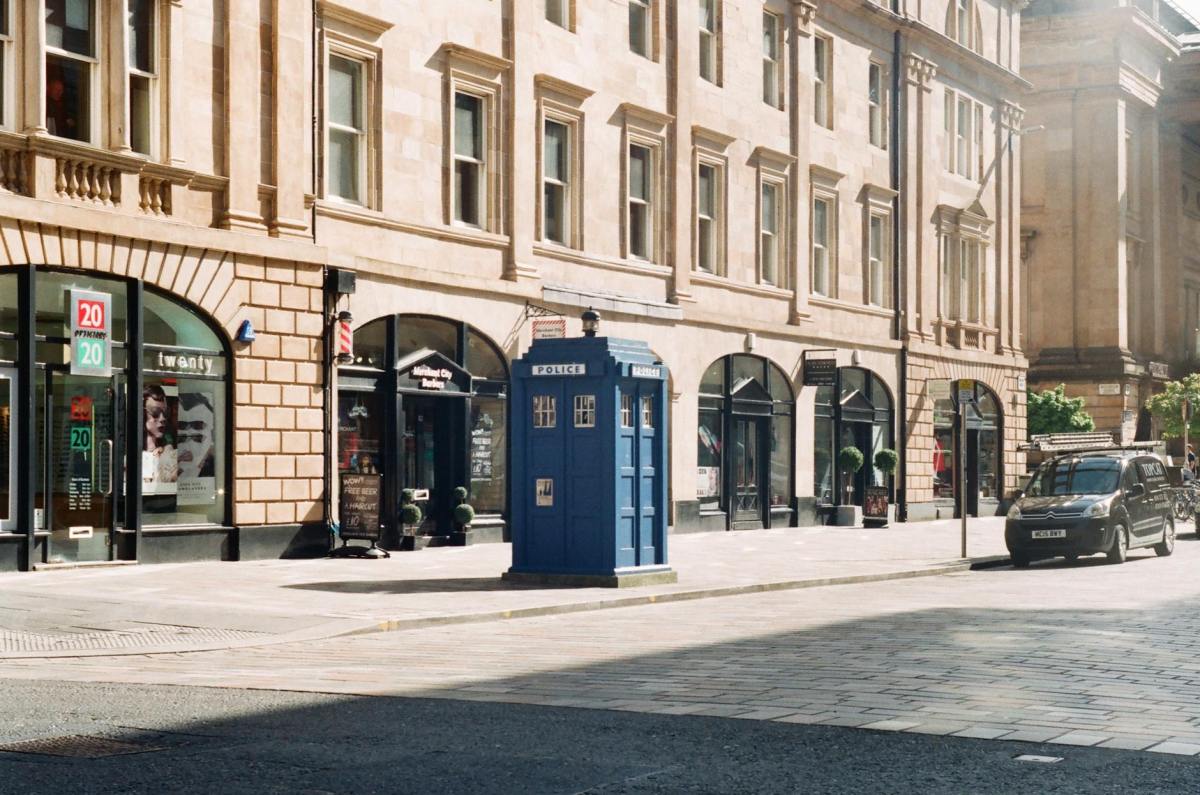
There’s something wonderfully peculiar about a time traveller wandering around the universe in a British police box. Time and space are the stuff of an infinite number of story lines. But the ones who strike a cord with us most are the humancentric ones. Our home, Earth is under threat. Humanity is in peril. Nobody knows what to do. Then stepping out of street furniture from the 1960s comes a hero. Not a muscle bound, gun toting superhero with magical powers. No, an eccentric, cerebral alien who looks like a college professor who took too many happy pills in their hippy phase. Humanoid in appearance. Wherever The Doctor goes so enemies follow, set for a final showdown[1].

Iconic features of Dr Who’s[2] life echo down through our decades. The Doctor’s vehicle is nothing like H G Well imagined. With a nice trick of being bigger inside than out it dazzles all who hitch a ride. If only we could master that transformation. I for one, don’t think it’s entirely impossible. Afterall isn’t physics up to about 12 dimensions now?

No saviour of the human race is complete without uniquely bad adversaries. Strangely enough quite a few are machine-based baddies. How in the moment is that? With increasing neurosis about what machines may be capable of in the near future. Daleks look a bit crude with what we know now. Unlike the iPhone we haven’t yet seen an upgrade to a version of the Dalek 15 Pro. I dread to think what that might do. They may have a resistance to any means of destruction.

Some Science Fiction can bore with an intensely serious inspection of our planetary dilemmas. Dr Who steers clear of that trap. Injecting humour and simple everyday relationships into the stories, the level is more connectable. One person matters, as much as billions.

My Doctor is Tom Baker. As a Time Lord, he captured that frenetic, unpredictable, jumbo schoolboy who knew no bounds. Yet, he retained a masterly command of dangerous situations. He could look stern as well as overjoyed. Never did I think that he would turn to the darkside.

My favourite evil monsters are the Cybermen. The idea that machines should decide that humans would be better if they were transformed into machines is a true horror story. It a kind of malevolent evil that doesn’t know it’s evil. It’s possible to believe that could exist.

Pure fiction, mixed with a scary look at expanding technology and always a partnership between good folk to overcome despots like The Master and singularly driven uncharitable aliens. That blend makes for wonderful entertainment. Long may television, and its replacements celebrate this combination. Regeneration has no end.

Today, it’s Doctor Who’s 60th Anniversary[3]. Happy birthday.


[1] https://www.imdb.com/title/tt0056751/

[2] https://en.wikipedia.org/wiki/Doctor_Who

[3] https://www.doctorwhotv.co.uk/doctor-who-is-60-today-99309.htm