Mindset

Safety is a mindset. Having a sense of risks and which ones to accept and which to reject is something we all develop. It’s a big part of childhood. Most of us have had burns, cuts or bruises that have resulted in doing something we would now consider having been stupid.

Some are destined to be over-cautious, and others are more openly adventurous. In time, we settle around a frame of thinking that suites us best. That’s fine in so far as taking personal risk is concerned. Whether to cross the street every time you see a mean looking dog or to buy a powerful motorcycle later in life that’s a personal preference.

Where activities, positive or negative only impact the risk taker then that’s an area where society shouldn’t be too heavy handed. Naturally, there are boundaries. The classic one is motorcycle crash helmets. Mandating them led to a lot of heated debate. Yes, we are discussing a personal risk in respect of the rider but the risk to society is an unacceptable number of fatalities, brain injuries and publicly borne health care costs.

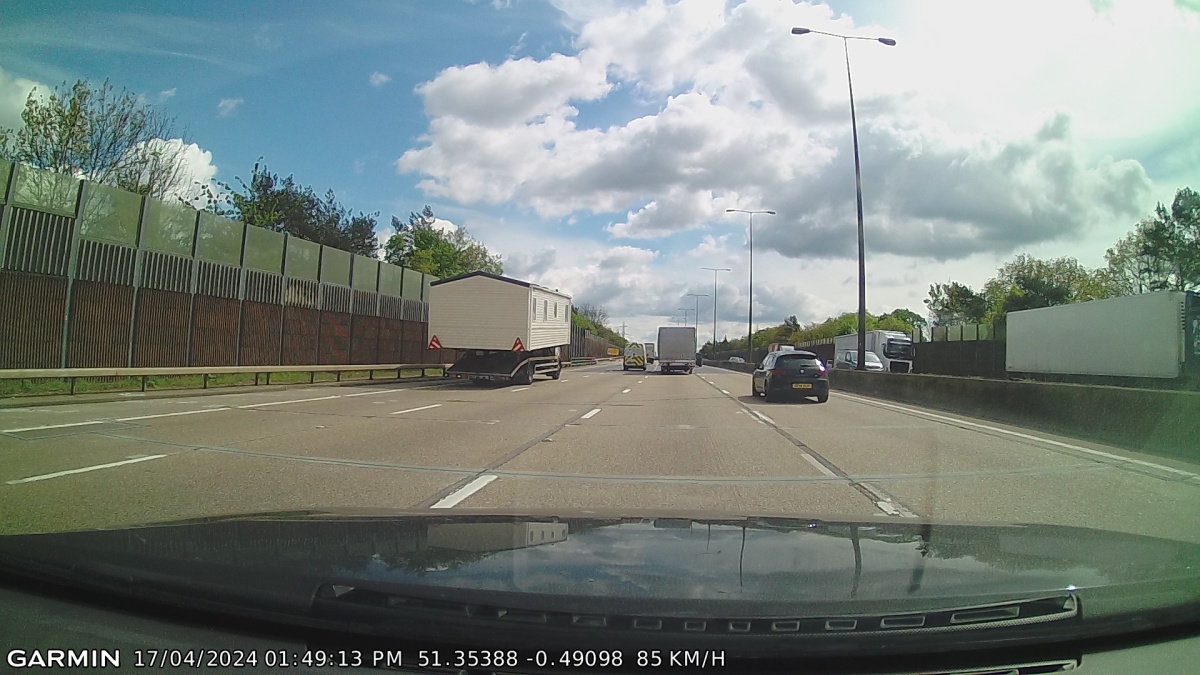
There I was, driving at less than the regulation speed (yes, I was) eastward on the M25 motorway. The details are stamped on a picture taken by my neat little Garmin dashcam. What’s in the picture? It’s a moveable building sitting on the back of a lorry. Nothing unusual about a lorry transporting stuff from A to B. What I saw was a large building on a relatively small lorry. When first seeing something like this on a busy road, my instinct is to give it a very wide margin.

The rectangular building was rocking gently. It was not a windless day. Not overly windy but a strong gusty breeze was blowing. Clear skies and dry tarmac. So, good driving conditions for a normal lorry with a normal load on a normal day. I’d estimate that this lorry was doing about 80km/hr. It wouldn’t be too difficult to do the sums in terms of the wind resistance of the building. It’s going to be significant. A large flat surface being pushed through the air at motorway speeds. As for sidewinds and gusts, this is a horrendous monster.

Back to safety being a mindset. My thought was – what on earth gave the carriers the idea that this arrangement for a wide load was a safe one for a motorway journey? No escort vehicle. No flashing lights. Just a couple of small red triangles. The straps and wooden blocks holding the load in place looked feeble. A powerful gust of wind on an exposed stretch of road and who knows what would have happen next. It wouldn’t have been pretty. I hope they got to their destination without incident.

Had this been done on private land then there would have been little public risk. Being done on a busy motorway – that’s a different matter. How do people convince themselves that such transport arrangements will be fine? I speculate:

  • Money. Maybe the haulage contractor undercut rivals to get the job. Maybe using a small lorry and ditching any escort vehicle saved money. Maybe there was time pressure and this was all that was available.
  • Bravado: A carrier imagines they have special skills and abilities so they can take risks that others would not take. Something uniquely puts them above others in the field. This cock-sure attitude is not uncommon.
  • Short Cuts. I’ve heard this argument used before – we did it last time and it worked, so we’ll do it again. That learned deviance is the source of many accidents. Past and present can have very different outcomes.
  • Shoulder shrugging: I’ve heard this argument used too – it’s legal, it’s within the rules so it can’t be wrong, can it? (The load maybe within the approved weight limits for the lorry. There may be no explicit rule on shape and size).

A good safety mindset means saying “no” when no is the right answer. All three of the above points can come into play and produce a toxic mix. Such is the way accidents happen. It doesn’t have to be this way but it often is. Before a critic says don’t be so high and mighty – yes, I’ve done foolish things too.

NOTE: The loading rules HGV maximum weights – GOV.UK (www.gov.uk)

Highways

The last time I visited the city of Baltimore was in 2012. It was the location of the annual seminar of the International Society of Air Safety Investigators (ISASI)[1]. That was when I was representing the European Aviation Safety Agency (EASA) at such international events.

The relationship between aviation accident investigators and regulators are generally cordial. There’s a great deal of work that requires cooperation and good communication. That’s not to say that the relationships between these two vital parts of national and international aviation safety systems is easy. It’s not. My reflection on that fact is that a degree of constructive tension is inevitable and not always a bad thing.

One way of seeing that relationship is that the primary role of an investigator is to make findings to prevent the repeat of a given accident. For a regulator the primary role is to ensure the complete aviation system runs safely on a day-to-day basis. Both organisations have the public interest at their heart. However, their operational context and perspective are different.

Firstly, my condolence to the families and friends of those who perished because of the Francis Scott Key Bridge accident[2]. The collapse victims and survivors had no way of knowing what was to happen on the night of the accident. I use the word “accident”. This was not an act of God, as some commentators would have it. The safety risks involved in the operation of the port in Baltimore could be anticipated.

In the US there’s an independent federal agency that is tasked with such major investigations. Interestingly, it’s the same one as that investigates aviation accidents and incidents. The National Transportation Safety Board (NTSB) is a multi-modal organisation. That is something we don’t have in the UK. Also, we don’t have a divide between federal and state organisations. Since in the UK we have separate independent national Air, Marine and Rail investigation agencies that cover the country (England, Scotland, Wales, and Northern Ireland).

I will not comment on the accident sequence or causes. It’s the job of an independent investigation to arrive at the technical facts. Recommendations will flow from that investigation.

Where a comment may be in order is that there are many locations across the globe where a vital piece of infrastructure, like a bridge being struck by a large container ship is a possibility. I’d generalise that further. When infrastructure that was designed a built 50 years ago meets modern day operational stress there’s going to be vulnerabilities. Yes, the aviation system is not immune from this fact too. It wasn’t so long ago when I read of PDP-11 computer hardware used for air traffic control (now, historic artifacts[3]). I’m sure there are still Boeing 747s, and alike that need floppy disks to update their hardware.

So, the wider subject is operational legacy systems working with modern systems. This is the interface that requires particular care. The safety risk appetite and exposure in the 1970s/80s was quite different from that which we expect upheld today.

Unfortunately, society is often reluctant to revisit this subject. Additionally, there’s the incentive to go for quick fixes and sweating assets. The example I have in mind the so-called “smart motorways” in the UK[4]. I don’t know how many fatalities can be linked to “smart motorways” but I’m sure, sadly, it’s too many.

POST: In time-off I enjoyed a trip out to Fort McHenry and a walk around the places where The Wire was filmed. The Fort McHenry story is interesting given its role in times of war. The British burnt the White House but the navy didn’t get past Fort McHenry in 1812.


[1] https://www.isasi.org/

[2] https://www.bbc.co.uk/news/av/world-us-canada-68661318

[3] https://www.tnmoc.org/air-traffic-control

[4] https://www.gov.uk/government/speeches/plans-for-new-smart-motorways-cancelled

Safety Culture 2

This may sound at variance with my last blog. I hope it’s not. I hope it’s complementary. What I’m highlighting here has been observed over decades of contact with a wide variety of organisations.

The term safety culture is fused into the pillars of ICAO Annex 19. The essence of building a good safety culture that fosters sound practices and encourages communications, in a non-punitive environment is at the heart of standards and recommended practices. With all those decades behind us the reader might assume that there’s unambiguous and well aligned attitudes and ways of working throughout the aviation industry. That’s not so.

On a spectrum of what could be called hard to soft the manner of application of know best practices can take different forms. By the way, please disassociate those two words with both easy and difficult. That’s not what I mean.

In my interpretation “hard” means like pages of Niccolo Machiavelli’s The Prince[1]. Aggressive, persistent, mandatory, uncompromising and all encompassing.

In my interpretation “soft” means like pages of The Little Book of Calm by Paul Wilson[2]. Harmonious, enlightened, progressive, sympathetic, and understanding.

As with extremes on any scale, going to the ends of that scale are not the best way to operate. I say “best” in terms of getting to ways of working to endure with engagement and effectiveness. I observe much of this depends on how power is disseminated through an organisational structure. Highly hierarchical organisations will approach culture differently from organisations with a relatively flat management system.

It may not be surprising to suggest that aviation Authorities can veer towards the “hard” approach and staff Unions towards the “soft” approach. Even when both are trying to reach the same goal. Where people come from a military background, command and control can be an instinctive reaction. Where people come from an advanced technology company background, collaboration and communication can be an instinctive reaction. In my observation there are advantages in both a hard and soft safety cultural approaches.

One advantage of a hard safety culture is that the time between discovery of a safety problem, taking corrective action and resolving that operational problem can be short. Clearly, that has distinct safety advantages. Certain airlines come to mind.

One advantage of a soft safety culture is that there can be the discovery of safety problems that would otherwise remain hidden. Where collective ownership of the problem is not in question. Again, clearly, that has distinct safety advantages too. Certain manufacturers come to mind.

I guess my message is as per much ancient thinking. All things in moderation. Try to reap the benefits of both ends of the scale. Balance.


[1] https://www.londonreviewbookshop.co.uk/stock/the-prince-niccolo-machiavelli

[2] https://www.waterstones.com/book/the-little-book-of-calm/paul-wilson/9780241257449

Safety Culture

Civil aviation remains an extremely safe means of transport. That said, any form of complacency must be addressed. It’s reassuring to say the past has been great but what passengers are most concerned about is their next flight. To have the confidence, to think it irrational to be afraid of flying, to look forward to the next journey, we must have a safe aviation system everywhere and all the time.

For any widespread system that has complex interactions between people and technology there’s never a moment when it can be taken for granted. We count the numbers, but safety is not purely an absence of accidents and incidents. Numbers counted are always past events. They have no direct causal influence on what happens next. True, there are factors in past accidents and incidents that will pop up again and again, but every flight is a unique event.

One of my colleagues who was a senior captain in a major international airline always remined me of the fact that, for all that has gone before, flight risk begins the moment an aircraft sets off down the runway with the intention getting to a destination. When the wheels lift off the ground there’s no stopping time. Reliant on the diligence, vigilance, and integrity of everyone who made a flight possible, flight risk is then in the hands of the crew.

The above is perhaps why we talk a lot about safety culture. The whole aviation family has a role to play. The care, professionalism, and watchfulness of every person makes a difference.

This can extend from the drafting of a new component for a new design, that a decade down the line. ends up as a part of an aircraft just about to leave the gate. This can go back to a flight instructors’ message that emphasised a key point back in a pilot’s initial training, years ago. This can encompass the extra care a couple of air traffic controllers took as they changed shifts.

Safety culture comes from caring. It’s that heightened awareness of the consequence of actions. Being alert to possibilities. Both the good kind, and the bad.

Safety culture is a matter for both individuals and organisations. One without the other doesn’t work. Placing a vigilant person in an organisation that doesn’t care is much like placing a reckless person in an organisation that does care. Although this is what I’ve written, systemic problems are likely the ones that are most likely to cause negative outcomes. This is where the role of management has the most impact.

Culture exists in context. When the ways people interact are determined by practices, processes, and procedures there’s an obligation on management to ensure they fit the bill. Drivers are often economic. In a commercial operation that’s no surprise. It’s when that driver displaces the safety imperative then safety suffers. There’s been several occurrences of this negative phenomena in the last year.

Dependency

It’s not unique. Charle Dickens wrote about it. We don’t like to admit it. We have a dependency on bureaucracy. Our complex society runs on it.

Whatever we do when it comes to the meeting of an individual with an organisation, it’s inevitable. Irrational people deny this fact or say it’s only true of public bodies, like government departments. It’s as if the generally high performance of modern computer systems renders them completely invisible.

One apt illustration of a dependency on systematic bureaucracy and digitisation combined can be read in a carefully constructed e-mail from the CEO of Sainsbury’s this weekend.

“I’m writing to update you on the technical issue that has affected our Groceries Online deliveries and some services in our stores this weekend.”

This could have come from any large complex organisation that exists in today’s digital world. When outages happen, we all sit patiently for affected systems to come back online with the full services that we normally take for granted. A sudden reversion to traditional cash transactions was a shock to the average post-COVID consumer.

This weekend my experience of one major hotel chain was that they would not accept cash at all in their restaurant. My “paper” money was useless. It sat in my pocket.

What we have is the power of utility. Systems become so good that we build ever more dependency into them doing the right thing, every time. The problem is that systems are often programmed to do certain tasks exceptionally well but as soon as there’s an unexpected deviation outside normal parameters the situation does not go well. 

An illustration of that experience can be read in the public version of the interim report on UK NATS[1]. After the event, and similar unfortunate events, there’s a cavalcade of calls for more contingency, more resilience, more planning, more training, more checking and so on.

That list is perfectly sensible. But wouldn’t it have been better if those actions had been taken up-front? I often saw this discovery in my time doing systems certification audits. Companies who spend a lot of money upfront to build software that was well characterised and tested were not guaranteed success, but their chances were greatly improved. Those who hit the road with over-confidence, marketing hype and rigorous cost cutting had a high probability of negative outcomes. It’s not a simple cause and effect but good system architecture, robust software and a management that understood the need to spend time and money judiciously do well.  

Just think. If a runner ran a marathon without a strategy, training, basic fitness, planning and sound motivation no one would expect them to be winning anything unless they were exceptionally lucky or unbelievably talented. Not many in the latter category.

There’s a lesson here. It’s been copied over and over. Saddy the almost completely invisibly of complex system that work well in everyday life means we soon take them for granted. And the result is?


[1] https://www.caa.co.uk/publication/download/21478

Safety

A considerable part of my working life has been in the analysis of occurrence data and trying to distiller the factors that cause or contribute to accidents and incidents. It’s rewarding work. An opportunity to influence that has value. I subscribe to the dictum that everything we do should contribute to continuous improvement in safety. Not zero risk but to keep risks low and under control, in so much as it’s possible.

Aviation only has the great success that it does because it’s a safe industry. For mass transport by air to be viable across the globe, the public must have confidence in it. They are willing to place whole families in the care of an airline to get them from London Gatwick to the Canary Islands for something that is not a physical need[1]. Regular leisure travel is a luxury and a privilege. We live in a fortunate age when overseas travel can be afforded by a large section of the population.

I watched the recent documentary on flight MH370. It’s sobering. It’s a story of the loss of a large aircraft that still seems unbelievable in this era. It’s the 10th anniversary of the disappearance of Malaysia Airlines flight MH 370 on 8 March 2014. The loss is a stark reminder that the oceans cover over 70% of the surface of the Earth. We know less about parts of the oceans than we do about the surface of Mars. The depths remain uncharted.

With a paucity of evidence theories have taken root. Official investigation reports are available. However, mystery remains particularly when it comes to answering the question – why? If as the documentary suggest, the willful actions of the pilot-in-command brought about the fatal outcome then there’s little to tell of his motivation. Highlighting the tragic Germanwings aviation accident doesn’t offer anything other than a context to possibilities. Evidence that the MH370 pilot-in-command was suicidal is scant. Although his known actions do not make much sense without invoking such a theory. Understanding what drives people to purposefully undertake unpredictable and irrational actions is an area of study that always needs attention.

Yesterday, Sunday, I was remined that threats to safety can come out of nowhere. Seemingly routine car journeys can suddenly take a turn in an unexpected direction. We become subject to the fates. I use the word “fate” but I’m not a great believer in the fates. Randomness plays a part but, in this case, yesterday afternoon, I was the subject to the foolish and negligent actions of another car driver.

On a wet “B” road that climbs and descends over chalk hills, there are triangular road signs that warn drivers that the road is a high risk road. What the signs are referring to is the wildlife. A deer may leap out of a roadside hedge at great speed and misjudge the road traffic. In fact, I did see an unfortunate small dead deer at the kerbside.

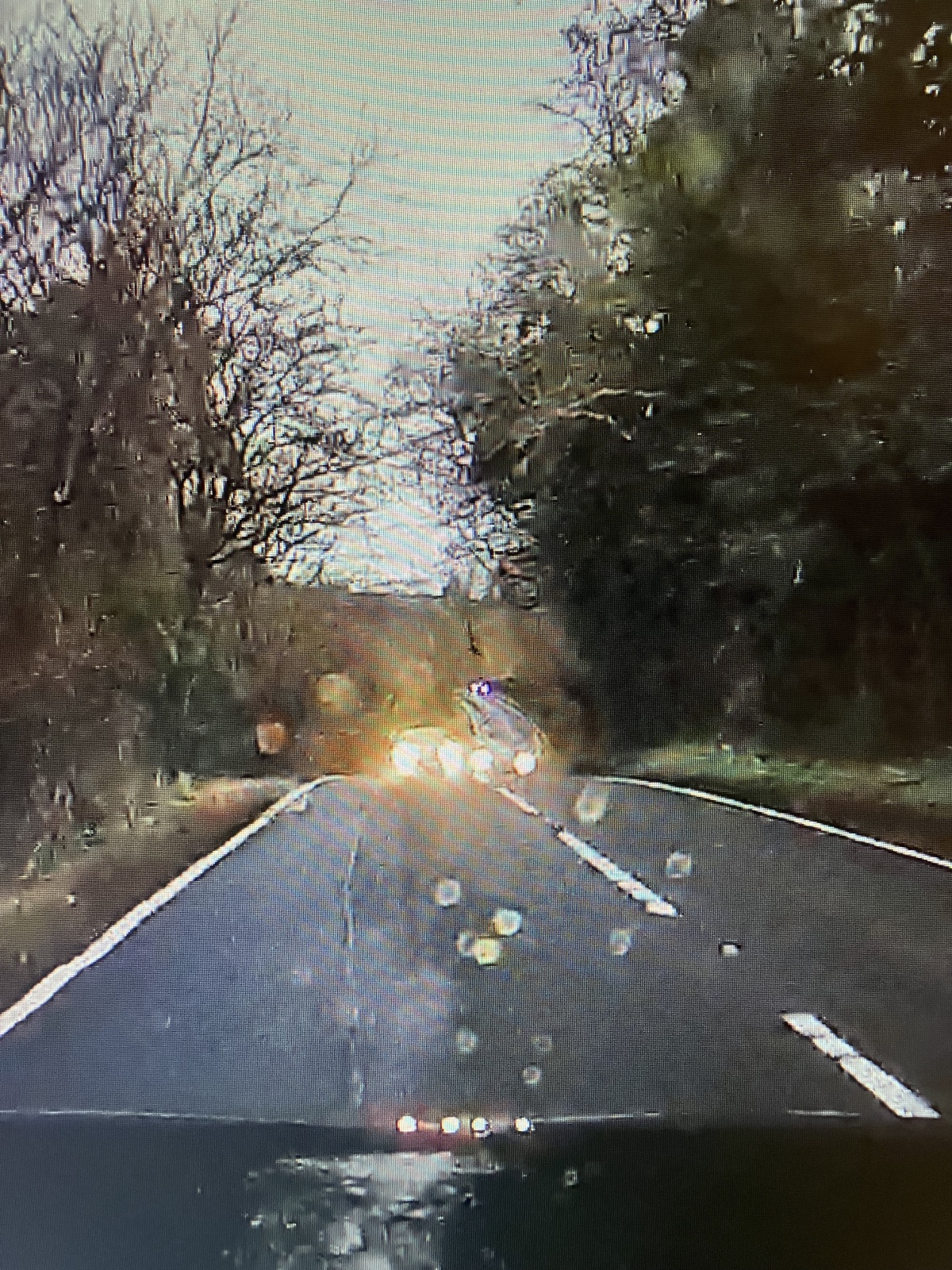
What happened to me had a purely human cause. Naturally, I would call it complete idiocy. Coming over the brow of a hill, and descending, suddenly there was 4 bright headlights ahead. On a narrow country road, with overgrown banks on either side that was a scary sight. Nowhere to go. In a faction of a second the overtaking car coming up the hill veered back into the right-hand lane. No more than a couple of yards in front of my car. Fortunately, there was no collision. What on earth was the motivation of that driver? Overtaking, at high speed, approaching the brow of a hill, on a wet county road, in poor light, sheer madness. A small red car, overtaking a larger car.

In safety work this points to the most difficult situations to understand. The irrational, or stupid or reckless, or carless human drives that are hard to design out of systems. How do we take effective corrective action when one person’s risk threshold is so very much higher than normal or acceptable? The problem with saying – take their licence away – is that this is always reactive. After a negative event. Maybe even a fatal one.


[1] https://www.simplypsychology.org/maslow.html

Comment

Custom and practice are as important as the rules and regulations that are part of our lives. Now and then, someone is criticized for applying the letter of the law without care for the spirit of the law. The same is true for custom and practice. Whereby, acting outside past norms can trigger a backlash.

Because, in free countries we believe in a free press, the rules and regulations that imping on what should and should not be said about events are always hard fought over. The banner of the “public interest” is touted as overriding. It may or may not be, but there’s an argument to be had.

In the aviation safety profession, I’ve grown up with an instinctively “need to know” disposition. I’ve shaken it off, mostly but there are signs that the attitude persists. This instinct can run counter to the transparency and openness that most people expect to see.

Why talk about the way major events are talked about?

A case in point is the recent runway collision in Tokyo. There’s much already written about the newsworthy aspects of the event, so I’ll desist from adding much more. There’s a lot of speculation too.

Graphs can be drawn of the media attention given to such tragic events against time. It’s typical that from moments after a major aviation accident until a few days after most initial facts are known there’s a huge surge in activity. This used to be described as newspaper column inches.

Today, wide ranging speculation is inevitable. It can be highly literate, and, on the other side of the coin, it can be badly informed, and now and then damaging.

In over three decades, I’ve been dealing with aviation accidents and incidents there has been notable changes in media and communications. For one, the universality of the INTERNET is now unquestionable. For another, the deference offered to authorities has diminished markedly. For yet another, the speed of with which images can travel around the globe is astonishing.

Most aviation professionals are tempered by caution. Aware of the techical complexities that can arise in aviation accident scenarios. What can seem in the heat of the moment to be an obvious cause and effect, after detailed analysis turns out to be wrong, or only a partial picture.

So, should aviation professionals be scathing about the enormous growth in commentary and public speculation? Especially when some of it is wild and or even outrageous on social media. No. I don’t think so. Like it or not this is our digital world. The freedom it affords to throw-up any opinion or theory can only be tempered a bit. The hope is always that the pure dross fades away when a reputable authority challenges it.

That then puts a responsibility on someone, with professional knowledge to challenge ill-founded speculation. Or, at least, to ensure that the major media outlets have reliable sources of trustworthy information. I don’t think aviation professionals should remain silent concerning speculation. That may have been the strategy decades ago. It no longer works. The greatest degree of transparency and openness, based on verifiable facts, should be the aim.

Comment?

Eurostar

More than a few times the thought that climate change will impact transport has been raised. Not so much as transport impacting climate change but the two go hand in hand. Whereas the assumptions built into roads, rails and airports were of their time, time doesn’t stand still.

More frequent heavy rain and raised tides, and the flooding associated with them, are to be expected. To hear that the rail tracks between London and the Channel Tunnel have been underwater shouldn’t be too much of a shock. Flooding is a worldwide threat to public transport systems. In London, over the last couple of days, flooded tunnels brought travel chaos. Millions of gallons of water were not where they were supposed to be.

We can get used to disruption caused by strong winds and torrential rain sweeping across the country. The question to ask is – should we? I always wonder as soon as I see the word: “unprecedented” in a public statement. Huge volumes of water may not have been predicted to overwhelm the pumping systems designed to keep them under control, but now we know. It makes me think we are going to hear the word “unprecedented” a lot more in future.

This city centre to coastline railway is relatively new[1]. It cost £6.84 billion and opened in November 2007. Most travel commentators would say that it has been a great success. I was looking forward to the day that the German train company, Deutsche Bahn was to implement plans for a London to Frankfurt train service. Sadly, that project was shelved in 2018. I wonder why[2]? That “B” word again.

The subject of these comment, the Thames Tunnel is over 3km long. The rail lines dive beneath the river from the counties of Essex to Kent. This High-Speed rail tunnel goes under the river near Fiddler’s Reach. This part of the River Thames, much like most of the tidal river, was once busy with commercial shipping. It’s been the site of unfortunate events before[3].

Further upstream is the Thames Barrier. A truly magnificent structure. The barrier protects central London against a storm surge. It works well. However, it will eventually need to be replaced. The inexorable tide, no pun intended, is moving just one way.

Risk is a multifaceted factor: operational, economic, social, political, safety, security. Did current risk assessments foresee a likelihood of flooding? I don’t know. The safe running of High-Speed trains through underwater tunnels should be subject to risk assessment. I’m sure it is.

Eurostar has experienced a set back as 2023 comes to an end. Eurostar services are again running as normal. But this weather-related event highlights the fact that climate change will impact transport systems. If the thought has not found its way onto the desk of a civil servant, it might be as well to do a high-level audit of the nations transport infrastructure.

Either that or get used to using the word “unprecedented” a lot more.


[1] High Speed 1 (HS1) is a 109.9-kilometre high-speed railway linking London with the Channel Tunnel.

[2] https://www.independent.co.uk/news/uk/politics/london-frankfurt-cologne-train-deutsche-bahn-db-eurostar-cancelled-shelved-a8394806.html

[3] https://www.britainfromabove.org.uk/en/image/EAW143996

Next Decade Aviation

Here, I thought I’d speculate on what’s coming our way. That’s looking at the next ten-years.

Although this maybe contradictory to my earlier writings the subject is by no means all or nothing. Aviation is a technology-based means of mobility. Without the technology component there is no flight. Aviation a youthful industry when compared with ships, roads, and rail.

On the other hand, people are at the heart of the aviation system. That’s particularly true in assuring its stability, safety, and security. People create, innovate and fix systems when they fail. People make go-no go decisions. People protect systems from attack.

Commercial aviation maybe a youthful industry but it has an inbuilt conservatism. It’s the characteristic of not wishing to change when systems are working well. This has both and upside and downside.

A maturity of rules, regulations, processes, and procedures comes about by continuous improvement. By people learning. However, it’s often the case that industry does not reflect the society that it serves. People are excluded or walk away when expectations are dashed.

Across the globe, the future of the aviation workforce depends upon change. There again is a rub. People operating in a successful system rarely welcome change. Especially, if the drivers for that change come from outside the tight knit community of aviation professionals.

The first decades of the jet-age were characterised by a sense of adventure, glamour, and pride. As commercial aviation became available to a wider traveling public there was a gradual opening to professional entrants from most sections of society, even if that was predominantly male.

Now, big company traditional career paths are more an exception rather than the norm. Aviation competes with other industries at a time of rapid digital transformation. This has the impact of opening a wide range of options to potential professional entrants. In the coming decade the trend is going to advance.

A successful aviation industry organisation looks for skills and behaviours as much as it looks for raw technical talent. Assuring stability, safety, and security means having a responsible attitude, an instinct to challenge and question.

Today in the post-pandemic world, the industry is going through a period some people have called the “great resignation”. A generation have walked away from the pressure and stresses of the crisis. Industry behaviour, in a rush to cut costs, exasperated this by treating people exceptionally poorly.

For a sustainable future, commercial aviation needs to work to eliminate the hire and fire cycle. The global aviation industry needs to think and act differently. Aviation needs to get off the trap of the “similar-to-me” effect found in hiring. When a selection bias dominates potential professional entrants are put off. Talented young people are likely to choose meritocratic employment where rewards are there for achievement and commitment regardless of non-relevant factors.

Some work will be replaced by automation. However, retaining aviation people with people skills, regardless of background, will be invaluable in the next decade.

Two upfront

One of the fundamentals that remains a part of civil aviation is having two pilots in the cockpit. It’s an indication of the safety related activities of the crew of a civil aircraft. Today, we have a mixture of human control and management. Pilots still fly hands-on when the need arises. The expectation is that throughout their working lives pilots have the competence to do so, at any stage in a flight.

Progressively, since the establishment of aviation’s international order in the 1940s the required crewing of aircraft has changed. Back in September, I visited the de Havilland Aircraft Museum in Hertfordshire. There I walked through the fuselage of a de Havilland DH106 Comet[1]. This was the first turbojet-powered airliner to go into service and it changed the experience of flying forever and a day.

That passenger aircraft, like aircraft of the time, had four crew stations in the cockpit. Two pilots, a navigator and flight engineer. It was the era when electronics consisted of valves in large radio sets and such long since forgotten devices as magnetic amplifiers. The story from the 1940s of IBM saying, “I think there is a world market for maybe five computers” is often repeated.

For modern airliners the navigator and flight engineer have gone. Their functions have not gone. It’s that having a crew member dedicated to the tasks they performed is no longer required. As the world of vacuum-tube electronics gave way to transistors and then to integrated circuits so computing got more powerful, cheaper, and abundant.

With a few significant failures along the way, commercial flying got safer and safer. The wave of change in a human lifetime has affected every mode of transport. More people travel to more places, more safely than ever could have been imagined 80-years ago. Does that mean the path ahead will take a similar shape? Excitable futurologists may paint a colourful picture based on this history.

Let’s get away from the attractive notion of straight lines on graph paper. That idea that progress is assumed to be linear. Tomorrow will be progressively “better” by an incremental advance. That’s not happening now. What we have is differential advances. Some big and some small. 

The aviation safety curve is almost flat. The air traffic curve, with a big hole made by COVID, is climbing again. The technology curve is rapidly accelerating. The environmental impact curve is troubling. The air passenger experience curve may even be at a turning point.

Touchscreen tablets already help flight preparation and management[2]. Flight plan changes can be uploaded and changed with a button press[3]. The squeezing of massive computing power into small spaces is being taken for granted. What does this leave a crew to do?

Back to the start. Two pilots in the cockpit, with executive responsibilities, remains the model that maintains public confidence in civil aviation. The golden rules still apply. Fly, navigate and communicate in that order. Crews, however much technology surrounds them, still need to act when things do not go as expected. Does this mean two cockpit crew forever? I don’t know.


[1] https://www.dehavillandmuseum.co.uk/aircraft/de-havilland-dh106-comet-1a/

[2] https://aircraft.airbus.com/en/newsroom/news/2021-02-electronic-flight-bag-the-new-standard

[3] https://simpleflying.com/datalink-communications-aviation-guide/