The Evolution of Air Traffic Control

Until civil air traffic started to grow the need for its control wasn’t the number one consideration. The pilot was the master of the skies. A basic “see and avoid” approach was taken. See another aircraft and avoid it at all costs. Note, I am talking about the early 1920s.

If you want a nice exploration of how it all started keep an eye on the site of the Croydon Airport Visitor Centre[1]. The first London airport was not Heathrow or Gatwick. No, there’s a stretch of grass, a hotel, industrial units and out of town shopping standing on the site in Croydon of the first London airport. 

Firstly, we can thank Marconi for the first radiotelephony. Providing a means for pilots to speak to airports enabled the development of Air Traffic Control (ATC)[2]. It got going out of necessity because there was limited space on the ground and many aircraft wanted to take-off and land.

Aerial navigation took off in the 1920s. A hundred years ago. WWII drove advancement in every aspect of technology. After WWII, the basic having been established, an international body was established to set standards for international flying. That’s where today’s ICAO originated.

Radar and VHF radio transmissions were the cutting-edge technology that enabled air traffic to grow. Radio navigation aids developed as did automatic landing systems. So, by the time the jet-age started there was a whole selection of technology available to manage air traffic. Not only that but the standards required for these systems to interoperate around the globe were put down on paper.

That legacy has served aviation remarkably well. Incremental changes have been made as new capabilities have been developed. Most notable of that evolution is to return elements of control to the cockpit. A traffic alert and collision avoidance system (TCAS) does just that. It provides a safety net.

What we have available to manage dense airspace and busy airports is a complex, highly interconnected, interdependent set of systems of systems and procedures that is not easy to unravel. Each part, in each phase of flight, plays its role in assuring safe operations.

News and rumours are that quick fixes are being demanded in the US. Responding to recent accidents and a perception that all the above in antiquated, a well know tech guru has been thrown at the “problem”. I shouldn’t be a cynic, as having a fresh pair of eyes looking at the next steps in the development of air traffic management should be good – shouldn’t it?

It’s my observation, as an engineer who knows a thing or two about these things, is that any simple solution means that the parties have not thought long enough about the problem. In this case there are no quick fixes. However, there’s likely to be incremental improvements and they will not come cheap. 


[1] https://www.historiccroydonairport.org.uk/opening-hours/

[2] https://www.historiccroydonairport.org.uk/interesting-topics/air-traffic-control/

The Future of High Streets

Traveling is great. There’s always something new to try. OK, I’ll add a caveat to that observation. There’s usually something new to try. What I’m focusing on here is our English urban environment. Whether that be the centre of a major city or a main street of a small town. Variety is the spice. Often communing from layers and layers of changes over decades.

What I can’t pretend is that all is well. There are well-known places that have cut out a specialist niche to thrive whatever the tidal wave of changes. However, even they are impacted by the trend for bland uniformity that the commercial world loves so much.

Yes, I might have a delightful afternoon in Oxford or Bath and think all is well. Then a stop in a less well-regarded city or town and the problems becomes clear. The shifting sands of our High Streets is leaving areas blighted by neglect or sanitised by unthinking development.

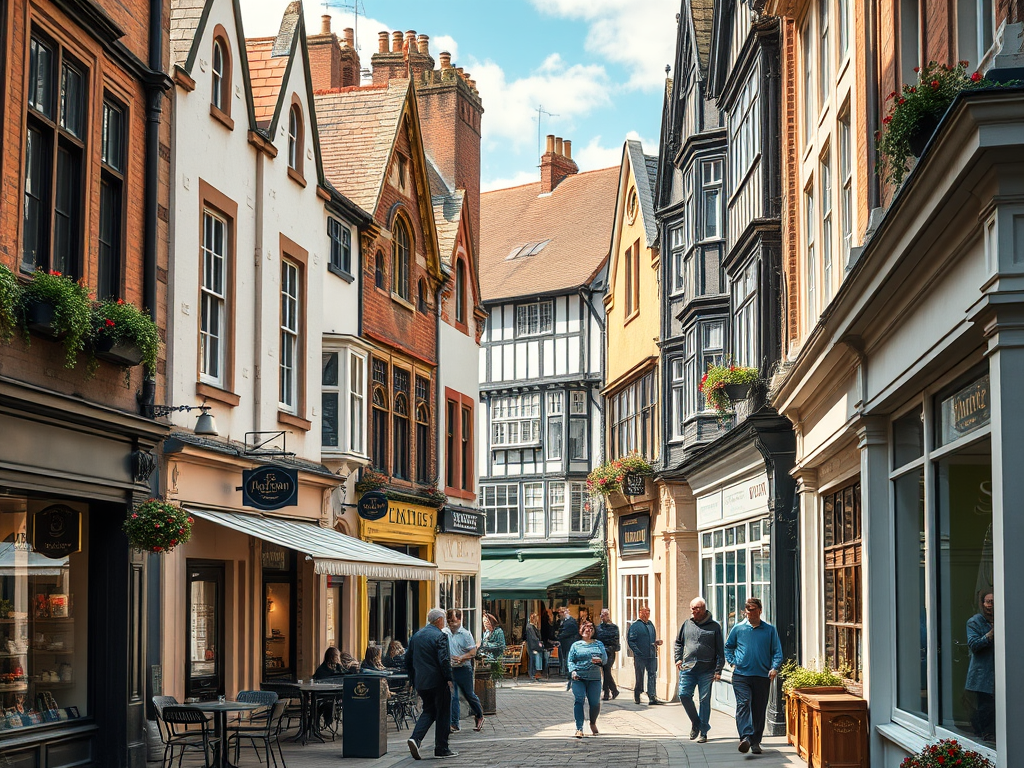
The function of the High Street is no longer that captured in Victorian photographs. The butcher, the baker and the candlestick maker. This Dickensian Street scene maybe nice to look at as a novelty. It hardly makes sense unless the intention is to preserve a museum like atmosphere.  

Our town planning can still be caught up a sort of Victoriana. Intent on preserving the line of shops that has existed since the traction engine replaced the horse. It’s nice to see, centrally placed, a traditional coaching inn, but even they survive as restaurants serving specialised cuisine or dusty antique shops.

So, what to do? I have a couple of themes. One is community identity. Another is facing the reality of the on-line world, and another is to bring everyday life back into centres.

Avoiding the bland mediocrity of modern design[1] should be up there high on the list. Future generations will castigate us we leave them such dull ordinariness as to make them look away. Every place has a story. It’s not a question of packaging that story up as a museum exhibit. It’s more a question of making a 21st century interpretation of a history.

Embrace the on-line world. It’s not going away. I don’t say hordes of flashing lights and screens the size of houses. No, let’s be a less crass. Free high-speed connections ought to be in the heart of our communities. Innovative thinking like portals[2] between centres offers opportunities. Even if these must be carefully managed. Connecting places creates new experiences.

There’s often a tussle between the wish to bring living spaces back to High Steets and the demands of the night-time economy. People make spaces work. That could be window boxes full of flowers or tables out on cobbled streets on a moon light night. What’s clear is that public transport, infrastructure, and affordable housing are a must.

More effort is needed to square this circle. Make sure a good life can be lived in a centre but at the same time it be welcoming to visitors. That’s tough for designers and planners but that’s where they should aim.


[1] https://www.prospectmagazine.co.uk/essays/42227/the-duel-has-modern-architecture-ruined-britain

[2] https://time.com/6977881/dublin-new-york-city-portal-temporarily-shut-down/

About Animals and Flying

Pigs do fly[1]. But only the more privileged ones. Yes, animals that fly are not restricted to those with their own wings. It’s true that the animal kingdom has been showing us how to fly long before powered flight took-off. Nothing more graceful than a bird of pray swooping and diving. We (humans) can’t match much of what they do with our flying machines however hard we try.

Birds long inspired great thinkers. They opened the prospect of human flight. If they can do it – why can’t we? Surely the right combination of aerodynamic structures and a source of power would solve the problem. Shocking, in a way, that it wasn’t until a couple of keen bicycle repair men and a smart mechanic persisted until they had a working machine. That was only just over a hundred years back.

So, today’s novelty News item[2] of a cat that didn’t want to leave an aircraft puts a smile on my morning face. For all the farm cats I have known, the story doesn’t surprise me at all. It’s the sort of situation where humans are almost powerless in the face of the preferences of a feline.

Naturally, the engineering staff of an airline will have a good look at where the cat has been in its wanderings. There’s always the remote chance for a rogue moggy to play with something they shouldn’t ought to play with. Even on a modern Boeing 737.

I used the word “remote” but there are definite cases of loose animals causing air safety hazards. Looking this one up, because it sits vaguely in my memory, I do recall a dog that crewed through electrical cables after it got free in a cargo hold. Now, however lovable and cuddly a dog maybe that’s a place that no one wants to be in.

Back in 2002, American Airlines Flight 282 approached New York’s JFK. It was a Boeing 757 that landed with chewed-up electrical cables. Crew members heard noises coming from the cargo hold and found that some aircraft radio and navigational equipment wasn’t working. A dog had chewed its way through a cargo bulkhead and attacked wires in an electronics compartment. 

A quick search reveals that there are more cases of incidents caused by loose animals than might first be thought. Animals are potentially hazardous cargo. Sadly, often these flight incidents are not good for the animals concerned.

One thing to remember is that a large aircraft, at flight altitude, is pressurised. That’s not at the air pressure on the ground (unless an airport is a long way up a mountain range). A dog with breathing difficulties is going to find an aircraft environment distressing. Dogs can be skillful escape artists. Myself, I’m not keen to share a flight with them.


[1] https://intradco-global.com/livestock-transport/

[2] https://www.thesun.co.uk/news/33273791/cat-causes-chaos-ryanair-plane-rome/

Investigating the Black Hawk and American Eagle Collision

What’s mysterious about the recent tragic collision between a US Army Sikorsky UH-60 Black Hawk helicopter and the American Eagle Flight 5342, was the failure of the normal procedure of “see and avoid” and the lack of an avoiding manoeuvre from the helicopter[1].

Taking the timings from reports of the investigators’ work so far, the air traffic controller’s instruction to the military helicopter to pass behind the commercial jet was seventeen seconds before the catastrophic collision impact. Given the trajectory of the commercial jet, as the pilots were focused on a landing, they had little possibility for an evasive manoeuvre other than a go-around. I imagine the commercial pilots and the tower controller reasonably assumed that the military helicopter would comply. In fact, why would they have any reason to question that assumption?

A question has arisen about night-vision goggles. Were the crew of the military helicopter using these devices? Night Vision Imaging System (NVIS) are not new[2]. They are used in both in military and commercial flying. There are a series of technical requirements that address their safe use. For commercial flying helicopters, that use such visual systems, they must additionally be equipped with a Terrain Avoidance and Warning System (TAWS). 

One of the down sides of night-vision systems are that the greatly enhanced capability can lead to overconfidence and potential misjudgements by pilots. When used by pilots these systems amplify ambient light and thus help pilots maintain visual references. That’s good for night flying over difficult terrain at low altitude. It’s not so good when there are multiple bright light sources all around, as there are in a big city.

I’m sure that the accident investigators will be giving the above subject a great deal of consideration. Afterall, the evening of this tragic accident was one of fine weather and fair visibility. The investigators have a significant task ahead analysing data and verifying the performance of both humans and machines in the accident situation.

NOTE 1: Worth a watch https://youtu.be/hlMTpIAlpw0

NOTE 2: Key safety system off in Army helicopter that collided with American Airlines jet, senator says | Reuters

NOTE 3: Night Flying “there are factors that can make it more challenging, like the lack of visual references and encountering visual illusions”. Flying into the Dark. What You Need to Fly at Night | by FAA Safety Briefing Magazine | Cleared for Takeoff | Jan, 2025 | Medium


[1] Evidence of a last-minute manoeuvre may still come to light. Sadly, the outcome remains the same.

[2] https://skybrary.aero/articles/night-vision-imaging-system-nvis

Advancements in Flight Recorder Technology and Regulations

My last posting addressed accident flight recorders and airworthiness requirements. That’s not enough. It’s important to note that aircraft equipage standards are addressed in operational rules. So, the airworthiness requirements define what an acceptable installation looks like but as to whether an operator needs to have specific equipage or not, that’s down to the operational rules in each country.

Internationally, the standards and recommended practices of ICAO Annex 6 are applicable. These cover the operation of aircraft. Flight recorders are addressed in para 6.3.1. and Appendix 8. Let’s note that ICAO is not a regulator. There are international standards but operational rules in each country apply to each country’s aircraft.

One of the major advances in accident flight recorders technology is the capability to record more data than was formerly practical. This has led to standards for Cockpit Voice Recorders (CVRs) advancing from 2-hour recording duration to 25-hours.

Proposed rule changes have been hampered by the impact of the global pandemic. Some new operational rules apply only to newly built aircraft. That means some existing aircraft can retain their 2-hour CVRs.

Another technology advance is what’s known as Recorder Independent Power Supply (RIPS). RIPS can provided power to the CVR for at least 10 minutes after aircraft electrical power is lost. The RIPS is often offered as a relatively straightforward aircraft modification.

I do not know if the South Korea Boeing 737-800 was required to have accident recorders with the capabilities listed above. If they were not, then there’s a good basis for recommending that changes be made to existing aircraft.

Fatal Boeing 737 Crash in South Korea

Jeju Air Flight 7C2216, arriving from the Thai capital of Bangkok, at South Korea’s Muan Airport (MWX), crashed at around 9am local time (00:00 GMT/UTC) on Sunday, 29 December 2024.

My condolences to the families and loved ones of those who died or were injured in this fatal aircraft accident.

Pictures of the Jeju Air Boeing 737-800 landing[1] show that no landing gear can be seen deployed. A video image shows the aircraft skidding down the runway at high speed. The aircraft is wings level. It is reported the aircraft overrunning the runway and colliding with a wall or ramp. The video image does suggest that the aircraft engine thrust reversers were deployed. This is wrong. Weight on wheels is needed for deployment.

MWX runway 19 has a Landing Distance Available (LDA) of 2800 m. The local visibility was reported as 9000m and the wind speed at 2kt.

Was the pilot in command trying to go around? The accident flight recordings should answer this question. That is from the aircraft Flight Data Recorder (FDR) and Cockpit Voice Recorder (CVR).

This remains a hope. Reports are that the FDR has been damaged. This should not be a surprise given the nature of the impact it suffered. However, both FDR and CVR are designed and tested to survive extreme cases.

The South Korean Ministry of Land, Infrastructure and Transport says that the accident flight and voice recorders have been recovered[2].

Jeju Air is a popular South Korean low-cost airline. The airline was established in 2005.

A full independent accident investigation will no doubt take place. That is in accordance with the standards and recommended practices of ICAO Annex 13.

Current media speculation surrounding possible causes of this Boeing 737 accident do not offer any satisfactory explanation for the sequence of events. For example, it would be astonishing if the root cause of the accident was a bird strike or multiple bird strike shortly before landing. The aircraft has several means to deploy its main undercarriage.

It is likely that safety culture, controller and pilot training, and airport facilities are bigger factors in this fatal accident than the fact that it involved the loss of a Boeing 737-800 aircraft.

NOTE: Boeing 737 “If the gear fails to extend properly or hydraulic system A is lost, the gear can be manually extended by pulling the manual gear extension handles, located in the flight deck.” Landing Gear

POST: The impact test in the applicable technical standards EUROCAE ED55 (FDR) and ED56A (CVR) are demanding. The recorder’s crash protected memory module is fired out of a canon into a shaped target to simulate an accident scenario. It must be readable afterwards.


[1] https://www.independent.co.uk/tv/news/south-korea-jeju-air-crash-b2671085.html

[2] https://www.bbc.co.uk/news/live/c4glr85l2ldt

SONAR in Ocean Wreckage Recovery

Finding aircraft wreckage in the deep ocean is possible. However, it requires a degree of good fortune. Most of all, it requires the searcher to look in the right places. Lots of other factors come into play, particularly if the ocean floor is uneven or mountainous.

The primary tool for imaging the ocean floor is SONAR. That’s using the propagation of sound in water. SONAR can be of two types. One is called “passive” and the other called “active”.

The first case is like using a microphone to listen to what’s going on around. Of course, the device used is named appropriately: a hydrophone. It’s a device tuned to work in water and not air. Afterall, sound travels much faster in a liquid than it does in air.

Passive SONAR depends on the object of interest making a noise. Just like we have directional microphones so we can have directional hydrophones.

Passive SONAR is only useful if the aircraft wreckage is making a noise. Since in the case of Flight MH370, the battery powered underwater location beacons attached to the accident flight recorders have long since stopped working this kind of SONAR isn’t going to be much use.

Active SONAR is analogous to RADAR. That is where a pulse of high frequency sound is sent out through a body of water. Then sensitive hydrophones pick up a reflection of that pulse. It is detected and all sorts of miraculous digital signal processing is done with the acoustic signal, and an image is then formed. From that displayed image the human eye or sophisticated algorithms can make sense of what they are looking at on the sea floor.

Active SONAR can give both range and bearing (direction). Timing the sound pluses from their transmission to reception can give a way of calculating range. Or distance from the object providing a reflection. Bats know how to do this as they navigate the dark.

In sea water, there are complications. Sound does not always travel in a straight line in sea water. The speed of sound in water depends on salinity, temperature and pressure. All three of these factors can be measured and compensated for in the SONAR signal processing that I mentioned above. Helpfully at ocean depths beyond a kilometre the calculations become easier.

The average depth of the Indian Ocean is over 3 kilometres. It’s mountainous underwater too. So, what are the chances of finding flight MH370 on the ocean floor after 10-years[1]? This prospect goes back to my earlier comment. It requires the searcher to look in the right places.

Just imagine encountering the Grand Canyon for the first time. It’s nighttime. An important object is lost in the canyon. You only have the vaguest theories as to where the object has come to rest. With a handheld touch you go out to search. What are the chances of finding the object?

There are several factors that are in your favour. One, you know what the object might look like or, at least, in part. Two, the easy search locations (flat/smooth) may be covered relatively quickly. Three, certain areas of the rocky canyon have already been searched. Still the odds are against finding the lost object without a high degree of good fortune. 

I wish the new planned searchers much good future[2].

NOTE 1: one of my student apprentice projects was to design and build a Sing-Around Velocimeter for use in relatively shallow sea water[3]. It worked but was cumbersome in comparison with the simple throw away devices used for temperature depth profiling.

NOTE 2: To get down to the ocean depths required it’s a side-scan sonar that may be used. This active sonar system consists of a towed transducer array that can be set to work at different depths. Imaging objects on the seafloor and underwater terrain is done as a towed array moves slowly forward through the water. The scanning part is the acoustic beam sweeps left and right. Each scan builds up part of an image.

In operation, as the frequency of the sound in water goes up so does the resolution of a potential image but, at the same time, the range of the sonar system goes down. Thus, a sonar system used for surveying may have low and high frequency settings. Unlike sound in air, here high frequency means above 500kHz.

NOTE 3: What will an aircraft accident recorder look like after a decade in the deep ocean? It might have survived well given the nature of the dark cold pressured environment. This picture is of an accident recorder recovered from relatively shallow sea water (Swiss Air Flight 111).

POST: Nice view of what SONAR can do, at least in shallow water Bristol Beaufort wreckage found


[1] https://www.cbsnews.com/news/mh370-plane-malaysia-new-search/

[2] https://www.bbc.co.uk/news/articles/cewxnwe5d11o

[3] https://apps.dtic.mil/sti/tr/pdf/AD0805095.pdf

MH370 and MH17: A Decade On

The unthinkable happened in 2014. One major international airline suffered two catastrophic accidents. These tragic events ran contrary to all the trends in historic aircraft accident data.

In March, flight MH370 disappeared. In July, flight MH17 was shot down. In both cases there were no survivors from these international flights. This remains an unprecedented situation. It is a sobering consideration that such dreadful events were possible in a mature international framework of civil aircraft operations and regulation.

A decade on the pain of those who lost friends, family and colleagues in these tragedies is not diminished. Aviation should not lessen its attention to discovering more about what happened and putting measure in place to prevent reoccurrence of these events.

These two aviation catastrophes are different in respect of causal factors. One remains a mystery but, from what is known, has the hallmarks of an operational accident. The other is undoubtably an aggressive malicious act. Failings in the two elements of aviation safety and security, often viewed separately, are both capable of catastrophic outcomes.

Malaysia Airlines was a State-owned airline in the traditional model. There’s no reason to suppose that the airline harboured deficiencies that led directly to the two fatal accidents. In hindsight, the question is often asked: could both accidents have been avoided?

The extensive underwater search for MH370, in the southern Indian Ocean, resulted in no findings. However, floating debris from the fateful Boeing 777-200ER was discovered. Unlike what happened with Air France Flight 447 were the installed accident flight recorders were recovered from the deep ocean, there has been no such good fortune in respect of MH370.

Accident flight recorders are one of the primary tools for accident investigators. Installed recorders are built and tested to withstand extreme conditions. The reasonable assumption being that they will be found with any aircraft wreckage. The accident of MH370, is one where a deployable recorder may have been beneficial. That is one that ejects from an aircraft when it is subject to the high impact of the sea surface and then floats, possibly away from an accident site. There is a good case to be made for installing both deployable and installed recorders[1]. Particularly a case for long-range international overwater aircraft operations.

The facts surrounding the criminal act of shooting down of flight MH17 are well established. Sadly, in a troubled world it is impossible to say that such malicious acts will never occur again. What is to be done? Avoidance is by far the optimal approach. Commercial flying over warzones, where heavy weapons are known to be used, is extremely foolish. Now, it is good that much more flight planning attention is paid to understanding where conflict zones exist[2].

NOTE 1: On 07 March 2014 at 1642 UTC1 [0042 MYT, 08 March 2014], a Malaysia Airlines (MAS) Flight MH370, a Beijing-bound international scheduled passenger flight, departed from KL International Airport [KLIA] with a total of 239 persons on board (227 passengers and 12 crew). The aircraft was a Boeing 777-200ER, registered as 9M-MRO.

NOTE 2: On 17 July 2014, at 13:20 (15:20 CET) a Boeing 777-200 with the Malaysia Airlines nationality and registration mark 9M-MRD disappeared to the west of the TAMAK air navigation waypoint in Ukraine. All 298 persons on-bard lost their lives.


[1] https://flightsafety.org/files/DFRS_0.pdf

[2] https://www.easa.europa.eu/en/domains/air-operations/czibs

Exploring the Kennet & Avon Canal

It’s the road to the west. The A4 out of London heads towards the west. It’s younger but bigger brother the M4 motorway goes the same way. Going the same way too is the Great Western railway and before that a major waterway, a canal. I guess the ancient roads predate the lot of them given that east-west traffic is an important part of English history. Certainly, the Romans went that way.

I now live at what is roughly the halfway point between London and the west. It’s where what is largely a level route from London starts to rise at a slow pace. That climb made linking rivers, most particularly the London Thames and the river Avon in the west, a challenge. The incentives were evident. So, much potential for trade. Moving heavy commodities around. Canals are truly visionary engineering infrastructure and now an inheritance that’s much treasured.

For people who like to walk, like me, canal towpaths[1] provide flat route between towns. A direct waterside route that wanders through lush countryside. Yesterday, I did the 15km between Newbury and Hungerford. Along that stretch, the Kennet & Avon Canal raises about 150 feet but it’s almost unnoticeable. The main signs are the difference between the fast-flowing waters of the river Kennet and the sober slow canal. A littering of canal locks and small brick-built bridges are a feature too.

The Kennet & Avon Canal was constructed between 1795 and 1810. It was eventually killed-off as a commercial enterprise by the construction of the Great Western railway. Being cheaper and faster along the iron road, transport of goods by water couldn’t compete. It’s in this modern time that the canal was restored. It’s been working again for the last 30 years. Now, it’s a centre of leisure pursuits, small businesses and alternative lifestyles.

The canal’s path follows the River Kennet and its narrowing flood plain. I found looking at how the waterflow is controlled by sluice gates and weirs a fascinating part of the walk. Ambling along the canal’s towpath is a great way to venture into the Berkshire countryside. There are a couple of points where the path changes sides and it’s a bit soggy in one or two places but overall, it’s relatively easy walking.

I did see an Otter on the opposite bank. It was a fleeting glimpse. He, or she, slinked away almost before I realised what I was looking at. Quite different from noisy ducks this Otter made virtually no sound or ripples on the water. 

Dotted along the canal near bridges, decaying concrete World War II-era pillboxes are a reminder that this would have been a defensive line if Britain had ever been invaded.

The walk took me under 4 hours. I was exceedingly fortunate with the weather on the day. A cool breeze and intermittent sunshine. Not bad for November.


[1] https://canalrivertrust.org.uk/things-to-do/walking

Travelling Post-Brexit

Ever since Brexit, I’ve had to have my passport stamped in and out of European countries. It’s like a reversion to the days when I got my first British passport. That was back in the late 70s.  It has a frighteningly youthful picture. Occupation – student.

I’m not so phased by the coming changes to European Union (EU) border controls. Naturally, it’s worth asking if Britian has become a more dangerous nation since the time before Brexit when we enjoyed freedom of movement. It’s a pity we didn’t value that freedom a lot more. It was thrown away far too easily.

Today, the electronic border controls expect us to stare at a camera. A securely held, I hope, database is used to check a list of biometric numbers against my image. I guess that’s a sure-fire way of saying that Mr Blogs is indeed someone who looks very much like Mr Blogs. Facial recognition technology has come a long way.

The next steps in tightening-up controls will be fingerprinting[1]. Not in the manner of Sherlock Holmes, with an ink pad. No, in the digital age an ominous machine will scan our fingers and check its records to see that not only does Mr Blogs look as he should but that he’s got the essential characteristics of Mr Blogs.

Certainly, in this new regime British citizens will not be able to overstay in European countries. Ones travel records will be a lot more quantifiable and precise than stamping a piece of paper. That is assuming such digital border control machines will be relatively error free.

One of the benefits of Brexit is that it will be easier to track the movements of British criminals in and out of the EU. The reciprocal will not be true. It will not be easier for British authorities to track continental European criminals in an out of the UK.

Ah the luxury of being a Third Country. Longer ques. More uncertainty. Less privileges.

What’s more is the introduction of the new EU border control systems will be “phased[2]”. This change will not be one big bang. So, different ports and airports will be doing different things at different times. Now, it doesn’t take a genius to see that confusion is most likely.

Travelling in 2025 is going to be more than the usual adventure.


[1] https://commonslibrary.parliament.uk/the-eu-entry-exit-system-and-eu-travel-authorisation-system/

[2] https://www.independent.co.uk/travel/news-and-advice/eu-biometric-border-fingerprint-entry-delay-b2627645.html