Relationship with the EU

Monday, Monday[1]. It’s a wonderful 60s song. Harmonies and mood are perfect. I wonder if the harmonies and mood will be perfect for the Prime Minister (PM) on Monday. Already the Sunday Press are setting the stage for Monday’s performance.

Reset, recalibration, reheat, rekindle, re-whatever. It’s a moment when relations between the UK and the European Union (EU) can make realistic progress[2]. In world full of uncertainty (could be a song in that one), for once the direction of travel is a constructive and positive.

I think the word “deal” is getting overplayed. Indications are that there’s no fundamental shift from Brexit meaning Brexit, as one former PM liked to say. In fact, the current PM is being highly cautious in the light of his Party’s reading of the latest opinion polls. For no sane reason I can think of, the swivel-eyed loons of the far-right are making hay.

It’s astonishing me how dim-witted the Conservative Party is in objecting to something when they don’t even know, for sure, what it is. Mind-blowing. And the rum cult of Reform Party doing the same with extra bile. What a load of prehistoric fruit loops.

Brexit supporters are spreading misinformation, again. Saying that UK has no influence. It’s true, the UK doesn’t have votes in the European Council or Parliament, but significant influence can be exercised on standards, and regulatory guidance, nevertheless. A better “deal” can bring much greater influence. Absolutely vital in the digital world, and for the UK, a country with a services-based economy.

Brexit has cost the UK dearly. The UK Treasury would have billions more in its coffers if the 2016 referendum had never taken place. The standard of living of every person in the UK is lower because of Brexit bungling. Ideally, that great mistake is an event to be written up for the history books and then forgotten.

On top of the above, uncharacteristic moves in the US, with Trump tariffs there’s nasty hit at the UK’s future prosperity. There couldn’t be a better time to repair relationships with the UK’s nearest neighbours. The countries with which we share most of our long history.

Even for those on the political right, practically, the EU is never going away, so until the day the UK rejoins the block, it’s wise to have the best possible relationship in all matters. Goods, services and people need to connect as a case of mutual benefit.

It’s time for hope. An optimistic tone should be set. A smile. Let’s hope we are singing Monday, Monday so good to me, Monday morning was all I hoped it would be. Naturally, that there be no crying, come Monday evening.


[1] https://genius.com/The-mamas-and-the-papas-monday-monday-lyrics

[2] https://www.independent.co.uk/news/uk/politics/brexit-uk-eu-reset-trade-deal-starmer-b2752285.html

Sustainable Aviation: Innovations and Challenges

Gas guzzling continues to be one of aviation’s problems. Combustion remains that the heart of most aircraft power plants. Taking large amounts of fossil fuel. Squeezing energy out of every drop of gasoline. Gobbling up more day after day. Pushing out emissions.

As I look out across the garden, I see gliding effortlessly as the warm air rises, a Red Kite[1] gracefully circling. Wings outstretched they hardly move them as they climb. They’re a distinctive small bird of prey, easily spotted because of their forked tail. Now, that’s what I call efficient flying. Using all that nature provides and wasting little energy.

Human attempts at flying are a million miles behind these magnificent birds. There’s still so much to learn about aerial navigation. It’s a matter of control. The sensing of ambient conditions and the precision movements needed to ascend and dive at will.

The search is on for effective change. There’s no pretence that the way commercial aviation operates is unsustainable. It’s true that the gas guzzlers of the air guzzle less gas now than they ever have but the physical facts remain.

None of this is new. I’m about to send a book called “Towards Sustainable Aviation” to a charity shop. It’s not that there’s anything wrong with it. The book is full of pertinent analysis and observations. Trouble is that it’s dated 2003.

I’m led to ask – what’s changed in over 20-years? In answering my own question – quite a lot but not enough. Discourse has moved on from academic quarters to the political sphere. Aircraft have become more fuel efficient. Driven by economic imperatives as much as any concern for the climate. Research initiatives are generously funded to come up with answers. Solutions like hydrogen, electric propulsion, and SAF (sustainable aviation fuel) are slowly moving from theory to practice. A few prototypes are flying. Limited supplies of SAF are flowing.

Unmistakable that’s where the problem lies. For all the hype, policy and government funding the pathway to genuinely sustainable aviation disappears way off into the horizon. There are setbacks too. Gas guzzling is back in fashion. Certainly, in Trump’s America.

We could make a much more of the technology that’s currently available. Yes, there are costs involved. Change is not a free ride. That said, sticking with the status-quo isn’t free either. Legacy costs mount up. One reason why older jets disappeared from fleets so quickly.

The next generation of commercial aircraft must make major steps forward. Since the life of a typical aircraft type can easily extend to 30-years, then change must happen in design now.

Typically, commercial aviation moves with graduated change. There’s an inherent conservatism in the system, as might be expected when safety and security are paramount. Facing this global challenge, there’s a need for a degree more radicalism.

Since high impact disruption is also in fashion, it’s time for airlines and manufacturers to adopt a pioneering spirt. It’s been done before. In the 1960s, that pioneering spirt gave us the Boeing 747, the Jumbo jet. That opened flying to a whole generation.


[1] https://www.rspb.org.uk/birds-and-wildlife/red-kite

Exploring a Riverside

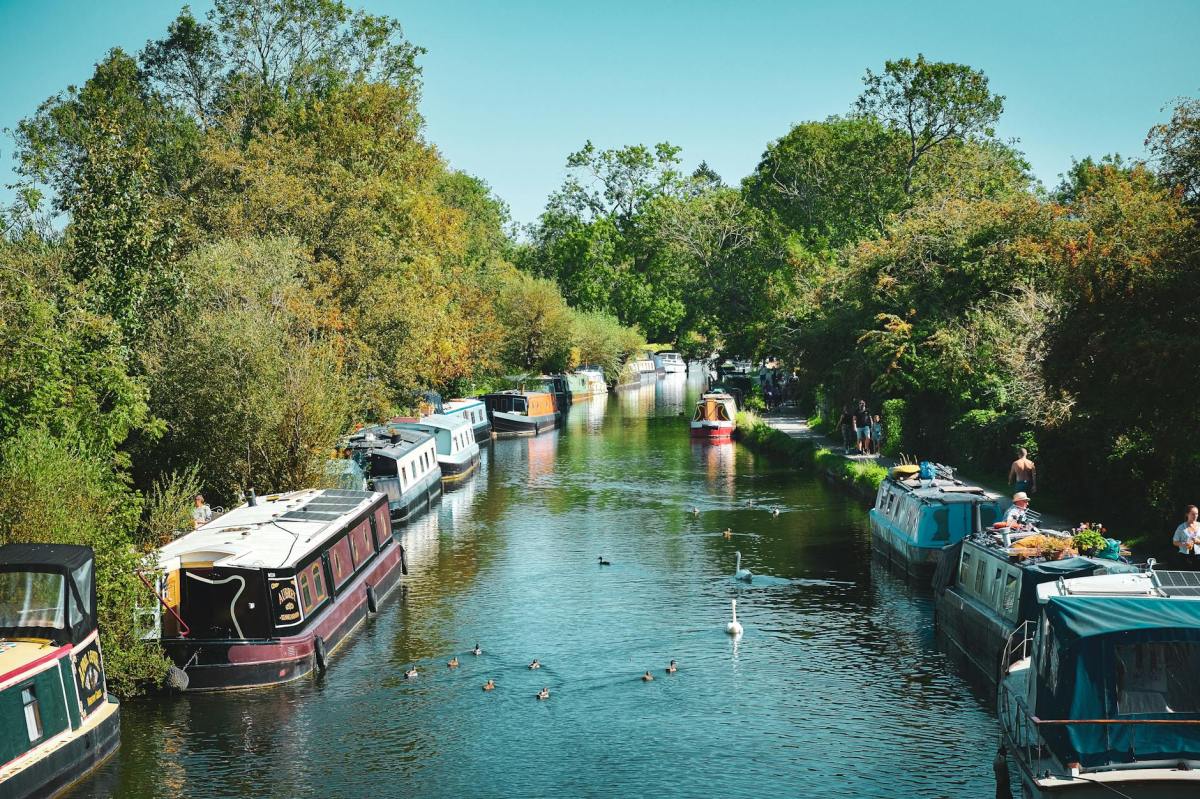
Riverside walks can be pleasant ways of spending a sunny spring evening. That’s what I did on Friday. Sun shining with a cool breeze sweeping through the trees. Underfoot even the unmade-up paths were dry, which is testament to the rainless weather of recent weeks. Even so, the riverbank showed signs of the flooding of the winter.

Reading is a town[1]. It’s England’s largest town. Now, I didn’t know that until I looked it up. The largest English town that I’ve been familiar with over the years is Crawley in Sussex. I think of that as a large town but it’s less than half the size of Reading. It’s the railway that makes Reading. Reading railway station was the last stop on the Great Western Railway (GWR)[2] when it was first opened in 1840. After that the railway forged west to be what we know now as the main thoroughfare across southern England.

Reading town has a long history. That’s no surprise given its position on the river Thames. It’s where the river Kennet, the canal and the river Thames meet. An obvious place for trading since Roman times. It’s a commercial town. Glass sided office blocks and Victorian brick work. For all that it doesn’t stand out as an architectural masterpiece.

Another surprise for me was leaning that town twinning is alive and well. That Reading in twined with Düsseldorf in Germany. A city more than twice the size of Reading. In fact, until this last year, I’ve been more familiar with Düsseldorf.

Our walk ended at The Fishermans Cottage[3]. I’m happy to recommend this small riverside pub.

From there, on the walk back to the railway station I did see the one of the more notable sites in Reading. That’s the Banksy’s Great Escape artwork[4] on Reading prison wall. Oscar Wilde spent time in that jail. The artwork has got a Perspex cover to keep the pigeons off. And anyone else who might think of spraying it.

That reminds me. It’s not unusual to have a phobia about dogs. Although dog owners mostly have a difficulty in getting their heads around the fact. On my riverside walk dogs were not the problem. Amongst our small group of walkers had a different phobia.

As we got to the confluence of the Thames and the Kennet, we discovered the phobia of one of our walkers. Alfred Hitchcock would approve. The Kennet’s tow path attracts Swans. These Swans are attracted by people with food. With no inclination to get out of the gently flowing river these lazy Swans wait for passers-by to pay attention to their needs. That’s no problem.

It’s called Ornithophobia. A fear of birds. Birds flock when free food is on offer. The worst of these can be thought of as flying rats. I talk of pigeons. That how I think of pigeons. Tom Lehrer[5] had the right idea about these annoying birdies. Frightening them away, at least for a moment, cleared our pathway. Like a flash they returned as we strolled into the pub.


[1] https://www.reading.gov.uk/

[2] https://www.gwr.com/stations-and-destinations/travel-inspiration/blogs/history-of-the-railways

[3] https://www.tripadvisor.co.uk/Restaurant_Review-g186363-d7363678-Reviews-The_Fishermans_Cottage-Reading_Berkshire_England.html

[4] https://banksyexplained.com/create-escape-march-2021/

[5] https://youtu.be/yhuMLpdnOjY

Cities Shaped by War

War is failure. Humans being quick to aggression, possessive and slow to reconciliation, it’s plagued every corner of history. Reason to go to war can be imperial, territorial, moral or ethical. In a democratic society, defeating an evil becomes an overwhelming imperative. That was certainly the case in the six years of the second world war. This week, it’s time to look back. To recollect the impact of the world war. To remember the sacrifice and suffering. To be thankful for the last 80-years years of relative peace in Europe.

For me these recollections take me to the experience of living in two cities. Cities on different sides of past conflicts. Severely damaged by the conflict. Targets because of their civic and industrial strength. Both cathedral cities with an ancient heritage.

My student life was spent in Coventry[1]. A decade of my working life was spent in Cologne[2].

Arriving as a fresh-faced student in the heart of the industrial Midlands, the architecture of Coventry city centre was so striking. It was that post-war vision of rebirth at a time when economic decline had set in. With an inner ring-road that was like a go-cart track, 50s style concrete avenues, windblown and neglected, there was little of the Medieval splendour of the pre-war city remaining. Standing proud in the middle of it was, and is, the skeleton of the old cathedral and the new one that ascended like a phoenix from the flames of war. Well worth a visit, the cathedral built in the 60s is a wonderful modern design. It plays with light and space to elevate emotions. A sign that we have a great capacity for reconciliation and regeneration.

Moving on just over 20-years, my encounter with Germany’s fourth largest city was full of hope and optimism. Based in Cologne, I experienced a city with even deeper roots than Coventry. Ironically, it was the destruction of the war that uncovered much of the Roman remains on display. At Cologne’s heart is a magnificent gothic cathedral that is more dominating of the landscape than perhaps ever it has been. Here the citizens of the city took a different approach to post-war rebuilding. Not so much embracing everything that was new, although there’s quite a bit of that approach, but reconstructing the old city in its original style. The culture of the city survives in the traditions of the annual carnival.

These two European cities have taken different paths. All the same, there are threads of common experience. Both have seen industrial decline and a search for a better future to thrive and grow. Both are distinctive and culturally colourful. Both carry the baggage of a brutalist architecture that was fashionable on the drawing boards of the late 1950s.

Visting the past in museums and walking the streets the marks of the last war are there to be seen by everyone. Passed by every day. Yet, mostly ignored in the humdrum of commuting and the busy obsession we have of staring at a “mobile” or call it a “handy”. Now and then it’s as well to look up. To look and see the bullet marks on stone structures, the nicely arranged medieval or Roman stones and cobbles, or the conserved streets that contain the ghosts of past generations. For good or ill, war has shaped the world we inhabit.

Peace is a far far better condition. I think of the “Coventry Cross of Nails[3]” as a symbol of reconciliation and peace. Let’s not forget.


[1] https://www.coventry.ac.uk/

[2] https://www.koelner-dom.de/en

[3] https://www.coventrycathedral.org.uk/reconciliation/community-of-the-cross-of-nails

Travel’s Societal Impact

Privilege is all around us. It’s, by definition, not equality. It’s a privilege to live in a country not torn by war or where the environment has not been decimated. It’s a privilege to be able to protest and strongly disagree with the powers that be. Indeed, in this country it’s a right too.

Debates about the moral or ethical grounds of inequality will never cease. That’s a hope of mine. For the minute we become timid and cowed by an authority that would rather supress such debates, then that’s the end of our democracy. We’d be free no more.

A large part of my career has been in the aviation industry, in one way or another. Putting aside the military uses of aviation, that’s another debate, civil aviation and the travel industry are two peas in a pod. Flying facilitates travel. Largely international travel. Apologies to the cargo industry, leisure flying and so many others.

One phenomenon that is not new, is that of raising the issue of responsibility. For example, the consequences of tourism to natural environments are often negative. Not always so. Huge effort is made by some countries and organisations to make tourism a positive. However, generally there are significant challenges to be grappled with in making travel affordable for all.

Wealthy young Europeans have been roving across boarders as part of a rite of passage since the 1600s. A “Grand Tour” was a form of discovery, education and cultural enrichment. Today, a student might call that a gap-year. Time taken out of formal studies to travel abroad. The aim, as well as having fun, is to return a more rounded person ready for whatever life might throw up.

Where do we sit as a society in terms of the balance between personal freedom and our collective responsibilities? Are activists right to attempt to slam or shame travellers for the negative impacts that they can trigger? These are uncomfortable questions. Ironically, these difficult questions are often raised by the people who have enjoyed the privilege of travel.

In my mind, a debate on this subject of balance reflects greater societal issues. When we look at a basic hierarchy of human needs then international leisure travel may not be top priority. However, life would be less rich and colourful without it. Embarking on an epic journey, that takes a traveller outside their comfort zone, can be a life changing event.

To defend the freedom to travel, I cannot avoid looking at the other side of the equation. There is an overwhelming responsibility to do something restorative. Ignoring the impact of travel, particularly civil aviation, is not an option anymore.

I know there are some politicians who scream for the abandonment of Net Zero policies and all they entail, but they are extremely foolish. Shifting the burden onto future generations is reckless. Appealing to those who want to escape the debate, or force a return to mythical age, is nothing more than doomed short-termism.

This is one reason I’m an advocate for electrification and the exportation of radical solutions, like hydrogen powered civil aviation. Technological solutions are part of the path to take. That, in of itself, may not be enough but at least engineering change is permanent.

Solutions by design are far more powerful than ephemeral political posturing. Legislation can be overturned in a weekend. A whole new way of operating aviation can be sustained for decades.

Communication Prevents Disasters

It’s often forgotten that there’s a need to repeat messages. We are not creatures that retain everything we see and hear. There are exceptional people, it’s true, those who cram away facts and have an amazing level of recall. Often that’s my reaction to watching students leading teams on University Challenge[1]. How on earth do they know those obscure facts?

Most of us do not respond well to those who say, “Well, I told them once. I’m not going to tell them again.” That line is probably one of the most misguided utterances a teacher can make. Like it or not, this approach is part of our heritage. Past ages, when deference was expected, listening was mandatory, and misremembering was entirely the listener’s fault.

We’ve had a cultural shift. Our complex technological society doesn’t work in a command-and-control way. Too many disasters can be traced to miscommunications and misunderstanding. Now, the obligation exists on those delivering a message to go some way to ensure that it’s received with a degree of comprehension. That’s when repetition has a role to play.

One of the pillars of Safety Management Systems (SMS) is Safety Promotion. It’s the Cinderella of the aviation safety world.

Why do I say that? Experience for one. It’s much easier to get policy made and funding for the “hard” sciences like data acquisition, analysis and decision-making systems. These are often perceived as providing tangible results. Actionable recommendations that satisfy the need to be recognised as doing something. Even if that something is questionable.

Communication is key to averting disasters. It’s no good having pertinent information and failing to do anything with it, other than file it. The need to know is not a narrow one. Confined to a specialist few.

Let’s go back to 2003 and the Space Shuttle Columbia accident[2]. This craft was destroyed in a disaster that claimed the lives of its crew. The resulting investigation report is extremely compressive, if slightly overwhelming, but it has some key points to make.

To quote, “That silence was not merely a failure of safety, but a failure of the entire organization.” [Page 192]. In other words, the hidden concerns and internal machinations of an organisation can smother safety messages and led to failure. Since 2003, it’s sad to say that there are multiple occasions when what has been learned has been ignored. The impact has been devastating.

So, to shape the future let’s remember the Cinderella of the aviation safety. Discovering problems is not enough. It’s vital that practical solutions and good practice gets promoted. That needs to be done forcefully and repetitiously.

NOTE: This is, in part, a reaction to watching this video presentation. https://acsf.aero/an-unforgettable-closing-to-the-2025-acsf-safety-symposium-with-tim-and-sheri-lilley/


[1] https://www.bbc.co.uk/programmes/b006t6l0

[2] https://ntrs.nasa.gov/api/citations/20030066167/downloads/20030066167.pdf

My First US Adventure

Let’s wind the clock back. My first trip to the US. It was a big adventure. One that I’d recommend to anyone in their 20s. The trip was a Pam Am fly-drive affair. A travel package that took me and three friends from London Heathrow to Seattle and back. In 1981, I had no idea that I’d be returning to Seattle numerous times in the following decade.

I keep a personal flight logbook. It’s a simple way of keeping track of the dates, times and places. Memory can be unreliable. When 40 years or more has past recollections of individual trips get jumbled up. Although this one is difficult for me to mistake.

We took off in the afternoon and flew across the Atlantic on flight PA 123. Slightly being in awe of the mighty Boeing 747-100. It was the largest aircraft doing that route on a regular basis.

Sadly, the Lockerbie bombing occurred 7-years later to a similar transatlantic Pan Am flight. The airline that brought the Boeing 747 to life didn’t survive after that tragic event.

One of the advantages of being a sandwich student was the ability to earn. To put some money away. To have the funds to plan an exploration like this trip without depending on the bank of mum and dad. To keep the costs down the four of us shared a car, the driving and the motel rooms along the way. In fact, we had a detailed itinerary that didn’t leave much slack time at all. Our travel planning was meticulous. I’d even arranged to visit an offshoot of the Plessey company in the Los Angeles suburbs. It was a real eyeopener. A maker of precision metals for the aerospace industry.

We arrived in Washington State only a year after the deadliest volcanic eruption[1] in US history. Naturally, being the students we were, we drove as close to the devastated area as the open roads would let us. I took pictures of that too. Views of forests felled like matchsticks.

We packed an enormous amount into August 1981. Returning to our final year as soon as we got back. This trip always reminds me that if you plan well and are determined enough you can do a hell of a lot in a short time. We drove over 6000 miles and took in a lot of the West Coast.


[1] The Mount St. Helens major eruption of May 18, 1980.

Plug and sigh

Daily writing prompt
Jot down the first thing that comes to your mind.

Weird, I know. My first thought as I looked across my tatty desk. Cables are irritating. Even the alternative is irritating. Tapping away at this keyboard I’m tied by a slim black wire that runs off into a darkened place. If I had a wireless keyboard, I’d be doubly irritated. Sure, as eggs are eggs the battery would not be charged when I needed it to be charged. And I would have put the battery charger away in a box and forgotten where I’d put it.

They’re everywhere. Cables and connectors. This could be the century of the cable, much a the last one. Dam things are cash cows too. Companies like to extract the maximum consideration out of us. Our fantastically capable new tech is useless unless we dip into our pockets and buy cables with just the right connector[1].

Fine, there have been attempts to overcome this bond we have with wires. Wireless charging and wireless connections don’t always deliver what they say on the box. They can be as much faff as plugging in cables. Physics dictates those energetic electrons like conductors. When power is needed, travelling faster and further through wires. Whizzing along with the potential to do work wherever they end up.

If I take the bigger picture, the situation is not so simple. Wires dedicated to communication are going out of fashion. Once upon a time copper wires brough the telephone into the house. Now, that communication is optical. Light flashes to the tune of the ones and noughts we seek.

Getting power from A to B, storing it and using it as needed, there lies unending challenges. From the mega to the micro level. Controversies about huge electricity pylons straddling the countryside. To powering the lean electronics hidden in the plastic case of my keyboard.

Oh! I have slipped the surly bonds of wires. And danced the earth on laughter-powered things.

To borrow a poetic line on flying[2]. If only we could loose this bond forever. Unlikely as it seems. In my profession we contend with the fact that civil aircraft, where lightness equals profit, there’s between 100 and 200 miles of wires.

Let’s think. Will this be perpetual? Put aside all the steps that machines may advance, at some level they come down to wires and multiple connections. In a way, lucky for us. That means there will always be an off switch.


[1] https://newsthump.com/2018/05/21/man-decides-to-keep-box-of-cables-hes-has-since-2002-for-another-year/

[2] https://www.poetryfoundation.org/poems/157986/high-flight-627d3cfb1e9b7

Safety Analysis

In discussions about safety one model is often called up. Its simplicity has given it longevity. It also nicely relates to common human experience. The model is not one of those abstract ideas that take a while to understand. If you have been on a safety training course, a lecturer will give it couple of minutes and then use it to draw conclusions as to why we collect and value safety data.

On illustration, and it’s a good one for sticking in the memory, is a picture of a big iceberg. Most of an iceberg is underwater. One the surface we only see a fraction of what is there. This is the Heinrich pyramid. Or Heinrich’s Law[1] but it’s not really a law in the sense of a complete mathematical law.

The logic goes like this. In discissions about industrial major accidents, there are generally a lot more minor accidents that precede the major ones. Although this was drawn up in the 1930s the model has been used ever since. And we extend its useful applicability to transport operations as much as workplace accidents.

Intuitively the model seems to fit everyday events. Just imagine an electrical cable carelessly extended over the floor of a hanger. It’s a trip hazard. Most of the time the trips that occur will be minor, annoying events, but every so often someone will trip and incur a major injury.

What we can argue about is the number of precursor events that may occur and their severity. It wouldn’t be a simple universal ratio, either. Heinrich said there were generally about 30 accidents that cause minor injuries but 300 accidents with no injuries. A ten to one ratio.

Forget the numbers. The general idea is that of the iceberg illustration. Underlying that example of the pyramid is the notion that there are a lot more low severity events that occur before the big event happens. Also, that those low severity events may not be seen or counted.

It’s by attempting to see and count those lesser events that we may have the opportunity to learn. By learning it then becomes possible to put measures in place to avoid the occurrence of the most destructive events.

In British aviation I will reference the 1972 Staines air accident[2]. A Brussels-bound aircraft took off from London Heathrow. It crashed moments later killing those onboard. One of the findings from this fatal aircraft accident was that opportunities to learn from previous lesser events were not taken. Events not seen or counted.

Thus, Mandatory Occurrence Reporting[3] was born. Collecting data on lesser events became a way of, at least having a chance of, anticipating what could happen next. Looking at the parts of the iceberg sitting under the water.

How many fatal accidents have been prevented because of the safety analysis of data collected under MOR schemes? If only it was possible to say.


[1] https://skybrary.aero/articles/heinrich-pyramid

[2] https://www.bbc.co.uk/news/uk-england-surrey-61822837

[3] https://www.caa.co.uk/our-work/make-a-report-or-complaint/report-something/mor/occurrence-reporting/

The Curious Case of Lists

How on earth does a humble soul like me make any comment at a time like this? Adding to the realms of things already said seems a bit pointless. We now have echo chambers sounding in echo chambers. Instead, I’ll take a sideways look. Mention one or two of the items that struck me during the week.

Penguins are getting a lot of Press. Ever since Trump decided to slap a tariff on an island inhabited by penguins there’s been a lot of speculations as to his ultimate motives. If I take Feathers McGraw as an example, I can well understand the need to make a pre-emptive strike against such a potentially villainous bird.

Of other notable penguins, I can only surmise that Trump has never heard of Pingu[1]. Now, there’s a subversive penguin if ever I saw one. He originated in Switzerland, which is strange to say the least.

I almost forgot another memorable fictional penguin of the past. A threatening comic character that combines menace with a gentlemanly swager[1]. One of Batman’s greatest foes. A well dressed master criminal unlike other criminals one might mention.


[1] https://youtu.be/yxqz9JqXdJU

I forgot it this year. Next year, I will pay attention to Penguin Awareness Day. 20 January might be winter to us but its summer to them. Birds that have the decency to dress up in black and white dinner jackets deserve some respect. I for one, will express my concern that the exports of our feathered friends may be taxed. Could it be that Trump is confused. Afterall the real penguins love the ice in the southern hemisphere. In fact, nowhere near Greenland.

“I’ve Got a Little List”. There’s a phrase that comes to mind. Lists, one in particular, does seem to have hit the News this week. I ask, why is there no modern-day equivalent of Gilbert and Sullivan? Accepted, companies do play with their songs and make words to fit the situation of the day[2]. There’s a great deal of scope for new lyrics.

The fabric of social media would rupture if there were no lists. I’m often entertained by an animation that shows a compilation of data as it ripples through the years. Something with colourful bar graphs that go up and down as the rank and order changes. A musical accompaniment that has no relation to what’s being presented. Lists are captivating. They spur a natural curiosity to look for the item of most personal interest. So, over time the economy of X or Y country goes up and then down and then up again. For sure, nothing stays the same for long. That maybe the moral of the week.


[1] https://youtu.be/7Uoug3d3AJE

[2] https://youtu.be/1NLV24qTnlg