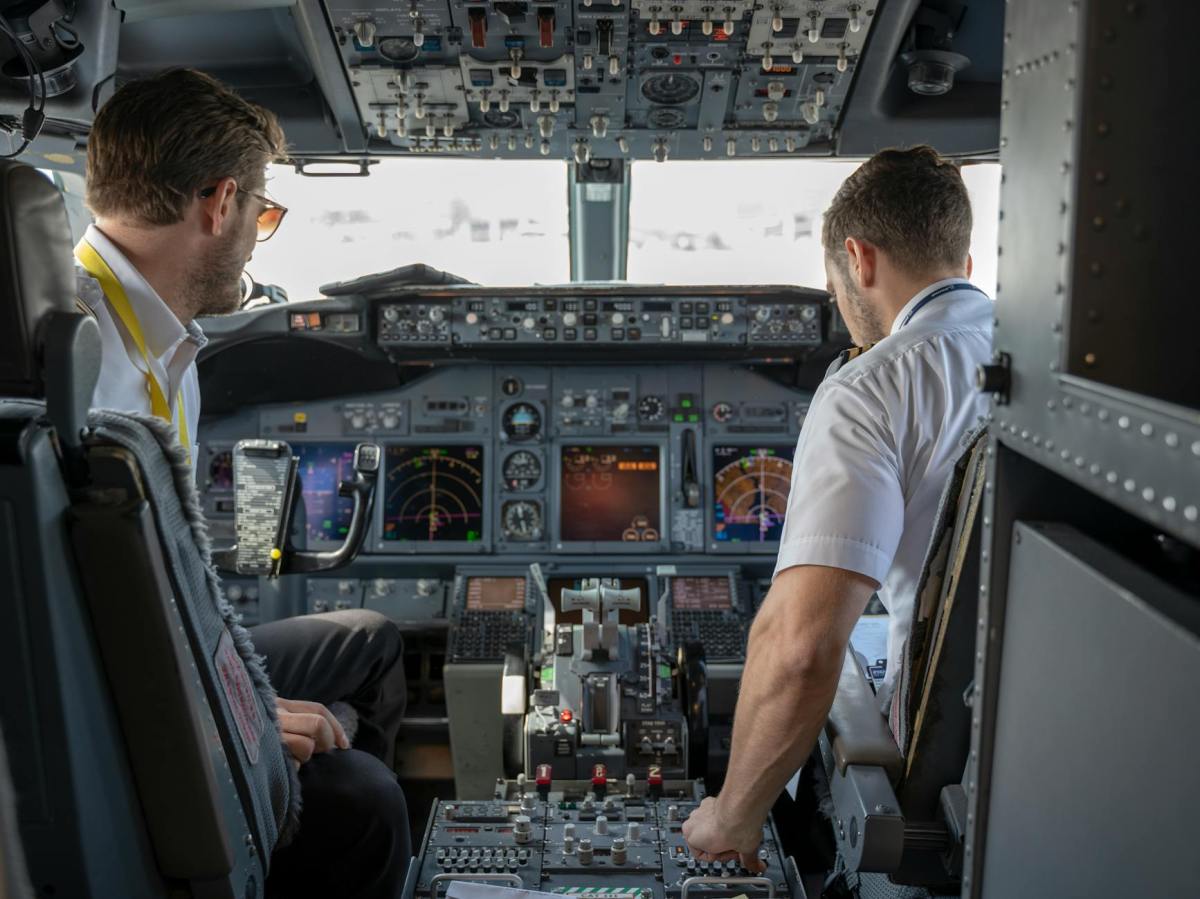
Future of Single Pilot Operations in Aviation

Flying embraces automation. Now, there’s a statement that didn’t ought to be controversial, but it can be. Even before we became engulfed by the modern digital age, analogue autopilots could assist in the task of flying. Some early ones were mechanical.

The need for full-time hands-on piloting of the physical controls that linked a human and an aircraft’s control surfaces is not fundamental. Large transport aircraft have stepped further, somewhat mimicking what their military counterparts did, and fly-by-wire systems have become commonplace.

As far as technological evolution is concerned, we remain in a transitionary phase. Commercial aircraft that fly overhead are a mixed community. Some, like the Boeing 737 series continue to have cables and pulleys that link aircraft systems and controls. Others, like the Airbus A320 series are the fly-by-wire digital aircraft types in regular service.

Between the pilots in the cockpit and the motion of an aircraft there is a computer. In fact, several computers arranged in a manner so that they continue to work even when subject to failures. A great deal of thought and effort has gone into designing aircraft systems that will be reliable in-service.

Looking at the safety numbers, starting in the 1980s when fly-by-wire was introduced, the overall service experience is extremely good. The practice of system safety assessment has delivered dependable and robust aircraft. Rigorous certification processes are applied. 

Through the technical developments that marched on from the 1980s one requirement has remained. That is that two pilots are needed in the aircraft cockpit. Granted there are exceptions to this rule for smaller transport aircraft. Single pilot operations are not new. For example, in many countries, the Cessna Caravan[1] is approved for a single pilot.

It’s 2025. It’s difficult not to notice the debate around Single Pilot Operations (SPO). That is to open large transport aircraft operations to a new rule. Lower operating costs may be achievable by making a change. It’s even said that this move is a way of continuing aviation’s growth as it becomes more and more difficult worldwide to increase the number of qualified pilots.

It’s good to see this subject being taken up in a forthcoming conference.

RAeS Flight Operations Conference 2025: Single Pilot Operations – Logical Progression or a Step Too Far?[2] 19 March 2025 – 20 March 2025. Royal Aeronautical Society Headquarters in London.

SPO may be enabled by use of complex systems to help make mission-critical decisions. The next step maybe with real-time “artificial” copilots and intelligent monitoring. Will this move the aviation industry toward safer and more efficient aircraft operations? That is the question.


[1] https://cessna.txtav.com/en/turboprop/caravan

[2] https://www.aerosociety.com/events-calendar/raes-flight-operations-conference-2025-single-pilot-operations-logical-progression-or-a-step-too-far

Investigating the Black Hawk and American Eagle Collision

What’s mysterious about the recent tragic collision between a US Army Sikorsky UH-60 Black Hawk helicopter and the American Eagle Flight 5342, was the failure of the normal procedure of “see and avoid” and the lack of an avoiding manoeuvre from the helicopter[1].

Taking the timings from reports of the investigators’ work so far, the air traffic controller’s instruction to the military helicopter to pass behind the commercial jet was seventeen seconds before the catastrophic collision impact. Given the trajectory of the commercial jet, as the pilots were focused on a landing, they had little possibility for an evasive manoeuvre other than a go-around. I imagine the commercial pilots and the tower controller reasonably assumed that the military helicopter would comply. In fact, why would they have any reason to question that assumption?

A question has arisen about night-vision goggles. Were the crew of the military helicopter using these devices? Night Vision Imaging System (NVIS) are not new[2]. They are used in both in military and commercial flying. There are a series of technical requirements that address their safe use. For commercial flying helicopters, that use such visual systems, they must additionally be equipped with a Terrain Avoidance and Warning System (TAWS). 

One of the down sides of night-vision systems are that the greatly enhanced capability can lead to overconfidence and potential misjudgements by pilots. When used by pilots these systems amplify ambient light and thus help pilots maintain visual references. That’s good for night flying over difficult terrain at low altitude. It’s not so good when there are multiple bright light sources all around, as there are in a big city.

I’m sure that the accident investigators will be giving the above subject a great deal of consideration. Afterall, the evening of this tragic accident was one of fine weather and fair visibility. The investigators have a significant task ahead analysing data and verifying the performance of both humans and machines in the accident situation.

NOTE 1: Worth a watch https://youtu.be/hlMTpIAlpw0

NOTE 2: Key safety system off in Army helicopter that collided with American Airlines jet, senator says | Reuters

NOTE 3: Night Flying “there are factors that can make it more challenging, like the lack of visual references and encountering visual illusions”. Flying into the Dark. What You Need to Fly at Night | by FAA Safety Briefing Magazine | Cleared for Takeoff | Jan, 2025 | Medium


[1] Evidence of a last-minute manoeuvre may still come to light. Sadly, the outcome remains the same.

[2] https://skybrary.aero/articles/night-vision-imaging-system-nvis

Snakes

Daily writing prompt
What’s the thing you’re most scared to do? What would it take to get you to do it?

Scary? That’s the moment when Indiana Jones is sealed into a tomb full of snakes. A young Harrison Ford, as Indiana Jones finds himself face to face with his worst nightmare[1]. 100% that would be me. If asked to step into a room full of hissing snakes, I’d run to the furthest hills.

Now, here in the UK, Channel 4 are airing a series called The Fear Clinic[2]. It makes great watching. If you have a strong phobia, you are not alone. Rats, mice or small dogs, I can understand. For me, those don’t kick-off a fear response, but I can understand.

The approach taken by the Amsterdam clinic in the TV series is to “encourage” their clients to face their worst fears. That’s supposed to trigger a cure that lasts. For some people that does seem to be the positive result. I guess we are not shown any destructively negative results of clients confronting their worst nightmares.

If asked to enter a room filled with slithering snakes, I’d be shouting “help” very loudly indeed. Luckly, since I have no need to encounter lots of snakes, I have no need to find a cure for my fully rational fear. The last time there was a snake looking at me, he/she was sitting behind solid glass[3]. Sitting on a tree branch not the least bit concerned about me standing there feeling uncomfortable. Safely I passed by trying not to make eye contact.

Since we are now entering the Year of the Snake, I ought to be careful.


[1] INDIANA JONES: RAIDERS OF THE ARK – The Well of Souls

[2] https://www.channel4.com/programmes/the-fear-clinic-face-your-phobia

[3] https://www.tripadvisor.co.uk/Attraction_Review-g190745-d1575308-Reviews-The_Living_Rainforest-Newbury_Berkshire_England.html

Economic Growth in Post-Brexit UK: A Call to Action

I do remember when there was a British newspaper called The Daily Telegraph. It represented establishment views. Was rather stuffy and what you might expect a certain type of middle-class accountant or lawyer to be reading on their commute to work.

It has become a pamphlet for the alt-right, supporters of oligarchies and whacky think-tanks pumped full of money from climate change deniers and overseas sources.

The sort of right-thinking people who gifted us with Liz Truss as Prime Minister. I shouldn’t be so dismissive because as recent history has shown these daily publications still have influence.

Now, Labour’s Chancellor of the Exchequer is shouting growth, growth, growth from the rafters. Not that her cry is an entirely bad one, it’s just that she is saying this with mufflers on her ears.

The Chancellor is right that the most important issue of the moment is the economy. There are a lot of people pointing out that a quick way to improve the UK’s economic situation is to knock down the barriers we have erected with mainland Europe. Next door is a huge market for our products and services.

Labour was telling us to believe in Brexit and that they could make it work. Most people know that this was last year’s meaningless words spread about before an election. Polling now shows that most people favour closer ties with our neighbours[1].

In some senses there’s little change. People are more likely to see the Lib Dems as anti-Brexit and the Conservatives as pro-Brexit. They remain unsure about Labour’s position. So, when the call goes out from the Lib Dems for closer economic ties with the European Union (EU) a whole host of predicable nonsense is said and published in newspapers like The Daily Telegraph.

Labour’s dithering makes the possibility of growth, growth, growth seem as unreliable as their protestations of love for Brexit before last year’s election.

The direction of travel is mighty obvious. Brexit has failed. Corrective action is long overdue. Forward thinking politicians really need to step-up and fight for a prosperous and economically successful Europe. One that includes us.

Labour has this term of government to make its mark. If it doesn’t then the possibility of extreme political elements getting a foothold in the UK are significant. Dithering for 5-years will be the biggest mistake after that of 2016. Corrective action may have a political cost in the immediate short-term, but the long-term benefits are there for all to see.


[1] https://yougov.co.uk/topics/politics/trackers/how-the-government-is-handling-the-issue-of-brexit-in-the-uk

Discontent with Conservatives

Those who stuck with the Conservatives at the last UK General Election must be regretting it. After their appalling record in government there are still 121 Conservative Party members of Parliament (MPs). This is the lowest number in the history of the Conservative Party. Parliamentary consistencies, like Reigate[1] and Staines[2], places where I have lived, have little, or no effective representation as the new year gets into its stride.

For what worth they are at this time in the electoral cycle, the Conservative Party and Reform Party (or company) are scrambling around trying to salvage any influence they can get. Both parties are no longer supported by their signed-up membership preferring major donors to pay the bills instead.

Frankly, we have no idea of their real membership numbers[3]. Political party membership hasn’t exactly been booming across the board. What’s clear is that the residual Conservative Party and Reform people are fishing in the same pond.

Last night, I happened to catch part of a Conservative political broadcast on the BBC. The general theme was politicians have let you down. This was said by Conservative leader Kemi Badenoch in a non-specific way to avoid saying Conservative politicians have let you down.

I did begin to wonder if she wouldn’t have done better by hosting a daytime cooking show from her immaculate kitchen. Now, I want to know if her mug had coffee or tea in it or was it just and empty prop? It seems to me every time Conservative rebrand, we see a different shade of blue being presented in the media. They are lucky that so many shades of blue are possible.

In the News too is Nigel Farage’s cold shouldering in the US. He may no longer be the far-right’s political great hope for the future. Reform may have to look elsewhere for its champion.

The 650 MPs that were elected by you and me to the House of Commons, at the 4 July 2024 UK General Election are likely to get a full-term. I’d guess that the new government can live with being relatively unpopular for at least a couple of years. After that they had better start showing that life has got better, public services work otherwise they will be a one hit wonder.

For political watchers its going to be fascinating to see how the pseudo-war on the right of politics will pan out in the UK. Will they combine? Having lived through the SDP–Liberal Alliance back in the 1980s, I know how hard it can be to restructure and reorientate in the British context.

There’s a lot of spinning of the wheels. Interim pain and uncomfortable partnering. The certainty being that not everyone will be happy or contented. Some notable people will go off in a huff. Eggs will get broken.

Or are we in a new era media where all that’s needed is tons of fakery and magical thinking. Plush marketing and dramatic assertions backed up by absolutely nothing.


[1] https://www.bbc.co.uk/news/election/2024/uk/constituencies/E14001442

[2] https://www.bbc.co.uk/news/election/2024/uk/constituencies/E14001505

[3] https://www.bbc.co.uk/news/articles/cq62qv3486qo

Financial Pressures and Local Government Restructuring

It was a long time ago, but I remember the travails of local government reorganisation. A massive amount of councillor and officer time was consumed. Endless discussions going backwards and forwards. Loads of heat but little light.

I had my one term as a Surrey County Councillor between 1993 and 1997. Now, that is 30-years back. A lot of water has passed under the bridge since. That said, the issues are still hanging in the air. The outcome of that Conservative attempt at local government reorganisation was no change for the one million people in Surrey. That meant one large County Council and eleven smaller Boroughs and Districts. Not forgetting several Town and Parish Councils.

Having moved, my concern is now local government reorganisation in Berkshire. The situation here is that the two-tier structure of local government has already been swept away. We pay our council tax to one unitary local authority.

Here we are in a different time and place. Labour’s first six months in government behind us. A new era. All smiles to begin. Sadly, the write-ups of the last six-months are less than flattering[1]. It would be reasonable to think that during a period of opposition in Parliament. Those 14-years. The prospective future government would have put in place policies and plans that would have been “oven ready,” to use a term an unsuccessful past Prime Minister would use.

Just as it was 30-years ago, English local government is facing huge financial pressures. Residents are struggling to access good services. Local issues, like potholes, planning, special educational needs and social care are as intractable as they always have been.

So, is this the time to bring out local government reorganisation again? Regardless of what I think, it’s clear that Jim McMahon MP, Minister of State (Minister for Local Government and English Devolution) has local government reorganisation on his agenda[2].

From what I hear, existing county Boroughs and Districts are going to become history. Small unitary authorities had better watch out too. Council leaders are being asked to find ways of building scale. That means no English local authority smaller than a population of half a million.

Will this turn around performance? Economies of scale may have some benefits. The problem that strikes me is the notion that “local”, meaning a natural community, is generally much less than 500,000 people. Especially in rural areas.

The Government White Paper that sets out these plans is called “English Devolution”. An interesting use of that nice word. In the circumstances that the new Minister imagines it could be that local government becomes more and more an implementing arm of central government. No more or less. To some extent this is already the cases, but localism and community are not completely extinguished. The tension continues to be one between governance being top-down or bottom-up driven.

The Labour government might imagine this “silver bullet” will harmonise, sanitise and make local services run like clockwork. I wonder if it will.


[1] https://inews.co.uk/news/messy-muddled-starmer-struggles-worse-rebellion-3444812

[2] https://www.instituteforgovernment.org.uk/event/government-2025-conference

Hot tin roof

At Christmas, conversations across the dinner table flow in all sorts of different directions. Once or twice, they do evoke memories that resonate. Days in the 1960s and 70s that are half remembered and maybe embellished.

It’s a steel three-bay Dutch Barn that brings us together. This old barn still stands but is more than likely riddled with rust and decay. It no longer does what it did during my childhood. That is holding hundreds of hay bales.

One of the regular farm duties was to give the barn a complete coating of “red oxide” paint. That’s the galvanised roof structure and not the tall steel columns that kept everything in place.

Up to the 1970s, lead was added to some red oxide paints. On refection, hours spent spreading this gloopy liquid about the corrugated barn roof was probably hazardous. The consolation being that this painting job was done on a completely exposed roof. That’s about as open air a job as any painting job can get. I remember the paint dried very quickly. That could be annoying.

The barn ran roughly East – West, with the lean-to section being exposed to the full force of any wind from the North. Getting up on the barn roof was easy. One side of the barn had a full-length lean-to section. It didn’t take much of a ladder to climb onto the lower part of the lean-to roof. The slope was steep enough to require a degree of care but the bolts that held the galvanised sheets in place helped add some grip for our boots.

My childhood experiments were ridiculous. They made eminent sense that the time. One involved making a parachute out of used black polyethene hay rick covering and baler twine and testing it by jumping off the barn lean-to roof. Remarkably this never resulted in any broken bones. I can only think that was down to the soft, muddy grass that I landed on. More mud than grass a lot of the time.

A completely different story is about filling the hay barn. Doing what it was designed to do. That’s store hay bales for the winter. Now, imagine the middle of summer. Blazing sunshine. A hot tin roof and the awkward spaces under it. Dry air, dust and noise everywhere. Working to self-imposed deadlines to get the hay in before the weather changed.

Today, mechanisation has taken the shear drudgery out of the annual ritual of haymaking. Most of the work is done sitting on a tractor. That might even be air-conditioned.

Let’s say, I’m talking about 1975, or a year either side. My dad, brother and I would be staking the hay bales in the barn. My mum would be on a loaded trailer putting the bales on an elevator. One by one. For the first five or six layers of hay bales we’d have an open space to work in. My brother and I would compete by showing off how far we could throw the bales as they came off the elevator. As we went up, layer by layer so the job got tougher and tougher. There was less space to work in. The heat and dust became almost overpowered.

Those are the moments I remember. Sweating like no sauna can make anyone sweat. As each hay bale came up, we’d have to think more carefully about where to put it. Stooped as we were compressed against the barn roof. That’s when our thoughts were to get the job done as quickly as possible. In these intense conditions, the thought of only having to do this job once a year and prospect of ice cream were just about enough to get us through.

+/- leadership

Daily writing prompt
What makes a good leader?

I’m past expecting “good”. There’re a million management books that pamper the art of perfection. Buy another book on management and the keys to success are assured. Like hell they are. There’s certainly more than enough advice about what makes a good leader.

Why don’t we focus on being a normal human leader? Let’s just say that we are all flawed. It’s embedded in Christianity with the biblical phrase – let’s he who is without sin throw the first stone. A great imperative but easily ignored by a bad leader.

I’d say a good leader is one that doesn’t consciously act as a bad leader. What do I mean? Here’s a snippet of the worst of the most mediocre managers I’ve worked for over the decades.

A traitor. A head who will have a group hug to agree a line on a difficult subject before going into an important meeting. Then as the meeting progresses poorly, throws his team members under the bus to save his own skin. When the going gets tough, the tough get going.

A showman. A polished head who drips with confidence and hutzpah. Says and does anything that raises their profile above any of his team. Always takes credit when things go well. Always in the picture. Ready for a quote. Rarely wavers or sees any damage done.

An emperor. An attractive head who initially engages and embraces his team members. Has a strong intellect. Learns all he can of their ideas and experiences. Uses that knowledge to his own advantage. Then demotes or discards or rides rough shod over his former colleagues.

A good leader maybe flawed. But “good” does not pursues the three above. Now, let’s turn to a positive reflection. Here’s three categories to look for.

A mentor. When you meet a head and your first thought is – I want to be like them. I want to know what they know. That’s the time when “good” becomes real. Here’s a learning opportunity to be grabbed with both hands.

A motivator. There are heads who walk into a room and the whole atmosphere changes. They stand at a podium and with a few words change the agenda. Never dull and predicable. They tackle the gritty questions of why and how.

A doer. That head who doesn’t just spout fine words. Through their reputation and list of achievements they show that positive change can happen. They can lead a team to achieve more than the sum of the parts.

Turn the clock back

Daily writing prompt
If you could un-invent something, what would it be?

Innovation is much of a byword. Climate crisis, feeding the world, ending wars, curing disease, creating endless energy, conquering space – they can all be done if someone, somewhere, just invents something smart right now. We are greater believers in the power of “invention” than we have ever been. Doesn’t matter if sitting on the right or left of politics.

Invention and discovery are not the same. Discovery is to uncover something we had not known or understood before. However, that something was always there waiting to be discovered.

Invention is for makers and dreamers. A contraption, a connection, a way of doing business, a machine or a crazy idea. Invention has a huge spectrum. I’ve never been to the Heath Robinson Museum[1]. Now, I mean to go.

To un-invent presupposes that it can be done. It has been done in the past. The classical world benefited from inventions that were lost in the dark ages. Later to be rediscovered.

Genuinely to uninvent is hard. Human imagination, with so many people on the planet, mitigates against it. Uninventing may be a short-lived move.

My view is that it would be best to try to un-invent a damaging idea or process. For example, let’s uninvent slavery or subjugation.


[1] https://www.heathrobinsonmuseum.org/

Classic Sports Car’s Legacy

I had two of them. It was a basic sports car that last came off the production line at the end of 1979. About 45 years-ago in Oxfordshire, England. The MG Midget was much loved.

The “Frogeye” Sprite came first. Then this small sports car went through several evolutions. Ending with the 1500 version[1]. Some say the 1500 version was the worst. I’d say that it had its ideocracies but remained great fun to own and drive. The heavy rubber bumpers were added to meet US market safety requirements. The extra power of the Triumph 1500 engine compensated to some extent, but they were a style disaster. On the positive side, whenever parked, those slab like matt black rubber bumpers, front and back, doubled up as seats.

It’s something in common with most roadgoing cars of the past. The MG Midget was considerably smaller than most cars being driven in 2025. Strange that the roads themselves haven’t changed as much as the cars of the day.

The lanes of Somerset and Dorset wind through the countryside in a pattern that makes little sense unless you study either the size and shape of ancient field systems or the Romans. The contrast is great. Twisting cart tracks that became tarmacked roads or straight lines that were forced onto the landscape in a point-to-point style. The lesser of them hasn’t had a great deal of attention. Thank God, you might say. There are still lanes that link small hamlets and farms that have grass growing down their middle. Overhanging dense hedges on either side.

Those were the roads that gave the most joy of driving my MG sports car. Not at any great speed. Open top with the summer sunshine through the trees and a breeze, what could be better?

Fine, caution is, and was, needed where fresh mud and tractors conspired to add some hazards. Visibility restricted and deep ditches or dirt banks added a few more. I did once come to grief because of farmyard mud. One of those places where the farmyard and the lane were indistinguishable. A herd of cows being paraded up and down the lane every day.

Sadly, my jet black “V” registration MG Midget sat in my garage for many years. Plans to get welding done and tidy-up the soft top never came to anything. I sold it. I can say: I wish I’d kept it. Trouble is that nice wish was never going to be realised.

Now, I live just down the road from Abingdon where all the MG sports cars were made. I do mean to explore the town as the weather improves.


[1] https://www.mgcc.co.uk/midget-register/midget-register/history/