Choice

Desperate British Prime Minister (PM) comes out with the line that the future will be troubled and fast paced change will outstrip past progress. Ok, so what’s new? Hasn’t that been the path of the world since the invention of the computer? Acceleration of change is now locked into humanities destiny.

The audacity of the man is astonishing. Having been intimately associated with calamitous failures of the past decade he espouses his unique abilities to keep us safe and secure.

Hell, I thought former PM Boris Johnson had a big ego. Monday’s speech goes beyond ridiculous[1]. When he says: “People are abusing our liberal democratic values” what comes to my mind is the right-wing government he leads.

We all know, it’s reported continuously, how dangerous the world has become. Noone in any major political party would dismiss that reality. That is bar the eccentric, downright crazy and maybe the fringes of the Greens party.

Interestingly, as far as I know, PM Rishi Sunak isn’t a climate change denier, but he doesn’t have much to say on this monumental global issue. When he says: “And in this world of greater conflict and danger, 100 million people are now displaced globally.” It should occur to him that competition for resources in a world where the climate is changing is at the root of this movement. By the way, there are 8 billion people in the world[2]. So, let’s get our reality in proportion. True, the 0.1 billion people now displaced globally is a figure likely to grow in the next decade. But they are not the enemy.

I had to laugh when I came to the mention in the speech of “robust plans”. The thing that has been characteristic of this Conservative period of government is the distinct lack of planning.

The country’s whole relationship with its neighbours was changed without any plan (Brexit). The ups and downs of the COVID epidemic were endured without a plan, other than that which was made up day-to-day. Year-on-year cuts in defence spending have only been reversed in the wake of global events not a plan of any kind. Surely the Conservatives can only offer a – make it up as we go along – way of governing? It’s what they’ve always done. Hence, the slow decline that has afflicted the country.

The PM lapses into a lazy “needs must” argument that sprinkled with Brexit bull****. Shakespeare would have approved. One example, in All’s Well That Ends Well:

Countess: Tell me thy reason why thou wilt marry.

Clown: My poor body, madam, requires it: I am driven on by the flesh; and he must needs go that the devil drives.

Nothing wrong with being positive about the future. As a country we can do great things. What the PM claims is to have a plan. What he hasn’t got is a plan. And if he did have a plan the likelihood of his own side following that plan is absolutely minimal. He only goes where the devil drives. 


[1] https://www.gov.uk/government/speeches/pm-speech-on-security-13-may-2024

[2] https://www.census.gov/popclock/world

Culture

Yet again, Boeing is in the news. The events of recent times, I feel are immensely sad. Now, it is reported that the FAA has opened an investigation into a possible manufacturing quality lapse on the Boeing 787 aircraft[1]. Concern is that inspection records may have been falsified.

A company that once had a massive professional engineering reputation has sunk to a place where expectations are low. It’s not so much that the company is having a Gerald Ratner moment. Unfortunately, the constant stream of bad news indicates something deeper.

It’s interesting to note that Frank Shrontz[2] passed away last Friday at the grand age of 92. He was the CEO and Chairman of Boeing, who led the company during development of the Boeing 737NG and Boeing 777 aircraft. In the 1990s, I worked on both large aircraft types.

A commonly held view is that, after his time and the merger with McDonnell Douglas the culture of the organisation changed. There’s a view that business schools graduates took over and the mighty engineering ethos that Boeing was known for then went into decline. Some of this maybe anecdotal. Afterall, the whole world has changed in the last 30-years. However, it’s undoubtably true that a lot of people lament the passing of an engineering culture that aimed to be the best.

A famous quote comes to mind: “Culture eats strategy for breakfast.” Those sharp 5 words get discussed time and time again. Having been involved in a lot of strategic planning in my time it’s not nice to read. How wonderful intent, and well described policies can be diluted or ignored is often an indicator of decline. It’s that cartoon of two cavemen pushing a cart with a square wheel. One says to the other: “I’ve been so busy. Working my socks off”. Ignored, on the ground is an unused round wheel. If an organisation’s culture is aggressively centred on short-term gain, then many of the opportunities to fix stuff gets blown out of the window.

We keep talking about “performance” as if it’s a magic pill. Performance based rules, performance-based oversight, and a long list of performance indicators. That, in of itself is not a bad thing. Let’s face it we all want to get better at something. The problem lies with performance only being tagged to commercial performance. Or where commercial performance trumps every other value an engineering company affirms.

To make it clear that all the above is not just a one company problem, it’s useful to look at what confidential reporting schemes have to say. UK CHIRP is a long standing one. Many recent CHIRP reports cite management as a predominant issue[3]. Leadership skills are an issue.


[1] https://aviationweek.com/air-transport/some-787-production-test-records-were-falsified-boeing-says

[2] https://www.seattletimes.com/business/boeing-aerospace/frank-shrontz-former-ceo-and-chairman-of-boeing-dies-at-92/

[3] https://chirp.co.uk/newsletter/trust-in-management-and-cultures-is-the-key-to-promoting-confidence-in-safety-reporting/

Mindset

Safety is a mindset. Having a sense of risks and which ones to accept and which to reject is something we all develop. It’s a big part of childhood. Most of us have had burns, cuts or bruises that have resulted in doing something we would now consider having been stupid.

Some are destined to be over-cautious, and others are more openly adventurous. In time, we settle around a frame of thinking that suites us best. That’s fine in so far as taking personal risk is concerned. Whether to cross the street every time you see a mean looking dog or to buy a powerful motorcycle later in life that’s a personal preference.

Where activities, positive or negative only impact the risk taker then that’s an area where society shouldn’t be too heavy handed. Naturally, there are boundaries. The classic one is motorcycle crash helmets. Mandating them led to a lot of heated debate. Yes, we are discussing a personal risk in respect of the rider but the risk to society is an unacceptable number of fatalities, brain injuries and publicly borne health care costs.

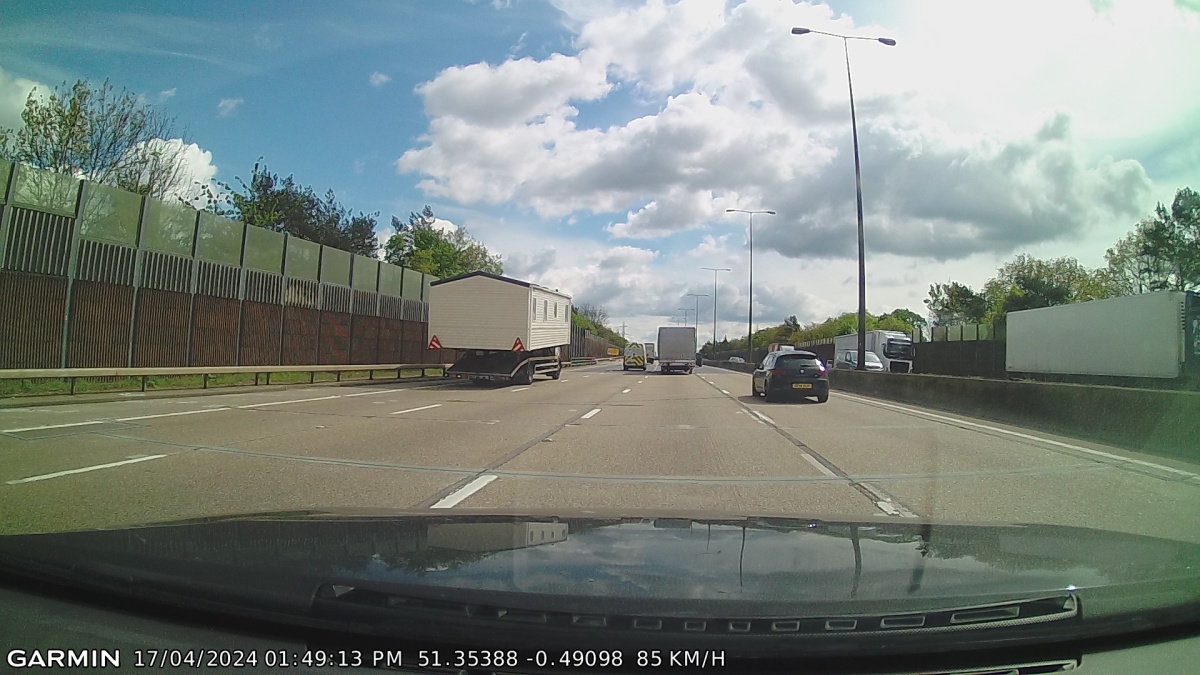
There I was, driving at less than the regulation speed (yes, I was) eastward on the M25 motorway. The details are stamped on a picture taken by my neat little Garmin dashcam. What’s in the picture? It’s a moveable building sitting on the back of a lorry. Nothing unusual about a lorry transporting stuff from A to B. What I saw was a large building on a relatively small lorry. When first seeing something like this on a busy road, my instinct is to give it a very wide margin.

The rectangular building was rocking gently. It was not a windless day. Not overly windy but a strong gusty breeze was blowing. Clear skies and dry tarmac. So, good driving conditions for a normal lorry with a normal load on a normal day. I’d estimate that this lorry was doing about 80km/hr. It wouldn’t be too difficult to do the sums in terms of the wind resistance of the building. It’s going to be significant. A large flat surface being pushed through the air at motorway speeds. As for sidewinds and gusts, this is a horrendous monster.

Back to safety being a mindset. My thought was – what on earth gave the carriers the idea that this arrangement for a wide load was a safe one for a motorway journey? No escort vehicle. No flashing lights. Just a couple of small red triangles. The straps and wooden blocks holding the load in place looked feeble. A powerful gust of wind on an exposed stretch of road and who knows what would have happen next. It wouldn’t have been pretty. I hope they got to their destination without incident.

Had this been done on private land then there would have been little public risk. Being done on a busy motorway – that’s a different matter. How do people convince themselves that such transport arrangements will be fine? I speculate:

  • Money. Maybe the haulage contractor undercut rivals to get the job. Maybe using a small lorry and ditching any escort vehicle saved money. Maybe there was time pressure and this was all that was available.
  • Bravado: A carrier imagines they have special skills and abilities so they can take risks that others would not take. Something uniquely puts them above others in the field. This cock-sure attitude is not uncommon.
  • Short Cuts. I’ve heard this argument used before – we did it last time and it worked, so we’ll do it again. That learned deviance is the source of many accidents. Past and present can have very different outcomes.
  • Shoulder shrugging: I’ve heard this argument used too – it’s legal, it’s within the rules so it can’t be wrong, can it? (The load maybe within the approved weight limits for the lorry. There may be no explicit rule on shape and size).

A good safety mindset means saying “no” when no is the right answer. All three of the above points can come into play and produce a toxic mix. Such is the way accidents happen. It doesn’t have to be this way but it often is. Before a critic says don’t be so high and mighty – yes, I’ve done foolish things too.

NOTE: The loading rules HGV maximum weights – GOV.UK (www.gov.uk)

AAM

This week, I watched an FAAs Advanced Air Mobility (AAM) webinar[1]. The subject was community engagement. AAM could be air taxies but it’s many uses of the new electric aircraft that are becoming a reality. The term eVTOL is used for those aircraft that have the capability of vertical flight. My reflection is that there are several aspects of AAM that need much more attention. Naturally, I’m taking the discussion of what’s going on in the US and thinking about it in relation to the UK.

  • Land Use Planning

Generally, National Aviation Authorities (NAAs) are consultees when it comes to land use planning. They do not determine planning applications. NAAs may well have set out policies and guidance on the subject but they will not be determining the site of vertiports.

It seems to me that there’s little chance that eVTOL aircraft routes will be established without sufficient community consent.  Community engagement has been appropriately recognised as essential. The aspects in play are like those for existing aerodromes. Often for AAM applications proposals are for the use of new locations, hence a concern. Anytime there’s a serious proposal for a new aerodrome the opposition is up and running long before the proposers have got their act together.

The subject is complicated by the mix of public and private ownership of infrastructure. If the intention is to interconnect AAM with other transport services (bus/train/boat/road), then complicated agreements are going to be inevitable. It’s not just about buildings and tarmac but having a trained workforce available is a location dependent issue too.

  • Business Models

I’m about to sound as if I’m securitising the plans of a contestant on The Apprentice[2]. There are plenty of way of losing money in commercial aviation. It’s been a well-practiced art over the years. Great ideas fall by the wayside after huge amounts of money have been expended. Customers are key. People must want to fly the routes available, time and time again. And like London Black Cabs be prepared to pay the fare. Given the relatively small cabin sizes that are on offer these people are likely to be moderately prosperous groups or individuals.

Regular schedules air services can produce a reliable income. Airport-to-airport connections seem like a good bet. Problem there is the conveyancing of weighty luggage. Busy airspace could be a challenge too. That said, with tens of thousands of people at both ends of a route, no doubt some people will choose a comfortable, speedy direct connection.

There are good possibilities for major event driven transport services. Getting to and from a motor race or horse race event or a concert or festival can be hell when tens of thousands of people are all trying to get to and from a location or venue. The numbers may well stack-up to make eVTOL a premium way of dodging the crowds in an environmentally sound way.

  • Batteries, Batteries, Batteries

Everything in respect of aircraft performance depends on power density. How much oomph can you get out of a small, light weigh physical space. Recharge and go. Do it, again and again. It’s as simple as that. Not only that but aircraft battery packs must be affordable and available. Whizzy technology that cost a mountain of cash and can only be use for a few hundred cycles is no use at all.

Power distribution infrastructure must be up to the job too. Who will pay for this is up for grabs. There’s a good case for public funding given that there are multiple uses of enhanced electrical supply. Given the monopolistic nature of power generation and distribution this will not be easy or quick.

That’s only three issues that require a great deal of attention. Not the attention of researchers. Not the attention of academics, Not the attention of political policy wonks. Connecting entrepreneurs and public bodies needs practical stimulus. The possibilities are exciting.


[1] https://youtu.be/1sfVuJlPQoY

[2] https://www.independent.co.uk/arts-entertainment/tv/news/the-apprentice-2024-winner-pies-b2531331.html

Highways

The last time I visited the city of Baltimore was in 2012. It was the location of the annual seminar of the International Society of Air Safety Investigators (ISASI)[1]. That was when I was representing the European Aviation Safety Agency (EASA) at such international events.

The relationship between aviation accident investigators and regulators are generally cordial. There’s a great deal of work that requires cooperation and good communication. That’s not to say that the relationships between these two vital parts of national and international aviation safety systems is easy. It’s not. My reflection on that fact is that a degree of constructive tension is inevitable and not always a bad thing.

One way of seeing that relationship is that the primary role of an investigator is to make findings to prevent the repeat of a given accident. For a regulator the primary role is to ensure the complete aviation system runs safely on a day-to-day basis. Both organisations have the public interest at their heart. However, their operational context and perspective are different.

Firstly, my condolence to the families and friends of those who perished because of the Francis Scott Key Bridge accident[2]. The collapse victims and survivors had no way of knowing what was to happen on the night of the accident. I use the word “accident”. This was not an act of God, as some commentators would have it. The safety risks involved in the operation of the port in Baltimore could be anticipated.

In the US there’s an independent federal agency that is tasked with such major investigations. Interestingly, it’s the same one as that investigates aviation accidents and incidents. The National Transportation Safety Board (NTSB) is a multi-modal organisation. That is something we don’t have in the UK. Also, we don’t have a divide between federal and state organisations. Since in the UK we have separate independent national Air, Marine and Rail investigation agencies that cover the country (England, Scotland, Wales, and Northern Ireland).

I will not comment on the accident sequence or causes. It’s the job of an independent investigation to arrive at the technical facts. Recommendations will flow from that investigation.

Where a comment may be in order is that there are many locations across the globe where a vital piece of infrastructure, like a bridge being struck by a large container ship is a possibility. I’d generalise that further. When infrastructure that was designed a built 50 years ago meets modern day operational stress there’s going to be vulnerabilities. Yes, the aviation system is not immune from this fact too. It wasn’t so long ago when I read of PDP-11 computer hardware used for air traffic control (now, historic artifacts[3]). I’m sure there are still Boeing 747s, and alike that need floppy disks to update their hardware.

So, the wider subject is operational legacy systems working with modern systems. This is the interface that requires particular care. The safety risk appetite and exposure in the 1970s/80s was quite different from that which we expect upheld today.

Unfortunately, society is often reluctant to revisit this subject. Additionally, there’s the incentive to go for quick fixes and sweating assets. The example I have in mind the so-called “smart motorways” in the UK[4]. I don’t know how many fatalities can be linked to “smart motorways” but I’m sure, sadly, it’s too many.

POST: In time-off I enjoyed a trip out to Fort McHenry and a walk around the places where The Wire was filmed. The Fort McHenry story is interesting given its role in times of war. The British burnt the White House but the navy didn’t get past Fort McHenry in 1812.


[1] https://www.isasi.org/

[2] https://www.bbc.co.uk/news/av/world-us-canada-68661318

[3] https://www.tnmoc.org/air-traffic-control

[4] https://www.gov.uk/government/speeches/plans-for-new-smart-motorways-cancelled

Safety Culture 2

This may sound at variance with my last blog. I hope it’s not. I hope it’s complementary. What I’m highlighting here has been observed over decades of contact with a wide variety of organisations.

The term safety culture is fused into the pillars of ICAO Annex 19. The essence of building a good safety culture that fosters sound practices and encourages communications, in a non-punitive environment is at the heart of standards and recommended practices. With all those decades behind us the reader might assume that there’s unambiguous and well aligned attitudes and ways of working throughout the aviation industry. That’s not so.

On a spectrum of what could be called hard to soft the manner of application of know best practices can take different forms. By the way, please disassociate those two words with both easy and difficult. That’s not what I mean.

In my interpretation “hard” means like pages of Niccolo Machiavelli’s The Prince[1]. Aggressive, persistent, mandatory, uncompromising and all encompassing.

In my interpretation “soft” means like pages of The Little Book of Calm by Paul Wilson[2]. Harmonious, enlightened, progressive, sympathetic, and understanding.

As with extremes on any scale, going to the ends of that scale are not the best way to operate. I say “best” in terms of getting to ways of working to endure with engagement and effectiveness. I observe much of this depends on how power is disseminated through an organisational structure. Highly hierarchical organisations will approach culture differently from organisations with a relatively flat management system.

It may not be surprising to suggest that aviation Authorities can veer towards the “hard” approach and staff Unions towards the “soft” approach. Even when both are trying to reach the same goal. Where people come from a military background, command and control can be an instinctive reaction. Where people come from an advanced technology company background, collaboration and communication can be an instinctive reaction. In my observation there are advantages in both a hard and soft safety cultural approaches.

One advantage of a hard safety culture is that the time between discovery of a safety problem, taking corrective action and resolving that operational problem can be short. Clearly, that has distinct safety advantages. Certain airlines come to mind.

One advantage of a soft safety culture is that there can be the discovery of safety problems that would otherwise remain hidden. Where collective ownership of the problem is not in question. Again, clearly, that has distinct safety advantages too. Certain manufacturers come to mind.

I guess my message is as per much ancient thinking. All things in moderation. Try to reap the benefits of both ends of the scale. Balance.


[1] https://www.londonreviewbookshop.co.uk/stock/the-prince-niccolo-machiavelli

[2] https://www.waterstones.com/book/the-little-book-of-calm/paul-wilson/9780241257449

Safety Culture

Civil aviation remains an extremely safe means of transport. That said, any form of complacency must be addressed. It’s reassuring to say the past has been great but what passengers are most concerned about is their next flight. To have the confidence, to think it irrational to be afraid of flying, to look forward to the next journey, we must have a safe aviation system everywhere and all the time.

For any widespread system that has complex interactions between people and technology there’s never a moment when it can be taken for granted. We count the numbers, but safety is not purely an absence of accidents and incidents. Numbers counted are always past events. They have no direct causal influence on what happens next. True, there are factors in past accidents and incidents that will pop up again and again, but every flight is a unique event.

One of my colleagues who was a senior captain in a major international airline always remined me of the fact that, for all that has gone before, flight risk begins the moment an aircraft sets off down the runway with the intention getting to a destination. When the wheels lift off the ground there’s no stopping time. Reliant on the diligence, vigilance, and integrity of everyone who made a flight possible, flight risk is then in the hands of the crew.

The above is perhaps why we talk a lot about safety culture. The whole aviation family has a role to play. The care, professionalism, and watchfulness of every person makes a difference.

This can extend from the drafting of a new component for a new design, that a decade down the line. ends up as a part of an aircraft just about to leave the gate. This can go back to a flight instructors’ message that emphasised a key point back in a pilot’s initial training, years ago. This can encompass the extra care a couple of air traffic controllers took as they changed shifts.

Safety culture comes from caring. It’s that heightened awareness of the consequence of actions. Being alert to possibilities. Both the good kind, and the bad.

Safety culture is a matter for both individuals and organisations. One without the other doesn’t work. Placing a vigilant person in an organisation that doesn’t care is much like placing a reckless person in an organisation that does care. Although this is what I’ve written, systemic problems are likely the ones that are most likely to cause negative outcomes. This is where the role of management has the most impact.

Culture exists in context. When the ways people interact are determined by practices, processes, and procedures there’s an obligation on management to ensure they fit the bill. Drivers are often economic. In a commercial operation that’s no surprise. It’s when that driver displaces the safety imperative then safety suffers. There’s been several occurrences of this negative phenomena in the last year.

Dependency

It’s not unique. Charle Dickens wrote about it. We don’t like to admit it. We have a dependency on bureaucracy. Our complex society runs on it.

Whatever we do when it comes to the meeting of an individual with an organisation, it’s inevitable. Irrational people deny this fact or say it’s only true of public bodies, like government departments. It’s as if the generally high performance of modern computer systems renders them completely invisible.

One apt illustration of a dependency on systematic bureaucracy and digitisation combined can be read in a carefully constructed e-mail from the CEO of Sainsbury’s this weekend.

“I’m writing to update you on the technical issue that has affected our Groceries Online deliveries and some services in our stores this weekend.”

This could have come from any large complex organisation that exists in today’s digital world. When outages happen, we all sit patiently for affected systems to come back online with the full services that we normally take for granted. A sudden reversion to traditional cash transactions was a shock to the average post-COVID consumer.

This weekend my experience of one major hotel chain was that they would not accept cash at all in their restaurant. My “paper” money was useless. It sat in my pocket.

What we have is the power of utility. Systems become so good that we build ever more dependency into them doing the right thing, every time. The problem is that systems are often programmed to do certain tasks exceptionally well but as soon as there’s an unexpected deviation outside normal parameters the situation does not go well. 

An illustration of that experience can be read in the public version of the interim report on UK NATS[1]. After the event, and similar unfortunate events, there’s a cavalcade of calls for more contingency, more resilience, more planning, more training, more checking and so on.

That list is perfectly sensible. But wouldn’t it have been better if those actions had been taken up-front? I often saw this discovery in my time doing systems certification audits. Companies who spend a lot of money upfront to build software that was well characterised and tested were not guaranteed success, but their chances were greatly improved. Those who hit the road with over-confidence, marketing hype and rigorous cost cutting had a high probability of negative outcomes. It’s not a simple cause and effect but good system architecture, robust software and a management that understood the need to spend time and money judiciously do well.  

Just think. If a runner ran a marathon without a strategy, training, basic fitness, planning and sound motivation no one would expect them to be winning anything unless they were exceptionally lucky or unbelievably talented. Not many in the latter category.

There’s a lesson here. It’s been copied over and over. Saddy the almost completely invisibly of complex system that work well in everyday life means we soon take them for granted. And the result is?


[1] https://www.caa.co.uk/publication/download/21478

Safety

A considerable part of my working life has been in the analysis of occurrence data and trying to distiller the factors that cause or contribute to accidents and incidents. It’s rewarding work. An opportunity to influence that has value. I subscribe to the dictum that everything we do should contribute to continuous improvement in safety. Not zero risk but to keep risks low and under control, in so much as it’s possible.

Aviation only has the great success that it does because it’s a safe industry. For mass transport by air to be viable across the globe, the public must have confidence in it. They are willing to place whole families in the care of an airline to get them from London Gatwick to the Canary Islands for something that is not a physical need[1]. Regular leisure travel is a luxury and a privilege. We live in a fortunate age when overseas travel can be afforded by a large section of the population.

I watched the recent documentary on flight MH370. It’s sobering. It’s a story of the loss of a large aircraft that still seems unbelievable in this era. It’s the 10th anniversary of the disappearance of Malaysia Airlines flight MH 370 on 8 March 2014. The loss is a stark reminder that the oceans cover over 70% of the surface of the Earth. We know less about parts of the oceans than we do about the surface of Mars. The depths remain uncharted.

With a paucity of evidence theories have taken root. Official investigation reports are available. However, mystery remains particularly when it comes to answering the question – why? If as the documentary suggest, the willful actions of the pilot-in-command brought about the fatal outcome then there’s little to tell of his motivation. Highlighting the tragic Germanwings aviation accident doesn’t offer anything other than a context to possibilities. Evidence that the MH370 pilot-in-command was suicidal is scant. Although his known actions do not make much sense without invoking such a theory. Understanding what drives people to purposefully undertake unpredictable and irrational actions is an area of study that always needs attention.

Yesterday, Sunday, I was remined that threats to safety can come out of nowhere. Seemingly routine car journeys can suddenly take a turn in an unexpected direction. We become subject to the fates. I use the word “fate” but I’m not a great believer in the fates. Randomness plays a part but, in this case, yesterday afternoon, I was the subject to the foolish and negligent actions of another car driver.

On a wet “B” road that climbs and descends over chalk hills, there are triangular road signs that warn drivers that the road is a high risk road. What the signs are referring to is the wildlife. A deer may leap out of a roadside hedge at great speed and misjudge the road traffic. In fact, I did see an unfortunate small dead deer at the kerbside.

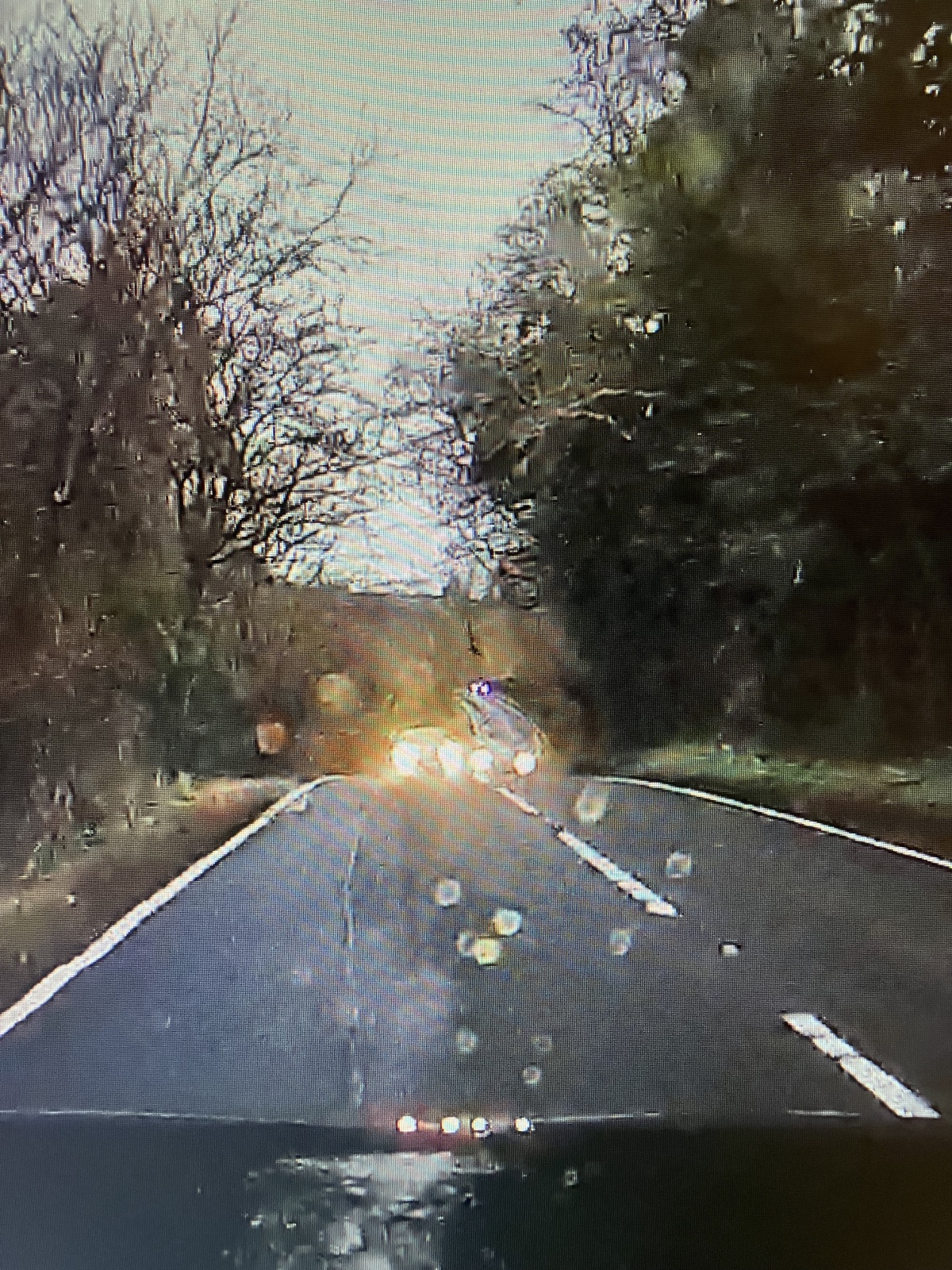
What happened to me had a purely human cause. Naturally, I would call it complete idiocy. Coming over the brow of a hill, and descending, suddenly there was 4 bright headlights ahead. On a narrow country road, with overgrown banks on either side that was a scary sight. Nowhere to go. In a faction of a second the overtaking car coming up the hill veered back into the right-hand lane. No more than a couple of yards in front of my car. Fortunately, there was no collision. What on earth was the motivation of that driver? Overtaking, at high speed, approaching the brow of a hill, on a wet county road, in poor light, sheer madness. A small red car, overtaking a larger car.

In safety work this points to the most difficult situations to understand. The irrational, or stupid or reckless, or carless human drives that are hard to design out of systems. How do we take effective corrective action when one person’s risk threshold is so very much higher than normal or acceptable? The problem with saying – take their licence away – is that this is always reactive. After a negative event. Maybe even a fatal one.


[1] https://www.simplypsychology.org/maslow.html

Friday evening

I listened. Well, it was unusual. On a Friday night, the country’s Prime Minister (PM) addresses the nation. Not much prior indication it was going to happen. What’s afoot, I thought. Could this be the moment a General Election is called? In the end it wasn’t an earth-shaking moment or likely to change the direction of the course of world events. The intention was good. There’s a strong need to step back. To condemn violent extremism in all its forms. Whether it’s ideological, from a political stance or religious in motivation.

Yes, people have a right to be passionate in pursuit of their beliefs. The limit comes in a liberal democracy when action steps over into aggression, intimidation, hate and violence.

Yes, it’s a sad day when a Westminster byelection results in the election of a maverick who as a disturbing track record of associating himself with alarming people and beliefs.

We (UK) are sure not in a good place, now. That does call for political leadership to step-up and face down those who would corrupt, divide, and wreak havoc. To do that across the board whether it be from the extreme left or extreme right. Wreckers are not new. They pop-up through history. Often using a false narrative to antagonise and stir-up insurrection. The results are always to the detriment of most people and to the advantage of a very few.

Is the PM facing down the those who’d happily wreck our liberal democracy? Friday evening was one attempt.

I agree with some commentators. If a speech is to be made outside the front door of Number 10, such an iconic setting, then there ought to be something of great substance in that speech. Afterall this is the place where PMs come and go, elections are called, and major crises are addressed. In this case there wasn’t much of great substance and vague messages were scattered throughout the PM’s rambling speech.

One problem is the misguided mixing of multiple different concerns in a mishmash. For example, protest is not de-facto bad. Illegal actions during a protest must be addressed much as illegal action any other time. If extra resources are needed to address those illegal actions surely it is for the government of the day to provision them appropriate to the task.

Perception matters. Condemning those who are clearly in opposition to the PMs political stance but turning a blind eye to those in the PMs camp who are just as bad, just smells bad.

Let’s be positive. It’s a good start. Leaders should come out an defend and preserve the liberty we all enjoy. They should craft langauage that unites. They should engage in robust debate on the side of truth. I wonder where we go from here. Will electioneering polticans stop the slurs and cheep remarks – unlikely.

POST 1: The PMs words on extremists and democracy have slipped off the on-line headlines rather quickly. Maybe his aim was for the weekend media to pick-up the debate in a thoughtful manner. Good luck with that one.

POST 2: Now, the PM is facing both ways. Paul Scully’s[1] utterances follow those of former Conservative Lee Anderson. When the majority of his party’s members think Islam is “A Threat To British Way Of Life[2]” and they would prefer a different leader from him no wonder the PM is calling for unity.


[1] https://www.telegraph.co.uk/politics/2024/02/26/paul-scully-no-go-areas-birmingham-london-islamophobia/

[2] https://www.huffingtonpost.co.uk/entry/majority-of-tory-members-believe-islam-is-a-threat-to-british-way-of-life_uk_65df4fd4e4b0e4346d54a740