Highways

The last time I visited the city of Baltimore was in 2012. It was the location of the annual seminar of the International Society of Air Safety Investigators (ISASI)[1]. That was when I was representing the European Aviation Safety Agency (EASA) at such international events.

The relationship between aviation accident investigators and regulators are generally cordial. There’s a great deal of work that requires cooperation and good communication. That’s not to say that the relationships between these two vital parts of national and international aviation safety systems is easy. It’s not. My reflection on that fact is that a degree of constructive tension is inevitable and not always a bad thing.

One way of seeing that relationship is that the primary role of an investigator is to make findings to prevent the repeat of a given accident. For a regulator the primary role is to ensure the complete aviation system runs safely on a day-to-day basis. Both organisations have the public interest at their heart. However, their operational context and perspective are different.

Firstly, my condolence to the families and friends of those who perished because of the Francis Scott Key Bridge accident[2]. The collapse victims and survivors had no way of knowing what was to happen on the night of the accident. I use the word “accident”. This was not an act of God, as some commentators would have it. The safety risks involved in the operation of the port in Baltimore could be anticipated.

In the US there’s an independent federal agency that is tasked with such major investigations. Interestingly, it’s the same one as that investigates aviation accidents and incidents. The National Transportation Safety Board (NTSB) is a multi-modal organisation. That is something we don’t have in the UK. Also, we don’t have a divide between federal and state organisations. Since in the UK we have separate independent national Air, Marine and Rail investigation agencies that cover the country (England, Scotland, Wales, and Northern Ireland).

I will not comment on the accident sequence or causes. It’s the job of an independent investigation to arrive at the technical facts. Recommendations will flow from that investigation.

Where a comment may be in order is that there are many locations across the globe where a vital piece of infrastructure, like a bridge being struck by a large container ship is a possibility. I’d generalise that further. When infrastructure that was designed a built 50 years ago meets modern day operational stress there’s going to be vulnerabilities. Yes, the aviation system is not immune from this fact too. It wasn’t so long ago when I read of PDP-11 computer hardware used for air traffic control (now, historic artifacts[3]). I’m sure there are still Boeing 747s, and alike that need floppy disks to update their hardware.

So, the wider subject is operational legacy systems working with modern systems. This is the interface that requires particular care. The safety risk appetite and exposure in the 1970s/80s was quite different from that which we expect upheld today.

Unfortunately, society is often reluctant to revisit this subject. Additionally, there’s the incentive to go for quick fixes and sweating assets. The example I have in mind the so-called “smart motorways” in the UK[4]. I don’t know how many fatalities can be linked to “smart motorways” but I’m sure, sadly, it’s too many.

POST: In time-off I enjoyed a trip out to Fort McHenry and a walk around the places where The Wire was filmed. The Fort McHenry story is interesting given its role in times of war. The British burnt the White House but the navy didn’t get past Fort McHenry in 1812.


[1] https://www.isasi.org/

[2] https://www.bbc.co.uk/news/av/world-us-canada-68661318

[3] https://www.tnmoc.org/air-traffic-control

[4] https://www.gov.uk/government/speeches/plans-for-new-smart-motorways-cancelled

Safety Culture 2

This may sound at variance with my last blog. I hope it’s not. I hope it’s complementary. What I’m highlighting here has been observed over decades of contact with a wide variety of organisations.

The term safety culture is fused into the pillars of ICAO Annex 19. The essence of building a good safety culture that fosters sound practices and encourages communications, in a non-punitive environment is at the heart of standards and recommended practices. With all those decades behind us the reader might assume that there’s unambiguous and well aligned attitudes and ways of working throughout the aviation industry. That’s not so.

On a spectrum of what could be called hard to soft the manner of application of know best practices can take different forms. By the way, please disassociate those two words with both easy and difficult. That’s not what I mean.

In my interpretation “hard” means like pages of Niccolo Machiavelli’s The Prince[1]. Aggressive, persistent, mandatory, uncompromising and all encompassing.

In my interpretation “soft” means like pages of The Little Book of Calm by Paul Wilson[2]. Harmonious, enlightened, progressive, sympathetic, and understanding.

As with extremes on any scale, going to the ends of that scale are not the best way to operate. I say “best” in terms of getting to ways of working to endure with engagement and effectiveness. I observe much of this depends on how power is disseminated through an organisational structure. Highly hierarchical organisations will approach culture differently from organisations with a relatively flat management system.

It may not be surprising to suggest that aviation Authorities can veer towards the “hard” approach and staff Unions towards the “soft” approach. Even when both are trying to reach the same goal. Where people come from a military background, command and control can be an instinctive reaction. Where people come from an advanced technology company background, collaboration and communication can be an instinctive reaction. In my observation there are advantages in both a hard and soft safety cultural approaches.

One advantage of a hard safety culture is that the time between discovery of a safety problem, taking corrective action and resolving that operational problem can be short. Clearly, that has distinct safety advantages. Certain airlines come to mind.

One advantage of a soft safety culture is that there can be the discovery of safety problems that would otherwise remain hidden. Where collective ownership of the problem is not in question. Again, clearly, that has distinct safety advantages too. Certain manufacturers come to mind.

I guess my message is as per much ancient thinking. All things in moderation. Try to reap the benefits of both ends of the scale. Balance.


[1] https://www.londonreviewbookshop.co.uk/stock/the-prince-niccolo-machiavelli

[2] https://www.waterstones.com/book/the-little-book-of-calm/paul-wilson/9780241257449

Safety Culture

Civil aviation remains an extremely safe means of transport. That said, any form of complacency must be addressed. It’s reassuring to say the past has been great but what passengers are most concerned about is their next flight. To have the confidence, to think it irrational to be afraid of flying, to look forward to the next journey, we must have a safe aviation system everywhere and all the time.

For any widespread system that has complex interactions between people and technology there’s never a moment when it can be taken for granted. We count the numbers, but safety is not purely an absence of accidents and incidents. Numbers counted are always past events. They have no direct causal influence on what happens next. True, there are factors in past accidents and incidents that will pop up again and again, but every flight is a unique event.

One of my colleagues who was a senior captain in a major international airline always remined me of the fact that, for all that has gone before, flight risk begins the moment an aircraft sets off down the runway with the intention getting to a destination. When the wheels lift off the ground there’s no stopping time. Reliant on the diligence, vigilance, and integrity of everyone who made a flight possible, flight risk is then in the hands of the crew.

The above is perhaps why we talk a lot about safety culture. The whole aviation family has a role to play. The care, professionalism, and watchfulness of every person makes a difference.

This can extend from the drafting of a new component for a new design, that a decade down the line. ends up as a part of an aircraft just about to leave the gate. This can go back to a flight instructors’ message that emphasised a key point back in a pilot’s initial training, years ago. This can encompass the extra care a couple of air traffic controllers took as they changed shifts.

Safety culture comes from caring. It’s that heightened awareness of the consequence of actions. Being alert to possibilities. Both the good kind, and the bad.

Safety culture is a matter for both individuals and organisations. One without the other doesn’t work. Placing a vigilant person in an organisation that doesn’t care is much like placing a reckless person in an organisation that does care. Although this is what I’ve written, systemic problems are likely the ones that are most likely to cause negative outcomes. This is where the role of management has the most impact.

Culture exists in context. When the ways people interact are determined by practices, processes, and procedures there’s an obligation on management to ensure they fit the bill. Drivers are often economic. In a commercial operation that’s no surprise. It’s when that driver displaces the safety imperative then safety suffers. There’s been several occurrences of this negative phenomena in the last year.

Dependency

It’s not unique. Charle Dickens wrote about it. We don’t like to admit it. We have a dependency on bureaucracy. Our complex society runs on it.

Whatever we do when it comes to the meeting of an individual with an organisation, it’s inevitable. Irrational people deny this fact or say it’s only true of public bodies, like government departments. It’s as if the generally high performance of modern computer systems renders them completely invisible.

One apt illustration of a dependency on systematic bureaucracy and digitisation combined can be read in a carefully constructed e-mail from the CEO of Sainsbury’s this weekend.

“I’m writing to update you on the technical issue that has affected our Groceries Online deliveries and some services in our stores this weekend.”

This could have come from any large complex organisation that exists in today’s digital world. When outages happen, we all sit patiently for affected systems to come back online with the full services that we normally take for granted. A sudden reversion to traditional cash transactions was a shock to the average post-COVID consumer.

This weekend my experience of one major hotel chain was that they would not accept cash at all in their restaurant. My “paper” money was useless. It sat in my pocket.

What we have is the power of utility. Systems become so good that we build ever more dependency into them doing the right thing, every time. The problem is that systems are often programmed to do certain tasks exceptionally well but as soon as there’s an unexpected deviation outside normal parameters the situation does not go well. 

An illustration of that experience can be read in the public version of the interim report on UK NATS[1]. After the event, and similar unfortunate events, there’s a cavalcade of calls for more contingency, more resilience, more planning, more training, more checking and so on.

That list is perfectly sensible. But wouldn’t it have been better if those actions had been taken up-front? I often saw this discovery in my time doing systems certification audits. Companies who spend a lot of money upfront to build software that was well characterised and tested were not guaranteed success, but their chances were greatly improved. Those who hit the road with over-confidence, marketing hype and rigorous cost cutting had a high probability of negative outcomes. It’s not a simple cause and effect but good system architecture, robust software and a management that understood the need to spend time and money judiciously do well.  

Just think. If a runner ran a marathon without a strategy, training, basic fitness, planning and sound motivation no one would expect them to be winning anything unless they were exceptionally lucky or unbelievably talented. Not many in the latter category.

There’s a lesson here. It’s been copied over and over. Saddy the almost completely invisibly of complex system that work well in everyday life means we soon take them for granted. And the result is?


[1] https://www.caa.co.uk/publication/download/21478

Safety

A considerable part of my working life has been in the analysis of occurrence data and trying to distiller the factors that cause or contribute to accidents and incidents. It’s rewarding work. An opportunity to influence that has value. I subscribe to the dictum that everything we do should contribute to continuous improvement in safety. Not zero risk but to keep risks low and under control, in so much as it’s possible.

Aviation only has the great success that it does because it’s a safe industry. For mass transport by air to be viable across the globe, the public must have confidence in it. They are willing to place whole families in the care of an airline to get them from London Gatwick to the Canary Islands for something that is not a physical need[1]. Regular leisure travel is a luxury and a privilege. We live in a fortunate age when overseas travel can be afforded by a large section of the population.

I watched the recent documentary on flight MH370. It’s sobering. It’s a story of the loss of a large aircraft that still seems unbelievable in this era. It’s the 10th anniversary of the disappearance of Malaysia Airlines flight MH 370 on 8 March 2014. The loss is a stark reminder that the oceans cover over 70% of the surface of the Earth. We know less about parts of the oceans than we do about the surface of Mars. The depths remain uncharted.

With a paucity of evidence theories have taken root. Official investigation reports are available. However, mystery remains particularly when it comes to answering the question – why? If as the documentary suggest, the willful actions of the pilot-in-command brought about the fatal outcome then there’s little to tell of his motivation. Highlighting the tragic Germanwings aviation accident doesn’t offer anything other than a context to possibilities. Evidence that the MH370 pilot-in-command was suicidal is scant. Although his known actions do not make much sense without invoking such a theory. Understanding what drives people to purposefully undertake unpredictable and irrational actions is an area of study that always needs attention.

Yesterday, Sunday, I was remined that threats to safety can come out of nowhere. Seemingly routine car journeys can suddenly take a turn in an unexpected direction. We become subject to the fates. I use the word “fate” but I’m not a great believer in the fates. Randomness plays a part but, in this case, yesterday afternoon, I was the subject to the foolish and negligent actions of another car driver.

On a wet “B” road that climbs and descends over chalk hills, there are triangular road signs that warn drivers that the road is a high risk road. What the signs are referring to is the wildlife. A deer may leap out of a roadside hedge at great speed and misjudge the road traffic. In fact, I did see an unfortunate small dead deer at the kerbside.

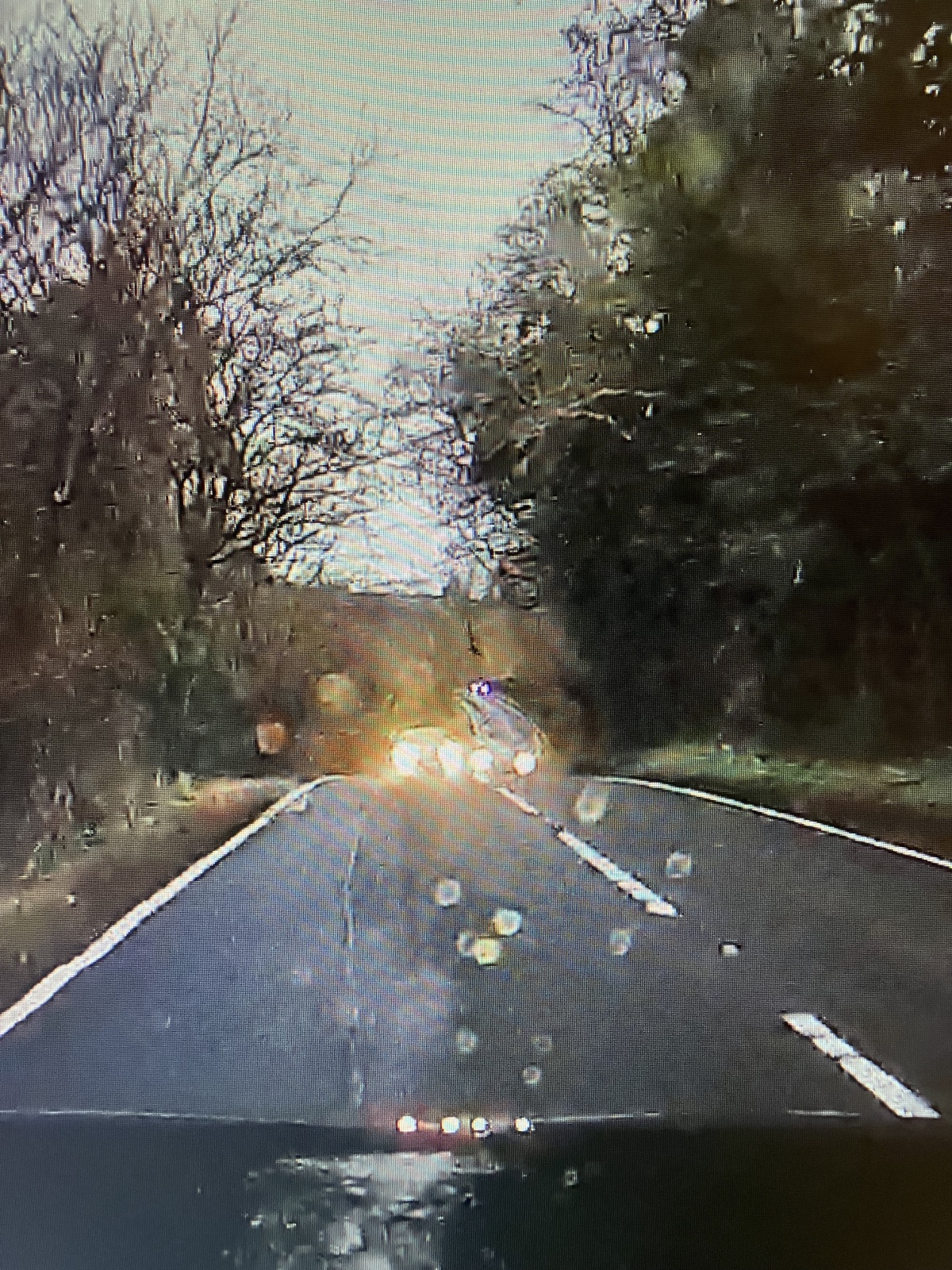
What happened to me had a purely human cause. Naturally, I would call it complete idiocy. Coming over the brow of a hill, and descending, suddenly there was 4 bright headlights ahead. On a narrow country road, with overgrown banks on either side that was a scary sight. Nowhere to go. In a faction of a second the overtaking car coming up the hill veered back into the right-hand lane. No more than a couple of yards in front of my car. Fortunately, there was no collision. What on earth was the motivation of that driver? Overtaking, at high speed, approaching the brow of a hill, on a wet county road, in poor light, sheer madness. A small red car, overtaking a larger car.

In safety work this points to the most difficult situations to understand. The irrational, or stupid or reckless, or carless human drives that are hard to design out of systems. How do we take effective corrective action when one person’s risk threshold is so very much higher than normal or acceptable? The problem with saying – take their licence away – is that this is always reactive. After a negative event. Maybe even a fatal one.


[1] https://www.simplypsychology.org/maslow.html

Friday evening

I listened. Well, it was unusual. On a Friday night, the country’s Prime Minister (PM) addresses the nation. Not much prior indication it was going to happen. What’s afoot, I thought. Could this be the moment a General Election is called? In the end it wasn’t an earth-shaking moment or likely to change the direction of the course of world events. The intention was good. There’s a strong need to step back. To condemn violent extremism in all its forms. Whether it’s ideological, from a political stance or religious in motivation.

Yes, people have a right to be passionate in pursuit of their beliefs. The limit comes in a liberal democracy when action steps over into aggression, intimidation, hate and violence.

Yes, it’s a sad day when a Westminster byelection results in the election of a maverick who as a disturbing track record of associating himself with alarming people and beliefs.

We (UK) are sure not in a good place, now. That does call for political leadership to step-up and face down those who would corrupt, divide, and wreak havoc. To do that across the board whether it be from the extreme left or extreme right. Wreckers are not new. They pop-up through history. Often using a false narrative to antagonise and stir-up insurrection. The results are always to the detriment of most people and to the advantage of a very few.

Is the PM facing down the those who’d happily wreck our liberal democracy? Friday evening was one attempt.

I agree with some commentators. If a speech is to be made outside the front door of Number 10, such an iconic setting, then there ought to be something of great substance in that speech. Afterall this is the place where PMs come and go, elections are called, and major crises are addressed. In this case there wasn’t much of great substance and vague messages were scattered throughout the PM’s rambling speech.

One problem is the misguided mixing of multiple different concerns in a mishmash. For example, protest is not de-facto bad. Illegal actions during a protest must be addressed much as illegal action any other time. If extra resources are needed to address those illegal actions surely it is for the government of the day to provision them appropriate to the task.

Perception matters. Condemning those who are clearly in opposition to the PMs political stance but turning a blind eye to those in the PMs camp who are just as bad, just smells bad.

Let’s be positive. It’s a good start. Leaders should come out an defend and preserve the liberty we all enjoy. They should craft langauage that unites. They should engage in robust debate on the side of truth. I wonder where we go from here. Will electioneering polticans stop the slurs and cheep remarks – unlikely.

POST 1: The PMs words on extremists and democracy have slipped off the on-line headlines rather quickly. Maybe his aim was for the weekend media to pick-up the debate in a thoughtful manner. Good luck with that one.

POST 2: Now, the PM is facing both ways. Paul Scully’s[1] utterances follow those of former Conservative Lee Anderson. When the majority of his party’s members think Islam is “A Threat To British Way Of Life[2]” and they would prefer a different leader from him no wonder the PM is calling for unity.


[1] https://www.telegraph.co.uk/politics/2024/02/26/paul-scully-no-go-areas-birmingham-london-islamophobia/

[2] https://www.huffingtonpost.co.uk/entry/majority-of-tory-members-believe-islam-is-a-threat-to-british-way-of-life_uk_65df4fd4e4b0e4346d54a740

One moment

I feel uneasy to quote Stalin but will do. In fact, there’s some disagreement as to whether he can be attributed. This short sentence may tell us something about the human condition. It’s not something that’s pleasant to acknowledge[1].

A single death is a tragedy; a million deaths is a statistic.

This is a ghastly historic saying. It’s enduring because there’s resonance in the words. One quick look at a national newspaper, tabloid or not, and the contrast between the detail afforded to stories of individuals and the aggregate impact of terrible events is significant. A journalist might say that’s because stories about people are relatable. Stories about complex and catastrophic situations involving masses of people are harder to witness, interpret and tell.

Alexei Navalny’s death is a tragedy. If he had lived, would he have been the Nelson Mandela of Russia? I wonder. Maybe not but he could have been the catalyst for change. Even if that change was to be slowing in coming.

A tyrannical regime that eliminates an opposition leader. History is littered with such dreadful events. Power corrupts. However, it’s notable that such events do not always end well for a tyrant. The name and the event become a strong echo that lasts for a very long time.

Images show police in Russia dragging mourners off. In the snow and ice. These images are not ones of a confident nation. In gathering to mark the death of an opposition leader Russian people are taking great risks.

Will there be consequences because of Alexei Navalny’s death in prison? There ought to be. Time will tell. Let’s look forward with hope. Let’s hope that Russia takes a different path in future. It’s a great country with enormous potential. Sadly, it’s going in a direction that will just deliver more catastrophes and tragedy.


[1] https://quoteinvestigator.com/2010/05/21/death-statistic/

14-years

All political parties have factions.  If the aim is to corral all liberals, social democrats, conservatives, or socialists and keep them under one roof it’s always going to be a hard job. Even as we speculate about the shelf-life of the traditional political ideologies, they remain powerful.

Liberals can be particularly difficult in this respect. It has been said that getting liberals to go in one direction is like trying to herd cats.  However, that picture is a dubious one in times when great injustices must be addressed, or a good cause strongly fires campaigning spirits.

What’s fascinating is the decline and fall of “normal” conservatism. That mild mannered compromise between self-interest, traditional values and deference has slowly fallen apart. It could be because of its poor fit with modern society but it’s more likely to be because it has ripped itself apart from within. Factions have strengthened and the core beliefs that formerly bonded people together have fractured. Brexit may have been both symptom and cause.

There’s the case that populism has been radically amplified by modern media. A crescendo of views and all we hear and see is the peaks and troughs. Anything in the middle is drowned out.

So, the current Prime Minister’s (PM), let’s remember we’ve had a few, calls for unity. It’s a trumpet sounding in an anechoic chamber. Not likely to be heard, except by himself and those standing next to him. Their smiles are professional smiles. Their hopes are forlorn.

Analogies are fun. Another one came up this week as the Parliamentary byelection results appeared. The British electorate could be compared to a sea going super tanker. That is, being big and having so much momentum, changing direction takes a long time. Once that direction has set there’s not much that can be done in the short-term. That national super tanker maybe going slightly left of centre whatever happens. Of course, a crude analogy isn’t necessarily true. It’s more of a prediction of what might happen if pivotal events do not intervene. That’s easy to say. It’s less easy to anticipate such dramatic earthshaking events.

One thing I can feel confident about is that this is not a re-run of 2019. No way. Nor is it a re-run of 1997. A vital ingredient is missing. We have no charismatic political leaders. Vision is in short supply.

Facebook has a habit of throwing up pictures from the past. One it threw my way this week was of me standing in Crawley town looking every bit a parliamentary candidate. That was 2010. I looked at the image and thought – if only I’d had some inclining of what was to come in the next 14-years.

If only I’d anticipated how badly the coalition would turn out for liberalism. If only I’d anticipated what foolish gamblers Cameron and Clegg were in thinking a national referendum would silence the Europhobic hordes. If only the Labour Party hadn’t gone on a doomed left-wing romp. If only the reality of Johnson’s unfitness for office had sunk in earlier.

Looking back provides lessons. It doesn’t predict what will happen next. We all to often get hooked on linear projections based on where we stand now. Forecasting is as much a mystery as ever it has been. That said, I think doing the maths is better than looking at the tea leaves or seaweed. A narrative for the future could read – don’t think “that’ll never happen,” think change is natures way of keeping us on our toes.

Here’s a prophecy. This one has good and bad. Long talked about and feared by those who milk the status quo, Proportional Representation (PR) will be implemented for national elections in the UK in the next 14-years. The dated model of big tent political parties will crumble. Ballot papers in years to come will have something for everyone. So, what’s bad about that transformation? Populism will not die. It will just eke out an existence in many new forms.

Space

Eutelsat OneWeb is a growing global connected community. That’s what the publicity says. Once upon a time I wrote about OneWeb. I wrote about it in the context of Brexit.

One of the touted benefits of Brexit was autonomy, in other words, British innovation leading the way to benefit Britain above all others. It’s that aggressive assertion of sovereignty that was at the core of Brexit. Remember, it wasn’t so long ago that this was part of Brexiters fantasies? 

In the Brexit turbulence the UK Government walked away from the EU’s Galileo programme. The UK no longer participates in the European Galileo or EGNOS programmes[1].

Then in 2020 the UK changed its original post-Brexit position and scraped building a national alternative to the Galileo satellite system[2]. At that time, Business Secretary Alok Sharma offered around $500 million of UK public money to acquire part of an organisation in trouble, called OneWeb.

OneWeb is a commercial Low Earth Orbit (LEO) satellite constellation now with an element of Government ownership. It’s network of satellites doesn’t have a global positioning capability, like Galileo.

To get its satellite network up and running, an expensive business, OneWeb merged with French company Eutelstat. Today, if we look at the 2020 investment made with public money the financial situation doesn’t look good. That doesn’t mean to say that things will not turn around in future years[3].

The Times newspaper has taken a nationalist view of the circumstance[4]. It’s a point that the intellectual property is not in the hands of the UK Government, but the investment could still turn out to be a useful long-term commercial bet. It’s gambling with public money.

As an aside, I’ve been looking at buying a new dishwasher for the kitchen. It’s made me aware of a capability that I had no idea had been developed. Namely, the connection of dishwashers via the web. I think this is what is called the Internet of Things (IoT). So, imagine that, British dishwashers connected by space as a Brexit potential benefit.

However, if there’s a change in the UK Government’s political direction after the next General Election there’s a strong possibility that the UK will return to the EU’s Galileo programme with some manner of partnership. When we get to 2026, we may look back on the decade behind as a vacuum, much like the vacuum of space. A time when an uncertain direction cost a great deal.


[1] https://www.gov.uk/guidance/uk-involvement-in-the-eu-space-programme

[2] https://www.politico.eu/article/uk-scraps-plan-to-build-global-satellite-navigation-system-to-replace-galileo/

[3] https://www.politicshome.com/thehouse/article/oneweb-uks-gamble-satellite-startup-pay-off

[4] https://www.thetimes.co.uk/article/656bd77c-c106-47c3-840b-674e9efc4f0e

Food

Food security matters. Much like energy security matters. Much like access to basic commodities. There are fundamental matters of supply that must not be ignored. International trade is a two-way street. But it must be a two-way street on the level. It’s possible to imagine a set of scales where there’s a balance between both sides. Maintaining that balance is a dynamic business.

It’s easy to understand how aggrieved farmers in Europe feel if they are subject to unfair competition. It’s the same in the UK. If say, meat comes into the UK, produced at a lower standard than domestic produced meat, and that undercuts farmers prices, that’s unfair and unwise.

News doesn’t just concern agriculture. Over the last weeks discussion about the UK’s ability to produce basic commodities, like steel, has occupied minds. Imports maybe cheaper. The trouble is that countries jeopardise domestic security and merely offload environmental concerns by increasing dependency on others beyond certain points. A sensible balance must be struck.

Political, marked trade imbalances are a nightmare. British farmers may not be so overtly militant as some on continental Europe, but they have a strong interest in influencing what laws say. Bandwagon jumping politicians from the far-right and far-left are taking advantage of the discontent that exists. None of these empty barrels have answers. That doesn’t stop them making a lot of noise.

Post-COVID, in all sorts of industries, there’s been, and still is, significant supply chain problems. For example, the price of farm machinery has gone through the roof. Although general inflation appears to be slowly coming down the hike that has happened, has happened. It’s bedded in.

Looking at the gap between input prices and outputs shows an unhealthy situation[1]. Producers have been squeezed. Their margins have been squeezed. It’s certainly not a good time to be a milk producer[2]. Even with optimism for the longer-term, today’s bills still need to be paid.

In the UK, there’s an often written about concern surrounding the power of the established major supermarkets[3]. These are almost monopolistic in their position in the marketplace. On the walls of their food warehouses pictures of smiling farmers and clean, shiny tractors are all the rage.

Because so much food goes through the doors of the supermarkets, if farmers want to protest, they are probably a better target than the UK Government. Alternatively, British farmers may need to work to reduce the influence of the middlemen. Going direct to the customer may not be for everyone but more could be done.

In a General Election year, it unlikely that politicians will pick a fight with British farmers. Their ears may prick-up for a short while. That’s a good time to make the case for domestic production.


[1] https://www.gov.uk/government/statistics/agricultural-price-indices/agricultural-price-indices-united-kingdom-november-2023

[2] https://www.nfuonline.com/updates-and-information/dairy-producers-braced-for-an-uncertain-future-nfu-survey-reveals/

[3] https://www.statista.com/statistics/280208/grocery-market-share-in-the-united-kingdom-uk/