Advancements in Flight Recorder Technology and Regulations

My last posting addressed accident flight recorders and airworthiness requirements. That’s not enough. It’s important to note that aircraft equipage standards are addressed in operational rules. So, the airworthiness requirements define what an acceptable installation looks like but as to whether an operator needs to have specific equipage or not, that’s down to the operational rules in each country.

Internationally, the standards and recommended practices of ICAO Annex 6 are applicable. These cover the operation of aircraft. Flight recorders are addressed in para 6.3.1. and Appendix 8. Let’s note that ICAO is not a regulator. There are international standards but operational rules in each country apply to each country’s aircraft.

One of the major advances in accident flight recorders technology is the capability to record more data than was formerly practical. This has led to standards for Cockpit Voice Recorders (CVRs) advancing from 2-hour recording duration to 25-hours.

Proposed rule changes have been hampered by the impact of the global pandemic. Some new operational rules apply only to newly built aircraft. That means some existing aircraft can retain their 2-hour CVRs.

Another technology advance is what’s known as Recorder Independent Power Supply (RIPS). RIPS can provided power to the CVR for at least 10 minutes after aircraft electrical power is lost. The RIPS is often offered as a relatively straightforward aircraft modification.

I do not know if the South Korea Boeing 737-800 was required to have accident recorders with the capabilities listed above. If they were not, then there’s a good basis for recommending that changes be made to existing aircraft.

Fatal Boeing 737 Crash in South Korea

Jeju Air Flight 7C2216, arriving from the Thai capital of Bangkok, at South Korea’s Muan Airport (MWX), crashed at around 9am local time (00:00 GMT/UTC) on Sunday, 29 December 2024.

My condolences to the families and loved ones of those who died or were injured in this fatal aircraft accident.

Pictures of the Jeju Air Boeing 737-800 landing[1] show that no landing gear can be seen deployed. A video image shows the aircraft skidding down the runway at high speed. The aircraft is wings level. It is reported the aircraft overrunning the runway and colliding with a wall or ramp. The video image does suggest that the aircraft engine thrust reversers were deployed. This is wrong. Weight on wheels is needed for deployment.

MWX runway 19 has a Landing Distance Available (LDA) of 2800 m. The local visibility was reported as 9000m and the wind speed at 2kt.

Was the pilot in command trying to go around? The accident flight recordings should answer this question. That is from the aircraft Flight Data Recorder (FDR) and Cockpit Voice Recorder (CVR).

This remains a hope. Reports are that the FDR has been damaged. This should not be a surprise given the nature of the impact it suffered. However, both FDR and CVR are designed and tested to survive extreme cases.

The South Korean Ministry of Land, Infrastructure and Transport says that the accident flight and voice recorders have been recovered[2].

Jeju Air is a popular South Korean low-cost airline. The airline was established in 2005.

A full independent accident investigation will no doubt take place. That is in accordance with the standards and recommended practices of ICAO Annex 13.

Current media speculation surrounding possible causes of this Boeing 737 accident do not offer any satisfactory explanation for the sequence of events. For example, it would be astonishing if the root cause of the accident was a bird strike or multiple bird strike shortly before landing. The aircraft has several means to deploy its main undercarriage.

It is likely that safety culture, controller and pilot training, and airport facilities are bigger factors in this fatal accident than the fact that it involved the loss of a Boeing 737-800 aircraft.

NOTE: Boeing 737 “If the gear fails to extend properly or hydraulic system A is lost, the gear can be manually extended by pulling the manual gear extension handles, located in the flight deck.” Landing Gear

POST: The impact test in the applicable technical standards EUROCAE ED55 (FDR) and ED56A (CVR) are demanding. The recorder’s crash protected memory module is fired out of a canon into a shaped target to simulate an accident scenario. It must be readable afterwards.


[1] https://www.independent.co.uk/tv/news/south-korea-jeju-air-crash-b2671085.html

[2] https://www.bbc.co.uk/news/live/c4glr85l2ldt

MH370 and MH17: A Decade On

The unthinkable happened in 2014. One major international airline suffered two catastrophic accidents. These tragic events ran contrary to all the trends in historic aircraft accident data.

In March, flight MH370 disappeared. In July, flight MH17 was shot down. In both cases there were no survivors from these international flights. This remains an unprecedented situation. It is a sobering consideration that such dreadful events were possible in a mature international framework of civil aircraft operations and regulation.

A decade on the pain of those who lost friends, family and colleagues in these tragedies is not diminished. Aviation should not lessen its attention to discovering more about what happened and putting measure in place to prevent reoccurrence of these events.

These two aviation catastrophes are different in respect of causal factors. One remains a mystery but, from what is known, has the hallmarks of an operational accident. The other is undoubtably an aggressive malicious act. Failings in the two elements of aviation safety and security, often viewed separately, are both capable of catastrophic outcomes.

Malaysia Airlines was a State-owned airline in the traditional model. There’s no reason to suppose that the airline harboured deficiencies that led directly to the two fatal accidents. In hindsight, the question is often asked: could both accidents have been avoided?

The extensive underwater search for MH370, in the southern Indian Ocean, resulted in no findings. However, floating debris from the fateful Boeing 777-200ER was discovered. Unlike what happened with Air France Flight 447 were the installed accident flight recorders were recovered from the deep ocean, there has been no such good fortune in respect of MH370.

Accident flight recorders are one of the primary tools for accident investigators. Installed recorders are built and tested to withstand extreme conditions. The reasonable assumption being that they will be found with any aircraft wreckage. The accident of MH370, is one where a deployable recorder may have been beneficial. That is one that ejects from an aircraft when it is subject to the high impact of the sea surface and then floats, possibly away from an accident site. There is a good case to be made for installing both deployable and installed recorders[1]. Particularly a case for long-range international overwater aircraft operations.

The facts surrounding the criminal act of shooting down of flight MH17 are well established. Sadly, in a troubled world it is impossible to say that such malicious acts will never occur again. What is to be done? Avoidance is by far the optimal approach. Commercial flying over warzones, where heavy weapons are known to be used, is extremely foolish. Now, it is good that much more flight planning attention is paid to understanding where conflict zones exist[2].

NOTE 1: On 07 March 2014 at 1642 UTC1 [0042 MYT, 08 March 2014], a Malaysia Airlines (MAS) Flight MH370, a Beijing-bound international scheduled passenger flight, departed from KL International Airport [KLIA] with a total of 239 persons on board (227 passengers and 12 crew). The aircraft was a Boeing 777-200ER, registered as 9M-MRO.

NOTE 2: On 17 July 2014, at 13:20 (15:20 CET) a Boeing 777-200 with the Malaysia Airlines nationality and registration mark 9M-MRD disappeared to the west of the TAMAK air navigation waypoint in Ukraine. All 298 persons on-bard lost their lives.


[1] https://flightsafety.org/files/DFRS_0.pdf

[2] https://www.easa.europa.eu/en/domains/air-operations/czibs

Revitalising Manufacturing

Yes, it’s good to have good trading relations with other countries. With a degree of pragmatism – as many as possible. Naturally, there are lines drawn in cases where countries share little of the UK’s values or are dictator run aggressors. Counting the hundreds of sovereign countries there are around the globe, a majority are friendly and mostly interested in mutual wellbeing.

However, post-2016[1] we are still living in strange times in the UK. In the same breath as some people talk of sovereignty and surrender, they say an extremely wealthy man in the US can solve all the UK’s problems. This nonsense defies any kind of logic.

There’s a peculiar celebration of the UK joining the Asia-Pacific Comprehensive and Progressive Agreement for Trans-Pacific Partnership (CPTPP) bloc. As if we didn’t have a huge trading block on our immediate doorstep. Joining one that offers a tiny gain overtime whilst leaving the other has cost a massive economic hit. The one thousands of miles away is significantly culturally different but the one next door is one where we share a common history.

I learn that there’s no point even thinking that logic has any influence on a Brexit supporter. Non whatsoever. Their view of the world comes from some lost imperial age.

Sadly, Brexit talk is only mumbled in darkened corners. That whopping great elephant in the room continues to get ignored. Even the UK’s new Labour Government is carrying on as if there were the former Conservative bunglers. There’s some woolly talk of reconciliation. There’s a lot of right-wing scaremongering. Practically, not a lot is changing.

In real terms, both UK exports and imports of goods are lower than in 2016, having shrunk by 1% and 2%, respectively[2]. Which is crazy given the new economic horizons. Especially in the switch to the need for more environmentally responsible goods. We should be modernising and strengthening UK design and manufacturing. Not just a bit but putting a rocket under both. Half hearted nice words by minor Ministers don’t cut it.

International trade fantasies will not build a stronger domestic economy and that illusive positive growth that’s often talked about in political speeches. With the coming of highly advanced computing, like artificial intelligence, countries with predominantly service based economies are gong to struggle. Basic service orientated jobs are going to get more automated. Like the traditional factories Henry Ford would have recognised, office complexes are hollowing out.

At least the new Labour Government isn’t pushing wholesale reopening coal mines or returning to a dependency on North Sea oil rigs. That said, I’m unsure what their attitude and policy is to rock fracking and imported gas supplies.

To make real economic progress we (UK) must make Brexit history. With our colleagues in Europe, we can be an innovation powerhouse. Making home grown products for the world markets of the future. Not languishing in a tepid imperial past or tugging at the shirt tails of some mega weird pugilist.


[1] UK referendum result: Of those who voted, 51.89% voted to leave the EU (Leave), and 48.11% voted to remain a member of the EU (Remain).

[2] https://personal.lse.ac.uk/sampsont/BrexitUKTrade.pdf

H2 Aircraft Design

Cards on the table. I’m a believer. Despite the immense technical challenges, Hydrogen is a viable fuel for future large civil aircraft. That said, operational service of such revolutionary aircraft isn’t going to happen in a hurry.

Reading the history, Concorde was an incredible test of the boundaries of what was possible and that was met, but it didn’t come easy. Breaking new ground is never easy. [A common saying that’s maybe open to challenge]. In aviation making step-changes happens every decade. What’s nearly always required is exceptional determination, almost beyond reason, large sums of money and special people.

Control systems – no big deal. Mechanical components – evolution possible. Turning a gaseous fuel into high-levels of propulsive thrust – can be done. Building a one-off technology proving research vehicle. It’s happening. At least for the light and commuter class of aircraft.

None of this is enough. Because the gap between an aircraft that can fly and an aircraft that can be produced in the thousands and go on to make an operational living and build an impressive safety and reliability reputation, that’s still a million miles off.

Today, there’s artist impressions of all sorts of different H2 aircraft configurations. It’s like people painted pictures of Mars with imaginary canals, long before anyone knew what the planet looked like in reality. Innovation starts with ideas and not all of them are sound.

As I expressed in my last article, crashworthiness must be given much consideration when speculating about future designs. It’s not always explicit in aircraft certification, cabin safety being the exception, but studying the history of accidents and incidents is essential. One of the successes of the authorities and industry working together is to take lessons learned seriously.

I remember looking at the pictures of the wreckage of Air France Flight 358, which crashed on landing in Toronto, Canada[1]. The fact that there were no fatalities from that accident is a testament to good operations and good design practices. The Airbus aircraft burned out but there was enough time for passengers and crew to get away.

My thought is what kind of H2 aircraft configurations would permit the same opportunity?

Considering this large aircraft accident, and others like it, then there’s a message as to where fuel tanks might best be placed. There’re some aircraft configurations that would have little hope of providing the opportunity for rapid evacuation of hundreds of people.

So, in my mind, don’t attached large pressurised cryogenic fuel tanks to the underbody structure of an aircraft fuselage. However robust the design and build of such fuel tanks they would be unlikely to survive as well as the cabin passenger seats, namely 9g[2]. That would not provide a good outcome post-accident.

Maybe, like aircraft engines sitting on pylons off the wings, that too is a good place for fuel tanks.


[1] https://asn.flightsafety.org/asndb/322361

[2] https://www.easa.europa.eu/sites/default/files/dfu/NPA%202013-20.pdf

Challenges of Hydrogen Fuel in Civil Aviation

This week has been a Hydrogen week. It’s great to learn more of the projects that are out there and the ambitions of those developing systems. Hydrogen is a live subject. Looking at the possible pathways for civil aviation to take there’s a myriad of choices. However, when it comes to the fuel for propulsion there are not so many potentials.

It’s surely the case that at some time in the future the use of fossil fuels to propel us across the skies will no longer be acceptable. Even if I’m talking to climate change sceptics the point must be made that fossil fuels are a limited resource. Not only that but the air quality around airports is a matter of concern.

It’s there in our basic education. Water is H2O. It’s that combination of Hydrogen and Oxygen that is essential to life on Earth. So, if we have a process that provides aircraft propulsion by using Hydrogen it should be a whole lot better for the environment than using Jet A1.

The problem is, and there’s always a problem, to carry enough Hydrogen it will need to be pressurised and in liquid form. That means extremely low temperatures, robust storage containers and extensive leak free plumbing.

Today, we have cars on the road that run on liquefied petroleum gas (LPG). It’s a novelty. It’s less harmful to the environment and can cost less. However, LPG systems need regular servicing. The point of mentioning this pressured gas in a transport system is that it has been integrated into regular everyday usage. That’s knowing that escape of even small quantities of the liquefied gas can give rise to large volumes of gas / air mixture and thus a considerable hazard[1].

Any analogy between the car and the aircraft can be forgotten. That said, one or two of the issues are similar. Yes, what happens when an escaped volume of gas / air mixture is ignited?

What scenarios would bring about conditions whereby a destructive explosion is possible?

Let’s start with the situations where aircraft accidents most often occur. Take-off and landing are those phases of flight. A surprising number of accident scenarios are survivable. The important part being to get an aircraft in trouble on the ground in such a way that an evacuation is possible. That can mean hitting the ground with a great deal of force[2].

Here’s the matter of concern. An aircraft with large cryogenic tanks and associated complex plumbing hits the ground at a force of many “g”. What then happens? Certainly, pressurised liquefied gas would escape. Being a very light gas, the uncontained Hydrogen would rise rapidly. However, trapped amounts of gas / air mixture would remain a hazard. Would that be ignited?

There are a lot of unknowns in my questions. Although there are unknowns, any post impact situation is likely to be very different from a situation with a conventionally fuelled aircraft.

Today’s, burn through requirements ensure that an external fuel fire is held back. Thereby ensuring enough time to evacuate. For a hydrogen aircraft ventilation may be essential to stop build-up of a gas / air mixture inside a fuselage. That means a whole different approach.


[1] https://youtu.be/AG4JwbK3-q0

[2] https://skybrary.aero/accidents-and-incidents/b772-london-heathrow-uk-2008

New Form of Monarchy in 2024?

An observation. There’s something strange going on across the Atlantic. You see, I have found inspiration in the story of America’s revolutionary struggle. The writings of Thomas Paine stirring up a radical movement. The strong desire to be independent of the rule of Kings and Queens. There’s a lot to be said for freeing a nation from imperial tyranny.

The Declaration of Independence in 1776 is a bold statement. Rejecting the royal authority of George III to set a new nation on an independent path. It proved to be a dynamic and prosperous democratic path. One that people across the world looked on with admiration.

It’s true that the United States has had its own dynasties. Powerful families and influential individuals that have shaped its history. However, since its independence, none of them have ruled as a monarch. None have wheeled massive power without checks and balances.

Yet here we are in 2024, and a form of pseudo monarch stands ready to take the reigns of power. Sure, democracy has played its part in putting one man in control. That, in of itself, is not unknown in the history books. The question to ask is when does a Republic tip over and become something quite different from what it has been?

I hope my observations are an exaggeration. It’s all to easy to see the News that commentators want us to see. I’ve often found that it’s most difficult to see things as they actual are as opposed to how they are shaped by personal beliefs and fleeting desires. Objectivity isn’t so easy.

This much can be said, the next four years are going to be turbulent ones. There’s a certainty in that conclusion. Even with the Atlantic in the way, just as the Jetstream brings us changeable weather, so unsettling waves of transformation will hit our shores.

The latest commentary coming from supporters of the new Trump regium in the US is one of polarisation. It’s the traditional stick-up. Choose between us and them. Our populous island off the shore of continental Europe must be squeezed into a choice between the US and the EU.

This monosyllabic way of framing a debate gets swallowed by the media. Overall, it’s nonsense. There’s no way that both will not be important for as far over the horizon as anyone can see. Both are going through periods of disruption. For once, domestically, the UK seems relatively stable. That’s putting aside the past damage done by Brexit and a Conservative government that fell into total disrepair. Yes, the UK can plot its path knowing that some internal consistency can be expected.

Everything I’ve written here is overshadowed by issues of global concern. Overshadowed being the sad reality. Climate change will not wait for the dust to settle from ardent disruptors. The planet’s atmosphere knows nothing of the exploits of prominent personalities. We desperately need to rediscover common interests and act on common concerns.

Exploring the Kennet & Avon Canal

It’s the road to the west. The A4 out of London heads towards the west. It’s younger but bigger brother the M4 motorway goes the same way. Going the same way too is the Great Western railway and before that a major waterway, a canal. I guess the ancient roads predate the lot of them given that east-west traffic is an important part of English history. Certainly, the Romans went that way.

I now live at what is roughly the halfway point between London and the west. It’s where what is largely a level route from London starts to rise at a slow pace. That climb made linking rivers, most particularly the London Thames and the river Avon in the west, a challenge. The incentives were evident. So, much potential for trade. Moving heavy commodities around. Canals are truly visionary engineering infrastructure and now an inheritance that’s much treasured.

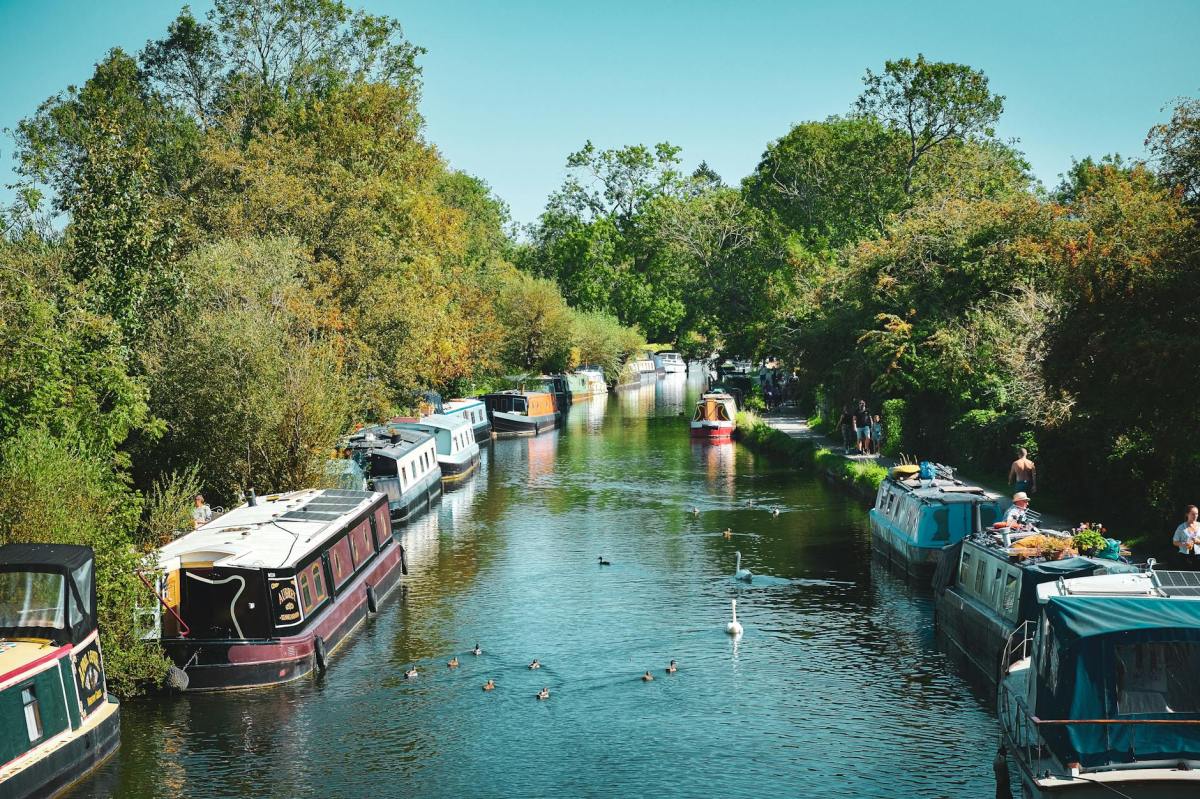
For people who like to walk, like me, canal towpaths[1] provide flat route between towns. A direct waterside route that wanders through lush countryside. Yesterday, I did the 15km between Newbury and Hungerford. Along that stretch, the Kennet & Avon Canal raises about 150 feet but it’s almost unnoticeable. The main signs are the difference between the fast-flowing waters of the river Kennet and the sober slow canal. A littering of canal locks and small brick-built bridges are a feature too.

The Kennet & Avon Canal was constructed between 1795 and 1810. It was eventually killed-off as a commercial enterprise by the construction of the Great Western railway. Being cheaper and faster along the iron road, transport of goods by water couldn’t compete. It’s in this modern time that the canal was restored. It’s been working again for the last 30 years. Now, it’s a centre of leisure pursuits, small businesses and alternative lifestyles.

The canal’s path follows the River Kennet and its narrowing flood plain. I found looking at how the waterflow is controlled by sluice gates and weirs a fascinating part of the walk. Ambling along the canal’s towpath is a great way to venture into the Berkshire countryside. There are a couple of points where the path changes sides and it’s a bit soggy in one or two places but overall, it’s relatively easy walking.

I did see an Otter on the opposite bank. It was a fleeting glimpse. He, or she, slinked away almost before I realised what I was looking at. Quite different from noisy ducks this Otter made virtually no sound or ripples on the water. 

Dotted along the canal near bridges, decaying concrete World War II-era pillboxes are a reminder that this would have been a defensive line if Britain had ever been invaded.

The walk took me under 4 hours. I was exceedingly fortunate with the weather on the day. A cool breeze and intermittent sunshine. Not bad for November.


[1] https://canalrivertrust.org.uk/things-to-do/walking

Travelling Post-Brexit

Ever since Brexit, I’ve had to have my passport stamped in and out of European countries. It’s like a reversion to the days when I got my first British passport. That was back in the late 70s.  It has a frighteningly youthful picture. Occupation – student.

I’m not so phased by the coming changes to European Union (EU) border controls. Naturally, it’s worth asking if Britian has become a more dangerous nation since the time before Brexit when we enjoyed freedom of movement. It’s a pity we didn’t value that freedom a lot more. It was thrown away far too easily.

Today, the electronic border controls expect us to stare at a camera. A securely held, I hope, database is used to check a list of biometric numbers against my image. I guess that’s a sure-fire way of saying that Mr Blogs is indeed someone who looks very much like Mr Blogs. Facial recognition technology has come a long way.

The next steps in tightening-up controls will be fingerprinting[1]. Not in the manner of Sherlock Holmes, with an ink pad. No, in the digital age an ominous machine will scan our fingers and check its records to see that not only does Mr Blogs look as he should but that he’s got the essential characteristics of Mr Blogs.

Certainly, in this new regime British citizens will not be able to overstay in European countries. Ones travel records will be a lot more quantifiable and precise than stamping a piece of paper. That is assuming such digital border control machines will be relatively error free.

One of the benefits of Brexit is that it will be easier to track the movements of British criminals in and out of the EU. The reciprocal will not be true. It will not be easier for British authorities to track continental European criminals in an out of the UK.

Ah the luxury of being a Third Country. Longer ques. More uncertainty. Less privileges.

What’s more is the introduction of the new EU border control systems will be “phased[2]”. This change will not be one big bang. So, different ports and airports will be doing different things at different times. Now, it doesn’t take a genius to see that confusion is most likely.

Travelling in 2025 is going to be more than the usual adventure.


[1] https://commonslibrary.parliament.uk/the-eu-entry-exit-system-and-eu-travel-authorisation-system/

[2] https://www.independent.co.uk/travel/news-and-advice/eu-biometric-border-fingerprint-entry-delay-b2627645.html

Navigating Heights

If I were to explain, the reasoning would go like this. It’s good to have a vivid imagination. As an engineer, it’s essential to be able to create a mental picture of what’s happening. But there’s a downside. Looking at a situation and seeing more than is there, opens the door to imagining all sorts of scenarios that are unlikely.

I’m talking about that experience of peering over a cliff edge to see what’s there. Curiosity being a strong urge. Then pulling back in fright of falling. Often when the ground is solid and safe. Often when nothing more than a spark in the imagination creates an unreasonable fear of falling. The fleeting image I have in mind is looking down at Beachy Head Lighthouse[1].

I have a curious relationship with hights. No, I’m not terrified of heights. It’s just that now and then that fear of falling does kick in. This feeling could be embedded or learnt from an early age. My mother tells a story of me as a toddler being halfway up a ladder. Sacring her. Me being oblivious to any danger and coming to no harm. Growing up on a family farm there was innumerable hazards around every corner.

One of the riskier things was to climb up the haybarn roof. This was an open steel framed structure spanning several bays. Corrugated sheets made up its roof. In the UK, we call these buildings a Dutch barn. This mostly refers to the curved shape of the roof. From the top of the barn, it was possible to see the whole farmyard.

Last week, I hiked around the Caldera de Taburiente on La Palma. I learnt that the term caldera has Spanish origins. So, I was in the right place to assess any fear of hights that might linger in my psyche. The Caldera de Taburiente is more than 2000 m deep.

Even the roughly hewn paths, some restored from local landslides, didn’t phase me. It’s as if, because I was one of thousands who have passed the same way, the dangers where contained. In fact, there were not. Some of the well-worn slippery stones underfoot had to be approached with a great deal of caution. Loose rocks and sheer drops had to be navigated with care.

The Caldera de Taburiente National Park is a magical place. It has a Jurassic Park feel about the place. Given that it’s not much more than a few million years old the place is far to youthful for dinosaurs. It has its own special natural beauty.

My aging but persisting vivid imagination had plenty to occupy itself as we climbed and descended in and out of the park. The whole hike was about 16 km. This was the second time I’d taken this circular route. What surprised me was the hard parts of the climb and decent following a riverbed on the way out. That part I’d conveniently forgotten.

No, I’m not terrified of heights when there’s solid ground underfoot. They do however have the capacity to scare or at least summon up a lot of extra care. I hope that inbuild sense of self-preservation never fails me.


[1] https://www.beachyheadlighthouse.co.uk/