Civilization’s Edge

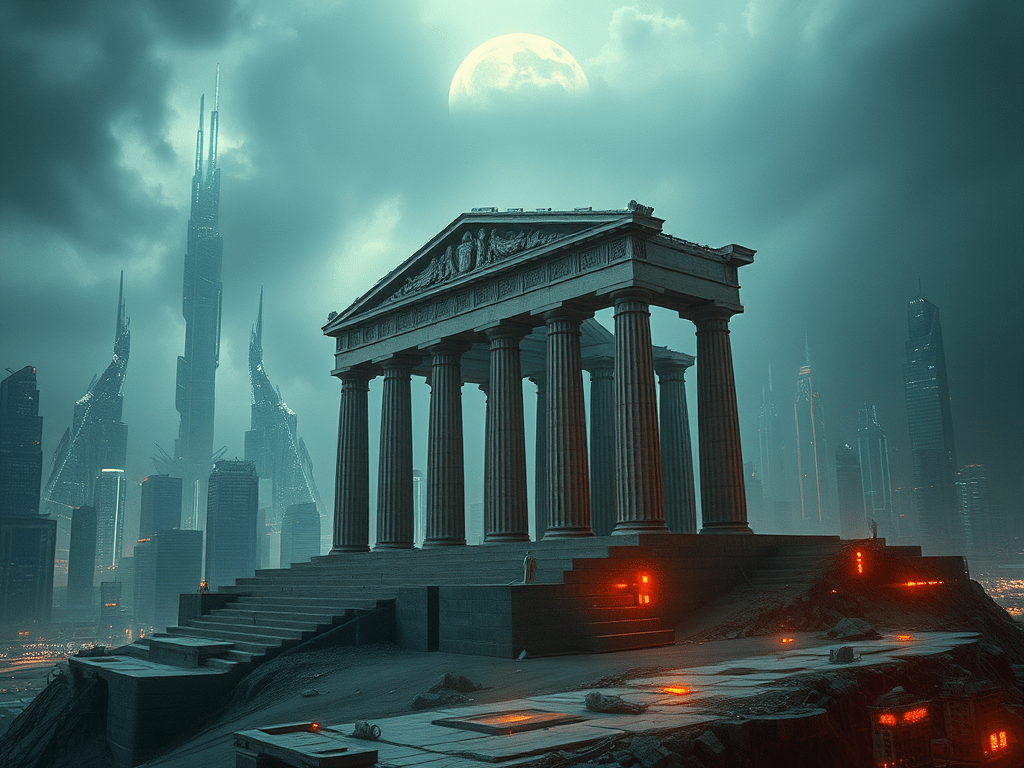
Civilizations rise and fall. That’s not new in the human experience of the last couple of thousand years. One of the causes of failure is an encounter with an entirely unexpected threat. When I say “unexpected” I mean unprepared for threat. Then finding that the defences that have been constructed fall simply and quickly because they didn’t anticipate that threat.

Another reason for failure is a perpetual human characteristic. Arrogance. Everyday imagining that the pinnacle of achievement is – now. Look how smart we are in the 21st Century. Capable, Superman like, of leaping so far ahead of our forefathers.

I’m a child of the analogue age. I was born into the space age. What that brought us, by necessity, was the digital computer in all its myriads of forms. Yet, from day one, it’s no better that a mass of fast switches. Ones and noughts. Nothing more. Nothing less.

With miniaturisation and an understanding of how materials work a massive, global, interconnected digital system, called the INTERNET, has been constructed. It’s flexibility and utility are undeniable. Its extended human capabilities way beyond that of past generations.

Now, I can start a sentence with “however” or “but” or despite this fact. The whole enterprise is still an unfathomable, dynamic number of ones and noughts.

There’s a kind of vulnerability that is elemental. Whatever might be written about powerful Artificial Intelligence (AI) systems it’s fair to say that the “A” is entirely accurate but the “I” is a bit of a myth. Mimicking intelligence is more the order of the day. That does make people shudder because that mimicking is so fast and draws on a massive amount of information. Seemingly that surpasses human capabilities. It doesn’t.

I write not of the machines that we have today but of those to come. I’ll resist the mention of the number 42. What’s happening is an acceleration of developments. These highly versatile tools that are permeating every aspect of life are not frozen in time. They overhaul themselves on a regular basis. What comes next is indeed machines that make machines. Algorithms that write algorithms.

Humanity is unprepared for the emergence of an intelligence that genuinely fits that bill. The whole idea of sovereignty and human autonomy might go out of the window. The ability to exercise control over where we are going is lost.

There are a lot of wealthy folks who are of a libertarian frame of mind who don’t seem too concerned about this race to the point of loss of control. This could be an expression of arrogance or ignorance or both. It could be the ultimate expression of short-termism.

It’s going to require real effort to hang on to democratic systems where we all have a stake in the direction of travel of our society. Money buys influence. Now, that influence is adverse to the idea of trying to regulate or moderate the advance of technology.

Civilizations rise and fall. Are we racing towards a cliff edge? Put aside climate change for a moment. Stop me from any tendance to doom-monger. My thought is that a comfortable, stable, prosperous society needs regulator instruments that work to mitigate threats. Let’s not be persuaded to ignore that reality.

Future of Engineering

I do find it astonishing that back in the early 1990s I was still producing handwritten material that then got typed up by a typist. Then, were edits and errors needed correcting, “cut and paste” really meant cutting and pasting paper. Applying Tipp-Ex correction fluid was normal. Wonder who uses that now? It’s still available.

Engineering practice adopted word processing rapidly from that time on-ward. It’s now almost inconceivable that anyone would get someone else to type up their work. Early lap-top computers that weighted heavily on the shoulders, were carried to meetings as necessity but not love. The joys of trying to find a printer that would work was a daily mission.

In about 30-years we’ve gone from that primitive introduction to the digital realm to machines that want to write papers and reports for us. From brick like “portable” computers that required cables and batteries that drained in minutes to the complete world being available on-line anywhere on the globe.

The mechanisms by which engineering design and development were done have advanced in such a way as to make the past seem rather curious. I’m not saying that we’ve become ever cleverer and more inventive with the passage of time, just that the speed of trail and error has increased dramatically.

Past mechanisms did make the ability to change a path, once set on that path, difficult. I remember the reluctance to introduce changes unless an overwhelming case could be made. In this new situation, making changes still has a cost associated with it, but the resistance to change isn’t so much driven by the processes used.

What’s happing, like it or not, is that artificial intelligence’s transformative impact is touching, or will be touching, everything we do. That includes engineering design and development.

I’d say it’s a good time to be an innovator. In theory, it should be possible to explore many more possibilities that could be explored in the past. That is for the same level of cost in time and money. There’s not a single part of engineering practice that will not be impacted. Classrooms, meeting rooms and workplaces where the business of communicating technical ideas and testing them goes on, will be fertile ground for the application of AI.

I don’t think we understand just how transformative the impact will be on engineering. It’s not all upside either. Technology’s promises are great. There are perils too.

AI can only know what it’s been trained on. That maybe extremely extensive. However, innovation comes from creativity and inventiveness where the past may only be a partial guide. Also, there’s the danger of overreliance on these almost magical tools too. New skills must develop to be critical and knowledge of the deficiencies of complex algorithms.

All of this is a bit different from paper, correction fluid, scissors and tape. What an exciting time to be a young engineer.

Evolving Communication

What happens when only a small percentage of the population can read and write? A historical perspective on that question gives the answer: feudalism. If texts are all in Latin and only the priesthood can read Latin, then it’s obvious what the results will be. That the priesthood acquires a superior power to that of the ordinary citizen.

Our interactions are what gives us our freedom. It’s difficult to challenge authority if that authority is holding all the cards. The means to communicate, and the willingness to do so, are integral to a free society. A democratic society.

Speculation about a future where humans spend most of their time interacting with machines is reasonable. In the last couple of decades, the increase in the number of machines that occupy more of our time is notable. Every trip to the supermarket[1] there’s the opportunity to enter a shop and leave without a single word to anyone. Not even a simple greeting or snippet of small talk. This is often sold as a benefit, faster, easier, less hassle.

If life can be conducted without the need for human communication, there are those who will take that path. Some will be by default and others willingly walk that path. If a majority do this then the balance of power shifts to advantage those who control the machines.

Before I go off on some dystopian movie plot, it may be as well to say that lot of new forms of communication have sprung up too. Those who play computer games and interact with other players all over the world. Such capabilities never existed until relatively recently.

What’s most concerning is the gradual distancing that is happening in politics. This might account for some of the disillusion that’s now evident. Gone are the days of major names addressing crowds directly. The idea that a political candidate would stand on a soapbox[2] in a public place and drum out their views and beliefs is getting remote. Such old-fashioned grass-roots campaigning methods are seen as dangerous and riddled with pitfalls.

Better a short video on a social media site is seen to be the substitute. Certainly, safer than standing up to a protest group or alternatively standing with them. Although, to be accurate, security has always been a matter of concern for public speakers. Taking onboard changes, verbal human to human communication is far from dead. It’s taking different forms. Mediated by the digital world we now act and speak differently. Post-COVID a degree of social etiquette has been lost.

Maybe this is why the UK Liberal Democrats are making so little impact on the national stage. With so many more elected members than one of their right-wing adversaries they still command less newspaper column inches (another old-fashioned term).

Like King Cnut[3], it’s foolish to think that the digital tide can be stopped. People must roll with it. If that means having a virtual pet or an artificial friend that will all become part of life’s colourful pageant. Small talk at a bus stop will never go away. However new ways of talking about the things that matter are happening – better adapt.


[1] https://www.theguardian.com/global/commentisfree/2025/aug/24/are-we-heading-for-a-world-where-no-one-ever-needs-to-talk-to-another-human-being

[2] http://news.bbc.co.uk/onthisday/hi/dates/stories/march/30/newsid_3739000/3739176.stm

[3] https://www.historic-uk.com/HistoryUK/HistoryofEngland/King-Cnut-The-Great/

Why ‘Artificial’ in AI May Be Misleading: A Deeper Look

On reflection it seems strange to me that the biggest commercial push in technology should be called Artificial Intelligence (AI). Universally, this term has seeped into the daily media as being the only form of shorthand for the coming transformation in our lives.

Generally, the word “artificial” isn’t associated with desirable qualities. If I say that it’s opposite is “natural” then there is a wide gulf between the two. It couldn’t be clearer. Place a plastic garden chair next to an antique wooden chair – case proven.

Imagine a marketing campaign for artificial cosmetics as opposed to natural cosmetics. Which one do you think would be the more successful? It’s honest to say that a product is artificial given that it’s manufactured but it’s much more appealing to talk about its natural roots.

A desire to elevate natural content has a historical context. It’s the industrial revolution that provided society with a rich wealth of choice. Trouble is that a legacy image of dark satanic mills[1] and grim-faces of exploited workers is written deep into our culture. The natural world was assaulted and abused by the unstoppable steam roller of the industrial revolution.

It’s reasonable to refer to a complex digital system as an artifact. Not in the way of an archaeological discovery. More like a popular game, chess, checkers or go, in that it’s extant and associated with a set of practices and rules.

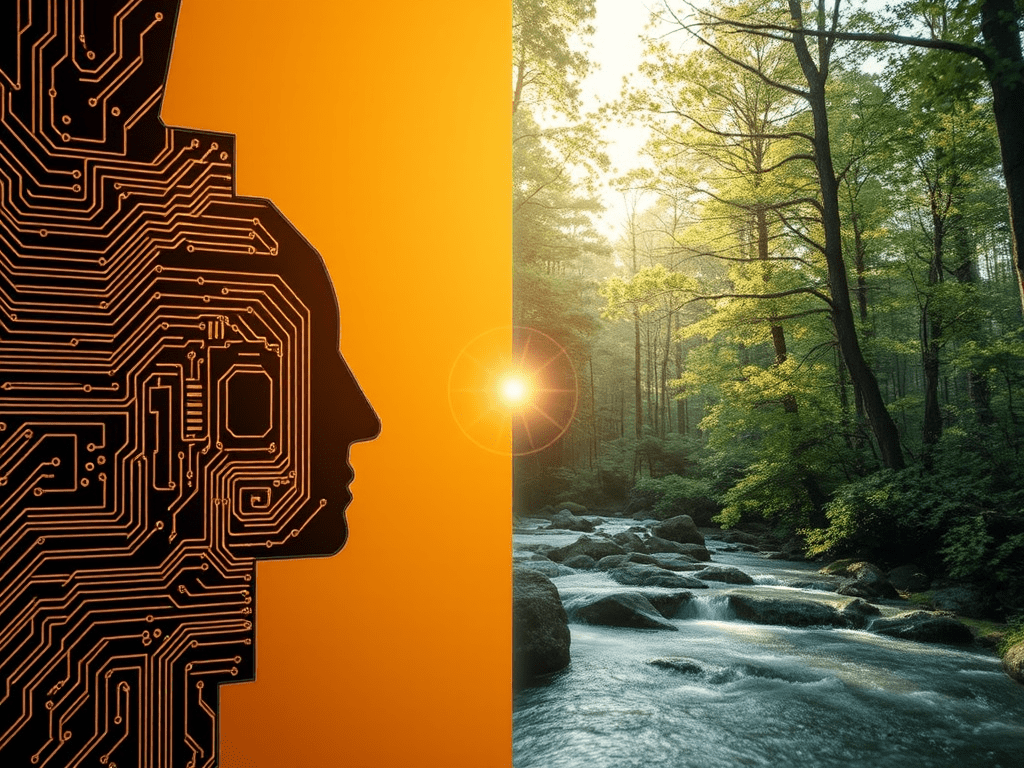
Today, AI doesn’t exist in nature. It may be inspired by nature, in terms of analogies with the workings of our brains. Neural networks and memory. Interconnections of circuits and wires and their arrangements are a human creation.

Having written the above, it does make me think; what will happen in 1000 years? A long time for our social structures and organisation but no time at all for any inhabitants of the Earth. Will someone be writing academic tones on the natural history of computers? Humans will be looking at them, and their evolution wondering how and why they got to do what they do. Much as we might now study ravens, rats and rabbits.

Surely AI will evolve. A natural process. Current systems will inevitably have deficiencies and flaws that get corrected in future generations. Experimentation is a human domain. Give it several decades and machines will be doing it for themselves.

The word “artificial” has a big downside. Although I’m having a lot of difficulty in thinking of a better general word. In my long-term scenario, what’s coming is a new branch of evolution. We know, the complexity of human behaviour is largely conditioned by our environment. We adapt. What AI may become, continuity dependent, will likely follow a similar path.

Whenever I visit the Natural History Museum[2] in London I like to look in on our ancestors. Today, our species, Homo sapiens, is the only human living. We once lived amongst our other human ancestors. Homo is the Latin word for “human” and sapiens is derived from a Latin word meaning “wise”.

There’s a story for you. Will AI eventually become Machina sapiens?


[1] “Dark Satanic Mills” is a phrase from William Blake’s poem.

[2] https://www.nhm.ac.uk/discover/the-origin-of-our-species.html

Enhancing Transport Safety

There’re claims that Artificial Intelligence (AI) will make transport safer. It’s to put a positive spin on the introduction of AI. Implying that existing safety deficiencies can be addressed with the power of AI.

It’s difficult to disagree with this simple assertion. There’s a list of risks that continue to be troubling. With directed design effort there are functions that AI can perform that mean it can have an advantage over conventional systems. With good design, no doubt high performing systems can be constructed.

In aviation, for example, if I consider the top five fatality risks, there’s a persistence of specific categories. We never seem to get away from loss of control in-flight (LOC-I) being high on that grim list. Runway related issues persist, and the hardy perennial of mid-air collision remains. Over the years progress has been made addressing controlled flight into terrain (CFIT), but that category of destructive events never disappears.

It’s fascinating to see that the industry thinks that AI itself is a risk[1]. High probability but low impact. This is considering a broad description of risk rather than a safety focus. Here the concern is related to the difficulties of practical implementation of this new technology.

Marketing people will big up the possibilities brought about by AI. This is what’s going on in relation to the most recent mid-air collision fatal accident. With sound justification given how crude elements of air traffic management are in specific locations.

We will never entirely displace “see and avoid” as a means of collision avoidance. Scanning the horizon looking for other air users. In my opinion, relying on this technique in relatively busy traffic areas is unwise, to say the least. This is where airborne AI assistants have much operational safety potential. Sucking up multiple information sources and processing masses of information to give accurate and instant advice. Such systems can be designed to give real-time updates not only to improve situation awareness but give avoiding action guidance, or even automated responses.

Let’s get back to the general assertion that AI will make aviation safer. On this one I’d be more cautious. For example, looking at LOC-I incidents and accidents there’s a complex mix of causal factors, and circumstantial factors. In addition, there’s the complexity of potential recovery actions too. Solving problems in 4-dimentions whatever the weather, whatever any damage incurred and however pilots react. This is where the probability numbers start to stack up.

That catch all disciplines “human factors” makes outcomes particularly difficult to calculate. Accidents are known where pilots and automation fight each other to produce bad outcomes.

AI is a machine. It will speedily crunch numbers in a mechanical manner. An extremely advanced manner but without emotion or, yet, not matching the imaginative capabilities of the human brain. Or for that matter the sophistication of human senses.

Would exceptional capable AI have saved Swissair Flight 111[2], for example? Sadly, I think not. On the day, likely an automated airborne system would have made the same decisions as the pilots. Decision making without the sense of precisely how the aircraft fire was developing would still have been hamstrung. I could raise other cases too.

Will AI make transport safer. In part. Not as a universal cure all.


[1] https://www.iata.org/en/publications/economics/reports/risks-2025-brief/

[2] https://www.bst-tsb.gc.ca/eng/rapports-reports/aviation/1998/a98h0003/a98h0003.html

Revolution: Hype vs Reality

Talk is of a revolution[1]. That sounds sensational. It sounds like marketing talk aimed at creating an insatiable desire for something new. So, that kind of talk immediately switches on the cynical side of my brain. Is this hype or is it real?

We’ve had plenty of both in my lifetime. Colourful boys adventure books with novelties like nuclear powered aircraft and moonbase vacations. It’s not that “flying a kite” is entirely bad. Those imaginings of the future had pictures of prototype flying cars. Now, we maybe on the verge of that prediction becoming real.

AI is not new. It’s been a research subject for decades. What we have most recently is the coming together of concepts and the practical machines on which to run those concepts. Amazing has been the speed of progress. That’s a modest word considering the sudden adoption of new tools that go way beyond simple INTERNET search engines.

Bill Hunter’s line: “You can’t stop progress”. At least that’s the line I remember of the 1994 film Muriel’s Wedding[2]. It was said on a rocky path to “progress” induced disaster.

My curiosity centres around avoiding the hype and finding out what’s real. That’s in the vain hope that I might not be left behind in this rapid surge of “progress”. So, to keep up with the latest technical developments I clicked on a TED App. The boss of TED, Chris Anderson has recently interviewed Sam Altman, the CEO of OpenAI[3]. He’s the guy behind ChatGPT. AI has elevated new people into the spotlight. It’s given established technology companies a headache. Their desire to be in the pack, or leading the pack is mighty strong.

My takeaways form this interview are that AI will outpace human intelligence, in time. No one knows how much time, but the path is set. The direction of travel isn’t in the control of traditional institutions or government departments. Society must get its head around a time when we live with machines that out pace us.

Second, it would be nice to have an enlightened global regulator to ensure that the massive amount of development going on produces outcomes that are for the public good. Chances of that happening are about zero, although not zero. There’s even a possibility that the industry at work on this technology realises the need for a set of enforceable rules.

Questions of safety are paramount. Even though society debated the impact that the INTERNET would have on us, steps to provide protections and boundaries only came about after the event. Lost in a storage box, I once had a book called “The Sleeping Sentinels”. Basically, the thought was that political parties and the legal profession are always more than ten steps behind the technologists. We are highly reactive.

One interesting aspect of the interview was the pauses. What was evident is that it’s hard to find the right language to describe what’s happening. Walking a tight rope between sounding like Chicken Little[4] and a wise respected elderly professor. Revolution is the right word.

POST: It’s not just IT Why AI Demands a New Breed of Leaders


[1] https://youtu.be/Xv8FBjo1Y8I

[2] https://www.youtube.com/watch?v=PLDcevp5w5o

[3] https://www.ted.com/talks/sam_altman_openai_s_sam_altman_talks_chatgpt_ai_agents_and_superintelligence_live_at_ted2025

[4] https://www.rottentomatoes.com/m/chicken_little

Transform of Future Careers

My education was an industrial one. I guess I was fortunate. No “A” levels for me.

Part of my apprentice programme was to move around the different departments of a major electronics company. That included a range from demanding technical areas, testing new designs, to the everyday pressure of a print room run by an ex-Army man who ran it as if he’d never left the Army. Yes, print rooms were once a staple part of an engineering company. Huge dyeline machines that constantly ponged of ammonia twinned with the noisiest dot-matrix printers ever made. I even got to learn some COBAL[1] with the business unit that put together our payslips. Amazingly enough I was introduced to mathematical concepts, like Fast Fourier Transforms (FFT), at a time when the digital logic needed to implement such algorithms consisted of large cabinet loads of discrete electronics. Now, my simple mobile phone can crunch numbers in this way.

Several weeks here, and several weeks there. One excursion meant spending hot summer days in the Mendip Hills at a quarry testing equipment in deep water. Another meant time working in a former brick-built railway shed that served as a small machine shop.

Of all the different experiences that I had in those formative years (16-18 years) the one that I’ll never forget was a secondment to a London based factory. The company’s training officer recognised that this small village country boy needed to go to the big city. Uppark Drive, Ilford no longer exists as a manufacturing plant. That’s no surprise. In the late 1970s that factory handled the company’s long-lived products. Technology that has gone forever.

Anyway, this is not so much about me. What I’m led to speculate about is what sort of modern-day engineering apprenticeship offers. Does it offer the variety of experiences that I had? Is industrial sponsorship as generous and altruistic as it once was? Do industry and government work hand in hand to ensure a future workforce has the skills that are needed?

Simply the answer is probably “no”. In fact, the structure and organisation of design and manufacturing organisations has changed dramatically. In aerospace there are some companies that have a major factory with every facility at their heart but most subcontract extensively. Colleges have been turned into educational shops, paid by student numbers.

Here’s a thought. It’s not so much what’s taught that’s key as much as the exposure to a variety of ways of thinking and working. A variety of exposure give a student a toolbox from which they can then draw. Finding interesting work will depend on adaptation and repurposing past skills. That’ll be the only way to assure the world doesn’t pass by at an ever-increasing pace.

I’m sure that advances in artificial intelligence (AI) will affect everyone[2]. The idea that all AI will do is displace people is wrong. It just means that, like my recollections above, the types of activities that needs to be done will be entirely different in 2065. Unless I’m highly unusual, I will be long gone. But if you are 25 years old this is worth a thought.


[1] https://archive.org/details/historyofprogram0000hist/page/n7/mode/2up

[2] https://nap.nationalacademies.org/download/27644#

The Human Touch

One of the most irritating aspects of bureaucracy is codification. What I mean is the need to tick a box that describes you or your problem. Restaurants, retailers, charities, religions, politicians and government departments all do the same. Sophisticated or crude administrative systems fall back on the same methods.

It’s immensely unsatisfying. Applicable to me, at this stage in life, is the age tick box. It doesn’t matter where the questionnaire or data gathering exercise comes from there’s always this box that starts at 65 years old. The previous box finishes at 64 years old.

This fits the respondent into the next step-up in age. Following from this simple date is a whole plethora of assumptions about the nature of a persons’ likes and dislikes, needs and wishes. An unsympathetic algorithm can then crunch numbers and send adverts for sheltered retirement homes, medication and certain types of undemanding travel opportunities.

Now, I could join the chorus of cries against bureaucracy. That would be popular but dumb. It’s a bit like the textiles we put on daily. We could go around naked as the day we were born. Trouble is that our present society doesn’t work well in the case where everyone is naked. Cold too.

So, it is with bureaucracy. It’s not going away anytime soon. The best we can do is to hunt for better ways of collecting data and making it useful for decision-makers and those who want to sell us something. Or even political parties that are keen to target us with their messages.

In the News this week is as good a sketch for an updated Yes Minister as any. Revolution is afoot. Suddenly the pen pushers who tie you up in red tape are going to be replaced with super-efficient algorithms and artificial intelligence to return us to paradise.

I think that’s the only reason Adam and Eve had to leave the garden of Eden. Nothing to do with apples. Well, not the ones that hang on trees. It was an iPad that had fallen though a time warp. Filling in a questionnaire on happiness it seems that one of them ticked the wrong box.

I see a difficulty with replacing civil servants with robotic algorithms and artificial intelligence. It might be the case that for routine activities, where the pattern of human behaviour is straightforward and well understood, a set of operations can be undertaken with a high degree of confidence that a good outcome will be provided.

Where I see the difficulty is that humans are notoriously messy. Inclined to irritation and not the least bit logical in their personal lives. Nothing that has been said this week is about truly eliminating bureaucracy, although that’s the illusion. It’s more about mechanising it using whizzy technology that’s so much better that that which has gone before (so they say).

Let’s just grow-up. We need public administration. We need it to work well. Fundamentally, it takes people to make it work. People who are motivated to work for the public good. People who are adaptive, caring and enabled to do a good job. Give them the tools to do the job. But are we kidding ourselves if we think complex algorithms and artificial intelligence are our saviours?