The Legacy of Paine

Reading a little of Thomas Paine’s rantings about the inequities of monarchy, it’s clear why he is remembered as a key part of the story of American Independence.

It’s not surprising that he viewed the British institutions of the 17th Century as arbitrary and tyrannical. An Englishman fervently attacking his country of birth. Pointing out every flaw and deficiency in respect of the condition of the common man.

He was a revolutionary provocateur and a provocateur of revolutions. His widely read pamphlets, the social media postings of the day, stimulated the American Revolution. A cry for freedom and escape from everything he thought rotten in Europe. America being a potential beacon of hope. Denouncing the English aristocracy sealed his fate. Now, he known as a founding American. So, where are we after 250 years[1]?

Europe to a great extent, slowly but surely, followed the American experiment. The power of privilege, the monarch, the aristocracy diminished, and the common man, and eventually woman too, asserted their rights through the ballot box.

Britain, although there are committed republicans, hasn’t thrown off the monarchy. It’s adapted its role in such a way that it retains popular public support. Europe has many “bicycling” monarchs who hold colourful ceremonial roles mostly as a celebration of traditions.

Are the roles of the continents reversing? Are the American States drifting towards a new monarchy? That concentration of arbitrary power and privilege in one place. It’s a situation for political philosophers to ponder.

Take recent utterings in the News that are wholly wrong. The European Union (EU) is in part, so that Europeans can be more like Americans. That’s not a popular thing to say so I’d better step with care. Although, much as changed in the post-war world, federalism isn’t coming to Europe any time soon.

The EU solves the historic diplomatic problem of asking – I want to call Europe. Who do I call? Recent generations in both continents have benefited tremendously from the constructive and positive dialogue across the Atlantic.

Back to my question. Are the roles of the continents reversing? Imagine Europe as the premier global bastion of freedom, democracy and liberty. A renaissance of enlightenment, of free speech and human rights. Perhaps it is already.

Sadly, it would be wrong of me to record this as fact. With the rise of populism and right-wing fantasists, we would do well to go back and read Thomas Paine. Although, that’s not an entirely a clear-cut line to take. Paine was very much in favour of small government and self-reliance. Traditional Republican themes. I’ll take his revulsion at tyranny.


[1] The Bicentennial culminated on Sunday, July 4, 1976, with the 200th anniversary of the adoption of the Declaration of Independence.

Two Centuries

The News can be overwhelming. It’s a constant barrage of terrible calamities, inadequacies, and past failures. I guess, that’s the manner of the daily News cycle. Put out a positive press release and watch it get ignored. Report of catastrophes and every media outlet copies the stories.

It’s as well to remember that within a week a new round of headlines displaces what was there before. It’s as well to step back. Perspective is an interesting phenomenon. It condenses the past, so that we see the major events more clearly. The nitty gritty of the everyday often fades and only the significant happenings remain.

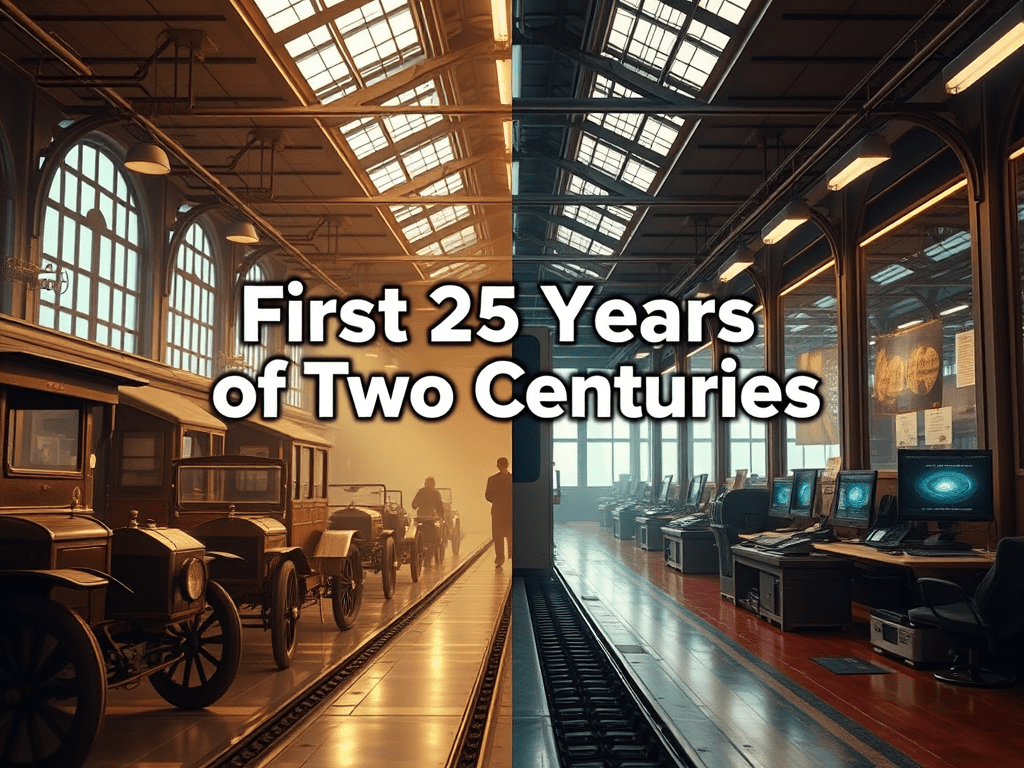
Let’s dabble in the macro and not the micro. What’s the big picture? It’s time to do a simple comparison. Take the first 25-years of the 20th Century and compare with the first 25-years of the 21st Century. Certainly, at the end of this year a complete summing-up could be done.

For now, I’ll do a random sweep across those two generations separated by a century.

Let’s think. There were no powered aeroplanes in 1900[1]. Few had an inkling that a world war was on the way. We were just figuring out what an Atom might be. Even the motor car was mostly for wealthy folk. The railways were king.

In 2000, I remember the optimistic fireworks and the controversy over the millennium dome. The forgotten panic of Y2K now seems strange. The World Wide Web[2] was getting traction amongst geeks. Mobile phones were gaining ground. Few saw the attack of 9/11 coming.

Being a child of the last century it’s easier to appreciate the changes. Let’s face it, today’s 25-year-olds had history lessons about subject that many people lived through. Although, there are a growing number of centenarians, most of them were in inkling in the parents’ eyes or babies pre-1925. Thus, we need to relay on the writers of history.

Here’s a proposition that warrants testing. Compared with the first 25-years of the 20th Century nothing much has happened in the first 25-years of the 21st Century. I know any division in time is an arbitrary matter. The Earth spinning on its axis cares little for human affairs. 24 hours in a day come and go whatever we do. That said, my proposition above does run contrary to the way people may feel about time passing. If indeed it does pass.

In both periods we might measure significance by the impact events have on people. There’s a propensity to say that world wars top the list in any account. That may well be fair. However, if we look at the growth in global population and the general improvements in human health despite that fact, then this is the greatest point to note.

When I say, nothing much has happened between 2000 and 2025, by comparison, it’s more to do with the pivotal moments that led to the creation of the technologies that we all now take for granted. Mastering the elements of science has made the biggest difference.

I’d say, in the public and social field, of politics, philosophy and economics[3] and we are as perhaps foolish as we have ever been. Convince me otherwise.


[1] https://www1.grc.nasa.gov/beginners-guide-to-aeronautics/powered-aircraft/

[2] https://www.w3.org/People/Berners-Lee/Weaving/Overview.html

[3] https://www.theguardian.com/education/2017/feb/23/ppe-oxford-university-degree-that-rules-britain

Relationship with the EU

Monday, Monday[1]. It’s a wonderful 60s song. Harmonies and mood are perfect. I wonder if the harmonies and mood will be perfect for the Prime Minister (PM) on Monday. Already the Sunday Press are setting the stage for Monday’s performance.

Reset, recalibration, reheat, rekindle, re-whatever. It’s a moment when relations between the UK and the European Union (EU) can make realistic progress[2]. In world full of uncertainty (could be a song in that one), for once the direction of travel is a constructive and positive.

I think the word “deal” is getting overplayed. Indications are that there’s no fundamental shift from Brexit meaning Brexit, as one former PM liked to say. In fact, the current PM is being highly cautious in the light of his Party’s reading of the latest opinion polls. For no sane reason I can think of, the swivel-eyed loons of the far-right are making hay.

It’s astonishing me how dim-witted the Conservative Party is in objecting to something when they don’t even know, for sure, what it is. Mind-blowing. And the rum cult of Reform Party doing the same with extra bile. What a load of prehistoric fruit loops.

Brexit supporters are spreading misinformation, again. Saying that UK has no influence. It’s true, the UK doesn’t have votes in the European Council or Parliament, but significant influence can be exercised on standards, and regulatory guidance, nevertheless. A better “deal” can bring much greater influence. Absolutely vital in the digital world, and for the UK, a country with a services-based economy.

Brexit has cost the UK dearly. The UK Treasury would have billions more in its coffers if the 2016 referendum had never taken place. The standard of living of every person in the UK is lower because of Brexit bungling. Ideally, that great mistake is an event to be written up for the history books and then forgotten.

On top of the above, uncharacteristic moves in the US, with Trump tariffs there’s nasty hit at the UK’s future prosperity. There couldn’t be a better time to repair relationships with the UK’s nearest neighbours. The countries with which we share most of our long history.

Even for those on the political right, practically, the EU is never going away, so until the day the UK rejoins the block, it’s wise to have the best possible relationship in all matters. Goods, services and people need to connect as a case of mutual benefit.

It’s time for hope. An optimistic tone should be set. A smile. Let’s hope we are singing Monday, Monday so good to me, Monday morning was all I hoped it would be. Naturally, that there be no crying, come Monday evening.


[1] https://genius.com/The-mamas-and-the-papas-monday-monday-lyrics

[2] https://www.independent.co.uk/news/uk/politics/brexit-uk-eu-reset-trade-deal-starmer-b2752285.html

Action Shapes Outcomes

There’s a foolishness that comes with great power. It gets played out every day over the News media. It’s when notable person x or y says words to the effect; nothing will happen unless I do it. This common notion gets projected to us through mass reporting and commentary.

Every second is a pivotal moment. A last chance to move, or a last chance to act. As if time stops when we know it branches into countless possibilities. Fine, pivotal life or death moments do exist. It’s only that they are less numerous than we might be led to think. Drama takes its place in the theatre of the everyday[1].

There’s an ancient lesson to learn. It goes like this, in a simple demonstration. Place any finger into a glass of clear water. Now, remove the finger and observer the hole.

It’s a lesson Archimedes would appreciate. Although he’s famous for displacement being an indicator of what’s doing the displacement. Between the two it’s the water that’s the constant. The ebbing and flowing of time. At least as we humans perceive it.

It’s not that an individual can’t make a difference. Far from it. Individual action can make a dramatic difference. Doing the right thing at the right time, if the opportunity arises, can be the difference between catastrophe and nothing much in particular, as an outcome. In the world of major accidents, designers and operators desperately try to avoid the possibility that a single act or failure that leads to catastrophe, but it does, on rare occasions happen.

The point in discussion is the matter of what is indispensable. How often do we get to choose what is indispensable? After an event, it’s easier to answer the question. Looking back, it can be said that the factor that made the most difference was this one or that one. Before an event, we are in the land of probabilities and shiny crystal balls. Mathematics and mysticism.

The Cuban Missile Crisis[2] offers a lesson. It was only in retrospect that people learned of the action of a Soviet Naval officer who prevented a submarine from launching a nuclear torpedo.

History tells how the pivotal moment arrived. That said, there was no way the man concerned knew before time that his role would be indispensable. History would be written dramatically differently if a nuclear engagement had happened.

In the end it comes down to doing the right thing at the right time when the opportunity arose. Sometime swimming against the tide of events. Not magic exuded by a powerful individual strolling the stage.

POST: A better one. All The World’s A Stage By William Shakespeare · Jim Broadbent https://youtu.be/gUJBEy-tbo0?si=NMkIRpIr8H0wdTgv


[1] https://youtu.be/caaPlIX6AkM

[2] https://www.jfklibrary.org/learn/about-jfk/jfk-in-history/cuban-missile-crisis

Myths vs. Reality

We live in a world of contradictions. What am I thanking about? The current febrile immigration debate has all the hallmarks of magical thinking. Here we are surrounded by water, living in an economically active favourable part of the world and yet public concern is directed at “others”.

I’ve no problem with the current British Government berating the past Government for not fixing a problem. It’s normal for a governing party in the first couple of years of their term of office to point the finger of blame. It’s easy. Painting a picture of past failure makes the road ahead clearer. It’s easier to start from a point of low expectations.

However, it seems it’s not the resurgence of the Conservative Party that the Labour Party are concerned about. Today, such a prospect would be like the reincarnation of a squirrel that had been run-over by a 42-ton truck driven by the electorate.

The announcement of the day is setting an ambition to squeeze immigration. Recent local elections have shown that this banner flies well with those who vote in local elections. Because the opinion polls give bizarre indications too, the questionable assumption is that if a General Election was called by an irrational Prime Minister there’d be a surge in far right-wing voting.

We have new kids on the block. They are not at all new even if the have a new name. It’s an Orwellian name. Because an ultra-conservative party isn’t in the business of newness as much as they are stirring up ancient antagonism.

Anyway, the Reform Party are the current snake oil salesman selling their easy solutions to difficult problems. They were once named; Referendum, UKIP and Brexit Party. All proponents of magical thinking and with a poor track record.

The story goes like this. Stop overseas immigration and make the hordes of economically inactive people of Britan take-up the vacancies that would result. When Reform voters hear this narrative, they don’t think it applies to them. They believe there’s a mythical group of lazy people who need to be forced back to work and off overly generous State benefits.

In this public debate it’s as well to look at the numbers[1]. Reform voters are predominantly of 50-years and older and the economically inactive are predominantly 50-years and over[2]. Thus, I say, we live in a world of contradictions.

COVID did see a large number of people take, or be forced into early retirement. Those who have experienced a lifetime of their terms and conditions of employment being degraded took the opportunity to do something else. Often that included voluntary work or caring roles. Reform have concocted plans to pressure people back into conventional employment. These plans are uncosted and not cheap. Lots of government funded incentives and training, for example. In the real world, funding must come from somewhere. That’s likely to be from the privatisation of health services and cancelled benefits. In this scenario don’t expect to get a state pension until well past 70 years


[1] https://researchbriefings.files.parliament.uk/documents/SN07119/SN07119.pdf

[2] https://www.gov.uk/government/statistics/economic-labour-market-status-of-individuals-aged-50-and-over-trends-over-time-september-2023/economic-labour-market-status-of-individuals-aged-50-and-over-trends-over-time-september-2023

Cities Shaped by War

War is failure. Humans being quick to aggression, possessive and slow to reconciliation, it’s plagued every corner of history. Reason to go to war can be imperial, territorial, moral or ethical. In a democratic society, defeating an evil becomes an overwhelming imperative. That was certainly the case in the six years of the second world war. This week, it’s time to look back. To recollect the impact of the world war. To remember the sacrifice and suffering. To be thankful for the last 80-years years of relative peace in Europe.

For me these recollections take me to the experience of living in two cities. Cities on different sides of past conflicts. Severely damaged by the conflict. Targets because of their civic and industrial strength. Both cathedral cities with an ancient heritage.

My student life was spent in Coventry[1]. A decade of my working life was spent in Cologne[2].

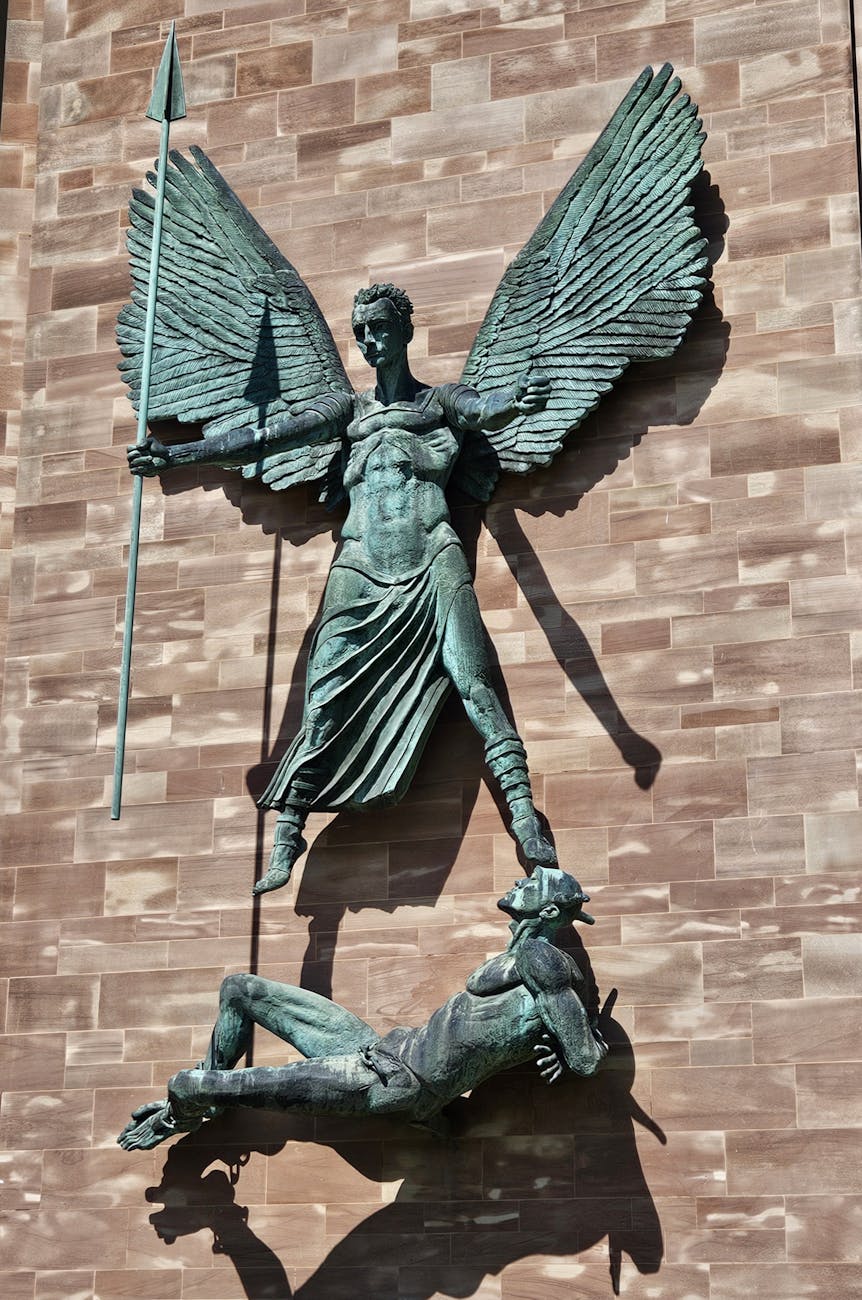
Arriving as a fresh-faced student in the heart of the industrial Midlands, the architecture of Coventry city centre was so striking. It was that post-war vision of rebirth at a time when economic decline had set in. With an inner ring-road that was like a go-cart track, 50s style concrete avenues, windblown and neglected, there was little of the Medieval splendour of the pre-war city remaining. Standing proud in the middle of it was, and is, the skeleton of the old cathedral and the new one that ascended like a phoenix from the flames of war. Well worth a visit, the cathedral built in the 60s is a wonderful modern design. It plays with light and space to elevate emotions. A sign that we have a great capacity for reconciliation and regeneration.

Moving on just over 20-years, my encounter with Germany’s fourth largest city was full of hope and optimism. Based in Cologne, I experienced a city with even deeper roots than Coventry. Ironically, it was the destruction of the war that uncovered much of the Roman remains on display. At Cologne’s heart is a magnificent gothic cathedral that is more dominating of the landscape than perhaps ever it has been. Here the citizens of the city took a different approach to post-war rebuilding. Not so much embracing everything that was new, although there’s quite a bit of that approach, but reconstructing the old city in its original style. The culture of the city survives in the traditions of the annual carnival.

These two European cities have taken different paths. All the same, there are threads of common experience. Both have seen industrial decline and a search for a better future to thrive and grow. Both are distinctive and culturally colourful. Both carry the baggage of a brutalist architecture that was fashionable on the drawing boards of the late 1950s.

Visting the past in museums and walking the streets the marks of the last war are there to be seen by everyone. Passed by every day. Yet, mostly ignored in the humdrum of commuting and the busy obsession we have of staring at a “mobile” or call it a “handy”. Now and then it’s as well to look up. To look and see the bullet marks on stone structures, the nicely arranged medieval or Roman stones and cobbles, or the conserved streets that contain the ghosts of past generations. For good or ill, war has shaped the world we inhabit.

Peace is a far far better condition. I think of the “Coventry Cross of Nails[3]” as a symbol of reconciliation and peace. Let’s not forget.


[1] https://www.coventry.ac.uk/

[2] https://www.koelner-dom.de/en

[3] https://www.coventrycathedral.org.uk/reconciliation/community-of-the-cross-of-nails

The Value of Public Service

In praise of public life[1]. That sound like such a strange sentence to utter about this last week. It’s been local election week. First Thursday in May is traditionally the day of elections in the UK.

It’s good to say that a political life is a positive. I’d say most councillors elected in this crop are motivated by the simple idea of public service. Yes, a lot of them will have completely different understanding as to what that means but there’s a general desire to make life better.

Naturally, there are the exceptions. That is those people who are ideologues, intent on imposing their views on people regardless of rational belief or any basic understanding of how the world works. Yes, I am talking about the blip that is the current results for the Reform Party. Blip it is. Like it or not, the turnout for local elections is sadly unimpressive.

Party politics is in jeopardy. I’ve nothing to object to politicians who take an independent line. It’s often those individuals who cross boundaries and unravel roadblocks to stop a stasis descending over a political assembly. A council chamber full of sheep helps no one.

To command popular support a practical political party must be a board church. We have a common expectation that decision-making forums be made up of our peer group. It’s embedded in the jury system. If decision-making in the public realm becomes so disconnected from everyday life, then respect is lost. However, if ever changing newspaper headlines drive governance – well, you get my point.

I say, conventional Party politics is in jeopardy because popularism is distorting the playing field. If a political Party becomes a rabble-rousing creature that sits on the backs of the electorate, then no good will come of it. That’s especially true when issues pursued are nothing much to do with the remit of a Council.

My prediction is that the new Reform councillors will soon get locked into lots of noisy arguments over issues that bypass the things that need to be done in each locality. No fixing potholes or planting trees when meaningless debates about “woke” can be had. No improving recycling achievements or properly funding care provisions. No building affordable housing or cleaning up waterways.

For political leaders and parties to regain respect and support there needs to be less communication about the possible ways and means and more about what’s been done. Populism takes over when people become fed-up with endless jam tomorrow arguments. The cycle of empty promises feeds the demigods.

My advice. Even if it’s just one pothole is fixed – tell people.


[1] Book Title – In Praise of Public Life : the Honor and Purpose of Political Science

Finding Balance

Regulation can be a contentious issue. That’s an understatement. A spectrum of views extends from the complete libertarian to the past soviet model. Citizens shouldn’t be encumbered by any restrictions to the State has the right to dictate every aspect of life. Clearly, there are immense downsides to either of these extremes. Luckily, although not everyone will agree, the set of political choices available in the UK covers the wide range from the far-right to the far-left. These labels are deficient when it comes to the detail. Often these two camps are similar in their authoritarian ways and means.

Rejecting the extremes, being a liberal, means finding a balance. That means a minimal number of rules and regulations to achieve the prosperity, safety and security goals that most people happily support.

A pendulum swings in the British political cycle. Never quite sure what the cycle time is on this one. What’s for sure is that our society’s tendency is to go from urges to tighten-up rules and regulations to impulses to eliminate or relax them with gusto. Often, the aim is to tweak or protect economic stability or tweak or promote economic growth. After the banking crisis of 2008 it was the first of these, now it’s the second.

Brexit is a strange oddity. Although, great claims were made for the loosening of the ties that bind us, the reality has been much onshoring of past rules and regulation. The forces of continuity have some good arguments.

It’s reported that Prime Minister Starmer is considering dynamically aligning UK regulations with EU regulations, as if that’s not happening pragmatically and piecemeal already. OK, this is not consistent across every sector of the economy. It’s a mixed bag. Politicians banging the drum but not doing much.

Let’s say the financial services market goes a different way from the technology sector. One has a history as long as your arm the other is being made-up as we speak. Clearly, there are risks in both deregulation and overregulation. Thus, I get back to that notion of finding a balance.

To hardened Brexiters EU and UK rules constrain. To their supporters they enable, facilitate and transform.

Now, what’s difficult to discern is where do Starmer and Reeves stand?

A direction of travel, to encourage investment in the UK, has been touted. That implies alignment rules. Investors rightly seek the largest market on offer. Like it or not, the UK is not the US, or even the EU when it comes to the size of its economy. Maybe, it’s taken Brexit to realise that we align as a matter of common interest. Mutual benefit.

Most of our safety and security goals are not subjects of intense competition. If you fly internationally, why would it make sense to compete on safety or security? The general expectation is that common high levels of safety and security are desirable.

As the weather improves so we are heading towards a year of the Labour Party in power. There’s disappointment and concern about the timidity of their actions. The word “reset” is banded about. A ridiculous word. Press the reset button to restore a past condition. No, choices need to be made. Closer alignment and partnership with the EU are the rational choices.

Humanity and Tolerance

Who doesn’t know this short sentence? “A rose by any other name would smell as sweet”. It has a particular meaning in play Romeo and Juliet. It’s Juliet saying she doesn’t care about her loves’ family name. The source of their great troubles. Being elegant and fragrant it’s no surprise that Shakespeare chose to speak of a rose.

More broadly this phrase makes the point that calling something different doesn’t change its core characteristic. Roses might not be the best example since naming these flowers plays a big part in distinguishing between one and another. So many modern hybrids. Instead, let’s go for trees. “An Oak by any other name would be a noble tree”. Which remains appropriate despite the number of different types of Oak trees.

Over the weekend, I was standing under a large ancient Holm Oak[1]. It had to be pointed out to me that that this type of Oak tree is evergreen. Most Oaks are not. An aged, stately and weathered one is definitely a noble tree.

I’m finding the News reporting of the moment mixed-up and confused. The word “diversity” gets thrown around like a political football. Let’s be clear. Diversity is everywhere. It is not unusual. Names are labels that we use like a scatter gun. Often to try to pick-out, to differentiate one group of humans from another. Not always with good intentions in mind.

Let’s remember our essence and intrinsic quality is that we are human. We live on planet called Earth and we need to find ways to get on with each other.

Today, there’s rather a lot of us. Globally, over 8 billion. However, that’s not the key factor. Let’s face it, in Shakespeare’s time there was a fraction of that number[2]. All the great strife and troubles he wrote into his plays are here now, as much as they were in his time. Proportionally, the diverse range of people and their ways of living haven’t changed that much.

It would be wise to heed the lessons of history. As we segment, categorise and slot groups of people into specific camps. The digital age, social media has added a dimension to this process. Now, likes and dislikes pigeonhole people into “similar” groups.

Here, I’m trying to keep the topic generic. Recent judgements from eminent judges, although necessary, hasn’t added a much to social harmony. To say “the law is an ass” is no understatement. I certainly wouldn’t want to fly on an aeroplane designed by lawyers. Although, it would be safe since it would never get off the ground.

I believe, we should treat each other in a way that respects that we are human, and thus diverse. That means tolerance and mutual understanding are essential. Not optional. Creating the need for bathroom police is the dumbest thing venerable British judges have done in a while.


[1] https://www.woodlandtrust.org.uk/trees-woods-and-wildlife/british-trees/a-z-of-british-trees/holm-oak/

[2] In 1600, around William Shakespeare’s time, the estimated world population was around half a billion. London’s population was about 245,000.

Cartoons capturing us

To me, it’s fascinating how a few lines of pen and ink can sum up so much. One of the great underestimated influences is the power of the cartoon. They speak of their times, they speak of social niceties, they speak of the ever-moving conveyer belt of humour.

Every day the cartoons of MATT[1] sum up, in a witty way, what the News has to say. A little composed abbreviation of an event, a thought, or an idea. Not the least bit easy to do unless that’s your talent. Believe me, I’ve had a go, and the results were not good.

A picture can tell a thousand stories. Substitute for page of words. Often this is said about photography and not so much drawing. Pictures have a language all their own. Their properties escape the communication difficulties that language can throw up.

Back to the few lines. A minimalist drawing in black and white with a sentence is the basic format. I wonder which comes first. The witty line or the image? I’ll bet that varies from person to person. An idea must spring from the mind first.

Let me say right away that not every cartoon hits the mark. I’ve got a daily tear-off New Yorker cartoon[2] calendar. It has a cartoon for the day. In the morning, I’ve torn off the last day and pondered at the worst of them, thinking what on earth were they on when they selected this one.

The reason I started writing these words is a reaction to the cartoons of H.M. Bateman[3]. He’s from another era. A world of English etiquette that has faded with time. Although, I expect if you go to the races at Royal Ascot[4] Bateman’s world lives on in its modern form.

What came to my mind is the link between social media and Bateman’s view of the world. A lot of his cartons depend on the notion that just below the surface the English are about to explode at any moment. Like the 1970’s sitcom character Basil Fawlty.

Under the social equilibrium that enables society to function there’s a seething mass of rage. A bubbling anger that can spill over at the least provocation. Then reason turns into unreason.

A sense that a minor faux pas reveals a sense of injustice that has simmered for years. One small social blunder and an avalanche descends on the poor victim. So, is social media behaviour merely an extension of a human characteristic that has aways been there? That we can easily take a violation of etiquette or social norms wholly out of proportion.

And my further thought. Have certain unscrupulous politicians learnt how to exploit this suppressed emotion. Have encouraged the volcano to explode on que. Prodded and poked it. Even having lifted the vail on the weaknesses of you and I, meant that they could get away with innumerable gaffes, and blunders. There’s an essay for a bored writer to take-up.


[1] https://www.chrisbeetles.com/

[2] https://www.newyorker.com/cartoons/daily-cartoon

[3] https://www.hmbateman.com/

[4] https://www.ascot.com/royal-ascot