Runaway

Real votes in real ballot boxes are the best way to get an indication of where we are in these unsettling times. OK, I admit that the voter turnout for local elections doesn’t match that of a General Election (GE) in the UK, by a long way. However, what you can say is that those who are motivated to vote in local elections are certainly going to make the effort to vote in a GE.

So, the voting trend that has been observed over the last year, at least, continues. The Labour Party is gaining ground. The Conservative Party is sinking rapidly. The Liberal Democrats and Greens are making measured progress. Independents are gaining. Nationalists are treading water. The newcomer, the Reform Party is growing rapidly from a petite base.

If you have any association with, or supportive opinion of the Conservative Party this must be an extremely unsettling time. Yes, a lot can change in the next few months but the political party in power in the UK is steaming towards an iceberg at high speed. It’s the modern-day Titanic of the British political scene. It’s quite sinkable. It’s members running in different directions.

Often vigorously supported by “conservatives” is the British First Past The Post (FPTP) voting system for GEs. As is self-evident from any inspection of its history, FPTP punishes harshly small political parties or political parties whose national support dips below a certain point. Probably for the first time in decades the British Conservative Party looks as if its heading for that fine line whereby it’s devastated by the results of a national election. The political dynamics are different in England, Scotland, Wales, and Northern Ireland. That said, the general trend of decline of the modern Conservative Party is national.

Brexit is a failed past experiment. The Banking crisis of 20-years ago, COVID-19 and so called “woke” don’t cut it as excuses. That’s pure desperation. Agreed, that no one predicted how conflict and war would be such a pressing concern.

It’s an opinion, but I’ll express it anyway, that the public are swept by a mood of discontent. They are soundly fed-up with the British Conservative Party. There’s little, if anything, that can be done about the trend set by this public mood. It’s an abstract concept, the “public mood” and not so easy to quantify or qualify. It’s the sort of thing that we only know by its symptoms.

The tone of language used to describe the Prime Minister (PM) and his Cabinet is one sign. It’s as much to say – who the hell would want his job unless they were barking mad? Putting on a brave face when the trend is set.

Moving away from the Titanic analogy to that of a runaway train[1], the image in my mind is that of a steam train driver frantically pulling every leaver that can be found but nothing changes. The train is going to crash.

T’was in the year of 24. On that old Westminster line. When the wind was blowing shrill. The polls closed. And the party would not hold. And Number 10 came racing down the hill.

I’ll bet someone can do better than me with that children’s favourite.

POST: Here’s why I made that reference from the 1960s-70s. Ed Stewpot Stewart’s Junior Choice ( 1OOO Tracks For Kidz Of The 60’s n 70’s ) – playlist by ANDREW HARRY BRIGGS | Spotify and Ed Stewart’s Junior Choice – playlist by Shaun Russell | Spotify


[1]Michael Holliday ‘The Runaway Train’ 1956 78 rpm https://www.youtube.com/watch?v=rNgpzF9N3_M

AAM

This week, I watched an FAAs Advanced Air Mobility (AAM) webinar[1]. The subject was community engagement. AAM could be air taxies but it’s many uses of the new electric aircraft that are becoming a reality. The term eVTOL is used for those aircraft that have the capability of vertical flight. My reflection is that there are several aspects of AAM that need much more attention. Naturally, I’m taking the discussion of what’s going on in the US and thinking about it in relation to the UK.

  • Land Use Planning

Generally, National Aviation Authorities (NAAs) are consultees when it comes to land use planning. They do not determine planning applications. NAAs may well have set out policies and guidance on the subject but they will not be determining the site of vertiports.

It seems to me that there’s little chance that eVTOL aircraft routes will be established without sufficient community consent.  Community engagement has been appropriately recognised as essential. The aspects in play are like those for existing aerodromes. Often for AAM applications proposals are for the use of new locations, hence a concern. Anytime there’s a serious proposal for a new aerodrome the opposition is up and running long before the proposers have got their act together.

The subject is complicated by the mix of public and private ownership of infrastructure. If the intention is to interconnect AAM with other transport services (bus/train/boat/road), then complicated agreements are going to be inevitable. It’s not just about buildings and tarmac but having a trained workforce available is a location dependent issue too.

  • Business Models

I’m about to sound as if I’m securitising the plans of a contestant on The Apprentice[2]. There are plenty of way of losing money in commercial aviation. It’s been a well-practiced art over the years. Great ideas fall by the wayside after huge amounts of money have been expended. Customers are key. People must want to fly the routes available, time and time again. And like London Black Cabs be prepared to pay the fare. Given the relatively small cabin sizes that are on offer these people are likely to be moderately prosperous groups or individuals.

Regular schedules air services can produce a reliable income. Airport-to-airport connections seem like a good bet. Problem there is the conveyancing of weighty luggage. Busy airspace could be a challenge too. That said, with tens of thousands of people at both ends of a route, no doubt some people will choose a comfortable, speedy direct connection.

There are good possibilities for major event driven transport services. Getting to and from a motor race or horse race event or a concert or festival can be hell when tens of thousands of people are all trying to get to and from a location or venue. The numbers may well stack-up to make eVTOL a premium way of dodging the crowds in an environmentally sound way.

  • Batteries, Batteries, Batteries

Everything in respect of aircraft performance depends on power density. How much oomph can you get out of a small, light weigh physical space. Recharge and go. Do it, again and again. It’s as simple as that. Not only that but aircraft battery packs must be affordable and available. Whizzy technology that cost a mountain of cash and can only be use for a few hundred cycles is no use at all.

Power distribution infrastructure must be up to the job too. Who will pay for this is up for grabs. There’s a good case for public funding given that there are multiple uses of enhanced electrical supply. Given the monopolistic nature of power generation and distribution this will not be easy or quick.

That’s only three issues that require a great deal of attention. Not the attention of researchers. Not the attention of academics, Not the attention of political policy wonks. Connecting entrepreneurs and public bodies needs practical stimulus. The possibilities are exciting.


[1] https://youtu.be/1sfVuJlPQoY

[2] https://www.independent.co.uk/arts-entertainment/tv/news/the-apprentice-2024-winner-pies-b2531331.html

Highways

The last time I visited the city of Baltimore was in 2012. It was the location of the annual seminar of the International Society of Air Safety Investigators (ISASI)[1]. That was when I was representing the European Aviation Safety Agency (EASA) at such international events.

The relationship between aviation accident investigators and regulators are generally cordial. There’s a great deal of work that requires cooperation and good communication. That’s not to say that the relationships between these two vital parts of national and international aviation safety systems is easy. It’s not. My reflection on that fact is that a degree of constructive tension is inevitable and not always a bad thing.

One way of seeing that relationship is that the primary role of an investigator is to make findings to prevent the repeat of a given accident. For a regulator the primary role is to ensure the complete aviation system runs safely on a day-to-day basis. Both organisations have the public interest at their heart. However, their operational context and perspective are different.

Firstly, my condolence to the families and friends of those who perished because of the Francis Scott Key Bridge accident[2]. The collapse victims and survivors had no way of knowing what was to happen on the night of the accident. I use the word “accident”. This was not an act of God, as some commentators would have it. The safety risks involved in the operation of the port in Baltimore could be anticipated.

In the US there’s an independent federal agency that is tasked with such major investigations. Interestingly, it’s the same one as that investigates aviation accidents and incidents. The National Transportation Safety Board (NTSB) is a multi-modal organisation. That is something we don’t have in the UK. Also, we don’t have a divide between federal and state organisations. Since in the UK we have separate independent national Air, Marine and Rail investigation agencies that cover the country (England, Scotland, Wales, and Northern Ireland).

I will not comment on the accident sequence or causes. It’s the job of an independent investigation to arrive at the technical facts. Recommendations will flow from that investigation.

Where a comment may be in order is that there are many locations across the globe where a vital piece of infrastructure, like a bridge being struck by a large container ship is a possibility. I’d generalise that further. When infrastructure that was designed a built 50 years ago meets modern day operational stress there’s going to be vulnerabilities. Yes, the aviation system is not immune from this fact too. It wasn’t so long ago when I read of PDP-11 computer hardware used for air traffic control (now, historic artifacts[3]). I’m sure there are still Boeing 747s, and alike that need floppy disks to update their hardware.

So, the wider subject is operational legacy systems working with modern systems. This is the interface that requires particular care. The safety risk appetite and exposure in the 1970s/80s was quite different from that which we expect upheld today.

Unfortunately, society is often reluctant to revisit this subject. Additionally, there’s the incentive to go for quick fixes and sweating assets. The example I have in mind the so-called “smart motorways” in the UK[4]. I don’t know how many fatalities can be linked to “smart motorways” but I’m sure, sadly, it’s too many.

POST: In time-off I enjoyed a trip out to Fort McHenry and a walk around the places where The Wire was filmed. The Fort McHenry story is interesting given its role in times of war. The British burnt the White House but the navy didn’t get past Fort McHenry in 1812.


[1] https://www.isasi.org/

[2] https://www.bbc.co.uk/news/av/world-us-canada-68661318

[3] https://www.tnmoc.org/air-traffic-control

[4] https://www.gov.uk/government/speeches/plans-for-new-smart-motorways-cancelled

Smart

One of the most irritating peak-time adverts on British TV, now, is the one where a fake Albert Einstein wibbles on to a fake dog in a hideously fake humorous manner. It’s condescending and preachy. What on earth the Albert Einstein has to do with household energy meters I can’t imagine. His famous equation is more useful for making nuclear bombs than measuring domestic power consumption. You might think the great man was an annoying Italian computer gaming character.

The smart meter is pushed on the basis that “you can better manage your energy”. I expect that’s true in most cases when they work well. I’ve had one for some time. We recently changed energy supplier. Guess what? In the transition I had to throw away an indicator and replace it with another.

In the news are reports of defunct smart meters causing people concerning problems. Smart meter mode means a meter can automatically send readings to an energy supplier. When they don’t work, lack of meter readings opens the door to energy companies making up bill estimates often to their advantage.

When I informed our power company, I got an education that put me right. Can’t possibly call the whole system a smart meter. No, that would be wrong. So, says the company:

“The smart meter you are enquiring about is actually an In Home Display, the smart meter is the meter on the wall.”

That informative reply reminded me of the Not The Nine O’clock sketch set in a gramophone shop. Foolish householder not knowing that it’s called an In Home Display (IHD). The smart meter is installed on the wall.

I’m in support of energy saving and the role an intelligent meter can play in monitoring the use of domestic energy. What are they trying to do – put me off?

Long gone are the days when meter readers knocked on the door and with a cheery smile jotted down the gas or electricity numbers in the understairs cupboard.

Now, I see the claim is that the “vast majority” of smart meters are operating as intended. That’s good. Those words mean about 88% according to a BBC report[1]. That sounds fine but what about the 12% who are in limbo? That’s not an inconsiderable number of people.

The roll out of smart metering technology started in 2011. There’s a first-generation and second-generation set-up out there in homes. A lot of work has been done to sort out communication problems. However, network coverage is not universal. Those connection issue are familiar to anyone with even the best mobile phone.

The BBC report is right to highlight problems. There ought to be a bigger focus on a plan for maintenance of the system as much as pushing new smart meter installations.


[1] https://www.bbc.co.uk/news/articles/cz9zqn77ezno

Safety Culture

Civil aviation remains an extremely safe means of transport. That said, any form of complacency must be addressed. It’s reassuring to say the past has been great but what passengers are most concerned about is their next flight. To have the confidence, to think it irrational to be afraid of flying, to look forward to the next journey, we must have a safe aviation system everywhere and all the time.

For any widespread system that has complex interactions between people and technology there’s never a moment when it can be taken for granted. We count the numbers, but safety is not purely an absence of accidents and incidents. Numbers counted are always past events. They have no direct causal influence on what happens next. True, there are factors in past accidents and incidents that will pop up again and again, but every flight is a unique event.

One of my colleagues who was a senior captain in a major international airline always remined me of the fact that, for all that has gone before, flight risk begins the moment an aircraft sets off down the runway with the intention getting to a destination. When the wheels lift off the ground there’s no stopping time. Reliant on the diligence, vigilance, and integrity of everyone who made a flight possible, flight risk is then in the hands of the crew.

The above is perhaps why we talk a lot about safety culture. The whole aviation family has a role to play. The care, professionalism, and watchfulness of every person makes a difference.

This can extend from the drafting of a new component for a new design, that a decade down the line. ends up as a part of an aircraft just about to leave the gate. This can go back to a flight instructors’ message that emphasised a key point back in a pilot’s initial training, years ago. This can encompass the extra care a couple of air traffic controllers took as they changed shifts.

Safety culture comes from caring. It’s that heightened awareness of the consequence of actions. Being alert to possibilities. Both the good kind, and the bad.

Safety culture is a matter for both individuals and organisations. One without the other doesn’t work. Placing a vigilant person in an organisation that doesn’t care is much like placing a reckless person in an organisation that does care. Although this is what I’ve written, systemic problems are likely the ones that are most likely to cause negative outcomes. This is where the role of management has the most impact.

Culture exists in context. When the ways people interact are determined by practices, processes, and procedures there’s an obligation on management to ensure they fit the bill. Drivers are often economic. In a commercial operation that’s no surprise. It’s when that driver displaces the safety imperative then safety suffers. There’s been several occurrences of this negative phenomena in the last year.

Unfair

That’s one way to start a note. “As a member of the post-active population”, I now feel that all the activity I now do is conveniently wrapped up as being somewhat like cosmic dark matter. It’s there in theory but no one knows what it is in fact. It’s activity that’s hidden activity.

There’s a great deal of talk about the large number of those people in their 50s, and above who have left the conventional workforce post-COVID. Unfortunately, much of it is tainted. The general implication being that the protestant work ethic runs deep and those who are not on the traditional 9-5 treadmill are letting society down. As if the only work worth counting is that which statisticians count into that magic number, namely Gross domestic product (GDP). The tyranny of an abbreviation. A great deal of useful productive and valuable activity is excluded from GDP.

Trogging off to Sunshine Deserts[1] every day, electronically or physically, and making or processing stuff and pushing rocks up hill is counted as the gold standard. This way of looking at the society is foolish. It comes from commentators being way behind the curve and politicians living life as if they were stuck in an idyllic childhood.

This way of thinking is especially true in the UK. More so than other European countries, we are dependent up charities and voluntary workers. German visitors are often struck by the number of charity shops in the UK. If you ask how palliative care, emergency services, children’s support, food banks, homeless shelters and crisis support are funded in German the response is simple – taxes.

The amount of unpaid work, like that performed in the home or by volunteers, in a massive range of organisations, is huge in the UK. That’s not wholly a bad thing. Sadly, this reality not recognised in government policy circles, other than being a way of off-loading responsibilities as funding cuts kick in. Of course, there’s politicians who turn-up for photo shoots at election time when there’s smidgen of recognition. If a charity is not in vogue or well known even those opportunities to raise funds and profile are few and far between.

All the above said, I do support the call for some education organisations that are deemed charities to lose the privileges rightly afforded to much more worthy charities. I know that’s a matter of judgement but not all fish in the sea are the same.

Often, it’s has struck me as strange that tertiary colleges (public funded education)[2] must pay Value Added Tax (VAT), but private colleges deemed to be “charities” do not. An uneven distribution of privileges is another characteristic of a way of doing things in this country.

As I understand, it what’s going on looks like this. Staff at Any Town College, where most local young people get their post-16 educational experience, order reams of paper for a printer. They pay 20% VAT. Staff at an expensive Public School, like the Prime Minister’s ex-college, order reams of paper for a printer. They don’t pay 20% VAT. That’s crazy.

No wonder growth is slow. No wonder social mobility is stifled. No wonder people are desperate for political change.


[1] https://en.wikipedia.org/wiki/The_Fall_and_Rise_of_Reginald_Perrin

[2] https://feweek.co.uk/no-plans-to-exempt-colleges-from-vat-says-treasury-secretary/

Protest

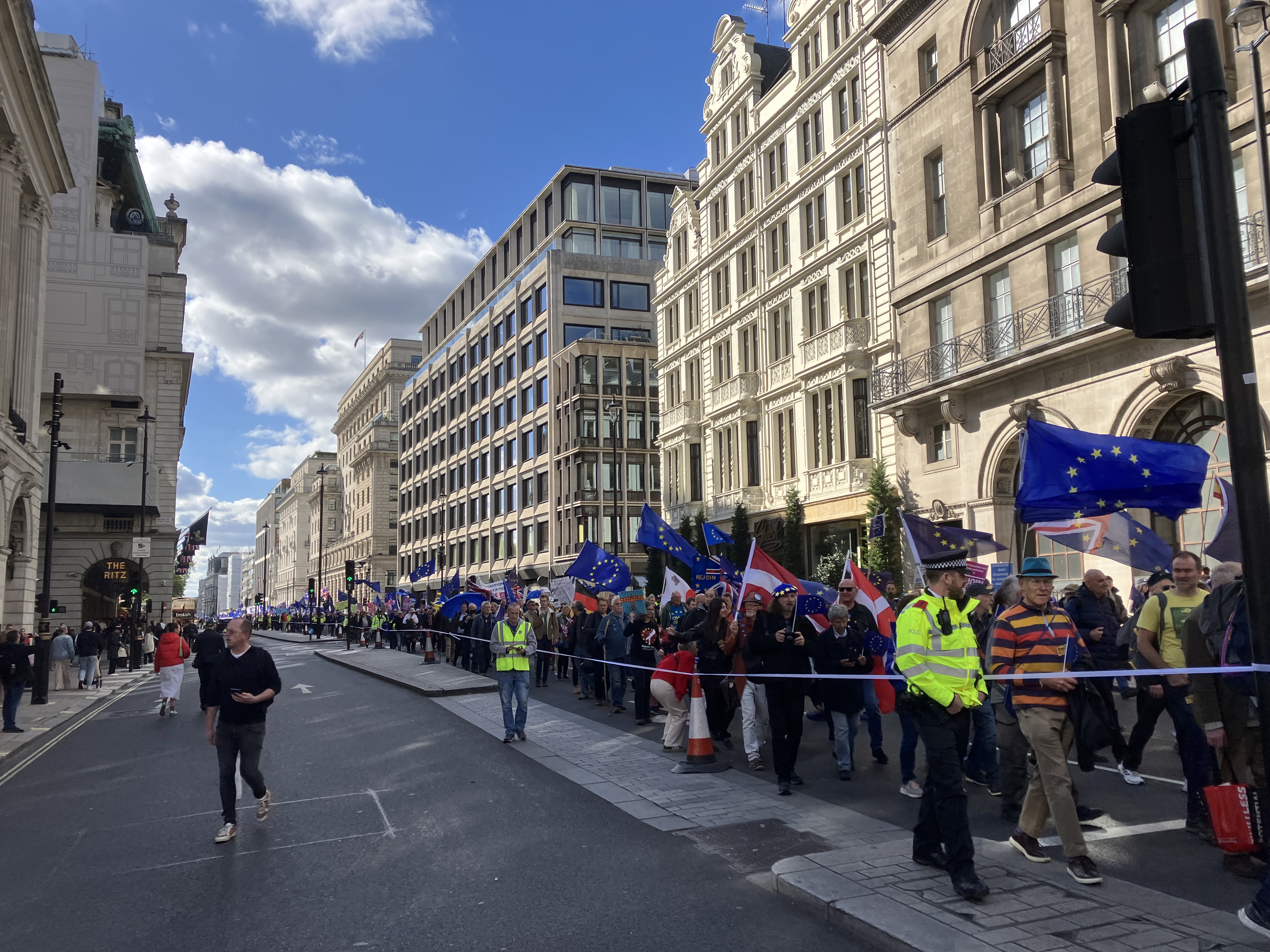
Experience of protest can range from the exhilarating and heartwarming to the frightening and intimidating. There’s a huge range of different experiences. Here’s a few:

During our Brexit phase of rocky turbulence, I stood in High Streets and marched through the city. Everything on the part of the remain protestors I met was peaceful and good natured. That can’t be said of those who took a different view. I distinctly remember a couple of in-your-face moments when approached by emotional and irrational individuals who seemed only to want to shout aggressive slogans in as intimidating manner as possible.

Overall, I’ve been fortunate. Every time I stood as a parliamentary candidate, more than 6-times, I was part of public events where people freely assembled. One of the mainstays of a British election campaign is an open event at a school or college where people can see and talk with candidates in-person and up close. These public events are essential for a functioning democracy. Voters can ask questions and draw their own conclusions from the performance of candidates answering in a local setting about key issues.

My work gave me the privilege of traveling to different countries. In my time off, I’d often look around and get a sense of what was driving political debate in that part of the world.

I remember a couple of occasions when the pure innocence of being a tourist brought be in contact with situations that if I’d known at the time I would have surely avoided. There’s one moment when walking through a huge square in Rome when I suddenly became aware that there were an unusual number of paramilitary police around. I was walking through crowds in the Piazza del Popolo. I looked back from where I’d been and noticed big green water cannon pointing towards the people around me. Inadvertently, I’d strode into a gathering of far-right political protestors. Once I’d clocked what was happening, I was out of there like a shot. 

Today’s, discussion about the nature of protest is one that should be handled in a careful and considered manner. There are threats and dangers that lurk in free and open public settings, but the answer is not to shut them down. Maintaining a balance is vital.

I do not agree with the Just Stop Oil protestors that their cause justifies the exceptional measure of parking themselves outside the homes of elected or would be politicians. Now, that maybe different when considering their places of work but it’s a basic human right – the right to a family life without intimidation. The families of those who work in politics must not be fair game.

In our media saturated world there are more ways of making a strong point about an issue now than there ever has been. There are more opportunities for creative and imaginative peaceful protests, more outlets, and more coverage. Maybe that’s part of the problem. Saturation.

Assemblies of people have and always will be, since classical times, a manner by which collective views will be openly expressed. They can become disruptive. That requires a degree of restraint and management. However, tightening restriction to the point of elimination of uncomfortable and troublesome protest will only make the overall situation much worse.

Protest can be the release of a pressure cooker. They signal where we all need to pay attention. They may not solve problems, but they are part of the equation.

QT

Over the years the BBCs Question Time (QT) debate programme[1] has played an important part in political discussions. It was a must watch for political activists and students at all levels. In fact, anyone interested in understanding the political views that permeate the country.

Unfortunately, the programme has declined to become a dull backwater for viewing if there’s nothing else on. The format is locked in to an awkward seeking of balance at the expense of an inquiry into the reasons and justifications for widely different views. There’s little in the way of vigorous cross-examination or investigation into the core values of the speakers.

I don’t want to blame the person who chairs the debate or the BBC for hanging on to the QT heritage. The programme has played an important part in the life of the country, in the past.

I don’t want to be one of those social media complainers for whom any deviation from the age of Robin Day is a blasphemy. Those black and white days are a wonderful snapshot of a long-lost era. The relationship between the public and their politicians has changes beyond recognition.

There’s no doubt that we have all become somewhat more superficial than may have been the case in the past. Politics has become something that is marketed to us as a commodity. It shouldn’t be that paper thin.

At its best such a debate programme gets to the fundamentals. If it merely tracks yesterday’s headlines the results are predicably shallow. Audience and panel members simply echo what we already know. What we’ve already heard elsewhere throughout the day.

What I want to know is more of the why and less of the what.

Say, a social liberal politician objects strongly to a dilution of human rights and a hard right leaning conservative welcomes such a dilution. We may already know that’s the positions they have adopted and campaigned on but are those positions of convenience or core beliefs?

Exploring what panel members really think and what they might really do is surly more interesting than allowing them to play to the audience, at home or in the room. I want an objective chair to put the panel members under pressure to uncover any deceptions. Deference born of an obsession with balance is as bad that born of class or impoverishment.

One of the parts of the format that seems unquestionable is the requirement to answer questions posed by members of the public. The audience is supposed to represent the members of the public not in the room. They rarely do. I’d much rather see a town square type format. That’s where the members of the public engaged are not so pre-selected or self-selecting. Walk out into a typical high street and randomly ask what question do you want answered? Do it live.

QT needs a major shakeup. It’s not quite dead. Its revitalisation is possible, but it needs to get off its current path.


[1] https://www.bbc.co.uk/programmes/b006t1q9

Food

Food security matters. Much like energy security matters. Much like access to basic commodities. There are fundamental matters of supply that must not be ignored. International trade is a two-way street. But it must be a two-way street on the level. It’s possible to imagine a set of scales where there’s a balance between both sides. Maintaining that balance is a dynamic business.

It’s easy to understand how aggrieved farmers in Europe feel if they are subject to unfair competition. It’s the same in the UK. If say, meat comes into the UK, produced at a lower standard than domestic produced meat, and that undercuts farmers prices, that’s unfair and unwise.

News doesn’t just concern agriculture. Over the last weeks discussion about the UK’s ability to produce basic commodities, like steel, has occupied minds. Imports maybe cheaper. The trouble is that countries jeopardise domestic security and merely offload environmental concerns by increasing dependency on others beyond certain points. A sensible balance must be struck.

Political, marked trade imbalances are a nightmare. British farmers may not be so overtly militant as some on continental Europe, but they have a strong interest in influencing what laws say. Bandwagon jumping politicians from the far-right and far-left are taking advantage of the discontent that exists. None of these empty barrels have answers. That doesn’t stop them making a lot of noise.

Post-COVID, in all sorts of industries, there’s been, and still is, significant supply chain problems. For example, the price of farm machinery has gone through the roof. Although general inflation appears to be slowly coming down the hike that has happened, has happened. It’s bedded in.

Looking at the gap between input prices and outputs shows an unhealthy situation[1]. Producers have been squeezed. Their margins have been squeezed. It’s certainly not a good time to be a milk producer[2]. Even with optimism for the longer-term, today’s bills still need to be paid.

In the UK, there’s an often written about concern surrounding the power of the established major supermarkets[3]. These are almost monopolistic in their position in the marketplace. On the walls of their food warehouses pictures of smiling farmers and clean, shiny tractors are all the rage.

Because so much food goes through the doors of the supermarkets, if farmers want to protest, they are probably a better target than the UK Government. Alternatively, British farmers may need to work to reduce the influence of the middlemen. Going direct to the customer may not be for everyone but more could be done.

In a General Election year, it unlikely that politicians will pick a fight with British farmers. Their ears may prick-up for a short while. That’s a good time to make the case for domestic production.


[1] https://www.gov.uk/government/statistics/agricultural-price-indices/agricultural-price-indices-united-kingdom-november-2023

[2] https://www.nfuonline.com/updates-and-information/dairy-producers-braced-for-an-uncertain-future-nfu-survey-reveals/

[3] https://www.statista.com/statistics/280208/grocery-market-share-in-the-united-kingdom-uk/

Bland & Blue

How do we get the politicians we do? There’s no originality in that monster question. If we look across the Atlantic the most political peculiar fight is going on. A couple of elder gentlemen running as fast as they are able. I have to say that with solemnity as I’m in my sixties. The United States (US) has a fight no one seems to want, brought about by an inability to plan successions.

In Britain, I look around and see a country full of capable and talented people and then compare them with the political choices in front of us. Big choices are going to be needed this year. The limited choice is as peculiar as any. It’s maddening.

This week, a full gloss blue leaflet popped through our letterbox. Now, I’ve no objection to people putting traditional political messages through the letterbox. One of my favourite sayings is from a long-gone Cornish politician of great merit. If you have something to say, put it on a piece of paper and stuff it through the letterbox. David Penhaligon[1] would make that a mantra. It was about community politics. It was about talking about the local issues that were of most concern to local people. Focusing on what matters.

Anyway, the folded A4 headshot that came through my door looked more like an advert for dentistry than a local political message. Gleaming smiles are fine. When they gleam so much and so wide, I’m reminded of the jailed politician in the second Paddington Bear movie[2]. More of the same and can I count on your vote? No meaningful substance.

The fictional Peruvian bear who travels to London in search of a home would have swiftly been sent to Rwanda by this mob. Paddington’s admirable and lovable qualities wouldn’t last ten minutes in real 21st century Britain.

I’m assuming this was a paid political leaflet distribution. The Post Office (PO) gave us two copies in two days. Along with some pizza adverts. This is not material carefully delivered by dedicated local party activists. No, it’s a commercial distribution. Remarkable when considering that Reigate’s constituency is a “safe seat”, where the past results for the Conservatives hardly need counting. Just measure the length of the ballot pile on the table.

These expensive colour leaflet distributions happen long before an election is called so that the costs don’t have to be counted in the election expenses of the candidate.

What’s surprising is that this shiny blue leaflet didn’t have a single potholes picture. That’s where the candidate or prospective candidate stands over a pothole and points. Implication being that they will solve that problem. No pictures of flood waters or the attendant sewage outfalls that have become fashionable on political leaflets. No pictures of traffic hazards or schools that need money spent on upkeep. No pictures of abandoned plans to improve local railway services. Just bland page fillers.

Nothing from other Parliamentary candidates – yet. Let’s hope they have something to say.


[1] https://en.wikipedia.org/wiki/David_Penhaligon

[2] https://en.wikipedia.org/wiki/Paddington_2